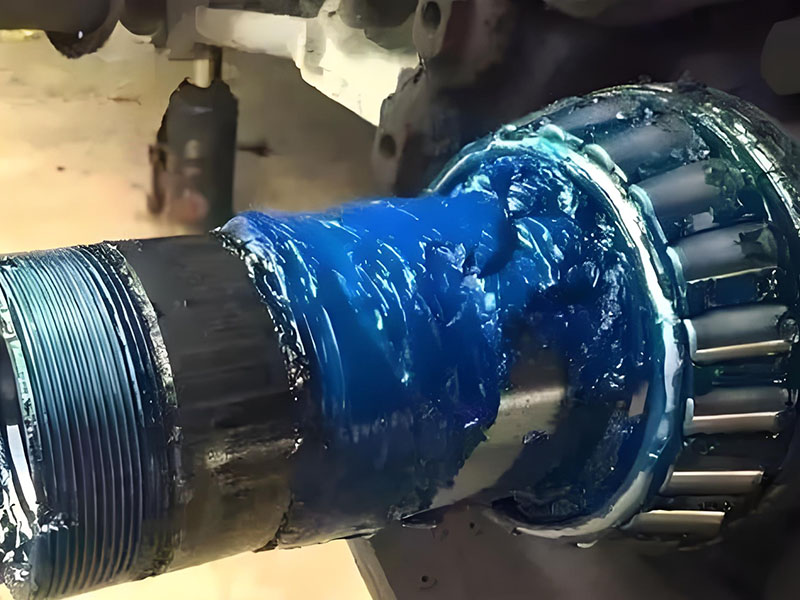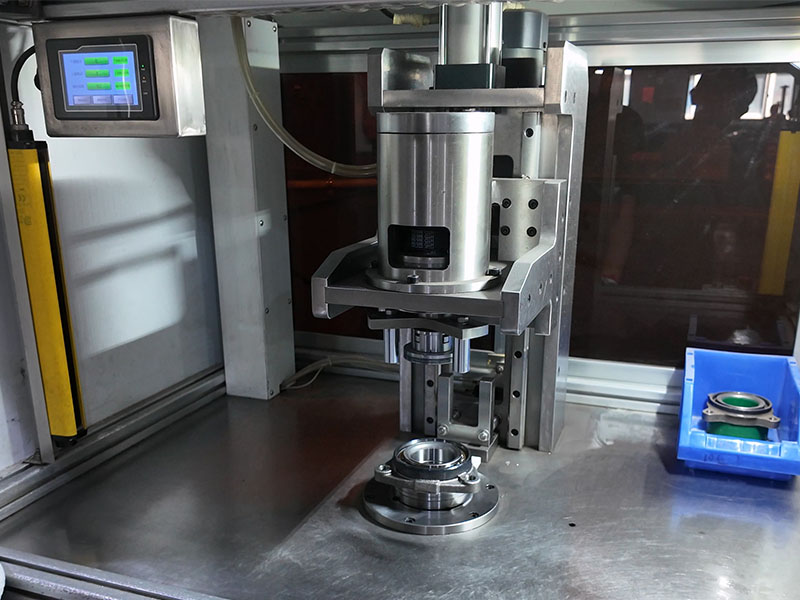
In the world of mechanical engineering, efficiency and compact design are paramount. Needle bearings, a specialized type of roller bearing, are the unsung heroes that make modern machinery possible. Characterized by their long, thin cylindrical rollers (with a length-to-diameter ratio greater than 3), they are engineered to deliver high load capacity in applications where radial space is limited . From the transmission in your car to the wing flaps on an aircraft, these robust components are everywhere.
DUHUI Bearing will explore the diverse uses of needle bearings, helping you understand their value and how to select the perfect one for your next project.
Understanding Needle Bearing Types and Components
Before diving into applications, it’s essential to understand the different forms needle bearings take. The specific design dictates its suitability for a particular task.
Main Types by Design
| Type | Load Capacity | Speed Capability | Space Efficiency | Typical Applications |
| Caged Needle Bearings | Medium | High | Excellent | Transmissions, high-speed machinery |
| Full Complement Bearings | Very High | Low to Medium | Excellent | Heavy machinery, industrial gearboxes |
| With Inner Ring | High | Medium | Good | Shafts that cannot be hardened/ground |
| Without Inner Ring | High | Medium | Outstanding | Hardened and ground shafts, maximizing rigidity |
| Needle Thrust Bearings | High (Axial) | Medium | Exceptional (Axial) | Gearboxes, clutches, slewing mechanisms |
| Combined Bearings | High (Radial & Axial) | Medium | Very Good | Complex load scenarios in one compact unit |
Core Components
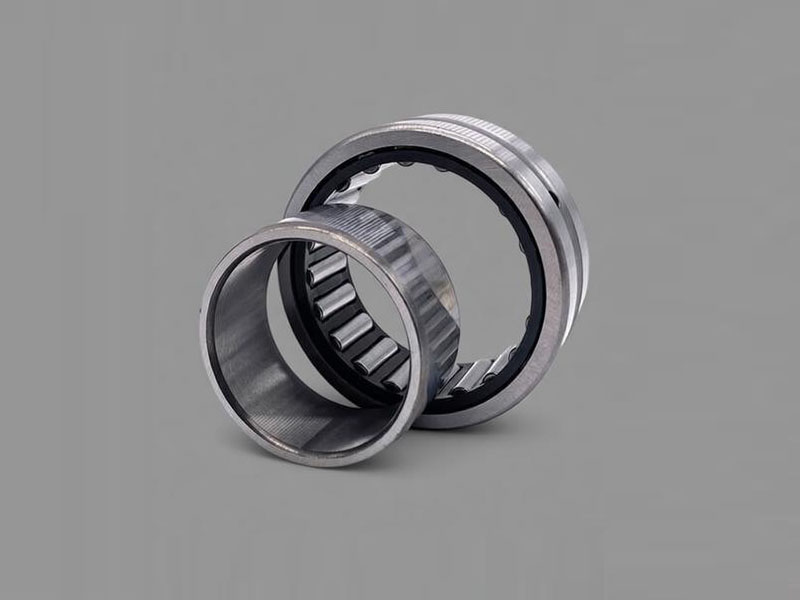
The performance of a needle bearing relies on the precision of its four key components :
- Needle Rollers: The load-carrying elements. Their small diameter and long length provide a large contact area.
- Cage: Separates and guides the rollers, reducing friction, improving heat dissipation, and allowing for higher speeds.
- Inner Ring: Provides a hardened, precision-ground raceway for the rollers. It’s used when the shaft itself cannot serve as a raceway.
- Outer Ring: The outer raceway that houses the assembly. It can be a solid, heavy-duty ring or a thin, drawn cup for minimal space usage.
Primary Applications of Needle Bearings Across Industries
The unique combination of a small cross-section and high load capacity makes needle bearings the preferred choice in a vast array of applications.
Automotive Industry
The automotive sector is a primary user of needle bearings. Their ability to handle high loads in tight spaces is critical for efficiency and performance.
- Transmissions and Gearboxes: They support rotating shafts and gears, managing high radial loads within the confined space of a transmission housing .
- Torque Converters: Needle thrust bearings handle the high axial loads generated during power transmission.
- Rocker Arm Pivots: They provide a low-friction pivot point for valve train components, ensuring precise engine timing.
- U-Joint (Universal Joints): Needle bearings are essential in the cross trunnion of drive shaft U-joints, allowing for smooth power transfer at varying angles.
Aerospace Applications
In aviation, reliability is non-negotiable. Needle bearings are chosen for their robustness and ability to perform under extreme loads and temperatures .
- Aircraft Engines and Gearboxes: They are used in accessory drives and gearboxes where space and weight are at a premium.
- Landing Gear Systems: Needle bearings support the massive shock loads of landing, bearing the full weight of the aircraft during touchdown and taxi .
- Flight Control Systems: In wing slat and flap carriages, they provide smooth, reliable movement under high, vibrating loads .
- Fuel and Hydraulic Systems: They are found in actuators and pumps that control critical flight surfaces.
Industrial Machinery
Modern industrial equipment demands precision, power, and durability.
- Hydraulic Pumps and Motors: The compact design of needle bearings allows for high-power density in hydraulic systems.
- Machine Tools: In spindles and tool changers, caged needle bearings provide the rigidity and precision required for high-quality machining .
- Printing and Textile Machines: These machines require numerous rotating parts in a limited space. Needle bearings offer a low-friction, reliable solution for high-speed operation .
Power Tools & Home Appliances
The need for lightweight, powerful, and compact tools makes needle bearings an ideal fit.
- Portable Drills and Saws: They support the motor shaft and gear train, allowing for powerful tools in a handheld form factor.
- Home Appliances: From washing machines to gardening equipment, needle bearings ensure quiet, efficient, and long-lasting operation .
Specialized Professional Applications
- Medical Devices: In surgical tools and dental drills, precision and reliability are paramount.
- Oil and Gas: They are used in downhole tools and drilling equipment, where they must withstand harsh environments and high shock loads.
- Robotics: Advanced needle bearings, like Schaeffler’s XZU series, are used in robotic joints to provide high rigidity and motion accuracy in a compact space .
Key Advantages of Using Needle Bearings
Why choose a needle bearing over other types? The benefits are compelling.
Compact and Space-Saving Design
This is the defining feature of a needle bearing. For any given shaft diameter, a needle bearing has the smallest radial cross-section of any roller bearing type, allowing engineers to design smaller, lighter, and more efficient machinery .
High Load Carrying Capacity
Despite their small size, the long rollers provide a large contact area with the raceways. This line contact allows them to support significantly higher radial loads than similarly sized ball bearings .
Durability and Cost-Effectiveness
Manufactured from high-grade materials like chrome steel (AISI 52100) or case-hardened steel, they offer excellent fatigue resistance and a long service life . Their compact design can also reduce the overall size and material cost of the surrounding machinery.
Versatility Across Designs and Industries
As detailed in the applications above, their versatility is unmatched. With options for caged or full complement, with or without inner rings, there is a needle bearing configuration for almost every rotating shaft application.
Challenges and Limitations
To ensure a successful application, one must also be aware of a needle bearing’s limitations.
Misalignment Sensitivity
Due to the line contact of the rollers, needle bearings are very sensitive to misalignment. Angular errors can lead to edge loading, causing premature roller or raceway failure. Precise shaft and housing alignment is crucial .
Wear and Fatigue
Like all mechanical components, they are subject to wear. Proper lubrication and cleanliness are vital. Contamination is a leading cause of premature bearing failure .
Speed Limitations
Full complement needle bearings (without a cage) have speed limitations due to roller-to-roller friction. If your application requires very high rotational speeds, a caged design is necessary .
Expert Guidance: How to Select the Right Needle Bearing
Choosing the right bearing is a critical decision that impacts the performance, lifetime, and reliability of your entire system .
Critical Factors to Consider
- Load Demands: First, determine if the load is radial, axial, or a combination. This will guide you towards a radial bearing, a thrust bearing, or a combined solution .
- Space Constraints: Measure the available radial and axial space. This will help you decide between a drawn-cup, a solid-ring, or a cageless design.
- Operating Conditions: Consider speed, temperature, and lubrication. High speed? Choose a caged version. Harsh environment? Consider stainless steel or special seals .
- Shaft and Housing Design: Can the shaft be hardened and ground? If yes, you can use a more compact bearing without an inner ring, saving space and cost .
Installation and Maintenance Best Practices
Proper installation and maintenance are just as important as the initial selection .
- Installation: Always use a press fit for the outer ring. Never hammer a bearing into place, as this can damage the thin outer ring and rollers . Use the correct tools to apply force evenly.
- Lubrication: Use high-quality grease or oil, preferably with Extreme Pressure (EP) additives, to handle the high contact pressures. Proper lubrication is essential for longevity .
- Seal Inspection: Regularly check seals for damage. They protect the precision internals from contaminants that can lead to premature wear .
Conclusion
Needle bearings are a cornerstone of modern mechanical design, providing an unbeatable combination of high load capacity and compact form. From the automotive and aerospace industries to industrial machinery and robotics, their versatility and performance are indispensable.
As a professional Chinese manufacturer, DUHUI is committed to providing high-quality needle bearings that meet international standards. Whether you need a standard model or a custom-engineered solution, our team is ready to help you navigate the options and find the perfect bearing for your needs.