Quick Answer
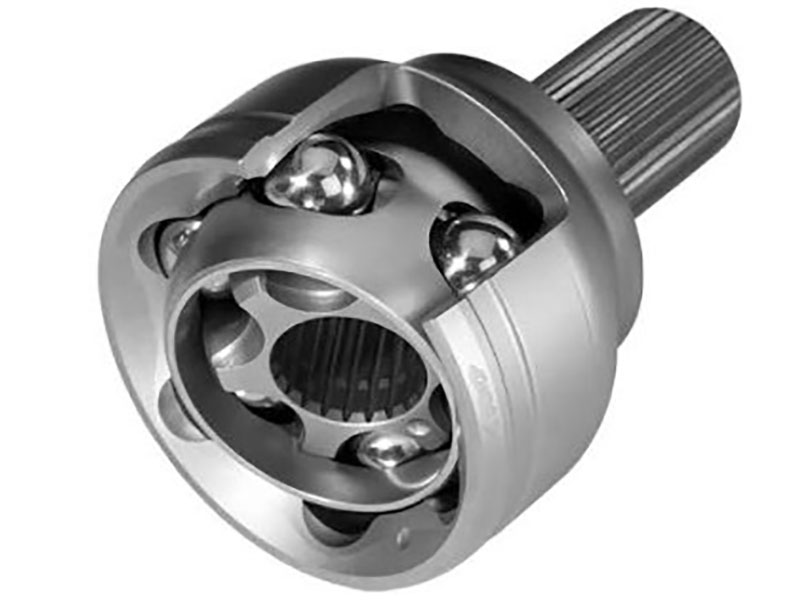
A Rzeppa CV joint—also referred to as a ball-type constant-velocity joint—is a mechanical coupling patented in 1927 by Alfred Hans Rzeppa, an engineer at Ford Motor Company. The joint transmits torque through six bearing-grade steel balls that travel within curved channels formed between an inner star-shaped race and an outer cup-shaped housing. A cage keeps these balls coplanar, and the curved track geometry automatically guides them into the angle-bisecting plane. The result: the output shaft matches the input shaft speed exactly, with no velocity fluctuation, across articulation angles up to 47°—and up to 52° on high-angle variants.
That rhythmic clicking you hear when your steering wheel is cranked to full lock? That is the sound of a Rzeppa CV joint approaching the end of its service life. Alfred Hans Rzeppa—a Ford engineer who secured his patent in 1927—gave his name to this six-ball, cage-guided mechanism that has quietly powered front-wheel-drive vehicles for close to a hundred years. Six decades after its invention, this joint design remains the prevailing choice for the outer axle positions on front-wheel-drive passenger vehicles worldwide.
But what exactly makes a Rzeppa joint different from a universal joint? Why do almost all front-wheel-drive cars use them on the outer ends of their axles? And why does a torn rubber boot often lead to a costly halfshaft replacement?
This article breaks down the Rzeppa CV joint—how it works, what is inside it, where it is used, how it compares to other joint types such as tripod and Cardan, what goes into its manufacturing, and what symptoms to look for when it starts to fail.
How Does a Rzeppa CV Joint Achieve Constant Velocity?
A Hooke’s joint—the cross-and-yoke universal joint (U-joint) found on truck driveshafts—speeds up and slows down twice per revolution when it operates at an angle. At small angles, that speed ripple is tolerable. But put a U-joint on a steered front wheel turning through 40°, and you get vibration, gear whine, and torque pulses you can feel through the steering wheel.
The Rzeppa joint’s solution is elegant: it ensures the contact points between the driving and driven sides always remain on the homokinetic plane—the geometric plane that bisects the angle formed by the two shafts. With the contact points locked to this plane, the angular velocities of input and output are perfectly equal at all times. No ripple. No vibration.
Here is how it achieves that:
- Curved grooves are machined into both the inner race and the outer housing—six grooves on each.
- Six steel balls sit in the grooves, one pair per groove.
- A cage holds all six balls in the same plane.
During straight-line driving, the balls remain centered in their respective grooves, and the joint transmits torque much like a solid coupling. When the wheel is turned, the inner race shifts its orientation relative to the outer housing. This movement causes the balls to roll along the curved tracks while the cage simultaneously tilts, preserving the coplanar arrangement of all six balls on the bisecting plane. As long as the balls stay on that plane—which the track geometry ensures automatically—the output speed precisely mirrors the input speed, regardless of the operating angle up to roughly 47°.
This is the key insight: the grooves force the balls into the angle-bisecting plane automatically. The driver does not need to do anything. The geometry handles it.
Rzeppa Variants: Plunging, Angle Grades, and the Birfield Name
While the standard fixed Rzeppa joint is the most common, the Rzeppa family includes several important variants that engineers, parts buyers, and technicians should recognize.
Plunging Rzeppa (Axial Travel)
The standard Rzeppa is a fixed joint—it has no axial plunge. But plunging variants (often referred to as plunging ball joints) exist for applications that need both high articulation and axial travel:
- Double Offset Joint – achieves plunge by lengthening the outer race grooves.
- Cross Groove Joint – the inner and outer race grooves are machined at an angle to the shaft axis, forcing the balls to move axially as the joint articulates.
In production vehicles, these plunging Rzeppa variants sometimes appear on the inboard (differential) side, serving the same role as a tripod joint while offering slightly better articulation. Supplier catalogs list them as distinct product lines.
Angle Capability Grades
Industry suppliers classify Rzeppa joints into three angle grades:
- Standard – 47° continuous
- Undercut Free – 50° continuous (modified groove geometry eliminates undercuts that limit travel)
- High Angle – 52° continuous (used in off-road and motorsport applications)
Birfield vs. Rzeppa – What is the Difference?
The term “Birfield joint” is often used interchangeably with Rzeppa, but they are not technically identical. Birfield is a specific variant or brand-licensed version of the Rzeppa joint. The practical difference lies in serviceability: a Birfield-type outer race is typically non-serviceable (integrated with the axle shaft assembly and staked in place), whereas many Rzeppa designs can be disassembled and rebuilt. If you are sourcing replacement parts, confirming whether the original equipment uses a true Rzeppa or a Birfield variant is essential—they are not always directly interchangeable.
Main Components of a Rzeppa CV Joint
A Rzeppa CV joint consists of six main components:
Outer Race (Bell Housing)
A cup-shaped outer member with six curved ball grooves machined into its inner spherical surface. The outer race is typically integrated with the output shaft or flange. Surface hardness typically runs 58–62 HRC, with a surface finish of Ra < 0.4 µm. These are typically made from carburized alloy steels like 20MnCr5 or 8620.
Inner Race
A star-shaped inner member with six matching grooves on its outer surface. The inner race typically has an internal spline for mounting to the axle shaft. The groove centers are offset a few millimeters from the center of the inner race—this offset is what creates the homokinetic geometry. Like the outer race, it is made from case-hardened alloy steel.
Cage
A thin-walled spherical shell with six rectangular windows (or pockets) that hold the balls in position. The cage holds all six balls in the same plane—the homokinetic plane essential for constant-velocity operation. New joints are manufactured with a cage-to-ball clearance of 0.02–0.08 mm. Once this clearance exceeds roughly 0.15 mm due to wear, the balls can drift off the bisecting plane during overrunning (coast) conditions, which produces an audible clunk each time the torque direction reverses.
Six Steel Balls
Bearing-grade chrome steel—typically AISI 52100 or equivalent. In passenger car applications, ball diameters typically range from 17 mm to 22 mm. Ball diameter tolerances are typically matched to ±0.002 mm per joint; mismatched balls cause uneven loading and pitting on the race grooves.
CV Boot
A corrugated neoprene or thermoplastic cover secured by two clamps. The boot keeps grease in and contaminants out. Service life is typically 80,000–150,000 km (50,000–93,000 miles). Boots should be inspected at every routine service—roughly every 10,000–15,000 km (6,000–9,300 miles)—for cracks, splits, or loose clamps.
Molybdenum Disulfide Grease
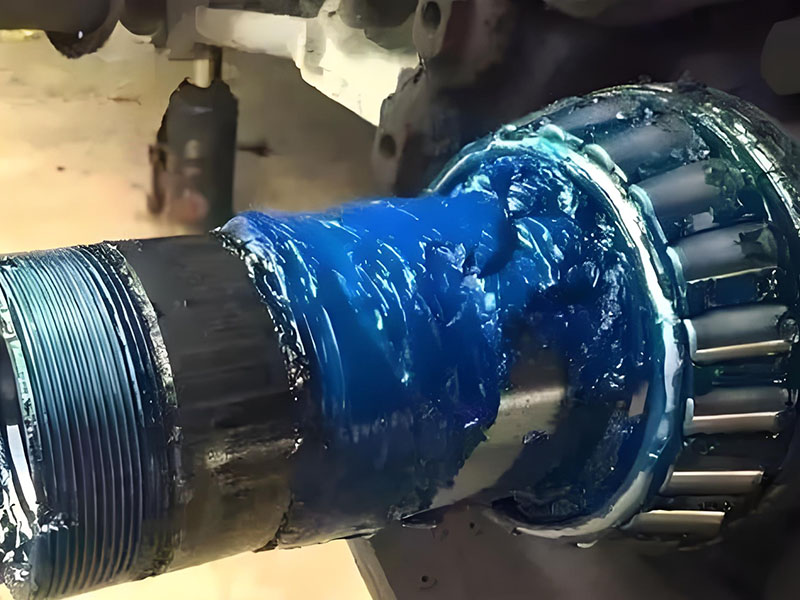
Special CV grease containing 3–5% MoS₂ (molybdenum disulfide). Rzeppa joints typically use the higher 5% MoS₂ content formulation. The grease is packed inside the sealed boot and provides both lubrication and corrosion protection. Note that inboard tripod joints often use lower-moly or moly-free NLGI 1 greases, while the outboard Rzeppa runs a heavier NLGI 1.5–2.0 grade with higher moly content.
How Rzeppa Joints Are Manufactured
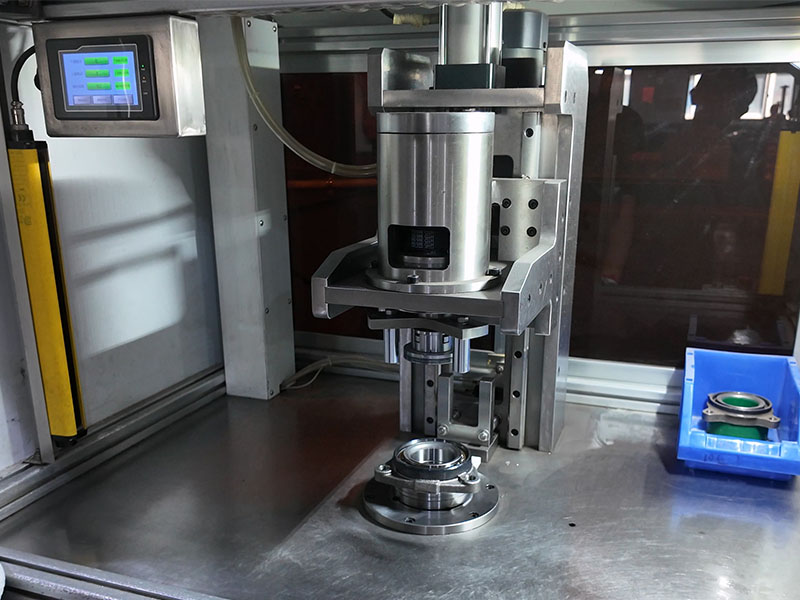
For a Rzeppa joint to survive 150,000+ km of torque reversals and road shock, its manufacturing process is as critical as its geometry. For manufacturers like DUHUI Bearing, mastering these parameters is the difference between a joint that fails at 50,000 km and one that reliably exceeds 200,000 km.
Forging and Heat Treatment
Both the outer housing (bell) and inner race are typically drop-forged from alloy steel billets—common grades include 20MnCr5 (case-hardening steel) and 8620. After rough machining, the raceways undergo induction heat treating to achieve surface hardness of 58–62 HRC while maintaining a tough, ductile core. The most wear-prone areas are the cage windows, ball tracks, and the cup’s internal spherical surface.
Typical Production Workflow
The end-to-end manufacturing process follows a strict sequence:
- Forging – near-net shape forming of housing and inner race
- Rough CNC machining – initial turning and milling
- Heat treatment – carburizing or induction hardening with controlled case depth
- Precision grinding – finish-grinding of ball tracks (Ra < 0.4 µm) and cage windows
- Ball matching – sorting and pairing balls to ±0.002 mm within a joint
- 100% dimensional inspection – checking ball track geometry, clearance, and preload
Material Details
- Balls – 100Cr6 (AISI 52100) bearing steel with controlled microstructure
- Races – 20MnCr5 or equivalent, with a controlled case depth of 0.8–1.5 mm (depending on joint size) to resist subsurface spalling
- Cage – typically case-hardened low-carbon steel or, in high-performance variants, brass/bronze cages to reduce scuffing
Understanding these manufacturing tolerances helps explain why aftermarket CV joints often fail sooner than OE units—even slight deviations in case depth or ball track curvature significantly reduce Hertzian contact fatigue life.
Where Rzeppa CV Joints Are Used
The Rzeppa CV joint is used wherever you need to transmit torque through a steering angle without speed fluctuation:
Passenger Cars
Almost every front-wheel-drive vehicle uses a Rzeppa joint as the outer (wheel-side) CV joint. Examples include the Honda Civic, Toyota Corolla, and Volkswagen Golf. Maximum articulation is typically 47°.
Light Trucks and 4×4 Vehicles
Four-wheel-drive pickup trucks with independent front suspension—like the Ford F-150 4×4 and Toyota Tacoma—use Rzeppa joints on the front axle shafts.
Marine Propulsion
Mercury Bravo and Volvo Penta sterndrive systems use Rzeppa joints in their driveshafts.
Agricultural Equipment
John Deere and Claas combine harvesters use Rzeppa joints on driven steering axles.
Motorsport
Formula Student and rally cars use Rzeppa joints in their driveline systems.
Industrial Robotics
AGVs (Automated Guided Vehicles) and wheeled mobile robots use Rzeppa joints on steering drive wheels.
Layout Note
The fixed Rzeppa joint is almost always located on the outboard (wheel) side, where it handles large articulation angles from steering. The inboard (differential) side typically uses a plunging joint—either a tripod joint or a double-offset ball joint—to absorb the axial length changes that occur as the suspension moves up and down.
Rzeppa vs. Tripod vs. Cardan: Which One Do You Need?
The table below compares the Rzeppa against its two primary alternatives, highlighting why each type is suited to different positions within the driveline:
| Feature | Rzeppa CV Joint | Tripod CV Joint | Cardan (U‑Joint) |
|---|---|---|---|
| Max articulation | 47° continuous (52° high-angle) | 22°–31° continuous | ~30° practical |
| Speed uniformity | True CV (0% ripple) | True CV (0% ripple) | 2× ripple/rev |
| Axial plunge | None (fixed type; plunging variants exist) | Up to 50 mm | None |
| Torque capacity per diameter | High | Higher than Rzeppa (same size) | Highest |
| Friction & heat generation | Higher (6 balls rolling/sliding) | Lower (rollers slide with less scrub) | Moderate |
| Typical location | Outboard (wheel side) | Inboard (differential side) | Rear driveshaft |
| Cost | Medium–high | Medium | Low |
| FWD service life | 150,000–300,000 km | 150,000–250,000 km | N/A |
Two critical takeaways from this table:
1. Tripod is stronger for its size. Because the tripod’s rollers have a larger effective contact patch and lower Hertzian stress for the same envelope, a tripod joint of the same outer diameter can transmit higher peak torque. This is why some racing applications use tripods on both ends—they can downsize the joint to save weight and still meet torque targets.
2. Tripod generates less friction and heat. The roller-bearing design produces less sliding friction than the six-ball Rzeppa geometry. In high-speed, high-torque EV applications, this lower friction has become a real advantage for inboard positions, though it still cannot match the Rzeppa’s articulation range for outboard steering.
So the choice is not about which is “better” overall—it is about which constraint drives your design: articulation angle (choose Rzeppa) or axial plunge + lower friction (choose Tripod).
Common Failure Modes and How to Diagnose Them
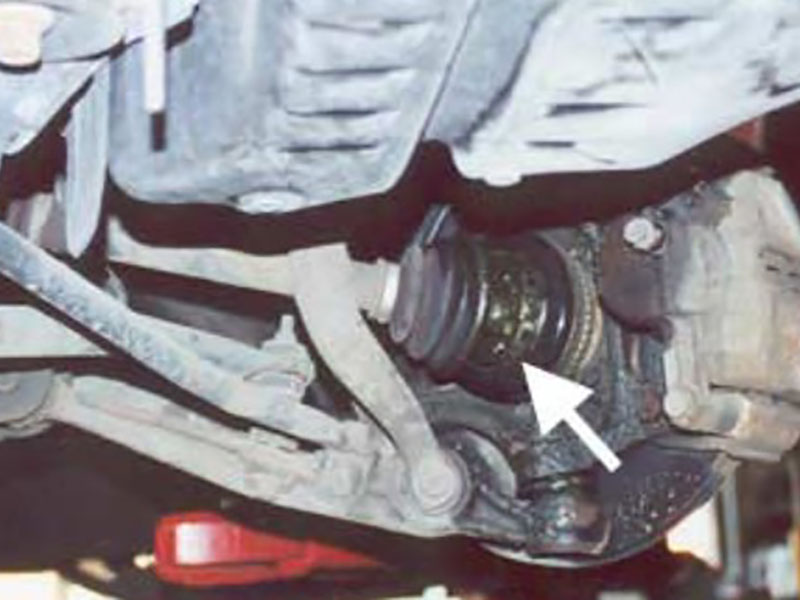
Common Causes of Failure
Torn Boot (The #1 Cause)
A damaged boot—torn, cracked, or simply leaking—is by far the most common reason CV joints wear out before their time. Because the joint rotates at high speed, centrifugal force can expel grease through even a tiny pinhole or hairline fracture. Once the grease is gone, dirt and water enter and cause rapid wear and corrosion. By the time the leak is discovered, many CV joints are already badly contaminated and need replacement. If you notice grease splatter around the inner wheel well, that is a classic torn CV boot symptom.
Cage Wear
Factory cage clearance is 0.02–0.08 mm. When clearance exceeds about 0.15 mm, the balls can deviate from the homokinetic plane under overrunning conditions, producing a clunk during torque reversal.
Spline Wear
Micro-motion fretting at the inner race spline can cause wear over time. This is typically a duty-cycle issue rather than a joint design flaw.
Contamination
Once the boot fails, water, road salt, and grit enter the joint. The abrasive particles accelerate wear on the balls, races, and cage.
Typical Symptoms
| Symptom | What It Means |
|---|---|
| Clicking or popping on turns | Classic outer Rzeppa joint wear. If you hear a clicking noise at full steering lock, the joint is already damaged. |
| Shudder or vibration under acceleration | Often indicates inner joint wear. |
| Clunk on take-off | Excessive clearance in the joint—often cage wear. |
| Grease splatter | Torn boot. Grease flung around the inner wheel well or underbody. |
Diagnosis and Repair
Early detection: If you catch a torn boot before the joint starts making noise—and the joint has only been exposed for a few hundred kilometers—you can clean the joint, repack it with fresh MoS₂ grease, and replace the boot. This can extend the joint’s service life significantly.
Once it clicks: If you hear clicking on turns, the race grooves or balls are already damaged. Replacing just the boot will not fix it. The joint or the entire halfshaft assembly needs replacement. A CV joint replacement cost varies by vehicle, but it is almost always more expensive than a simple boot change.
Inspection schedule: CV joints themselves do not have a fixed replacement interval. But the boots should be inspected at every routine service—roughly every 10,000–15,000 km (6,000–9,300 miles). Look for cracks, splits, loose clamps, or grease flung around the wheel well.
Service life: With intact boots, Rzeppa joints often exceed 150,000–250,000 km (93,000–155,000 miles).
Practical Repair Tips for Shops and DIYers
Beyond identifying the symptoms, here is what matters for repair decisions:
The Early Intervention Window
If a boot tear is discovered while the joint is still quiet and free of measurable play (no clicking, no detectable radial backlash), a boot-only repair is entirely viable. Clean the joint thoroughly, inspect the balls and races for scoring, repack with fresh 5% MoS₂ grease, and install a new boot. This can restore full service life at a fraction of the cost of a halfshaft replacement.
The “Boot-Only” Trap
The clock starts ticking the moment the boot tears. If the vehicle continues to be driven for weeks or months, debris erodes the raceways. By the time the clicking starts, the damaged joint can also damage surrounding components—the wheel bearing, hub, or even the transmission output seal can suffer from the resulting vibration and metal debris. A simple boot repair turns into a much larger repair bill.
Outer Race Fails First
The outer race (wheel-side joint) wears significantly faster than the inner race. Why? It operates at higher articulation angles, and it is directly exposed to the harshest environmental hazards—road splash, stones, salt, and mud—which attack the boot from the outside. Even with an intact boot, the outer joint experiences 3–5 times more ball travel cycles than the inner joint over the same distance. Routine boot inspections should prioritize the outer boots first.
Torque Capacity: How Much Load Can a Rzeppa Joint Handle?
The maximum torque a Rzeppa CV joint can transmit depends on three factors: the Hertzian contact stress where each ball meets its raceway, the number of balls actively sharing the load, and the pitch radius at which those balls apply force.
The formula is:
Tcap = n × Fball × Rpcd × cos(β/2)
Where:
- Tcap = torque capacity at articulation angle β
- n = number of balls actually carrying load (6 at low angles, dropping to 3–4 at high angles)
- Fball = allowable Hertzian contact load per ball (based on raceway curvature and material)
- Rpcd = pitch circle radius of the ball centers
- β = articulation angle between input and output shafts
At low articulation angles (5°–10°), all six balls carry load evenly, and the joint reaches its rated capacity. At 30°–40°, torque capacity drops to roughly 60–70% of the rated value. Above 45°, you are at the geometric limit—sustained torque at these angles will cause track spalling within hours.
Real-world example: A 3.5-ton electric delivery van (Mercedes eSprinter class) with peak wheel torque of 3,325 N·m, six 19 mm diameter balls, Rpcd = 28 mm, and single-ball allowable load of 22,000 N:
| Angle | Effective Balls | Torque Capacity | Notes |
|---|---|---|---|
| 5° (highway cruise) | 6 | ~3,690 N·m | 11% above peak—comfortable |
| 35° (tight turn) | 4 | ~2,350 N·m | Below peak wheel torque |
| 47° (full-lock parking) | 3 | ~1,695 N·m | ~50% of rated capacity |
The key takeaway: 0°–30° is the optimal operating range, where the joint maintains over 90% of its rated torque capacity. Angles above 40° should be reserved for low-speed parking maneuvers only.
Conclusion: Key Takeaways on Rzeppa CV Joints
The Rzeppa CV joint is one of the most successful mechanical designs of the 20th century. Since Alfred Hans Rzeppa filed his patent in 1927, it has enabled front-wheel drive to become the dominant layout in passenger cars worldwide.
Here is what you need to remember:
- It is a true constant-velocity joint—no speed ripple, no vibration, even at 47° of articulation.
- Six steel balls, a cage, and curved grooves are all it takes to maintain the homokinetic condition automatically.
- The boot is everything—the #1 cause of failure is a torn boot allowing grease loss and contamination. If you see grease splatter or hear a clicking noise on turns, act immediately.
- Catch it early—replace the boot before the joint clicks, and you can save the joint.
- Once it clicks, it is too late—the joint is already damaged and needs replacement.
For manufacturers and suppliers in the driveline industry, understanding the Rzeppa joint’s geometry, materials, and failure modes is not just academic—it is the foundation for producing reliable, long-lasting CV components. Whether your role involves designing drivelines for next-generation EVs, repairing worn axles in the workshop, or sourcing components for manufacturing, a solid grasp of Rzeppa joint fundamentals will serve you well.
FAQs About Rzeppa CV Joints
Q: What is a Rzeppa CV joint?
A: A Rzeppa CV joint—also called a ball-type constant-velocity joint—is a coupling invented by Ford engineer Alfred Hans Rzeppa in 1926 and patented in 1927. It uses six steel balls, a cage, and curved grooves in an inner and outer race to transmit torque at angles up to 47°–50° with zero speed ripple.
Q: What is the maximum angle a Rzeppa joint can handle?
A: Standard Rzeppa joints handle up to 47° continuous. Undercut-free designs reach 50°, and high-angle designs can go to 52°. 47° is effectively the geometric hard limit for standard designs—beyond that, the cage contacts the housing or the balls can disengage from the grooves.
Q: What is the difference between a Rzeppa and a tripod CV joint?
A: A Rzeppa joint offers greater articulation (47° vs. 22°–31°), making it ideal for the outboard (wheel) position. A tripod joint offers much greater axial plunge (up to 50 mm), making it ideal for the inboard (differential) position where suspension travel changes the shaft length. A tripod joint of the same size is typically stronger and can be made smaller and lighter, and it generates less friction.
Q: What is the difference between a Rzeppa joint and a U-joint (Cardan joint)?
A: A U-joint produces a speed ripple twice per revolution when operating at an angle. The larger the angle, the worse the ripple. A Rzeppa joint has no speed ripple at any angle—it is true constant velocity. That is why Rzeppa joints are used on steered front wheels, while U-joints are limited to rear driveshafts with small operating angles.
Q: What are the symptoms of a failing Rzeppa CV joint?
A: The classic symptom is clicking or popping on turns—especially at full steering lock. Other symptoms include shudder or vibration under acceleration (often the inner joint), a clunk on take-off, and grease splatter around the wheel well from a torn boot.
Q: My boot is torn but the joint is not clicking yet. What should I do?
A: If you catch it early—before the joint starts making noise and within a few hundred kilometers of the tear—you can clean the joint, repack it with fresh MoS₂ grease, and replace the boot. This can save the joint. If it is already clicking, the joint is damaged and must be replaced.
Q: Do Rzeppa CV joints need regular maintenance?
A: The joint itself is sealed and maintenance-free. But the boots need regular visual inspection—every 10,000–15,000 km (6,000–9,300 miles) or at every routine service. Look for cracks, splits, loose clamps, or grease flung around the wheel well.
Q: How long does a Rzeppa CV joint last?
A: With intact boots, Rzeppa joints typically exceed 150,000–250,000 km (93,000–155,000 miles). Some last well beyond 250,000 km. The boot is the limiting factor—not the joint itself.
Q: Can I replace just the boot, or do I need to replace the whole joint?
A: You can replace just the boot—if the joint is not making noise and has not been contaminated for long. If the joint is already clicking on turns, the internal components are damaged and the joint or halfshaft assembly must be replaced.
Q: Why is the Rzeppa joint used on the outside (wheel side) and not the inside?
A: Because the outside joint needs to handle large steering angles—up to 47° at full lock. The Rzeppa joint’s strength is high articulation. The inside joint sees much smaller angles (around 20°) but needs to handle axial plunge from suspension travel—that is where the tripod joint excels.
Q: What is the difference between a standard Rzeppa joint and a Birfield joint?
A: Birfield is a specific variant or brand-licensed version of the Rzeppa joint. The practical difference is serviceability: a Birfield-type outer race is typically non-serviceable (integrated with the axle shaft assembly), whereas many Rzeppa designs can be disassembled and rebuilt.
Q: How much does it cost to replace a Rzeppa CV joint?
A: The cost varies widely by vehicle and whether you replace the entire halfshaft assembly or just the joint. A boot-only repair is the most affordable option if caught early; replacing the entire halfshaft assembly is significantly more expensive. Labor costs also vary by region and shop rate. Many repair shops recommend replacing the entire halfshaft because it saves labor time and includes a new outer joint, but for vehicles where the joint is caught early, a boot replacement can be a cost-effective alternative.