Quick Answer
Needle roller bearings use long, thin rollers with a length-to-diameter ratio of 4:1 or higher. They offer 2 to 8 times the load capacity of ball bearings of the same size, with a much smaller radial cross-section. Roller diameters range from 1.5 mm to 12 mm, lengths from 4 mm to 100 mm. Hardness requirements: rollers at least HRC 58; shaft raceways at least HRC 60. Caged designs suit speeds up to approximately 5,000 RPM. Common applications include automotive transmissions, pumps, compressors, and planetary gears.
If you work with automotive transmissions, industrial machinery, or any equipment where space is tight but loads are heavy, you have likely encountered needle roller bearings. They are small in cross-section yet capable of carrying substantial loads. But with so many types, configurations, and specifications available, how do you choose the right one? How do you install it correctly? And when something goes wrong, how do you diagnose and fix the problem? This guide answers exactly those questions—step by step.
What Are Needle Roller Bearings?
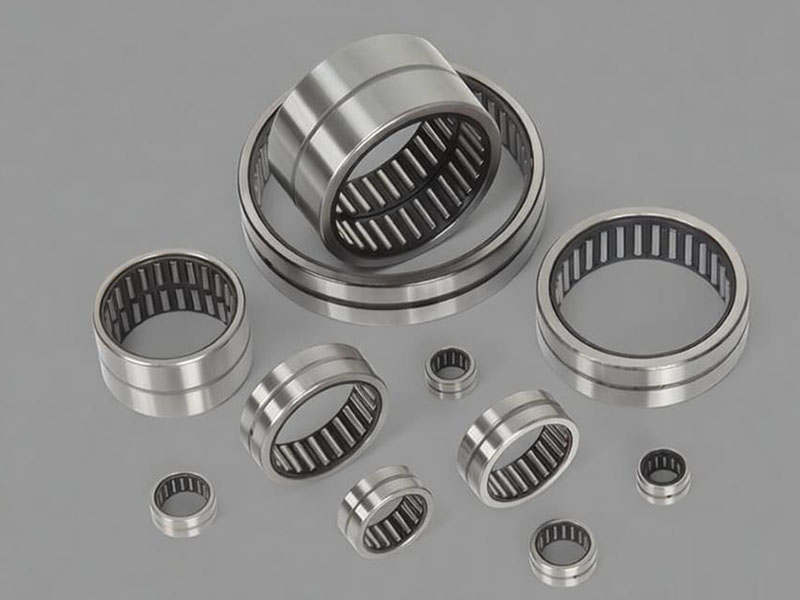
Needle roller bearings are a specialized type of rolling-element bearing that use long, thin cylindrical rollers as the rolling elements. These rollers, called needle rollers, have a length at least four times their diameter—and in many designs, the ratio reaches 10:1 or higher. This slender geometry allows needle roller bearings to deliver exceptional load-carrying capacity within a very compact radial space.
The defining characteristic of needle roller bearings is the line contact between the needle rollers and the raceways. This line contact creates a larger contact area than the point contact found in ball bearings. As a result, needle roller bearings can handle significantly higher loads than ball bearings of equivalent size.
Needle roller bearings vs. ball bearings:
- Ball bearings use point contact between balls and raceways. They are well-suited for high-speed operation and light to moderate loads.
- Needle roller bearings use line contact. Their radial cross-section is much smaller, and they offer 2 to 8 times the load capacity of a ball bearing of the same size.
- Needle roller bearings typically operate at lower speeds than ball bearings, but they are the preferred choice when radial space is limited and high load capacity is required.
Needle roller bearings vs. cylindrical roller bearings:
While both are roller-type bearings, needle roller bearings use rollers that are significantly longer and thinner than standard cylindrical rollers. The radial cross-sectional height is much smaller, making the needle roller bearing the more space-efficient option.
For automotive applications—such as transmissions, steering systems, and engine components—the compact design and high load capacity of needle roller bearings make them indispensable.
Types of Needle Roller Bearings
By Load Direction
Radial needle roller bearings are designed primarily to handle radial loads—forces that act perpendicular to the shaft axis. These are the most common type and are used in applications where the primary force is radial.
Thrust needle roller bearings (AXK series) are engineered to carry axial loads—forces that act parallel to the shaft axis. These bearings are used in applications where thrust loads are present, such as in automotive transmissions and steering columns.
Combined bearings can handle both radial and axial loads simultaneously. These are used in more complex applications where loads come from multiple directions.
By Structural Design
Drawn cup needle roller bearings feature a thin-walled outer ring (drawn cup) that is pressed into the housing. These bearings offer maximum compactness and are ideal for applications where installation space is extremely limited. Common series include TA and HK.
Machined-ring (solid) needle roller bearings have a thick, machined outer ring that provides higher rigidity and is better suited for heavy loads and impact loads. These include:
- NK series – without inner ring
- NA series – with inner ring
- RNA series – without inner ring
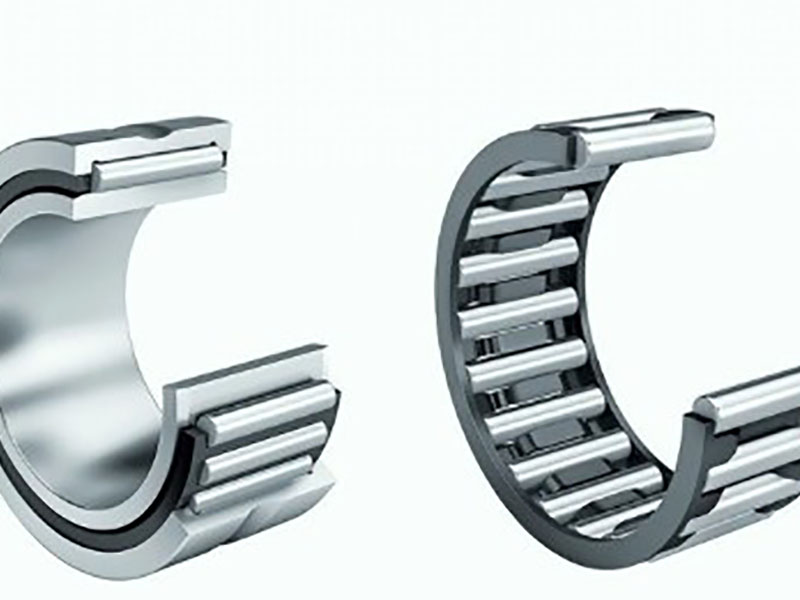
Full complement needle roller bearings have no cage (retainer). This design allows the maximum possible number of needle rollers to be packed into the bearing, resulting in the highest radial load capacity. However, the absence of a cage means higher friction and heat generation, so these bearings are best suited for low-speed, heavy-load applications.
Caged needle roller bearings use a cage to guide and separate the needle rollers. The cage improves lubrication distribution, reduces friction, and allows for higher operating speeds. While they contain fewer rollers than full complement designs, their speed capability and lower friction make them the better choice for moderate to high-speed applications.
By Application Type
Track rollers / cam followers are specialized needle roller bearings designed to run on cam tracks or guide rails. They are commonly used in cam mechanisms, conveyor systems, and automation equipment.
One-way clutch bearings (HF series) allow rotation in one direction only while locking in the opposite direction. These are used in indexing mechanisms, anti-reversal applications, and overrunning clutches.
Cage and needle assemblies (KT series) are lightweight designs that consist only of needle rollers and a cage, without inner or outer rings. These are used in high-speed applications where minimizing weight and inertia is critical.
Components of a Needle Roller Bearing
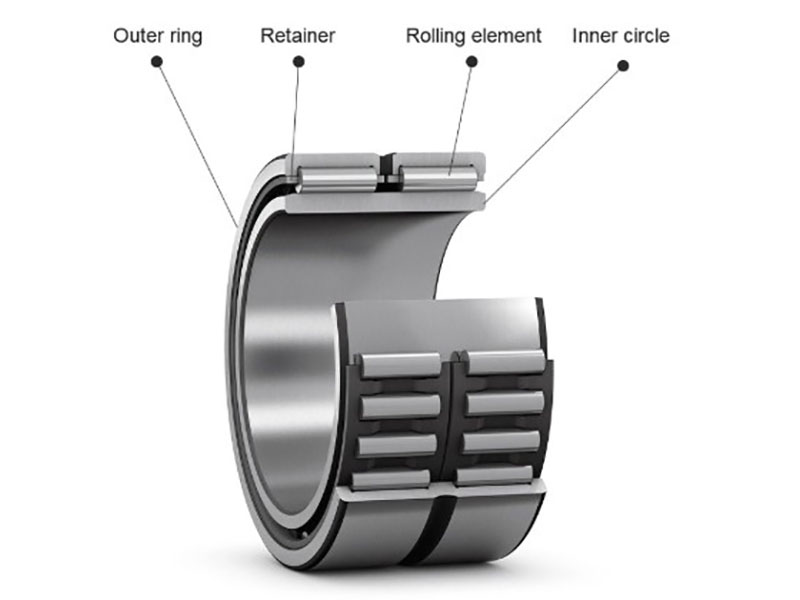
A needle roller bearing consists of four core components: raceways, inner ring, cage, and needle rollers.
Needle Rollers – The Load-Carrying Elements
Needle rollers are the rolling elements that carry the load and transmit motion. They offer several performance advantages:
- Low coefficient of friction
- High power transmission efficiency
- Low heat generation
- Minimal lubrication requirements
- Easy maintenance
Needle rollers are available in a wide range of sizes, with diameters from 1.5 mm to 12 mm and lengths from 4 mm to 100 mm. They can be arranged in single-row or double-row configurations depending on the load requirements.
Geometry considerations: The length-to-diameter (L/D) ratio of needle rollers typically ranges from 3:1 to 10:1. To reduce stress concentrations and improve lubrication conditions, the ends of needle rollers are usually manufactured with a crown (convex) or tapered profile. Needle rollers with a diameter of 6 mm or less are most common in standard applications.
Beyond their use in bearings, needle rollers can also function as locating pins in certain mechanical assemblies.
Common materials for needle rollers include bearing steels such as SAE 52100 (100Cr6 / GCr15), 1085, and 1055, as well as stainless steels including 303, 304, 313, and 440. The choice of material depends on the application requirements—stainless steel is used where corrosion resistance is needed, while standard bearing steel offers an optimal balance of strength and cost.
Hardness is a critical quality parameter. Needle rollers typically require a hardness of at least HRC 58 to withstand the high contact stresses encountered during operation.
Inner Ring and Outer Ring
The inner ring is the rotating component that fits onto the shaft. Its diameter is smaller than that of the outer ring. The outer ring remains stationary within the housing.
Some needle roller bearing designs do not include an inner ring. In these designs, the shaft itself serves as the rolling surface. This approach reduces the bearing’s radial cross-section even further but requires the shaft to meet strict hardness and surface finish requirements.
Both inner and outer rings are typically manufactured from alloy steel and undergo heat treatment to achieve the necessary hardness and wear resistance.
Cage (Retainer)
The cage—also called a separator or retainer—serves two essential functions:
- Guiding the needle rollers to maintain proper alignment
- Separating the rollers to ensure even load distribution and prevent roller-to-roller contact
The cage also helps retain lubricant and facilitates proper lubrication distribution across all rolling elements.
Benefits of Needle Roller Bearings
Needle roller bearings offer a compelling combination of advantages that make them the preferred choice in space-constrained, high-load applications:
- Low coefficient of friction – The rolling action of the needle rollers minimizes energy loss and heat generation.
- Easy maintenance – Simple design and robust construction reduce the frequency and complexity of maintenance tasks.
- High radial load capacity – The line contact between rollers and raceways allows the bearing to handle substantial radial loads.
- Exceptional durability – Properly manufactured and maintained needle roller bearings offer long service lives.
- High rigidity – The large contact area provides excellent stiffness, which is critical in precision applications.
- Speed capability – Caged designs can operate at moderate to high rotational speeds. As a general benchmark, caged needle roller bearings perform well up to about 5,000 RPM in production applications; beyond this range, deep groove ball bearings or specialized high-speed designs are more appropriate.
- Space efficiency – The compact radial cross-section makes needle roller bearings ideal for applications where every millimeter counts.
Needle Roller Bearing Selection Considerations
Choosing the right needle roller bearing for a specific application requires careful evaluation of several factors:
Load: Needle roller bearings are primarily designed for radial loads. If the application involves axial (thrust) loads, a thrust needle roller bearing or a bearing with flanges should be selected.
Speed: Compare the bearing’s speed rating (limiting speed) against the actual operating speed, with a safety margin. For high-speed applications, caged designs are preferred over full complement designs. As a practical guideline, when operating speeds exceed approximately 5,000 RPM, caged needle roller bearings are strongly recommended; full complement designs are not suitable at these speeds due to excessive friction and heat generation.
Installation space: When radial space is limited, needle roller bearings are often the ideal solution. The drawn cup design offers the most compact profile. If you are looking for a needle bearing size chart to compare dimensions across different series, most manufacturers provide detailed dimensional tables in their catalogs.
Inner ring selection: If the shaft surface cannot meet the hardness requirement (typically HRC 60 or higher) and surface finish specifications, a bearing with an inner ring should be selected. Using the shaft as a raceway without proper hardness will lead to premature wear and bearing failure.
Drawn cup vs. machined ring: Drawn cup bearings are designed for press-fit installation in housings and are suitable for lighter applications. Machined-ring bearings offer higher rigidity and are better suited for heavy loads and shock loads.
Full complement vs. caged: Full complement bearings offer higher load capacity but are speed-limited. Caged bearings run at higher speeds with lower friction but have slightly lower load capacity.
Industry Applications of Needle Roller Bearings
Needle roller bearings are used across a wide range of industries due to their compact design and high load capacity:
Automotive – Transmissions, rocker arm pivots, pumps, compressors, planetary gears, universal joints, steering systems, and torque converters.
Aerospace and defense – Actuation systems, landing gear components, and flight control mechanisms
Industrial machinery – Robot reducers, machine tools, and automation equipment
Heavy equipment and agricultural machinery – Construction equipment, tractors, and harvesters
Household appliances and small motors/power tools – Washing machines, electric tools, and small electric motors
If you are exploring a specific needle bearing application, the selection factors discussed earlier (load, speed, space, and lubrication) will guide you toward the right choice for your equipment.
Installation and Maintenance
Installation Guidelines
Proper installation is critical to the performance and service life of needle roller bearings:
- Clean thoroughly – Before installation, ensure the bearing, shaft journal, and housing bore are completely free of dirt, metal particles, and other contaminants.
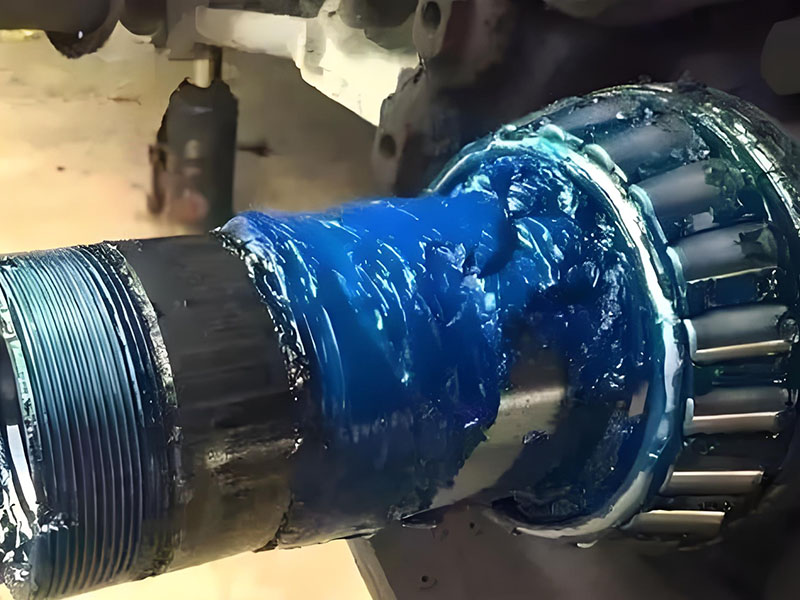
- Apply lubricant – Apply a thin layer of grease or oil to the shaft and housing bore to facilitate installation and provide initial lubrication.
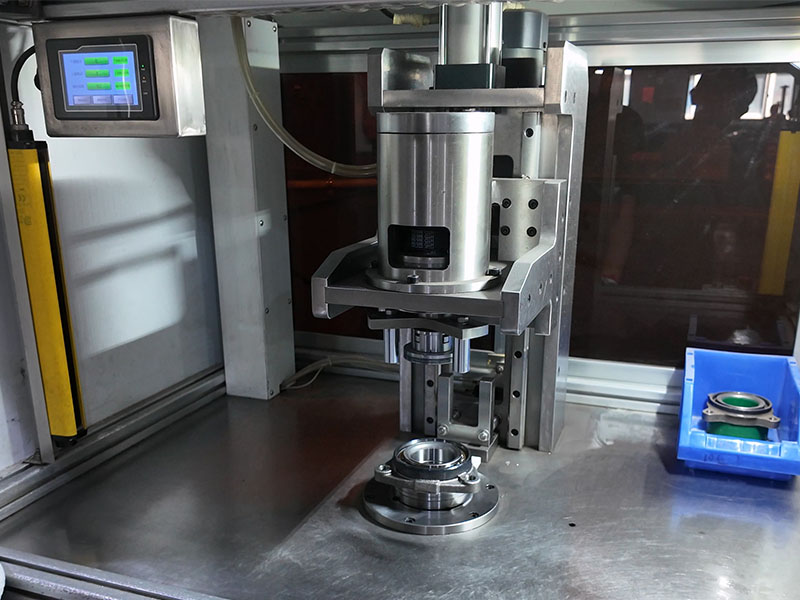
- Use proper tools – Never strike the needle rollers or cage directly. Use dedicated installation tools or a press to apply force evenly to the bearing ring.
- Check alignment – Improper installation angle will prevent smooth insertion and may damage the bearing.
- Control housing bore tolerances – Housing bore tolerance is critical. If the bore is too loose, the outer ring may shift; if too tight, the bearing may bind or seize.
Lubrication
- Grease is the most common lubricant for needle roller bearings and is suitable for most general applications.
- Oil is recommended for high-speed or high-temperature applications where better heat dissipation is needed.
- Lubricant quantity must be controlled – Too much lubricant causes overheating due to churning; too little leads to insufficient lubrication and accelerated wear.
Maintenance
- Regularly clean the bearing surface and mounting area to prevent dust or metal particles from entering the bearing.
- Periodically inspect for signs of wear, loosening, or surface damage.
- Monitor operating temperature and noise levels—unusual changes often indicate developing issues.
Failure Diagnosis and Replacement
Common Failure Modes – Causes and Symptoms
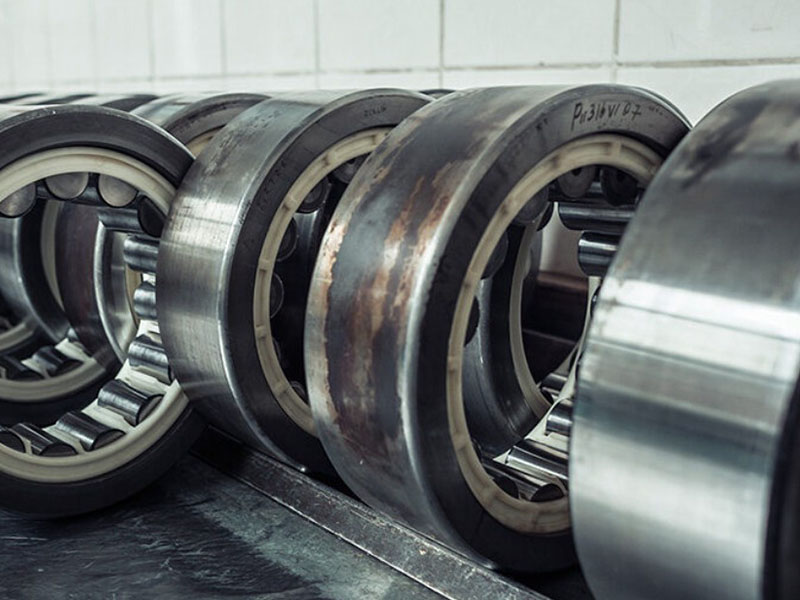
Understanding common failure modes helps in early detection and prevention:
Shaft raceway wear / scuffing
- Causes: Shaft too soft or insufficient surface finish, inadequate lubricant film, contamination
- Symptoms: Visible scoring or galling on the shaft surface; increased operating temperature
- Prevention: Ensure shaft hardness meets requirements (HRC 60+), use proper lubricant, maintain cleanliness
False brinelling / fretting wear
- Causes: Vibration while the bearing is stationary (common during transport or idle periods)
- Symptoms: Shallow depressions in the raceway at roller spacing intervals; rust-colored debris
- Prevention: Use vibration-damping measures during storage and transport; apply preload where possible
Abnormal noise and vibration
- Causes: Wear, improper installation, contamination, or damage to rolling elements or raceways
- Symptoms: Grinding, squealing, or clicking sounds during operation; noticeable vibration
- Diagnosis: Listen for unusual sounds during operation; investigate and correct the root cause
Overheating
- Causes: Insufficient lubrication, overload, or excessive ambient temperature
- Symptoms: Housing temperature significantly above normal operating range; discoloration of bearing components
- Diagnosis: Check lubricant condition and quantity; verify load is within bearing specifications
Premature wear
- Causes: Incorrect bearing selection, poor lubrication, or harsh operating conditions
- Symptoms: Reduced performance, increased play, visible wear patterns on rollers or raceways
- Prevention: Select the correct bearing type and size; follow lubrication recommendations
When and How to Replace
A needle roller bearing should be replaced when any of the following conditions are observed:
- Visible damage such as spalling, cracking, or surface flaking on rollers or raceways
- Excessive radial or axial play that cannot be corrected by adjustment
- Persistent abnormal noise or vibration that does not resolve with lubrication
- Operating temperature consistently above normal range despite proper lubrication
- Performance decline affecting equipment output or precision
Replacement best practices:
- Record the bearing identification number – Note the series and dimensions to ensure correct replacement
- Inspect the housing and shaft – Check for damage to mating surfaces; repair or replace if necessary
- Clean thoroughly – Remove all old lubricant and contaminants before installing the new bearing
- Follow installation guidelines – Apply the same installation procedures outlined in the Installation and Maintenance section above
- Monitor after replacement – Check temperature, noise, and vibration during initial operation to confirm proper installation
The Lifespan of a Needle Bearing
There is no single answer to how long a needle roller bearing will last—service life depends on multiple factors:
- Bearing quality – The steel quality and manufacturing processes directly affect durability
- Maintenance practices – Proper lubrication and regular inspection extend service life
- Operating conditions – Temperature, contamination levels, and vibration all impact longevity
- Load levels – Operating within or beyond the bearing’s rated capacity
Under proper lubrication and maintenance, needle roller bearings in automotive engines can last 12 years or more. In industrial applications, service life varies widely based on duty cycles and operating conditions.
To maximize bearing life:
- Select the correct bearing type and size for your specific application
- Install correctly following the guidelines in this guide
- Maintain proper lubrication and keep contaminants out
- Monitor for early signs of failure and address issues promptly
- Replace bearings at appropriate intervals based on operating conditions and manufacturer recommendations
Conclusion
This guide has walked through the full lifecycle of needle roller bearings—from understanding what they are and how they are built, to selecting the right type for your application, installing and maintaining them correctly, diagnosing common failure modes, and replacing them when necessary. The key takeaway is that proper selection and maintenance directly determine service life. By following the selection criteria, installation best practices, and regular inspection routines outlined above, you can maximize the performance and longevity of your needle roller bearings. If you encounter any of the failure symptoms discussed, address them promptly to prevent further equipment damage.
FAQs
Q1: What is the difference between a needle roller bearing and a ball bearing?
Needle roller bearings use line contact between the rollers and raceways, while ball bearings use point contact between the balls and raceways. This means needle roller bearings offer 2 to 8 times the load capacity of ball bearings of the same size. Ball bearings, however, are better suited for high-speed operation. Needle roller bearings also have a much smaller radial cross-section, making them ideal for space-constrained applications.
Q2: How do I choose between a needle roller bearing and a cylindrical roller bearing?
Choose a needle roller bearing when radial space is extremely limited and high load capacity is needed—its cross-section is much smaller than a cylindrical roller bearing of equivalent load rating. Choose a cylindrical roller bearing when you need higher speed capability and can accommodate a larger radial envelope.
Q3: When should I choose a needle roller bearing with an inner ring?
Choose a bearing with an inner ring when the shaft surface cannot meet the required hardness (typically HRC 60 or higher) and surface finish specifications, or when the shaft is expected to experience wear during service. Using an inner ring protects the shaft from wear and simplifies replacement.
Q4: What is the difference between full complement and caged needle roller bearings?
Full complement bearings have no cage and can accommodate the maximum number of rollers, offering the highest radial load capacity. However, they generate more friction and heat and are best suited for low-speed, heavy-load applications. Caged bearings have fewer rollers but offer better lubrication, lower friction, and higher speed capability—suitable for applications up to approximately 5,000 RPM.
Q5: Can needle roller bearings handle axial (thrust) loads?
Standard radial needle roller bearings are designed primarily for radial loads and are not intended to carry axial loads. If axial loads are present, use a thrust needle roller bearing or select a bearing with flanges designed to handle thrust forces.
Q6: What are the common signs that a needle roller bearing is failing?
Common failure indicators include:
- Unusual noise during operation (grinding, squealing, or clicking)
- Excessive vibration
- Overheating of the bearing housing
- Difficulty rotating or binding
- Visible wear, spalling, or surface damage on rollers or raceways during inspection
Q7: What lubricant should I use for needle roller bearings?
Grease is suitable for most general applications. Oil is recommended for high-speed or high-temperature applications where better heat dissipation is needed. The lubricant quantity must be controlled—too much causes overheating, too little causes wear. Always follow the bearing manufacturer’s lubrication recommendations.
Q8: How do I properly install a needle roller bearing?
Key installation steps include:
- Clean the bearing and mating surfaces thoroughly before installation
- Apply a thin layer of lubricant to facilitate installation
- Use proper installation tools—never strike rollers or cage directly
- Ensure housing bore tolerances are correct (too loose or too tight both cause problems)
- Check alignment to prevent binding
Q9: What speed can a needle roller bearing handle?
Needle roller bearings are suitable for moderate speeds. For applications above approximately 5,000 RPM, caged designs are strongly recommended over full complement designs. At very high speeds, deep groove ball bearings or other high-speed bearing types may be more appropriate. Always verify against the manufacturer’s published limiting speed data for the specific bearing model.
Q10: How do I know when a needle roller bearing needs replacement and how do I replace it?
Replace a bearing when you observe visible damage (spalling, cracking, flaking), excessive play, persistent abnormal noise or vibration, or consistent overheating. Follow these steps:
- Record the bearing identification number for correct replacement
- Inspect and clean the housing and shaft
- Install the new bearing following proper installation procedures
- Monitor temperature and noise during initial operation