Quick Answer
Universal joints typically last around 100,000 miles (160,000 km) under normal conditions. Premature wear and breakage usually come down to six main causes: lack of lubrication, excessive operating angles, overloading from oversized tires or engine upgrades, improper installation, over-flexing/binding, and damaged yokes. Most failures can be prevented with regular maintenance—greasing every 5,000 miles for greaseable joints—and keeping operating angles within 1–3 degrees whenever possible.
If you’ve ever replaced a universal joint only to have it fail again a few months later, you know the frustration. U-joints are tough components—they handle thrust load, drive-angle movement, and vehicle-load torque, and they can survive 75,000 to 125,000 miles or more. So when they keep wearing out or breaking prematurely, something is wrong.
The good news is that U-joint failures follow patterns. Once you understand what causes them, you can diagnose the root problem and stop replacing joints unnecessarily. Below, we’ll walk through every major cause—from the obvious to the overlooked—so you can identify what’s killing your U-joints and fix it for good.
Cause 1: Overloading and Overworking
U-joints are engineered for specific torque and weight ratings. Exceed those limits, and you’re asking for trouble.
Oversized tires without driveline upgrades. Big tires aren’t just heavier—they multiply the load on your U-joints exponentially. The added leverage from larger diameter tires increases the torque the driveline must transmit, and the extra unsprung weight subjects joints to greater impact forces on every bump.
Heavy-duty or off-road use without upgraded components. If you’re using your vehicle for towing, rock crawling, mudding, or desert running, standard-duty U-joints won’t cut it. The constant shock loading from rough terrain accelerates wear far beyond what street driving produces.
Engine or transmission upgrades without driveline upgrades. More horsepower and torque are great—until your U-joints become the weakest link. A high-performance engine can easily exceed the torque capacity of stock U-joints.
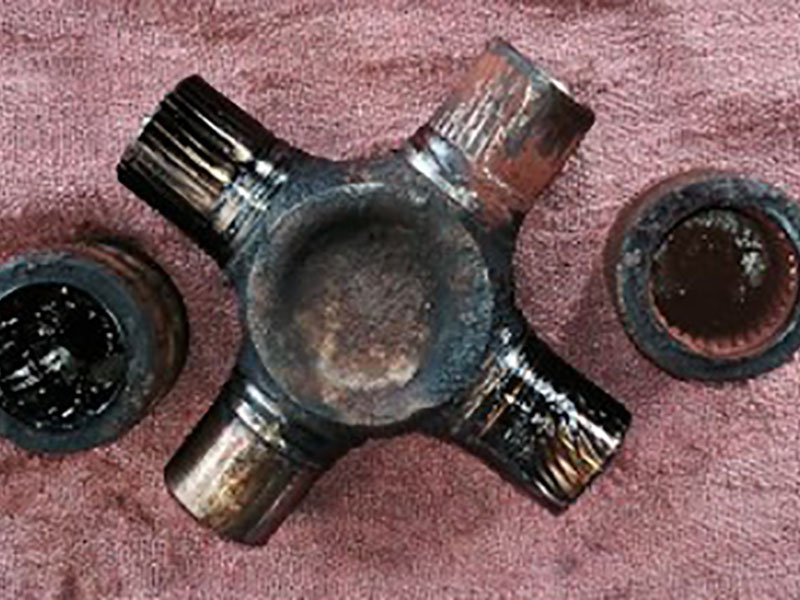
Overloading bends yoke ears. When a U-joint is overloaded, the yoke ears can actually bend. Once that happens, the bearings can’t roll properly inside the bearing cups. Instead of rolling smoothly, they hammer against the cross surface, creating brinelling (surface indentations) that quickly destroys the joint.
Extreme use cases. Track days, heavy towing beyond rated capacity, aggressive off-roading—all of these shorten U-joint life. If you race on the track or take your vehicle off-roading regularly, expect extra strain on your entire drivetrain.
Cause 2: Poor Lubrication and Maintenance
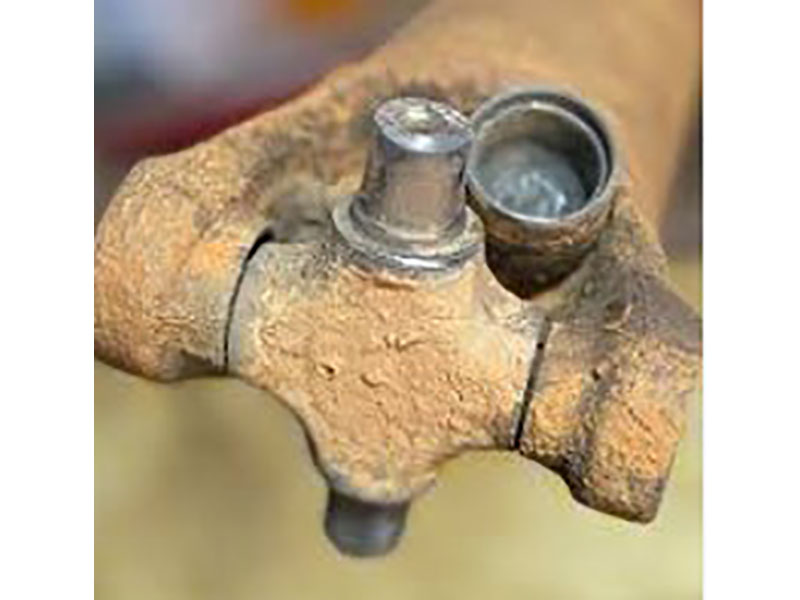
Lack of lubrication is the single most common cause of U-joint failure—period. This applies to both greaseable and sealed (non-greaseable) U-joints.
For greaseable U-joints: If you don’t grease them at the recommended interval, heat builds up inside the joint. That heat degrades the seals, which then allows grease to escape. Without adequate grease, metal components run dry against each other.
For sealed U-joints: These come factory-filled with grease and have no zerk fitting. But the seals can crack with age. Once a seal fails, dust and moisture get in, and the grease slowly washes out. The joint may look fine from the outside while the inside is already worn.
Vibration shakes grease out. Driveline vibration doesn’t just annoy you—it physically pumps grease out of the U-joint through the seals. This leaves the needle bearings and cross running with insufficient lubrication.
Heat can “cook” grease. If your U-joint is mounted close to an exhaust component, the radiated heat can break down the grease chemically, turning it into a hard, crusty residue that no longer lubricates.
Water intrusion is devastating. Here’s something many off-roaders learn the hard way: when a hot U-joint is submerged in cold water (like crossing a stream), it acts like a vacuum pump. The rapid cooling creates negative pressure inside the joint, which sucks water and muddy water right past the seals. Water mixed with grease becomes an abrasive paste that eats away at the cross and needle bearings from the inside.
Recommended practice: For greaseable U-joints, check and grease them at every oil change—roughly every 5,000 miles (8,000 km). If you’ve been off-roading or fording water, grease them immediately afterward to flush out any contaminants.
Cause 3: Angle Problems
U-joints are designed to operate within specific angle ranges. Push beyond those limits, and you’re dramatically shortening their life.
The numbers matter. According to Spicer engineering guidelines:
- 1–3 degrees: Ideal operating range for vibration-free performance
- 3–6 degrees: Still workable, but joint life is reduced
- Over 6 degrees: Expect excessive vibration and rapid failure
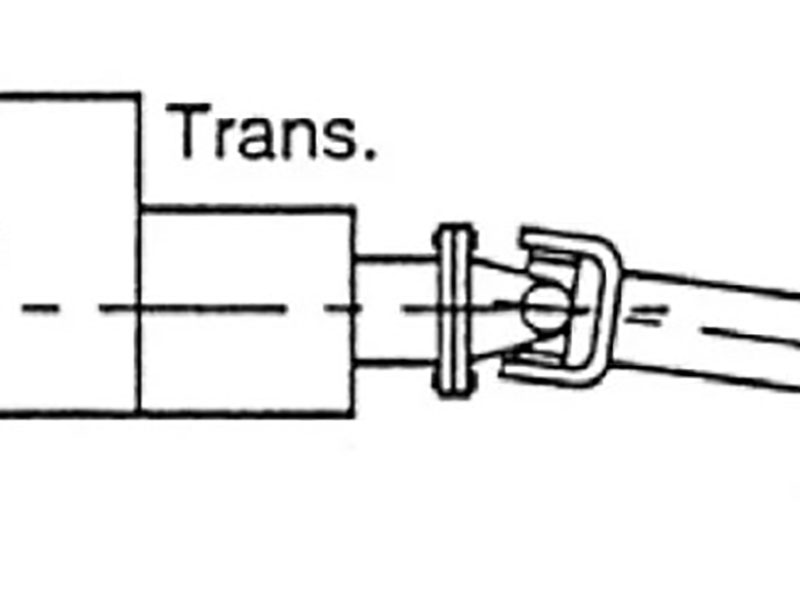
Lift kits change everything. A 3-inch suspension lift can increase your operating angle from 1–3 degrees to 5–6 degrees or more. That single modification—without correcting pinion angles—can cut U-joint life in half or worse.
The vibration problem. Every U-joint that operates at an angle creates vibration—it’s inherent to the design. The larger the angle, the more the joint accelerates and decelerates with each rotation. This creates torsional vibration that doesn’t just wear out the U-joint—it also hammers the transmission output shaft bearing and the differential pinion bearing.
Imbalance makes it worse. If your driveshaft is out of balance (from a dent, missing weight, or worn center bearing), that vibration compounds with the angle-induced vibration. The result is a constant hammering effect on your U-joint bearings.
What to do: After any suspension modification or tire upgrade, measure your U-joint operating angles. Use a digital protractor like the Spicer Anglemaster® or a bubble-type protractor. Spicer also offers a free online Driveline Operating Angle Calculator that can help you determine if your angles are within spec.
Cause 4: Over-Flexing and Binding
When your suspension cycles to its extremes, U-joint angles can reach their mechanical limits—and things start binding.
Full suspension droop. Rock crawlers know this scenario well: one wheel stuffed up into the fender, the other hanging at full droop. The driveshaft angle at the drooping axle can hit 20 degrees or more. Standard U-joints are typically designed to operate smoothly up to about 15–20 degrees. Beyond that, the cross starts interfering with the yoke ears—that’s binding.
Axle wrap on leaf-spring vehicles. Under hard acceleration, leaf springs can deform into an “S” shape, changing the pinion angle dramatically in an instant. That sudden angle change can spike U-joint stress beyond what the joint can handle.
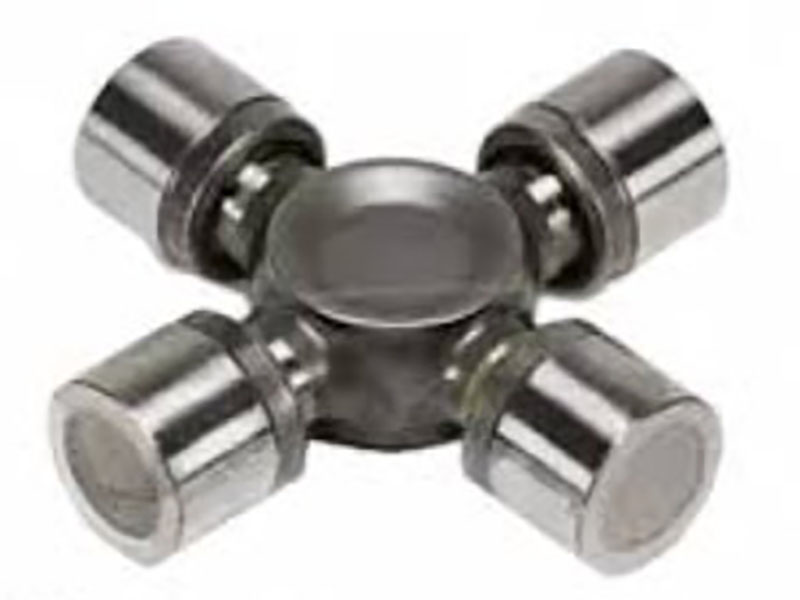
The visual check. Look at your yokes. If you see shiny or polished areas where the cross has been rubbing against the yoke ears, that’s a clear sign of binding. Those shiny spots mean metal has been wearing against metal at extreme angles.
Shock loading is the killer. Here’s when U-joints actually break—not just wear out. When you’re spinning wheels in mud or on gravel and suddenly catch traction, the impact load can snap a cheap cast U-joint instantly. The joint goes from free-spinning to locked in a fraction of a second, and the torque spike finds the weakest point.
Cause 5: Yokes Damaged or Worn
The yokes that hold your U-joints matter just as much as the joints themselves.
Worn yokes = worn U-joints. If the yoke ears are worn, elongated, or distorted, they won’t hold the bearing cups properly. The cups can shift slightly under load, which changes the bearing alignment and accelerates wear.
Bent yoke ears. A bent yoke ear prevents the bearing from rolling smoothly inside the cup. Instead, the bearing gets pinched or loaded unevenly, which creates hot spots and premature failure.
Cracked yokes. Stress fractures in yokes are a serious safety issue. A cracked yoke can fail catastrophically, dropping the driveshaft while you’re driving.
What to check: During every U-joint replacement, inspect the yokes carefully. Look for:
- Cracks or stress lines around the ears
- Elongated bolt holes
- Damaged sealing surfaces where the bearing cup seats
- Signs of wear where the U-joint cross has been contacting the yoke
Cause 6: Improper Installation
Even a brand-new, high-quality U-joint won’t last if it’s installed incorrectly.
Incorrect U-bolt torque. U-bolt nuts need to be torqued to manufacturer specifications—not “good and tight.” Over-torquing can distort the bearing cups, while under-torquing allows movement. As a general reference, ½-inch cap-retaining bolts typically need 64–87 lb-ft, while ¾-inch bolts require 190–215 lb-ft. For smaller automotive U-joints (common on passenger cars and light SUVs), spec may be as low as 20–30 lb-ft—always check your joint’s service manual or packaging for the exact figure.
Brinelling from improper torque. If you over-torque the U-bolts, you can actually brinell the bearing cups—creating tiny indentations in the bearing races that lead to rapid failure.
Misaligned bearing cups. When you’re pressing the cups into the yokes, they need to go in straight. If a cup goes in crooked, the needle bearings can get displaced or damaged during installation. Those damaged needles will fail quickly once the vehicle is back on the road.
Loose bolts. Bolts that aren’t torqued to spec—or that work loose from corrosion or vibration—can allow the U-joint to shift. In extreme cases, the driveshaft can actually come detached.
Damaged driveshaft tubes. Even a small dent in the driveshaft tube can cause high-speed vibration. You might not feel it clearly, but that vibration is constantly hammering your U-joint bearings.
The torque sequence matters. When tightening strap bolts, follow the proper sequence—typically tightening in a counter-clockwise pattern starting from position one. This ensures even clamping pressure on the bearing cups.
Normal Wear and Tear
Sometimes, your U-joints aren’t failing prematurely—they’re just old.
Typical service life. Under normal conditions, U-joints typically last about 100,000 miles (160,000 km). However, this varies widely—some fail before 75,000 miles under heavy use, while others stretch beyond 125,000 miles with gentle driving and diligent maintenance.
Faster wear for hard use. If you frequently off-road, tow heavy loads, or drive in extreme conditions, expect shorter U-joint life. That’s not a defect—it’s the physics of harder use.
Age matters too. U-joints can last for decades in a lightly used vehicle, or they can break when the vehicle is still relatively new. Quality of the joint, type of vehicle, and how it’s used and maintained all play a role.
Symptoms of U-Joint Failure
Catching U-joint problems early can save you from a catastrophic failure. Here’s what to listen and feel for:
| Symptom | What It Sounds/Feels Like |
|---|---|
| Clunking when shifting | A metallic clunk or bang when shifting from Drive to Reverse or vice versa |
| High-speed vibration | A vibration felt through the vehicle at highway speeds—the driveshaft spins 3–4 times faster than the wheels |
| Squeaking/chirping at low speed | A high-pitched squeak that changes with vehicle speed, often the first warning sign |
| Metal-on-metal squeal | Squeaking from insufficient grease—metal parts rubbing directly |
| Clunking on acceleration | A clunk or bang when accelerating from a stop |
| Rust or red powder on bearing cups | Reddish-brown dust around the seals means moisture has gotten in and rust is forming |
| Cracked seals | Visible cracks in the rubber seals around the bearing cups |
| Play in the joint | Any detectable movement when you grab the driveshaft and try to twist it—there should be zero play |
Consequences of Ignoring U-Joint Failure
Ignoring a failing U-joint doesn’t just mean replacing the joint later—it can mean replacing much more expensive components.
Transmission damage. Driveline vibration wears out the transmission tail housing bushing and output shaft seal. Once the seal fails, transmission fluid leaks out. Run low on fluid, and you’re looking at a transmission rebuild.
Differential damage. The same vibration damages the pinion seal and bearing in the differential. A failed pinion bearing can destroy the ring and pinion gears.
Driveshaft destruction. When a U-joint fails completely at speed, one end of the driveshaft comes loose. That loose driveshaft can flail around under the vehicle, punching through brake lines, fuel tanks, and even the floor pan. It’s not just expensive—it’s dangerous.
Yoke damage. A catastrophic U-joint failure often bends or twists the yoke ears beyond repair. When that happens, you’re not just replacing a U-joint—you’re replacing the entire driveshaft or yoke assembly.
Conclusion
Universal joints are remarkably durable components—they routinely last 100,000 miles when properly maintained and operated within their design limits. When they fail prematurely, it’s almost always traceable to one of the six causes we’ve covered: overloading, lack of lubrication, excessive operating angles, over-flexing/binding, damaged yokes, or improper installation.
Here’s what you can do to maximize U-joint life:
- Grease greaseable joints every 5,000 miles—or immediately after off-roading or water crossings
- Check your operating angles after any suspension or tire modification—keep them under 3 degrees when possible
- Inspect yokes for wear, bending, or cracking every time you replace a U-joint
- Torque U-bolts to manufacturer specs—not by feel (and verify your specific bolt size first)
- Don’t ignore the warning signs—squeaking, clunking, and vibration are telling you something
If you’re consistently burning through U-joints despite careful maintenance, the problem isn’t the joint—it’s something upstream. Check your angles, inspect your yokes, and consider whether your driveline components are matched to your vehicle’s actual use. A little diagnostic work upfront can save you from replacing U-joints every few months.
FAQs
Q: How long do U-joints typically last?
A: Under normal conditions, U-joints typically last about 100,000 miles (160,000 km). Some last 75,000–125,000 miles or more. Actual lifespan depends on joint quality, vehicle type, how the vehicle is used, and maintenance.
Q: What are the main types of U-joints?
A: The two main types are the cross and roller type (most common) and the ball and trunnion type. Cross and roller U-joints come in two variants: greaseable (with a zerk fitting) and sealed/non-greaseable (factory-filled, no maintenance fitting).
Q: Which is better—greaseable or sealed U-joints?
A: Neither is universally “better”—it depends on your use case. For daily driving, sealed U-joints are more convenient; the factory grease stays clean and lasts. For off-road/heavy-duty, greaseable is better—regular greasing flushes out contaminants and wear particles.
Q: How often should I grease greaseable U-joints?
A: At minimum, grease them every 5,000 miles (8,000 km)—typically at each oil change. If you off-road or ford water, grease them immediately afterward.
Q: What’s the most common cause of U-joint failure?
A: Lack of lubrication is the single most common cause. Other major causes include excessive operating angles, overloading, improper installation, and normal wear.
Q: How do I check if my U-joint is worn?
A: Raise the vehicle safely and grab the driveshaft—try to twist it. There should be zero play in the U-joint. Look for rust or reddish-brown powder around the bearing cup seals—that means moisture has entered. Check the seals for visible cracks. Listen for clunking when shifting, vibration at speed, or squeaking at low speed.
Q: How do I prevent premature failure after lifting my vehicle?
A: After any lift or tire upgrade, measure your U-joint operating angles. Use a digital protractor like the Spicer Anglemaster® or the free Spicer Driveline Operating Angle Calculator online. If angles exceed 3 degrees, consider adjustable control arms or pinion shims to correct the geometry. For extreme angles, consider upgrading to heavy-duty U-joints designed for higher-angle operation.
Q: Can I keep driving with a bad U-joint?
A: No. Continuing to drive with a failing U-joint can cause transmission damage (worn tail housing bushing and seal), differential damage (worn pinion bearing and seal), and catastrophic driveshaft failure—the shaft can detach and damage brake lines, fuel lines, or the floor pan. If you suspect U-joint failure, have it inspected immediately.
Q: How much does U-joint replacement cost?
A: Parts: Standard OEM U-joints typically run $20–$50; heavy-duty versions $75–$100 or more. Labor: Typically $110–$224 depending on region and vehicle. Total: Average $316–$412 for the complete job. U-joint replacement is one of the more affordable driveline repairs—which is why it pays to catch problems early.
Q: How can I prevent premature U-joint wear?
A: Grease regularly (greaseable joints) or inspect regularly (sealed joints). Check yokes for cracks, wear, or damage at every service. Verify operating angles after any suspension or tire modification. Avoid overloading and extreme driving conditions. Consider upgrading to forged heavy-duty U-joints if you off-road frequently. Use full-circle snap rings instead of traditional C-clips for better yoke ear retention in high-stress applications.