Quick Answer: A CV axle is the complete half‑shaft that transfers engine power to the drive wheels. A CV joint is the flexible connector at each end of that axle. Every CV axle contains two CV joints (inner and outer). When a CV joint wears out, mechanics typically replace the entire CV axle because the labor cost is nearly the same and the opposite joint is likely to fail soon.
Are “CV axle” and “CV joint” the same thing? In automotive repair, these two terms are often used as if they mean the same component. However, there is a clear technical difference. This article explains what each part does, how they relate to each other, and why the distinction matters for vehicle maintenance and repair decisions.
A CV axle (constant velocity axle) is a complete drive shaft assembly. A CV joint is a sub‑component of that assembly. Every CV axle has two CV joints – one at the transmission side (inner joint) and one at the wheel side (outer joint). Understanding this difference helps vehicle owners interpret diagnostic reports and communicate more effectively with service technicians.
What Is a CV Axle?
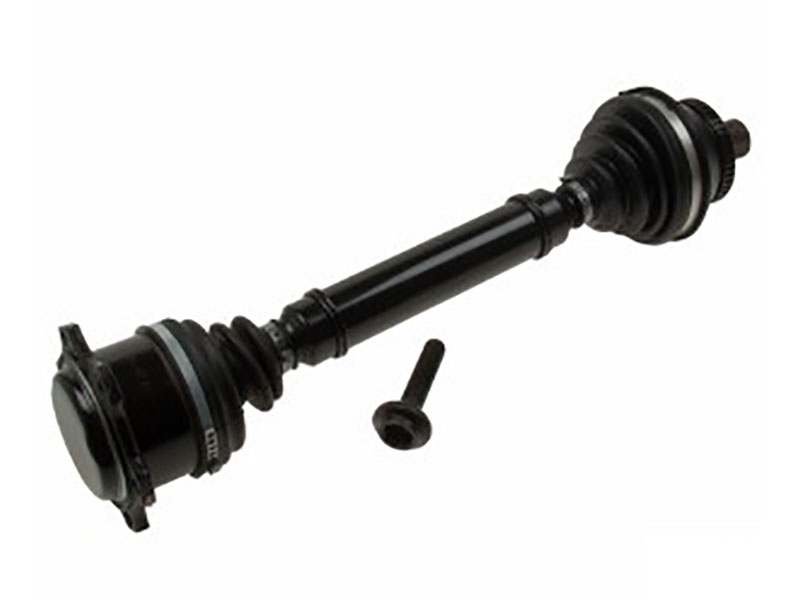
A CV axle is a rotating shaft that delivers power from the transmission or differential to the drive wheels. It is a complete assembly designed to handle torque while accommodating vertical suspension travel and steering angles. The term “constant velocity” means the output speed remains equal to the input speed even when the axle operates at an angle, unlike conventional universal joints that produce speed fluctuations.
A standard CV axle assembly consists of three major elements:
- A steel axle shaft (also called a half‑shaft)
- An inner CV joint – connects to the transmission or differential
- An outer CV joint – connects to the wheel hub
CV axles are used on front‑wheel drive vehicles, all‑wheel drive vehicles, and many independent rear suspension systems. Each drive wheel has its own CV axle. For a typical passenger car, two CV axles are present on the front axle, totaling four CV joints on the vehicle.
What Is a CV Joint?
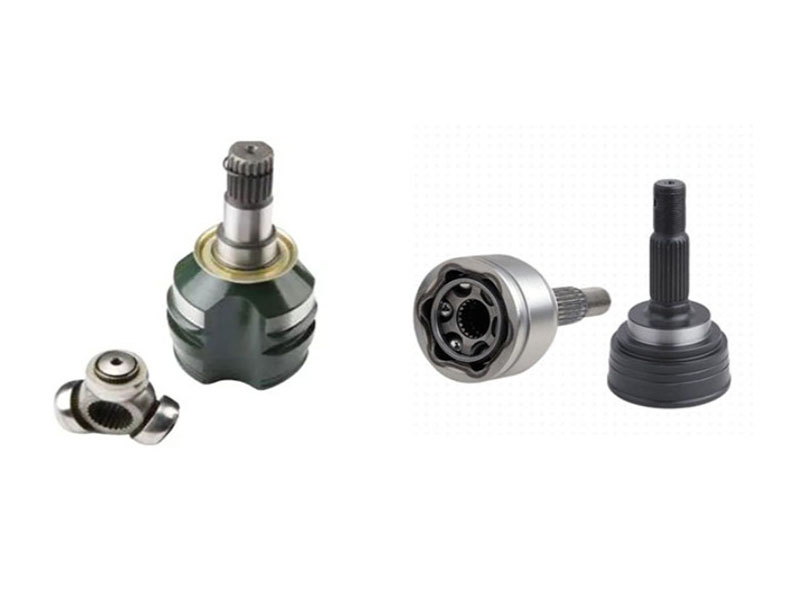
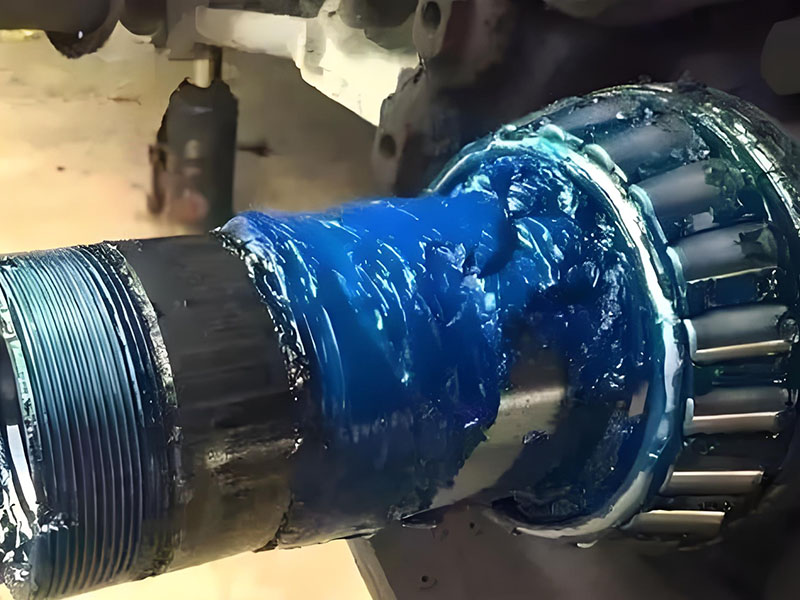
A CV joint is a mechanical coupling that allows a rotating shaft to transmit power through a variable angle while maintaining a constant rotational velocity. Inside each CV joint, a set of steel balls or rollers moves within a cage, all packed with high‑temperature grease for lubrication.
On a standard CV axle, the two CV joints have different functions:
- Outer CV joint – located at the wheel end. It must operate at steering angles up to 45–50 degrees while turning. This joint is subject to higher wear because of frequent angle changes.
- Inner CV joint – located at the transmission end. It allows the axle to extend and retract as the suspension moves up and down. It also handles higher torque loads during acceleration.
A rubber or polyurethane CV boot (dust cover) seals each joint, retaining the grease and preventing dirt, water, and road salt from entering. If the boot remains intact and the grease is clean, a CV joint can often last beyond 150,000 miles (240,000 km) under normal driving conditions.
Key Differences Between a CV Axle and a CV Joint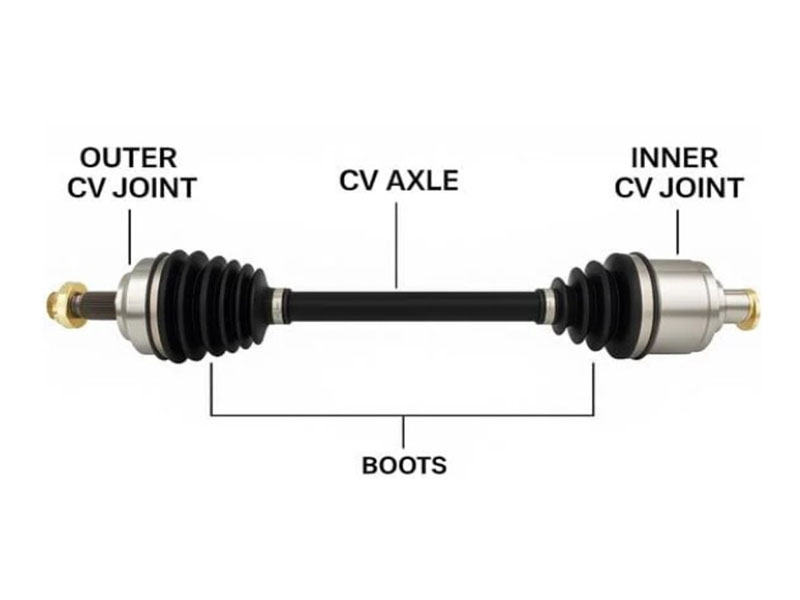
The difference between a CV axle and a CV joint is primarily a matter of scope. A CV axle is the complete assembly; a CV joint is one component within that assembly.
| Aspect | CV Axle | CV Joint |
|---|---|---|
| Definition | Complete half‑shaft assembly | A sub‑component inside the axle |
| Components included | Shaft + inner joint + outer joint + boots | Bearing cage, balls/rollers, grease, boot |
| Quantity per drive wheel | One | Two (inner and outer) |
| Typical replacement | Entire unit is replaced | Only replaced individually in early damage cases |
To illustrate the relationship: a CV axle functions like a complete arm, while the CV joints act as the wrist joints at each end. The axle shaft provides the structural connection, and the joints provide the flexibility needed for steering and suspension motion.
From a repair standpoint, when a CV joint becomes worn – indicated by clicking sounds during turns or vibration under acceleration – most repair facilities replace the entire CV axle rather than the individual joint. The reasons include nearly identical labor time for replacement versus joint disassembly, and the fact that the opposite joint has experienced the same mileage and operating conditions. More detailed explanations are provided in the FAQ section below.
Conclusion
The difference between a CV axle and a CV joint is clear: the CV axle is the complete drive shaft assembly, while the CV joint is a flexible coupling within that assembly. Every CV axle contains two CV joints. In everyday discussion, the terms are often used interchangeably without causing confusion. However, understanding the distinction helps vehicle owners better grasp repair estimates and diagnostic findings.
Common symptoms of CV joint wear include clicking or popping noises during low‑speed turns, vibration during acceleration, and grease splattered around the inner wheel area. If any of these signs appear, a drivetrain inspection is recommended. Early detection of a torn CV boot may allow joint‑only service, while delayed action typically requires a full CV axle replacement.
Frequently Asked Questions (FAQs)
Q: Can I use “CV axle” and “CV joint” interchangeably?
A: Yes, in routine communication with a mechanic, swapping the two terms will not cause misunderstanding. Technically, however, a CV axle is the complete assembly that includes two CV joints. One axle per drive wheel; two joints per axle.
Q: If a CV joint fails, why do shops usually replace the entire CV axle instead of just that joint?
A: Several factors explain this common practice:
- Labor cost: Removing the axle, disassembling it, pressing off the old joint, and installing a new joint takes roughly the same time as bolting on a complete new axle assembly. Once the axle is out, the extra cost of a full assembly is modest compared to labor savings.
- Opposite joint wear: Both inner and outer joints have endured the same mileage, heat cycles, and road conditions. Replacing only one joint risks a second repair within months.
- Complete axle pricing: For most passenger cars, a brand‑new CV axle assembly (including both joints, shaft, and boots) ranges from USD 40 to 150 in the aftermarket. Labor is the dominant cost, so a full replacement is more cost‑effective.
- Serviceability limitations: Many OEM axles use a cold‑pressed or circlip‑retained outer joint that is not designed for disassembly. Factory service manuals often specify whole‑axle replacement.
If a torn CV boot is discovered immediately, the joint has not been contaminated, and the vehicle has low mileage, a boot‑and‑grease replacement may save the joint. For most daily‑driven vehicles, however, a full CV axle replacement is the safer and more economical choice.
Q: Is a clicking sound during turns always a bad CV joint?
A: A rhythmic clicking or popping noise while turning at low speed (e.g., in a parking lot) is the most characteristic symptom of a worn outer CV joint. However, similar sounds can also come from a failing wheel bearing, worn suspension ball joints, or even a tire issue. A professional lift inspection is needed to confirm the source.
Q: How do inner and outer CV joint failure symptoms differ?
A: Outer joint wear produces a clicking or popping noise on slow turns (left or right), because the outer joint operates at high angles during steering. Inner joint wear causes a clunking sound or heavy vibration during acceleration or deceleration, especially in a straight line. The inner joint handles plunge and suspension travel, so wear there creates axial play.
Q: Can I continue driving with a bad CV joint?
A: Short, low‑speed trips (e.g., to a repair shop) may be possible, but extended driving is not advised. Once a joint begins clicking, internal wear accelerates rapidly. If the joint fails completely, the axle may lose power transmission or, in extreme cases, separate from the vehicle, leading to loss of control or immobilization.
Q: Is CV axle configuration the same for FWD, RWD, and AWD vehicles?
A: Front‑wheel drive (FWD) and many independent‑rear‑suspension vehicles use CV axles on both driven wheels. Traditional rear‑wheel drive (RWD) – the main driveshaft typically uses universal joints (U‑joints) rather than CV joints. However, some RWD cars with independent rear suspension do use CV axles for the rear wheels. All‑wheel drive (AWD) / 4WD – the front wheels always use CV axles. The rear wheels use CV axles if the vehicle has independent rear suspension; solid‑axle designs may use U‑joints.
Q: Can I replace a CV axle myself?
A: Yes, it is a DIY‑friendly task for experienced home mechanics, but it is considered medium‑difficulty. The job requires removing the wheel, brake caliper, axle nut, and often disconnecting lower ball joints or control arms to free the axle from the transmission. Essential tools include a breaker bar, axle puller or slide hammer, and a torque wrench. Without proper tools and mechanical knowledge, professional installation is recommended to avoid damaging the transmission seal or new axle.