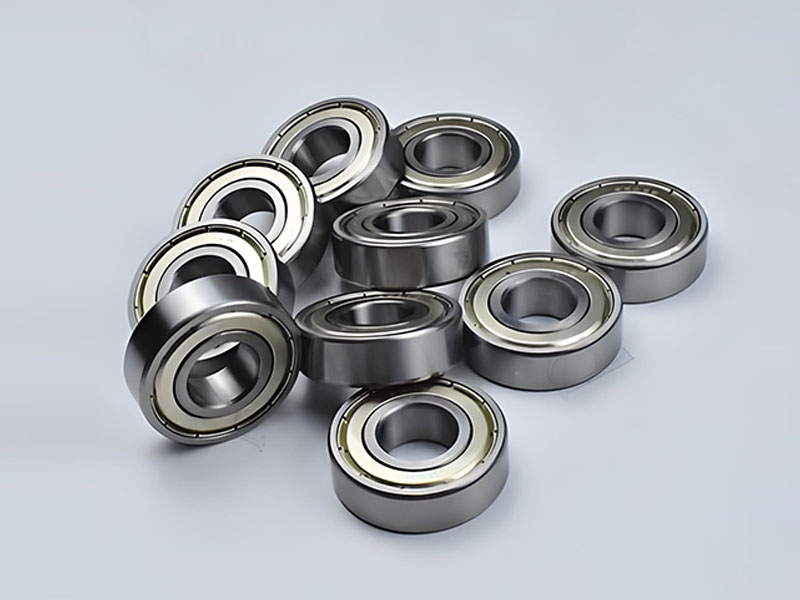
Quick Answer: Kaydon bearings are thin-section ball bearings and slewing ring bearings used where precise rotation must fit a compact or high-load structure. The six common types discussed here are Type A angular-contact, Type C radial-contact, Type X four-point-contact, Ultra-Slim, Reali-Slim TT turntable, and slewing ring bearings. Type A favors thrust, Type C favors radial load, Type X carries combined radial, axial, and moment loads, and the other three address very small sections, small turntables, or larger rotational structures.
Kaydon bearing selection starts with the load path, not the outward similarity of the bearing. A thin-section bearing can look similar across families while behaving very differently under thrust, radial load, moment load, preload, and low-torque rotation. The six types below separate those behaviors and show where each format fits.
What Are Kaydon Bearings?
Kaydon Bearings is a manufacturer of thin-section bearings, turntable bearings, and slewing ring bearings. Founded in 1941 and now a brand within SKF Group, Kaydon offers standard and custom ball bearings, roller bearings, and slewing rings with diameters from 0.75 in to 240 in. The product families most relevant to this comparison are Reali-Slim, Ultra-Slim, Reali-Slim TT, and slewing ring bearings.
Kaydon uses several contact forms and structures: angular contact, radial contact, four-point contact, eight-point contact, cross roller, three-row roller, and wire-race designs. These terms describe how the rolling elements meet the raceways; they are not interchangeable labels for the same bearing.
Manufacturing locations include Muskegon, Michigan; Avon, Ohio; Sumter, South Carolina; Monterrey, Mexico; Suzhou, China; and Cajamar, Brazil. The Muskegon plant holds ISO 9001:2015 and AS9100D certifications and includes ISO Class 5 and ISO Class 7 cleanrooms. Standard Reali-Slim rings and balls can use SAE-AISI 52100 bearing steel or AISI 440C stainless steel. Standard rings and balls are through-hardened and dimensionally stabilized for a nominal temperature range of -65°F to +250°F (-54°C to +121°C).
Quick Comparison: The 6 Popular Kaydon Bearing Types
| Type | Contact or load behavior | Standout advantage | Typical uses |
|---|---|---|---|
| Type A Angular-Contact Reali-Slim | 30° contact angle; about 67% of a full ball complement; a single bearing mainly carries thrust in one direction | Higher axial/thrust capacity than Type C or Type X of the same size | Machine spindles, scanning equipment, robot joints, semiconductor equipment, and aerospace mechanisms that need stiffness or precise positioning |
| Type C Radial-Contact Reali-Slim | Single-row Conrad-type radial ball bearing; limited bidirectional axial load | Lower friction than Type X for low-torque rotation | Precision rotary shafts, encoders, optical instruments, antenna mechanisms, packaging equipment, and robot auxiliary axes |
| Type X Four-Point-Contact Reali-Slim | Gothic arch raceways; radial, bidirectional axial, and moment loads | One bearing can replace two conventional bearings in many designs; internal radial preload is possible | Robot joints, radar and satellite antennas, medical scanning systems, precision turntables, semiconductor equipment, and mechanisms with overturning moments |
| Ultra-Slim | Thin-section series in Type A, Type C, and Type X forms | 2.5 x 2.5 mm standard cross-section for very tight envelopes | Optoelectronic equipment, satellite communication equipment, semiconductor equipment, and medical instruments |
| Reali-Slim TT Turntable | Single-row four-point contact with Gothic arch raceway | 1.5-6.0 in bore and 0.25 in height; geared options available | Robots, radar antennas, factory positioning tables, and inspection turntables |
| Slewing Ring | Broad turntable category with four-point, eight-point, cross roller, three-row roller, and wire-race structures | Large-diameter rotation with geared series; RK 20-47 in and XT to 240 in class | Cranes, aerial work platforms, excavators, wind turbines, mining equipment, conveyors, and filling equipment |
The first three entries are Reali-Slim contact styles: Type A, Type C, and Type X. Ultra-Slim is a thin-section series that uses those same contact forms in a 2.5 x 2.5 mm section. Reali-Slim TT is a small turntable format, and slewing ring bearings are a larger category with several internal structures.
1. Type A Angular-Contact Reali-Slim Bearings
The Kaydon Reali-Slim Type A angular-contact thin-section bearing is built for thrust and combined positioning duties. Its 30° contact angle and ball count of about 67% of a full complement support higher axial/thrust capacity than Type C or Type X bearings of the same size. A single Type A bearing mainly carries thrust in one direction. When the application needs reverse thrust capability or moment resistance, use a paired arrangement. Kaydon part-number codes for paired Type A bearings include B for back-to-back, F for face-to-face, T for tandem, and U for universal duplexing. Typical uses include machine spindles, scanning equipment, robot joints, semiconductor equipment, and aerospace mechanisms that need high axial capacity, precise positioning, or stiffness. Do not treat a single Type A bearing as a bidirectional thrust solution.
2. Type C Radial-Contact Reali-Slim Bearings
Kaydon Reali-Slim Type C radial-contact thin-section bearing is a single-row Conrad-type radial ball bearing designed mainly for radial loads. It can accept a limited amount of bidirectional axial load, but when thrust is the main design condition, an angular-contact bearing group is the safer choice. Compared with a Type X bearing of the same size, Type C generally has lower friction and suits low-torque rotation. Typical uses include precision rotary shafts, encoders, optical instruments, antenna mechanisms, packaging equipment, and robot auxiliary axes. On a long shaft, a Type C bearing can serve at the floating end when the opposite end is located by a Type X bearing, which helps avoid over-constraint. Do not select Type C as the default when axial/thrust load is primary.
3. Type X Four-Point-Contact Reali-Slim Bearings
Kaydon Reali-Slim Type X four-point-contact thin-section bearing uses Gothic arch raceway geometry in both rings. One bearing can carry radial load, bidirectional axial load, and moment load at the same time. In many structures, one Type X bearing can replace two conventional bearings, reducing installation space, weight, and part count. Type X can also be supplied with internal radial preload for higher stiffness or zero free play. Typical uses include robot joints, radar and satellite antennas, medical scanning systems, precision turntables, semiconductor equipment, and mechanisms with overturning moments. Avoid using two Type X bearings on the same shaft because Kaydon notes this may create excessive friction torque.
4. Ultra-Slim Bearings
Kaydon Ultra-Slim thin-section bearings are a very small cross-section series offered in Type A, Type C, and Type X contact forms. The standard cross-section is 2.5 x 2.5 mm. They are selected when the mounting envelope cannot accommodate a larger section and the application still needs precise rotation and weight control. Typical uses include optoelectronic equipment, satellite communication equipment, semiconductor equipment, and medical instruments. A laser communication terminal case used a stainless steel Ultra-Slim bearing sized 60 x 66 x 2.5 mm. The main selection reason is the small section and low weight combined with accurate positioning in limited space.
5. Reali-Slim TT Turntable Bearings
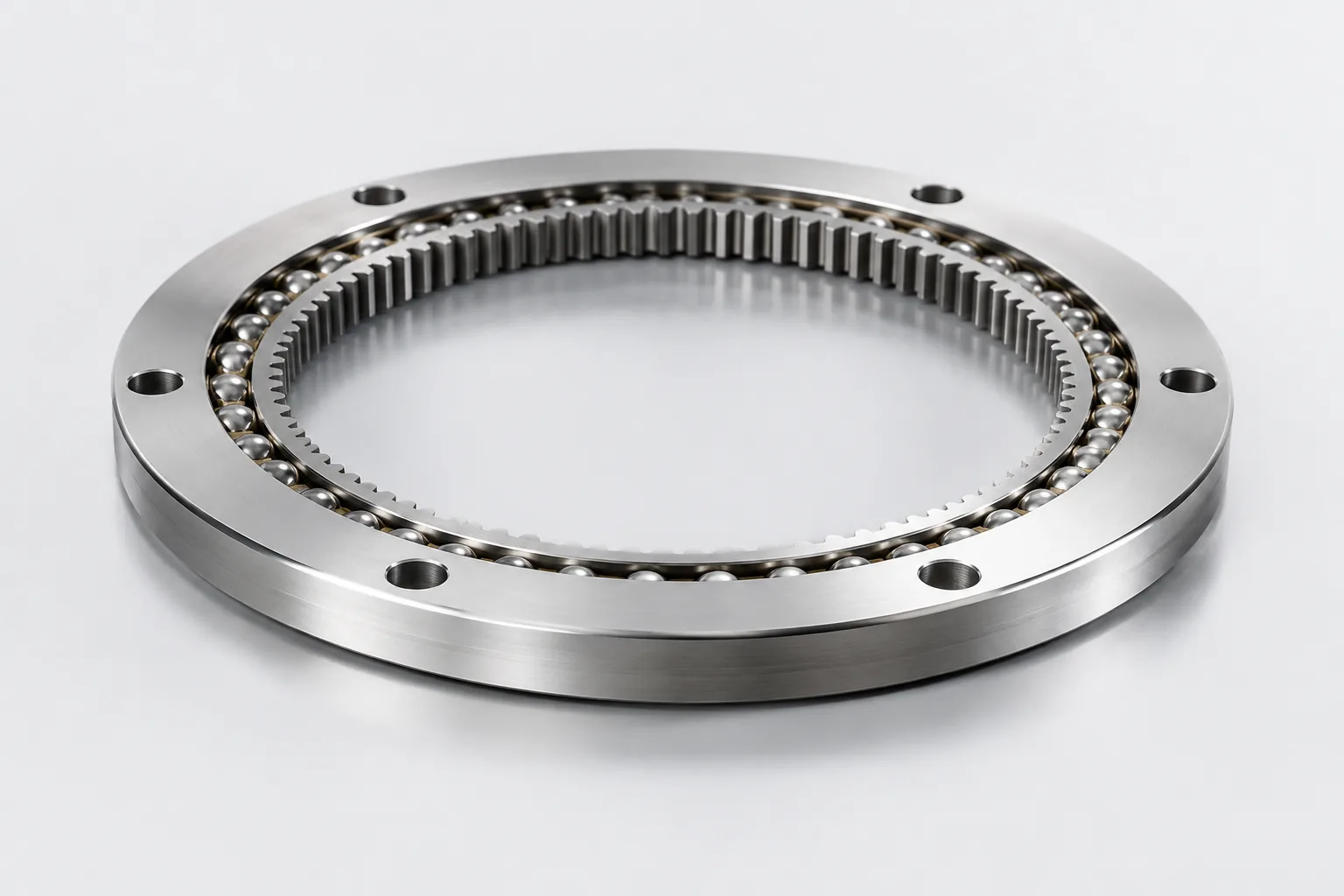
Kaydon Reali-Slim TT is a four-point-contact turntable bearing in a small thin-section format. It uses a single-row ball set, four-point contact, and Gothic arch raceway, so it can carry radial, axial, and moment loads simultaneously. Standard bearings have a bore range of 1.5-6.0 in and a bearing height of only 0.25 in. Gear options include no gear, internal gear, or external gear. The gear specification is 64 diametral pitch, 20° pressure angle, and AGMA Class 10. Bearings are factory lubricated and can be mounted directly with screws. Stainless steel versions can use AISI 440C rings and steel-reinforced seals. The bearings are cleaned and packaged in ISO Class 7 cleanrooms, and versions meeting ISO Class 5 requirements are also available. Typical uses include robots, radar antennas, factory positioning tables, and inspection turntables. Use Reali-Slim TT when a small-diameter turntable must combine rotation, moment support, and optional gearing in a thin envelope.
6. Slewing Ring Bearings
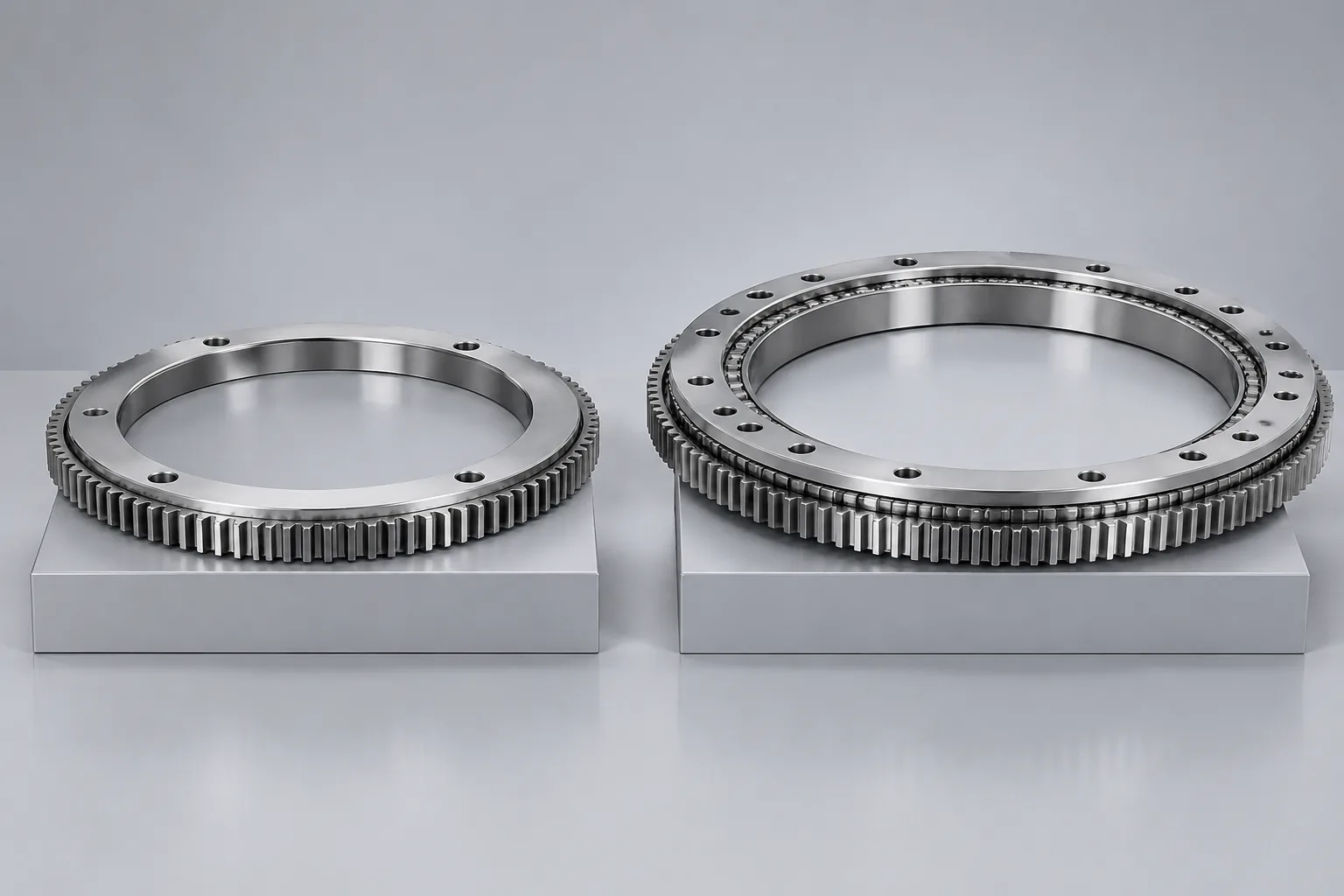
Kaydon slewing ring bearings are a broad turntable bearing category, not a single thin-section contact type. Main structures include four-point contact, eight-point contact, cross roller, three-row roller, and wire-race designs. Standard series families include four-point contact RK, HS, HT, MT, KH, and XT; eight-point contact DT; cross roller XR; and three-row roller TR. Series selection depends on size, load capacity, moment rating, gearing, and the application structure. The RK series covers 20-47 in (500-1,200 mm) outside diameter and is available with no gear, internal gear, or external gear. RK gears use a 20° pressure angle involute stub design, AGMA Class Q5, with a recommended backlash of 0.005-0.015 in. The HS series offers about twice the capacity of RK in a similar mounting envelope, with moment ratings up to about 139,900 ft-lb. The XT series can be manufactured to the 240 in class, with potential capability up to about 10,000,000 ft-lb moment, 6,000,000 lb thrust, and 1,300,000 lb radial load. Typical uses include cranes, aerial work platforms, industrial positioners, excavators, wind turbines, mining equipment, conveyors, and filling equipment. Select the series after defining outside diameter, thrust/radial/moment loads, gear requirement, and mounting interface.
How to Choose the Right Kaydon Bearing Type
- Load direction: Type A provides higher axial/thrust capacity than Type C or Type X of the same size. Type C is the radial-first choice and has lower friction than Type X for low-torque rotation. Type X carries combined radial, bidirectional axial, and moment loading.
- Envelope: Ultra-Slim uses a 2.5 x 2.5 mm standard section. Reali-Slim TT provides a 1.5-6.0 in bore and 0.25 in height. Slewing rings begin at RK 20-47 in and extend to the XT 240 in class.
- Stiffness and preload: Type X can be supplied with internal radial preload for higher stiffness or zero free play.
- Friction and torque: Type C is the lower-friction choice when low-torque rotation matters.
- Mounting and gearing: Reali-Slim TT and slewing rings offer geared options, while thin-section Reali-Slim types focus on precision rotation.
- Environment and cleanliness: Reali-Slim TT offers cleanroom cleaning and packaging. Review the standard material and temperature range against the application before selection.
Use the comparison table and this checklist together. A bearing that is strong in the dominant load direction can still be the wrong choice if it does not fit the envelope, cannot be preloaded as needed, adds too much friction, lacks the required gearing, or does not suit the operating environment.
Conclusion
The six popular types of Kaydon bearings solve different rotation problems. Type A is the one-direction thrust specialist, Type C is the radial and low-torque choice, Type X handles combined radial, axial, and moment loads, Ultra-Slim saves space, Reali-Slim TT packages a small turntable, and slewing rings support larger structures with heavier load cases. Confirm the dominant load, envelope, preload, friction, gearing, cleanliness, and material and temperature limits before ordering. A bearing that matches the load chart but ignores mounting or environment can still fail in service.
FAQs
Q1: What are the six popular types of Kaydon bearings?
A: The six popular types are Type A angular-contact Reali-Slim, Type C radial-contact Reali-Slim, Type X four-point-contact Reali-Slim, Ultra-Slim, Reali-Slim TT turntable, and slewing ring bearings.
Q2: What is the difference between Kaydon Type A, Type C, and Type X bearings?
A: Type A is an angular-contact bearing with a 30° contact angle and higher axial/thrust capacity than Type C or Type X of the same size. Type C is a single-row Conrad-type radial bearing with lower friction than Type X. Type X uses Gothic arch raceways to carry radial, bidirectional axial, and moment loads.
Q3: Which Kaydon bearing type handles combined radial, axial, and moment loads?
A: Type X four-point-contact Reali-Slim bearings handle combined radial, bidirectional axial, and moment loads because their Gothic arch raceways support four contact points. A single Type X can often replace two conventional bearings, and it can be supplied with internal radial preload.
Q4: Are Kaydon Ultra-Slim bearings available in Type A, C, and X contact forms?
A: Yes. Ultra-Slim bearings are offered in Type A, Type C, and Type X contact forms, with a standard 2.5 x 2.5 mm cross-section. They are used where the mounting envelope is very small but precise rotation is still required.
Q5: What are Reali-Slim TT bearings used for?
A: Reali-Slim TT bearings are used in robots, radar antennas, factory positioning tables, and inspection turntables. Their single-row four-point contact design carries radial, axial, and moment loads in a bearing with a 1.5-6.0 in bore and 0.25 in height.
Q6: How do I choose between Reali-Slim TT and slewing ring bearings?
A: Choose Reali-Slim TT when the turntable is small and the envelope is thin, especially when an internal or external gear is useful. Choose a slewing ring when the structure is larger and the design needs higher load or moment capacity across series such as RK, HS, or XT.
Q7: What materials and temperature range are standard for Kaydon Reali-Slim bearings?
A: Standard Reali-Slim rings and balls can use SAE-AISI 52100 bearing steel or AISI 440C stainless steel. They are through-hardened and dimensionally stabilized for a nominal range of -65°F to +250°F (-54°C to +121°C).
Q8: Are Kaydon bearings made by SKF?
A: Kaydon Bearings is now a brand within SKF Group, and its manufacturing locations include Muskegon, Avon, Sumter, Monterrey, Suzhou, and Cajamar. For a specific bearing, confirm the production site from the product label or manufacturer record.