Quick Answer
What is the difference between 1310 and 1350 U-joints? The 1310 is a lighter-duty universal joint with 1.063″ bearing caps and a 3.219″ overall width, rated at 1,600 lb-ft minimum elastic limit. It is commonly found in Jeeps and half-ton trucks. The 1350 is a heavier-duty joint with 1.188″ bearing caps and a 3.622″ width, rated at 2,200 lb-ft minimum elastic limit—about 37.5% stronger. The 1350 is typically used in 3/4-ton and 1-ton trucks. It costs more, requires yoke upgrades, and offers less angular flexibility than the 1310. Your choice depends on tire size, horsepower, vehicle weight, and how you use the vehicle.
If you have ever shopped for a replacement U-joint or considered upgrading your driveshaft, you have probably come across the numbers 1310 and 1350. But what do they actually mean? And more importantly, which one do you need?
The short answer: 1310 is lighter-duty; 1350 is heavier-duty. But the real question is not which is “better”—it is which is right for your vehicle and how you use it. A 1350 will not make your daily driver better if you never push a 1310 to its limits. On the other hand, running a 1310 on a heavily modified off-roader with 37-inch tires is asking for trouble.
This guide breaks down the key differences between these two U-joint series and gives you a practical framework for choosing the right one.
What Is a U-Joint?
A universal joint (U-joint) is the flexible connector in your driveshaft that allows power to transfer from the transmission to the axles while accommodating changes in angle as your suspension moves. Think of it as the “joint” in your driveline that bends while spinning.
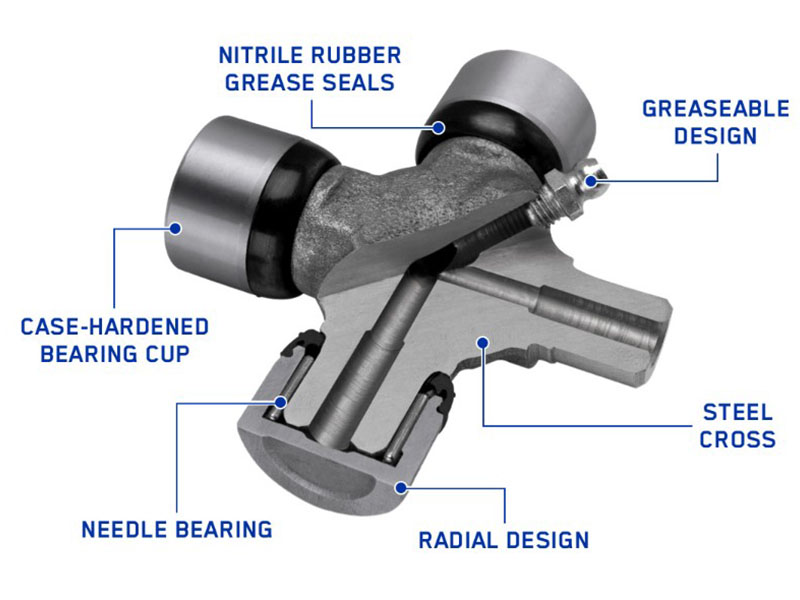
A typical U-joint consists of a cross-shaped center piece (the trunnion) with four bearing cups pressed onto each end, needle bearings inside the cups, and grease seals to keep contaminants out. The series number—1310, 1350, etc.—refers to the physical size of the joint, which directly determines its strength capacity.
When you upgrade from a 1310 to a 1350, you are not just swapping the joint itself. The yoke and other driveshaft components typically need to be upgraded as well because the larger joint will not fit into a 1310 yoke.
1310 vs 1350: Size, Strength, and Angle Compared
Physical Dimensions
This is where the numbers actually matter. The 1310 and 1350 series have different physical dimensions, and they are not directly interchangeable without changing the yoke.
| Specification | 1310 Series | 1350 Series |
|---|---|---|
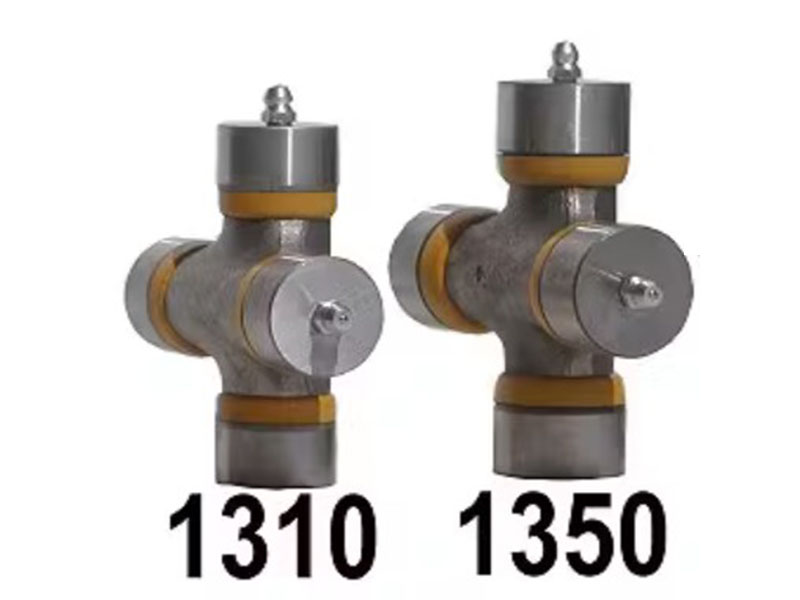
| Overall width (cap to cap) | 3.219″ (approx. 3 1/4″) | 3.622″ (approx. 3 5/8″) |
| Bearing cap diameter | 1.063″ (1 1/16″) | 1.188″ (1 3/16″) |
| Width in millimeters | 81.73 mm | 91.99 mm |
| Cap diameter in millimeters | 27.00 mm | 30.17 mm |
The 1350 uses the wider body of the 1330 joint but pairs it with larger trunnions and bearing cups. That wider body and larger cap diameter are the main reasons it can handle significantly more torque.
Torque and Strength Ratings
This is where the difference really shows up. The 1310 series is rated at 1,600 lb-ft minimum elastic limit, while the 1350 series is rated at 2,200 lb-ft.
The 1350 is approximately 37.5% stronger than the 1310. Some sources cite a 30% to 41% range depending on how strength is measured.
For continuous torque (sustained driving), the 1310 is rated at 400 lb-ft and the 1350 at 1,240 lb-ft. For short-term peak torque (like a dragstrip launch), the 1310 handles 800 lb-ft while the 1350 handles 1,680 lb-ft.
Working Angle
The 1310 series typically offers more angular flexibility than the 1350 series. A standard 1310 U-joint is rated for approximately 30 degrees operating angle, while a 1350 is rated for about 20 degrees.
This difference comes down to physical size. The 1350’s larger body and bearing cups take up more space, which limits how far the joint can bend before the cups contact the yoke ears. The smaller 1310 has more clearance, allowing it to operate at steeper angles without binding.
In short-wheelbase vehicles where driveshaft angles are naturally steeper, the 1310 is often the better choice. When angles get extreme, the 1310’s flexibility advantage can be the deciding factor—even if it means sacrificing some strength.
Advantages and Disadvantages of 1310 and 1350
1350 Series: Advantages
- Significantly stronger: About 37.5% more torque capacity than 1310
- Better for heavy loads: Handles the extra stress from large tires, high horsepower, and heavy vehicles
- More durable in extreme conditions: Better suited for rock crawling, mudding, and other high-stress off-road use
- Reduced failure risk: Less likely to break when you are pushing your vehicle hard
1350 Series: Disadvantages
- Higher cost: 1350 components typically cost more than 1310 parts
- Less parts availability: 1310 joints are stocked at virtually every auto parts store; 1350 joints are less common
- Less angular flexibility: The larger body limits operating angles—about 20 degrees vs. 30 degrees for the 1310
- Requires yoke upgrade: You cannot just drop a 1350 into a 1310 yoke—the bearing cups are different sizes (1.188″ vs. 1.063″)
1310 Series: The “Weak Link” Strategy
Here is something most people do not consider: a 1310 can actually protect your more expensive drivetrain components.
The 1310 is often the weakest link in the drivetrain. When something has to give under extreme load, the U-joint breaks first—and replacing a U-joint is a lot cheaper than repairing a damaged axle, differential, or transfer case.
This is not a bug; for many drivers, it is a feature. If you are running a 1310 and you break a joint on the trail, you swap in a spare and keep going. If you upgrade to a 1350 and something else breaks instead, you are looking at a much more expensive and time-consuming repair. That said, replacing a U-joint on the trail can be a messy job, and some experienced off-roaders prefer to avoid the hassle altogether by going with a stronger joint from the start.
How to Choose: 1310 or 1350?
When to Stick with 1310
A 1310 is likely sufficient if:
- Daily driving or light off-roading is your primary use
- Tires are 33 inches or smaller—35s and up are where you start needing more strength
- Horsepower is under 400—stock or mildly modified engines do not stress a 1310
- You have a short-wheelbase vehicle where angular flexibility is critical
- Budget is a concern and you want cheap, widely available replacements
- You want the “weak link” protection—preferring to break a cheaper U-joint rather than an expensive axle
When to Upgrade to 1350
Consider upgrading to a 1350 if:
- Tires are 35 inches or larger—this is the most common threshold for upgrading
- Horsepower exceeds 400—modified engines put significantly more stress on the drivetrain
- Vehicle weight has increased significantly—overland builds can add 1,000+ pounds of gear and armor
- You do hardcore off-roading—rock crawling, mudding, or desert running where failures are common
- You have upgraded other drivetrain components—if your axles and transfer case are stronger, your U-joint should match
- You tow heavy loads—extra weight means extra stress on every drivetrain component
- You are planning future upgrades—building for bigger tires or more power down the road
The Rear vs. Front Axle Consideration
Your rear driveshaft does most of the work. It handles acceleration, towing, and the majority of the torque load. The front driveshaft only engages in 4WD and typically sees much less stress.
This means you do not necessarily need the same U-joint front and rear. A common and sensible approach:
- Rear axle: Go with 1350 for maximum strength where it matters most
- Front axle: Stick with 1310—it is cheaper, more flexible, and sees less stress
Other Factors to Weigh
Gear ratio matters. Lower numerical ratios (like 3.29, 3.56, 4.10) mean the driveshaft turns slower but under more load. Higher ratios (4.88, 5.13) spin the driveshaft faster but with less torque per revolution. If you are running low gears with big tires, you are putting more strain on your U-joints.
Driveshaft angle matters too. Short wheelbase means steeper angles. When angles get extreme, the 1310’s flexibility can be a deciding factor.
Match the whole system. Your U-joint should be appropriate for your entire drivetrain. If your axles and transfer case are built for heavy duty, do not cheap out on the U-joint—it becomes the weak point.
Conclusion
Here is the bottom line:
The 1310 is a lighter-duty U-joint found in most Jeeps and half-ton trucks. It is cheaper, more widely available, and offers better angular flexibility—plus it serves as a sacrificial “weak link” that can protect expensive drivetrain components.
The 1350 is a heavier-duty U-joint found in 3/4-ton and 1-ton trucks. It is about 37.5% stronger but costs more, requires yoke upgrades, and offers less angular flexibility.
How to choose: If you are running 35-inch tires or larger, have over 400 horsepower, carry heavy loads, or do serious off-roading, the 1350 is worth the upgrade. If you are daily driving with stock or near-stock specs, the 1310 is perfectly adequate and may even be the smarter choice.
Do not forget the front/rear split. Your rear axle does the heavy lifting—consider a 1350 there while keeping a 1310 up front. And if you are unsure, remember that upgrading to a 1350 requires changing your yoke too. Factor that into your budget and planning.
FAQs
Q1: How do I tell the difference between a 1310 and 1350 just by looking?
Look at the bearing cup diameter. A 1310 has 1.063″ (1 1/16″) cups; a 1350 has 1.188″ (1 3/16″) cups—noticeably larger and more robust.
Q2: Can I put a 1350 U-joint in a 1310 yoke?
No. The bearing cups are different diameters—1.188″ vs. 1.063″. You need to upgrade the yoke to accept the larger joint.
Q3: What is a conversion U-joint?
A conversion (or “marriage”) U-joint has one side in 1310 spec and the other in 1350 spec. It allows you to connect a 1310 driveshaft to a 1350 yoke (or vice versa) without replacing everything.
Q4: How much stronger is a 1350 than a 1310?
About 37.5% stronger based on minimum elastic limit torque ratings (2,200 vs. 1,600 lb-ft). Some sources cite 30% to 41% depending on measurement method.
Q5: What is the difference between 1330 and 1350?
The 1330 uses the same bearing cups as the 1310 (1.063″) but has the wider body of the 1350 (3.622″). The 1350 upgrades both the body width AND the bearing cup diameter. A 1330 is a moderate upgrade; a 1350 is a substantial one.
Q6: Is a 1310 “bad” or “weak”?
Not at all. It is perfectly adequate for most vehicles and applications. The 1310 is rated for 1,600 lb-ft minimum elastic limit—well above what most stock vehicles produce. Only heavily modified or hard-used vehicles need the extra strength of a 1350.
Q7: Should I upgrade both front and rear to 1350?
Not necessarily. Most experts recommend upgrading the rear first (it does most of the work) while keeping the front at 1310. The front driveshaft only engages in 4WD and sees much less stress.
Q8: What is more important—U-joint strength or angle flexibility?
It depends on your vehicle. Short-wheelbase rigs with extreme suspension travel need angular flexibility—the 1310 is often the better choice there. Long-wheelbase vehicles or those with milder angles can prioritize the 1350’s strength.