Quick Answer: Axle nut torque specs differ because the nut does more than hold a fastener. Bearing design, nut type, drivetrain, axle position, model year, production date, service updates, friction conditions, and the tightening procedure all change the correct value. A unitized hub may need a final clamp load, while an adjustable bearing may need a torque-and-back-off sequence. Use the latest vehicle-specific OE information for the exact axle and nut.
Two repair sources can list different axle nut torque specs for the same model, and both may be correct for their own scope. The practical task is to separate real engineering differences from unit conversion, rounding, and a value that belongs to a different fastener. The sections below cover what the axle nut controls, how bearing and nut design change the procedure, and how to verify the right specification before tightening.
What an Axle Nut Torque Spec Actually Controls
The center axle nut does more than keep a hub from falling off. It clamps the hub or bearing assembly, helps establish bearing preload, and retains the bearing so it does not separate in service. On many drive-axle hubs, the specified torque is an engineering setting, not a generic fastener value. Incorrect torque is a major cause of poor hub fit and premature failure.
Three fasteners are easy to confuse. The axle nut is not the hub-mounting bolt, and it is not the lug nut. A wheel-nut value or a knuckle-bolt value applied to the center axle nut is a common identification error. Axle-nut torque, hub-mounting torque, and lug-nut torque are separate specifications.
The word torque also changes meaning with bearing design. On a unitized hub, the number usually represents a final clamp load or preload. On an adjustable tapered roller bearing, the same kind of number may be only one step in an adjustment sequence. Read the surrounding procedure with the value, not the value alone.
Bearing Design and Nut Type Change the Meaning of Torque
First identify whether the hub uses a unitized bearing or an adjustable wheel bearing. The torque procedure has a different purpose in each design, and the nut retention method adds another variable.
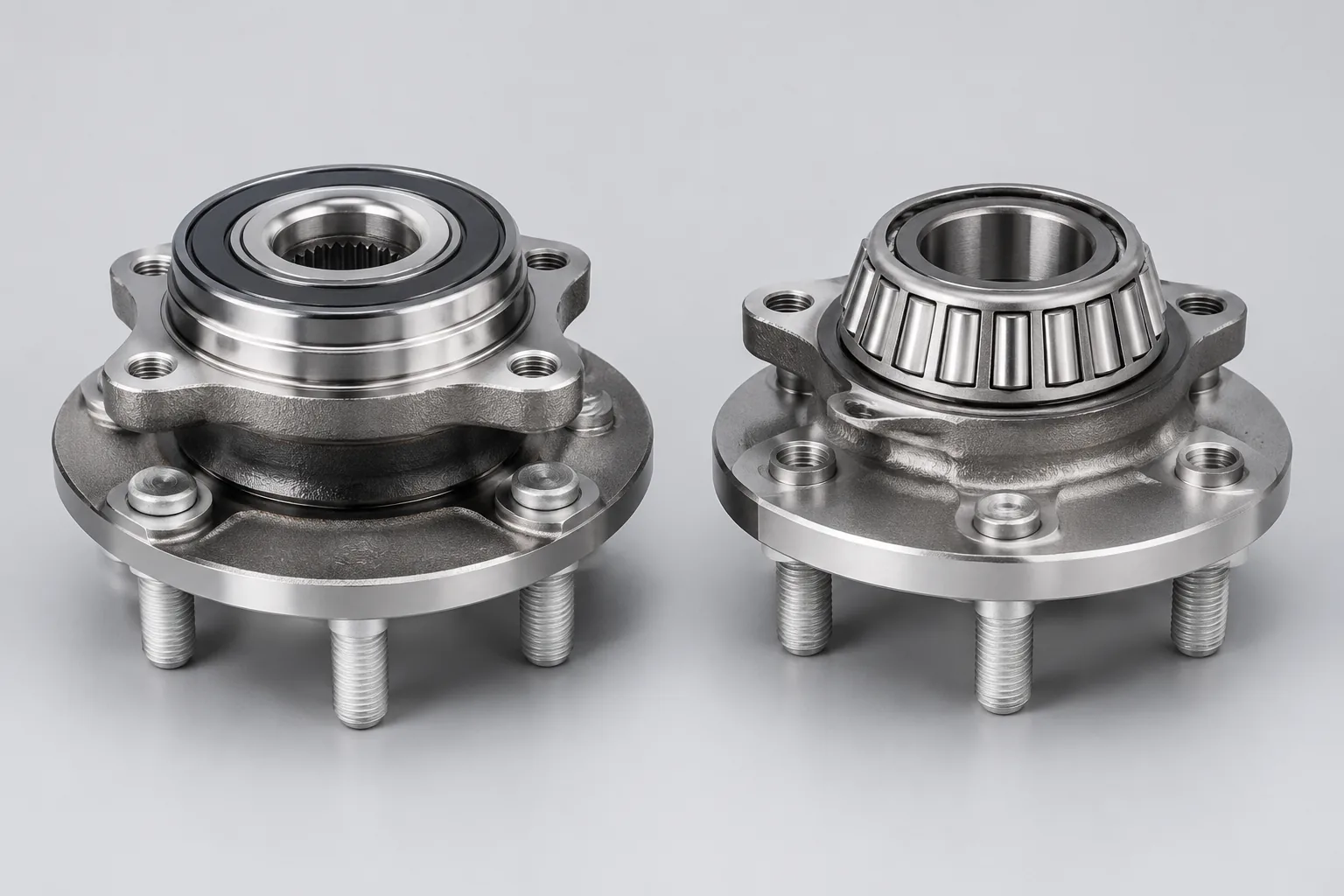
Unitized Hubs vs Adjustable Wheel Bearings
On most unitized hubs, the center nut provides a specified clamp force or preload. The bearing is sealed and pre-set, so the nut does not adjust bearing clearance in the traditional sense. The target is the clamp load that keeps the bearing races and hub faces in firm contact.
On an adjustable wheel bearing, initial torque is only one step. The procedure usually includes loosening, re-torque, and an end-play check. The same torque number can mean final clamp load on one design and an intermediate adjustment step on another.
Locknut and Retention Designs
Retention design is part of the specification. Spindle and axle nut systems include:
- standard nuts
- stamped nuts
- castle nuts
- double-nut systems
A locking assembly may consist of a locking washer, a locking snap ring, and a nut. Each design has its own tightening and securing sequence.
A castle nut may need to align with a pin hole, but only through the specified procedure. Do not raise or lower torque to make the pin fit. A locking washer or snap ring can also change the order of tightening and final locking. Choose the torque by the actual nut and bearing design, not by socket size, thread diameter, or the appearance of the old nut.
Vehicle Configuration, Axle Position, and Model Year Change the Value
Drive type and axle position are not interchangeable. Front and rear values can differ, and 2WD, AWD, FWD, and RWD layouts may use different specifications. Model year can change the value even within the same model name, so a number copied without year context is unreliable.
Drive Type and Front or Rear Position
The 2003-2006 Mitsubishi Outlander 2WD shows a clear split: 245 N·m (181 ft-lb) front and 176 N·m (130 ft-lb) rear. The same-year AWD version lists 245 N·m (181 ft-lb) at both front and rear.
That does not make AWD and 2WD equal in general. It shows only that this model range used matching values in one layout and different values in another. Confirm the driven axle and the vehicle drivetrain before using a number.
Model Year, Production Date, and Vehicle Configuration
Model year ranges can hide meaningful changes. The Mitsubishi Outlander AWD lists 175 N·m (129 ft-lb) for 2007-2013, 270 N·m (199 ft-lb) for 2014-2016, and 250 N·m (184 ft-lb) for 2017. A single model name is not enough to identify the correct value.
Production date can matter separately from model year. The 2017-2024 Chrysler Pacifica and Voyager front halfshaft hub nut is 310 N·m (228 ft-lb) only on vehicles built on or after 2017-06-24; earlier builds are excluded because the halfshaft shaft strength is lower and the higher value may damage the halfshaft. The bulletin behind that split is covered below.
Configuration can also produce more than one listed value. The 2015-2017 Mercedes-Benz S600 rear axle nut lists both 350 N·m (258 ft-lb) and 390 N·m (288 ft-lb) with different footnotes. The footnotes point to a different configuration, part, or installation procedure, so the model and year alone do not settle the specification.
Adjustment Procedures and Torque-Plus-Angle Specs
Some axle nuts are not tightened to one final torque and left there. The specification may include an initial torque, a loosening step, a re-torque, an angle, and an end-play check. A torque figure from an adjustment procedure must not be mistaken for the final running setting.
The 1997 GMC C2500 2WD procedure is a clear example. The adjusting nut is first tightened to 68 N·m (50 ft-lb), then re-torqued to 41-54 N·m (30-40 ft-lb), then backed off 135-150 degrees. Final bearing end play must be 0.025-0.25 mm (0.001-0.010 in), and the outer locknut is 88 N·m (65 ft-lb). The 50 ft-lb step is not the final axle nut torque.
The 2006 Ford F-250 2WD full-floating axle uses a different sequence: 95 N·m (70 lb-ft), back off 90 degrees, then 20 N·m (15 lb-ft), with zero end play confirmed by a dial indicator. The 2000 Saturn LS2 front axle-to-hub nut is another torque-plus-angle example: 115 N·m (85 ft-lb) to seat the bearing, back off, 20 N·m (15 ft-lb), then add 90 degrees. Castle-nut alignment is allowed only as the procedure permits.
Rotating the hub during adjustment, using a dial indicator, and checking end play can matter as much as the torque number. The full sequence, rotation, angle, and end-play requirement apply together.
Fastener Condition, Lubrication, and Installation State Affect Clamp Load
Thread condition, lubrication, nut-seat coating, and thread damage change the clamp load produced by the same torque reading. A service manual requirement for dry assembly, specified lubrication, or a new nut is part of the specification. Adding lubricant and reusing the old torque can produce the wrong clamp load.
Prevailing-torque axle nuts are often one-time-use fasteners and should not be reused. A new halfshaft, hub, or replacement nut may differ from the original part, so check the OE procedure and the new nut part number and design before reusing an old torque figure.
An impact wrench should not be used for final tightening. It can over-tighten the nut and may damage threads or the outer CV joint, and it can contribute to premature wheel bearing wear. Use a calibrated torque wrench and the OE specification. Unless the OE procedure says otherwise, tighten the axle nut with the vehicle lifted and the hub unloaded, then lower the vehicle and torque the lug nuts.
Service Bulletins and Superseded Specifications
A service bulletin can formally replace an older torque value. A current bulletin may therefore disagree with a printed manual or an older database without either being a typing error. Apply a bulletin only to the vehicles, axles, and production dates it covers.
TSB 03-008-24, dated 2024-08-28, updates the 2017-2024 Chrysler Pacifica and Voyager front halfshaft hub nut to 310 N·m (228 ft-lb) for vehicles built on or after 2017-06-24. Earlier halfshafts have insufficient shaft strength, and the bulletin warns that the higher value may damage the halfshaft. The update also addresses a nut-loosening problem, so it is an engineering change, not a catalog correction.
SB-07-002, dated 2007-02-10, reduces the outer wheel-bearing nut torque on MFS-06 and MFS-08 front non-drive steer axles from 271-401 N·m (200-300 lb-ft) to 203-305 N·m (150-225 lb-ft). WRL-21R, revised 2024-03-28, specifies 220 N·m (162.3 ft-lb) for axle nut 902170049 and requires the axle nut, wheel-bearing flange bolts, strut self-locking nuts, and tie-rod-end nuts to be replaced.
Do not apply a higher updated value to earlier vehicles excluded by the bulletin. The older specification remains correct for those vehicles.
Why Online Axle Nut Torque Numbers Often Conflict
Some apparent conflicts are only unit conversion or rounding differences. 220 N·m is about 162 ft-lb; 250 N·m is about 184 ft-lb; 270 N·m is about 199 ft-lb; and 310 N·m is about 228 ft-lb. A table that rounds to the nearest ft-lb can show roughly 1 ft-lb of difference without a different engineering value.
Other conflicts are real. They come from model year, drivetrain, front or rear position, production date, configuration, nut design, or a different tightening procedure. A value may also belong to a different fastener, such as a hub-mounting bolt or a lug nut, rather than the center axle nut. A general thread-size torque chart is not a substitute for the vehicle or component specification.
Before treating two numbers as a conflict, compare the vehicle, axle, year, production date, nut design, and procedure. A real supersession or bulletin update is a genuine change, not a conversion error.
How to Find and Apply the Correct Axle Nut Torque Spec
Use this sequence when you need a reliable axle nut torque spec:
- Latest OE workshop or VIN-specific service information for the exact vehicle, including any required procedure.
- OE technical service bulletins or recall notices that may supersede an older value.
- Installation instructions supplied with a new halfshaft, bearing, hub, or nut, including the new nut part number and design.
- Bearing or component manufacturer application data as a cross-check, not as a replacement for the OE procedure.
Before tightening, identify the exact fastener, axle, bearing design, and whether the nut is one-time-use. Use a calibrated torque wrench and follow the sequence, angle, rotation, end-play check, and loaded or unloaded condition required by the procedure. Forums, generic torque tables, and thread-size charts are not reliable for a final axle nut specification.
If sources conflict, match each number to its vehicle scope and prefer the latest applicable OE information. A generic value should not be used when the OE procedure requires a sequence, angle, or end-play setting.
Conclusion
There is no universal axle nut torque spec because bearing design, nut type, drivetrain, axle position, model year, production date, service updates, friction conditions, and the tightening procedure all change the correct value. A number copied without that context is unreliable even when it looks precise.
Use the latest vehicle-specific OE information, confirm the exact axle and nut design, and follow the full tightening procedure rather than copying a number from a general table. Wrong torque can affect bearing preload, hub retention, and service life, so verify the specification before tightening.
FAQs
Q1: Can I use a standard torque chart based on axle nut thread size?
A: No. Thread size alone does not define the bearing preload, nut design, friction condition, or installation procedure. Use the vehicle or component specification, not a generic thread-size chart.
Q2: Why do two repair sources list different torque for the same model?
A: The numbers may apply to different model years, drivetrains, front or rear axles, production dates, configurations, nut designs, or procedures. One source may also be older than a service bulletin that superseded the value. Match the source scope before treating the numbers as a conflict.
Q3: Do I need to replace the axle nut every time?
A: Not every nut is one-time-use, but many prevailing-torque axle nuts are. Check the OE procedure and the replacement part instructions; do not reuse a nut that the specification says to replace.
Q4: Should the axle nut be tightened with the vehicle on the ground?
A: Follow the OE procedure. If it does not state otherwise, published hub-assembly guidance says to tighten the axle nut with the vehicle lifted and the hub unloaded, then lower the vehicle and torque the lug nuts.
Q5: What does torque-plus-angle mean for an axle nut?
A: It means the specification uses a torque value followed by a specified rotation, such as an additional 90 degrees. The angle is part of the clamp-load setting and must not be replaced with a higher torque reading.
Q6: How do I convert an axle nut torque from N·m to ft-lb?
A: Use a reliable conversion and keep the original unit visible when checking a source. Common examples are 220 N·m about 162 ft-lb, 250 N·m about 184 ft-lb, 270 N·m about 199 ft-lb, and 310 N·m about 228 ft-lb.
Q7: Is an impact wrench acceptable for final axle nut tightening?
A: No. Impact tools can over-tighten the nut and may damage threads or the outer CV joint. Use a calibrated torque wrench for final tightening and follow the required hub-loaded or hub-unloaded condition.