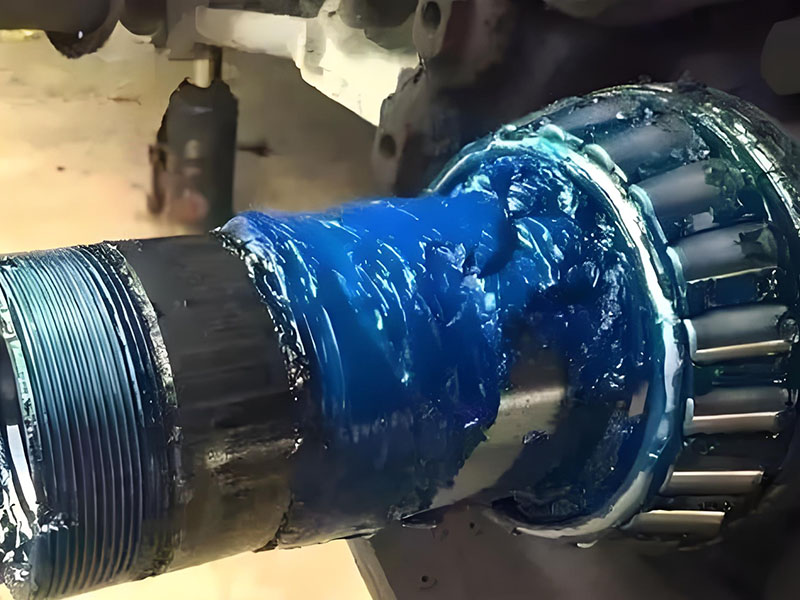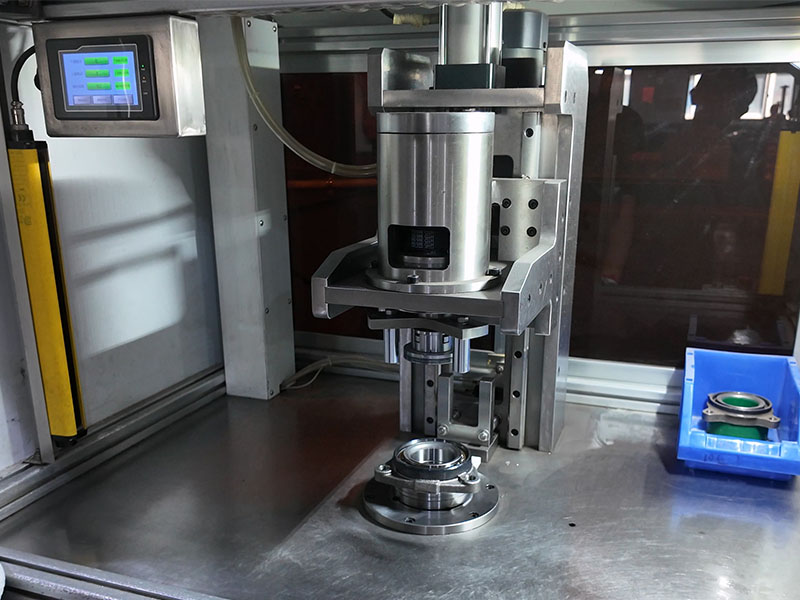
What are the exact dimensions of a 30205J bearing? What radial and axial loads can it support? And where is it used beyond standard automotive applications? This guide provides technical answers for engineers, procurement specialists, and maintenance technicians. Below is a complete breakdown of the 30205J tapered roller bearing, covering specifications, structure, load capacity, installation procedures, and industry applications.
Technical Specifications of Bearing 30205J
The 30205J is a metric single-row tapered roller bearing conforming to ISO 355 dimensional standards. The following table summarizes its key boundary dimensions and load ratings.
| Parameter | Value | Unit |
|---|---|---|
| Bore diameter (d) | 25 | mm |
| Outside diameter (D) | 52 | mm |
| Total width (T) | 16.25 | mm |
| Inner ring width (B) | 15 | mm |
| Outer ring width (C) | 13 | mm |
| Weight (approx.) | 154 | g |
| Basic dynamic load rating (C) | 2830 | kgf |
| Basic static load rating (Co) | 2300 | kgf |
| Grease lubrication speed limit (typical) | 7,100 | min⁻¹ |
| Oil lubrication speed limit (typical) | 10,000 | min⁻¹ |
| Effective load center distance (a) | 12.7 | mm |
The bore diameter of 25 mm accommodates shafts with matching diameter, while the 52 mm outer diameter determines the housing bore requirement. The total width of 16.25 mm includes both the cone and cup, distinguishing it from the inner ring width of 15 mm.
Additional chamfer dimensions: cup chamfer (r) minimum 1 mm, cone chamfer (r) minimum 1 mm. For shaft abutment, the minimum diameter (da min.) is 34 mm; for housing abutment, the maximum diameter (Da max.) is 46 mm. These values are important for proper seating and stress distribution during installation.
Structure and Components
The 30205J tapered roller bearing consists of a cone (inner ring with rollers and cage) and a cup (outer ring). This separable design allows the cone assembly and cup to be mounted independently—a practical advantage in applications where shaft and housing installation must be carried out sequentially.
Four Main Components
Like all tapered roller bearings, the 30205J comprises four basic elements:
- Cone – The inner ring that mounts onto the shaft, including a flange that guides the roller ends
- Cup – The outer ring that fits into the housing bore
- Tapered rollers – Conical rolling elements that ensure line contact with both raceways
- Cage – A retainer that spaces the rollers evenly around the cone circumference
Separability and Interchangeability
The separable construction of the 30205J means that the cone and cup can be handled as two independent units. This facilitates bearing inspection, cleaning, and replacement without requiring complete disassembly of the entire equipment assembly. The “J” suffix in the designation indicates that the bearing meets ISO 355 specifications, ensuring that cone assemblies and cups are interchangeable with those produced by other manufacturers that also comply with the same standard. This interchangeability simplifies sourcing and replacement for maintenance teams.
Load Capacity and Speed Performance
Combined Radial and Axial Load Handling
Tapered roller bearings are specifically designed to accommodate both radial loads (forces perpendicular to the shaft axis) and axial loads (forces parallel to the shaft axis) simultaneously. In the 30205J, the conical geometry of the raceways and rollers ensures that the lines of contact converge at a common point on the bearing axis, which allows the bearing to efficiently transmit combined loads.
The basic dynamic load rating (C) of 2830 kgf defines the constant radial load under which a group of identical bearings would achieve a rated life of one million revolutions. The basic static load rating (Co) of 2300 kgf represents the maximum static load the bearing can withstand without permanent deformation of the rolling elements or raceways.
Axial Load Factors
The 30205J has calculation factors that help engineers determine equivalent dynamic bearing loads:
- e = 0.38 (constant)
- Y1 = 1.6
- Y0 = 0.88
These factors are used to calculate the equivalent dynamic bearing load when both radial and axial loads are present. For a single bearing arrangement, the axial load component must be balanced by an opposing axial force, which is typically achieved by mounting two bearings in tandem or opposition.
Speed Performance
Typical speed limits for the 30205J are 7,100 min⁻¹ with grease lubrication and 10,000 min⁻¹ with oil-bath or circulating oil lubrication. Actual achievable speeds depend on load magnitude, operating temperature, and cooling conditions. Grease is generally suitable for most general-purpose applications, while oil lubrication is preferred for higher speed operations or where improved heat dissipation is required.
Installation and Clearance Adjustment
Separable Mounting Advantage
Because the cone assembly (inner ring with rollers and cage) can be separated from the cup (outer ring), the 30205J offers flexible mounting options. In practice, the cup is first pressed into the housing bore, and the cone assembly is then mounted onto the shaft. Once the shaft is inserted into the housing, the bearing can be secured by tightening a locknut or other axial retaining device.
Preload and Endplay Settings
One of the defining characteristics of tapered roller bearings is the ability to adjust internal clearance or apply preload during installation. Single-row tapered roller bearings are typically used in pairs because a radial load generates an induced axial force that must be opposed.
For most general-purpose applications (such as wheel hubs and gearboxes), a slight endplay (positive clearance) of 0.02 to 0.11 mm is specified to accommodate thermal expansion and prevent overheating. For applications requiring high stiffness and rotational accuracy (such as machine tool spindles), a preload (negative clearance) is applied. However, excessive preload increases frictional heat and reduces bearing service life.
General Adjustment Procedure
When adjusting tapered roller bearings, the following steps should be followed:
- Rotate the bearing to ensure rollers assume their correct operating position, with the large end face of each roller in contact with the cone flange
- Tighten the locknut to seat the bearing components
- Measure the starting torque or axial movement to determine the current clearance
- Adjust the nut to the specified setting (preload or endplay)
- Lock the nut in position and verify the setting after final torque application
Proper installation tools and clean handling conditions are essential to avoid contamination and bearing damage.
Applications of Bearing 30205J
The 30205J tapered roller bearing is found in a broad range of automotive, industrial, and specialized equipment where combined radial and axial loads must be managed within a compact dimensional envelope.
Automotive Applications
In the automotive sector, the 30205J is commonly used in gearboxes and transmission assemblies, where it supports shafts that experience both the radial forces from gear meshing and axial thrust forces. It also appears in wheel hub applications, where it must handle the vehicle’s weight (radial load) as well as the lateral forces generated during cornering and acceleration (axial load). Truck axles and steering systems also utilize this bearing type.
Industrial Machinery Applications
Industrial equipment that benefits from the 30205J includes electric motors, where the bearing supports rotor shafts that operate at moderate speeds with occasional axial loads. Conveyor systems, pumps, and gear drives also utilize this bearing type for its combination of load capacity and separability. Mining equipment and engineering machinery auxiliary drives frequently specify the 30205J.
Specialized Equipment
Beyond the primary applications listed above, the 30205J is also specified for:
- Robotics (joint actuators and drive systems)
- Dental equipment (high-speed handpieces and chair positioning mechanisms)
- Forklifts and material handling equipment
- Construction equipment (small excavators, compact loaders)
- Agricultural implements with rotating shafts
Other Tapered Roller Bearing Specifications
The 30205J belongs to the ISO 355 metric series of single-row tapered roller bearings. Other commonly used specifications within the same dimensional series are listed below for reference.
| Bearing No. | Bore (d) mm | OD (D) mm | Width (B) mm | Dynamic load rating (Cr) kgf |
|---|---|---|---|---|
| 30203 | 17 | 40 | 12 | 2090 |
| 30204 | 20 | 47 | 14 | 2900 |
| 30205 | 25 | 52 | 15 | 2830 |
| 30206 | 30 | 62 | 16 | 4380 |
| 30207 | 35 | 72 | 17 | 5500 |
| 30208 | 40 | 80 | 18 | 6420 |
When selecting a bearing for a specific application, three core factors should be prioritized: load magnitude and direction (determine whether Cr and Co are adequate), operating speed (grease or oil lubrication limit), and environmental conditions (dust, moisture, or temperature extremes).
Conclusion
The 30205J tapered roller bearing offers a balanced combination of compact dimensions (25 mm bore, 52 mm OD) and substantial load capacity (dynamic rating of 2830 kgf, static rating of 2300 kgf). Its separable cone-and-cup construction provides flexibility during installation, while the adjustable clearance characteristic allows optimization for either endplay or preload depending on application requirements. Common applications include automotive gearboxes, electric motors, trucks, mining machinery, robotics, dental equipment, and industrial gear drives. When selecting the 30205J, engineers should verify speed ratings against operating conditions and ensure proper adjustment during mounting to achieve full service life.
Frequently Asked Questions (FAQs)
Q1: What does the “J” suffix in 30205J mean?
A1: The “J” suffix indicates that the bearing meets ISO 355 dimensional specifications for metric tapered roller bearings. Bearings with the “J” suffix have cup width, cup smaller inside diameter, and contact angle determined in accordance with ISO 355, ensuring interchangeability with other manufacturers‘ bearings that carry the same number.
Q2: What is the difference between 30205 and 30205J?
A2: The 30205 and 30205J share identical boundary dimensions—both have a 25 mm bore, 52 mm outside diameter, and 15 mm inner ring width. The difference lies in the contact angle design: the “J” suffix denotes compliance with ISO 355 specifications. In practice, bearings with and without the “J” suffix are often interchangeable, but dimensional verification against manufacturer drawings is recommended.
Q3: Can the 30205J handle axial loads in both directions?
A3: A single 30205J bearing can accommodate axial load in one direction only. When axial loads reverse direction or must be supported in both directions, two 30205J bearings are typically mounted in a back-to-back or face-to-face arrangement. The axial load capacity of a single bearing is determined by the contact angle and is represented by the calculation factors (Y1 and Y0).
Q4: How should the 30205J be lubricated for maximum service life?
A4: For speeds up to 7,100 min⁻¹, grease lubrication using an NLGI grade 2 or 3 lithium-complex grease is generally adequate. For speeds exceeding this limit up to 10,000 min⁻¹, oil-bath or circulating oil lubrication is recommended. The lubricant must provide sufficient film thickness to prevent metal-to-metal contact at the rib–roller end interface.
Q5: What torque or preload should be applied during installation of a 30205J?
A5: The specific preload or endplay setting depends on the application and mating bearing arrangement. For typical wheel hub or gearbox applications with two bearings in opposition, a cold endplay of 0.02 to 0.11 mm is commonly specified to achieve near-zero running clearance after thermal expansion. Always consult the equipment manufacturer‘s service manual for the exact setting.
Q6: Is the 30205J available with seals or shields?
A6: Standard single-row metric tapered roller bearings like the 30205J are typically open bearings without integral seals or shields. When sealing is required, the equipment housing must incorporate contact seals, labyrinth seals, or dust shields. For environments with high contamination risk, manufacturers offer sealed versions on request for some tapered roller bearing series, but availability should be confirmed with the bearing supplier.
Q7: Can the cone and cup of a 30205J be mixed with those from a different manufacturer?
A7: Because the 30205J conforms to ISO 355 specifications, cone assemblies and cups from different ISO 355-compliant manufacturers are generally interchangeable in terms of boundary dimensions. However, internal geometries (such as raceway profiles and surface finishes) may vary between manufacturers, which could affect load distribution and service life. For optimal performance, using matched components from the same manufacturer is recommended.