Quick Answer: There is no official global ranking of top slewing bearing manufacturers, so this overview compares seven representative makers on published size ranges, load data, production locations and quality references. The list includes thyssenkrupp rothe erde, Liebherr-Components, Rollix, IMO, Kaydon, Schaeffler and JTEKT, all of which publish verifiable catalog or certificate information. Compare like for like: standard catalog sizes, factory ranges, segmented capability and measurement service limits are not the same number.
Slewing bearing sourcing usually starts with a shortlist, and a shortlist is only as good as the data behind it. Diameter figures taken from different contexts, a certificate that covers a site rather than a product, or a ranking with no stated method can all send a buyer in the wrong direction.
This overview profiles top slewing bearing manufacturers using public, checkable information only, and explains how to read the numbers each company publishes before you request a quotation.
What Counts as a Slewing Bearing Manufacturer in This Overview
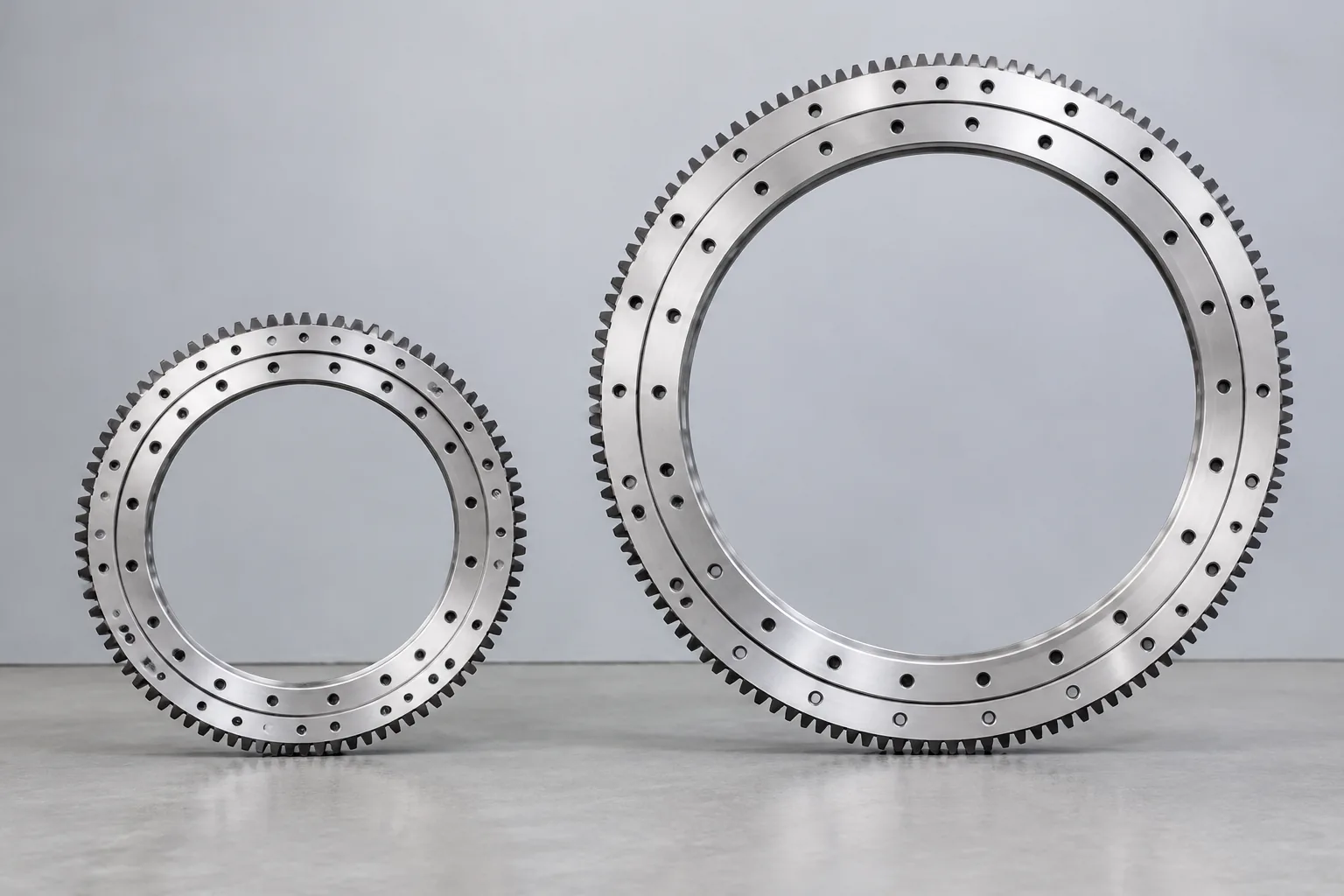
A slewing bearing, also called a slewing ring or turntable bearing, is a large-diameter rolling bearing with one or more ball or roller raceways. It carries axial load, radial load and tilting moment at the same time, which is why it sits at the rotation joint of cranes, excavators, wind turbines and tunnel boring machines.
For this overview a manufacturer has to meet three tests: in-house design and manufacturing capability, published product data such as size ranges or load figures, and documented quality or inspection references that a buyer can actually check. Distributors, trading companies and ranking lists that name no verifiable source are left out of the core comparison.
Product scope also differs. Some companies publish a broad standard catalog; others concentrate on custom, segmented or very large bearings. Those scopes are not interchangeable and are kept separate throughout the profiles below.
Why There Is No Single Official “Top” Ranking
No standards body, regulator or industry association publishes a unified global ranking of slewing bearing manufacturers. Any list of top suppliers is therefore a selection made on stated criteria, not a measured market order.
In this overview, top manufacturers are defined as representative suppliers with verifiable manufacturing and quality information. Profiles are ordered for readability, not by market share or perceived quality.
Company-reported figures stay company statements. Defontaine/Rollix has stated that it holds 21% of the wind-turbine blade-bearing market; that figure comes from the company itself and is not an independent ranking. Size and load limits are reported as published, without turning them into a league table.
Comparison Criteria Used in This Overview
Every profile follows the same five points so the entries can be read side by side.
- Manufacturing model: in-house design, production sites, and custom or segmented capability.
- Published size range: standard catalog sizes, factory manufacturing ranges, segmented-bearing capability and measurement or service capability are listed separately.
- Load and performance data: axial load, radial load, tilting moment, raceway type, gear options and precision series where published.
- Quality references: ISO certificates, EN 10204 inspection documents, and class-society approvals or design and acceptance references.
- Application fit: wind, construction, mining, marine, tunnel boring, machine tools and heavy industrial equipment.
Quick Comparison of Representative Manufacturers
The table summarizes published capability only. It is not a ranking, and current catalogs and certificates should be verified before sourcing.
| Manufacturer | Published size or capability | Quality or inspection references |
|---|---|---|
| thyssenkrupp rothe erde | Spain plant 200-3,300 mm; joint-face measurement service up to 25,000 mm | ISO 9001, ISO 14001, ISO 45001, ISO 50001; DIN EN ISO 1101 |
| Liebherr-Components | Segmented bearings for diameters above 7,500 mm | EN 10204 2.1, 2.2, 3.1, 3.2; DNV, ABS, Bureau Veritas, Lloyd’s Register, API references |
| Rollix / Defontaine Group | 100-6,200 mm | DNV, ABS, Bureau Veritas, Lloyd’s Register, RINA |
| IMO | Raceway diameter 120-6,000 mm | EN 10204 3.1 and 3.2; Lloyd’s, DNV, GL, ISO-related references |
| Kaydon Bearings / SKF | XT series outside diameter up to 240 in, about 6.10 m | ISO 9001:2015 at Muskegon and Monterrey |
| Schaeffler / INA | Product diameters up to about 4 m; test capability up to 3.5 m and 15 t | ISO dimension series 18 and DIN 616 references |
| JTEKT / Koyo | Has delivered an 8.37 m four-segment slewing bearing | Large bearing catalog CAT.NO. BS008EN-1DS |
Representative Manufacturers and Published Capabilities
Each profile below covers location, product scope, published size or load data and quality references in the same order, so a shortlist can be built by direct comparison.
thyssenkrupp rothe erde
The company thyssenkrupp rothe erde Germany GmbH, whose brand is rothe erde, is listed at Beckumer Str. 87, 59555 Lippstadt, Germany. The company offers ball, roller and other large slewing bearings with internal gear, external gear or ungeared configurations.
- Peterlee, UK: diameters up to 2,175 mm.
- Visano, Italy: diameters up to 2,500 mm.
- Zaragoza, Spain: diameters from 200 to 3,300 mm.
Technical service includes measuring joint faces up to 25,000 mm, referenced to DIN EN ISO 1101. That is a measurement service limit, not a standard bearing size.
German certifications listed include DIN EN ISO 9001:2015, ISO 14001:2015, ISO 45001:2018 and ISO 50001:2018, with certificate numbers including 44 100 181504, 44 104 181504, 44 126 181504 and 44 764 181504, listed as valid to 14 January 2028. The US Aurora plant holds ISO 50001:2018 certificate C742149, whose scope covers the design, manufacture and supply of large slewing bearings, gear rings and seamless rolled rings, listed as valid to 8 April 2028.
Liebherr-Components
The manufacturing entity is Liebherr-Components Biberach GmbH, Hans-Liebherr-Straße 45, 88400 Biberach an der Riß, Germany. Slewing bearing production locations include Biberach in Germany, Monterrey in Mexico and Guaratinguetá in Brazil.
Product structures include ball, roller, tapered-roller, segmented and custom slewing bearings. For large applications above 7,500 mm diameter, segmented slewing bearings can be offered.
Biberach company information lists founding in 2012, about 1,300 employees, 261,600 m² total area and 85,650 m² building area. Material or inspection certificates can be provided to EN 10204 type 2.1, 2.2, 3.1 and 3.2, and the company references certification and inspection bodies including Bureau Veritas, Lloyd’s Register, DNV, API and ABS. Typical markets are construction machinery, mining, wind power, marine, port equipment and offshore platforms.
Rollix / Defontaine Group
Rollix is the slewing bearing business of Defontaine Group and a French manufacturer that has developed slewing bearings since 1969. The published product range is 100-6,200 mm, with geared or ungeared options.
Materials include C45, 42CrMo4, titanium alloys, aluminum and other special alloys. Product types cover single-row or double-row ball, crossed-roller, two-row or three-row roller, thin-section and high-precision slewing bearings.
- High-precision Compact series: mean diameters 148-2,455 mm, with a standard speed index up to 40,000 NDm and custom capability up to 100,000 NDm.
- RT Rotary Table series: 100Cr6 material, mean diameters 255-1,030 mm, standard speed index up to 50,000 NDm.
The company states more than 1 million slewing bearings installed worldwide and about 95% of production exported to more than 65 countries. DNV, ABS, Bureau Veritas, Lloyd’s Register and RINA appear among its third-party certification or approval references.
IMO
IMO GmbH & Co. KG is based at Imostraße 1, 91350 Gremsdorf, Germany, and states that its products are manufactured only in Gremsdorf. The company has developed and produced slewing bearings and slewing drives since 1988.
The published slewing bearing raceway diameter range is 120-6,000 mm. Products can use one, two or three ball or roller raceways to carry axial force, radial force and tilting moment simultaneously, with internal gear, external gear or ungeared designs and induction-hardened raceways.
Technical documentation supports EN 10204 3.1 or 3.2 inspection documents and design or acceptance to Lloyd’s, ISO, DNV and GL requirements. Research collaborations include Fraunhofer IWES and IMKT at Leibniz University Hannover. Typical large applications include cranes, tunnel boring machines, multi-megawatt wind turbines and filling lines.
Kaydon Bearings / SKF
Kaydon Bearings product information is published through SKF’s official media platform. The US location is 2860 McCracken Street, Muskegon, Michigan 49441, with a manufacturing base in Monterrey, Mexico.
Product types include four-point contact ball, eight-point contact ball, crossed-roller, three-row roller and custom slewing bearings.
- RK series: outside diameter 20-47 in.
- HS, HT, MT and KH series: outside diameter 4-66 in.
- XT series: outside diameter up to 240 in, about 6.10 m, with catalog potential capability listed up to 10,000,000 ft-lb tilting moment, 6,000,000 lb axial load and 1,300,000 lb radial load.
The Muskegon plant holds ISO 9001:2015 certification covering design and manufacture of custom ball bearings, roller bearings, precision bearings and bearing assemblies. The Monterrey plant holds ISO 9001:2015 certification covering manufacture, repair and distribution, including precision ball, roller and turntable or slewing ring bearing assemblies.
Schaeffler / INA
Schaeffler Technologies AG & Co. KG, known for the INA brand, offers four-point contact ball and crossed-roller slewing bearings with internal gear, external gear or ungeared options. Official material states product diameters up to about 4 m.
- VLA, VLI and VLU 20 four-point contact series: rolling-element pitch circle diameter 414-1,094 mm.
- VSA, VSI and VSU 25 series: 755-1,055 mm.
- XSA, XSI and XSU 14 crossed-roller series: 414-1,094 mm, with catalog static capability up to about 670 kN radial load and 1,360 kN bi-directional axial load.
SX crossed-roller bearings correspond to ISO dimension series 18 under DIN 616. The ASTRAIOS large-bearing test rig in Schweinfurt, Germany, can test bearings up to 15 t and 3.5 m outside diameter and simulate wind-turbine loads and moments.
JTEKT / Koyo
Official JTEKT product history records delivery of an 8.37 m four-segment ultra-large slewing bearing, and related products target heavy engineering equipment such as tunnel boring machines.
The large ball and roller bearing catalog CAT.NO. BS008EN-1DS covers large bearings with a bore diameter of 100 mm and above. Official applications include steel equipment, wind power equipment, civil engineering machinery and other large industrial machinery. JTEKT is best read here as a representative of ultra-large, segmented and heavy-engineering slewing bearing capability, not as a supplier whose entire large-bearing catalog consists of slewing bearings.
How to Read Diameter and Capacity Claims Correctly
Diameter statements are not one measurement. Keep four categories apart:
- Standard catalog size: a series that can be ordered from a catalog page.
- Factory manufacturing range: what one plant can produce, which may differ between sites.
- Segmented-product capability: a bearing built in segments for diameters beyond single-piece limits.
- Measurement or service capability: a service such as joint-face measurement, which says nothing about the largest bearing a plant builds.
A 25,000 mm joint-face measurement service, for example, is not a standard bearing manufacturing size, and a segmented diameter is not the same as a single-piece bearing limit. Load ratings also depend on bearing type, raceway configuration, gear option, mounting, safety factor and duty cycle, so maximum figures only become comparable at drawing level. Ask for current catalog pages, load curves and confirmation for the exact application.
Certifications, Inspection Documents, and Project Approvals to Verify
ISO 9001 is a quality management system certification and does not by itself certify a specific slewing bearing model. A certificate can be genuine and still not cover the item you are buying.
For material and inspection documentation, check whether EN 10204 2.1, 2.2, 3.1 or 3.2 certificates are available for the scope you need. For marine and offshore projects, verify project-level requirements from class societies such as DNV, ABS, Bureau Veritas, Lloyd’s Register or RINA.
Before awarding an order, confirm certificate scope, certificate number, validity date and the specific manufacturing site. Then check whether design verification, material traceability, non-destructive testing and acceptance testing are included in the project quality plan.
Matching Manufacturers to Typical Applications
- Construction and mining equipment: look for broad ball and roller slewing bearing portfolios with documented inspection options.
- Wind power: compare published precision series, test capability, large-diameter segmented options and project certifications.
- Marine, port and offshore: verify class-society references and EN 10204 documentation rather than relying on ISO 9001 alone.
- Tunnel boring and heavy civil engineering: check ultra-large, segmented and heavy-duty bearing experience.
- Machine tools and precision rotation: compare high-precision crossed-roller and compact series where published.
Application load cases and duty cycles decide the selection. A maximum-diameter table is a starting filter, not a selection method.
RFQ and Verification Checklist for Comparing Manufacturers
- Request the current product catalog and confirm the exact series, raceway type, gear option and precision class.
- Ask for allowable axial load, radial load, tilting moment, speed index and application safety factors.
- Request drawings, mounting interface requirements, raceway hardness, gear data and lubrication provisions.
- Request certificate scope, EN 10204 document type, class-society approvals and site-specific ISO certificates.
- Confirm whether the required size is a standard catalog item, a custom single-piece bearing or a segmented bearing.
- Ask for test reports, inspection plan, packaging, delivery route and after-sales support for the target region.
Limitations of This Overview
This overview summarizes public manufacturer information and is not an exhaustive list of global slewing bearing suppliers. Company-published size ranges and capabilities can change, so verify them against current catalogs and quotations.
No market-share ranking is asserted here, and certification validity and scope should be checked with the certificate issuer or the manufacturer. Final supplier selection should include technical evaluation, commercial terms, quality audits and application-specific testing.
Key Takeaways
- Top should mean representative, verifiable capability rather than an unsupported market-share ranking.
- Compare suppliers on the same criteria: manufacturing scope, published size data, load data, certifications and application fit.
- Keep catalog sizes, factory ranges, segmented capabilities and service or measurement limits in separate columns.
- Verify current certificates, inspection documents and project approvals before purchase.
Conclusion
Choosing among top slewing bearing manufacturers is a data exercise before it is a commercial one. The published record shows real differences in scope: catalog ranges from 100 mm upward, segmented bearings for diameters above 7,500 mm, raceway diameters to 6,000 mm, series-level static load figures, and plant-level ISO certification in more than one country.
The safe next action is to define your load case first, then request the exact series page, drawing, certificate scope and inspection document type from two or three shortlisted manufacturers. Compare those documents, not the headline diameter. Where a figure cannot be confirmed for your application, treat it as unconfirmed and keep it out of the decision.
FAQs
Q1: Is there an official global ranking of top slewing bearing manufacturers?
A: No. No standards body, regulator or industry association publishes a verified global ranking, so any list reflects the selection criteria of whoever compiled it. This overview defines top manufacturers as representative suppliers with in-house design and manufacturing capability, published product data and documented quality or inspection references. Use such a list to build a shortlist, then qualify each supplier against your own application requirements.
Q2: What does a manufacturer’s maximum slewing bearing diameter actually mean?
A: It depends on which figure is quoted. A standard catalog maximum describes an orderable series size, a factory range describes what one plant can produce, a segmented capability describes a bearing built in sections, and a service figure such as joint-face measurement up to 25,000 mm describes a measurement task rather than a bearing size. Always ask which category a published diameter belongs to before comparing suppliers.
Q3: Is ISO 9001 enough for marine or offshore slewing bearing projects?
A: Usually not on its own. ISO 9001 certifies a quality management system at a site, not an individual bearing, and marine or offshore projects typically add class-society requirements from bodies such as DNV, ABS, Bureau Veritas, Lloyd’s Register or RINA. Check the certificate scope and the specific manufacturing site, then confirm the project-level approval, material traceability and acceptance testing required for your application.
Q4: What is the difference between EN 10204 3.1 and 3.2 inspection certificates?
A: Both are inspection documents for a delivered lot, but they differ in who signs. A 3.1 certificate is issued by the manufacturer’s independent inspection representative, while a 3.2 certificate is countersigned by the purchaser’s authorized representative or an independent inspector. Specify the type you need in the purchase order, because suppliers may offer 2.1, 2.2, 3.1 and 3.2 documents at different cost and lead time.
Q5: When should I consider a segmented slewing bearing?
A: When the required diameter exceeds practical single-piece manufacturing or transport limits. Segmented designs are published for diameters above 7,500 mm, and ultra-large four-segment bearings around 8.37 m have been delivered for heavy engineering equipment. Segmented construction changes mounting, joint design and inspection requirements, so confirm the interface drawing and the assembly procedure with the manufacturer before ordering.
Q6: Can I compare tilting moment and load ratings directly between manufacturers?
A: Not directly from headline figures. Ratings depend on the series, raceway type and number, gear option, mounting, safety factor and duty cycle, and published values may be catalog potential rather than a released rating for your size. Compare load curves and drawings for the exact bearing, with the same safety factor and load case, and treat any figure that cannot be confirmed at drawing level as unverified.