Quick Answer: Qualifying a polyurethane roller supplier means proving the supplier can meet a defined application envelope before comparing price. Start with load, speed, hardness, chemical exposure, tolerance, bonding, and inspection needs. Then require batch traceability, test reports, process controls, sample approval, and clear technical and commercial terms. A weighted scorecard with pass/fail gates turns those criteria into a documented, repeatable sourcing decision.
Supplier qualification for polyurethane rollers is a risk-control process, not a search for the lowest quotation. Two suppliers can quote the same roller size and still differ in compound control, bonding, inspection, change notification, and commercial exposure. The practical way to compare them is to define what the roller must do, ask for evidence against that duty, and score the answers before a purchase order is released.
Start With The Roller Application, Not The Supplier
Begin with the roller duty, because the evidence package should match the application. A conveyor guide roller and a high-load industrial roller do not need the same checklist. Record the application envelope before contacting suppliers, and use it as the baseline for samples, test reports, and quotations.
- Load and motion: load per roller, linear speed or RPM, start-stop frequency, and any shock or reversing duty.
- Contact and environment: durometer, rebound, abrasion exposure, temperature range, chemical contact, cleaning agents, and outdoor or humid storage.
- Geometry and balance: crown or profile, dimensional tolerance, surface finish, concentricity, runout, and dynamic balancing needs.
- Core and bond: core material and preparation, adhesive system, cure control, bond inspection, and any metal-to-polyurethane joint requirements.
Separate critical-to-quality requirements from preferences. A cosmetic color match may be a preference; a hardness window that controls nip pressure or a bond that must survive continuous load is a critical requirement. The scorecard should reflect that difference. Non-critical or low-volume rollers may use a simplified qualification path, but material traceability and dimensional verification should remain.
Technical Criterion 1: Material Formulation And Traceability
Ask for batch-level material traceability. The supplier should be able to connect the delivered roller to the polyurethane grade or prepolymer type, curative system, batch records, certificate of analysis, storage conditions, and shelf-life controls. Material grade, batch number, and COA traceability should be available for each production lot.
Confirm how the supplier controls formulation consistency, color or additive variation, regrind policy, and change notification. A stable process is more important than a broad product list. For oil, chemical, hydrolysis, or food-contact exposure, request documented compliance for the intended environment; food-contact or regulated applications may require FDA or EU 10/2011 documentation, so confirm the applicable rule with the end user.
Custom-formulated compounds may have supplier-proprietary details. In that case, require performance evidence and change-control commitments instead of full recipe disclosure.
Technical Criterion 2: Hardness, Mechanical Properties, And Test Evidence
Request test reports for hardness, tensile strength, elongation, tear resistance, abrasion resistance, compression set, rebound, and bond strength where those properties affect the roller duty. Common methods to request include ASTM D2240 for hardness, ASTM D412 for tensile and elongation, ASTM D5963 or DIN 53516 for abrasion, and ASTM D395 for compression set. Verify applicable editions with the supplier.
Check whether hardness is measured on a test slab or on the finished roller, and whether test locations are defined for thick or curved parts. A slab result does not automatically represent a thin cover or a curved working surface. Test reports should be traceable to the production batch and should state the test method and acceptance limits.
Ask the supplier to state its hardness tolerance rather than assuming a typical capability. Safety-critical or high-speed rollers may require third-party testing or witness testing. Thin sections or finished curved surfaces may need an alternative hardness measurement method, so agree on the method before sampling.
Technical Criterion 3: Machining, Bonding, And Dimensional Capability
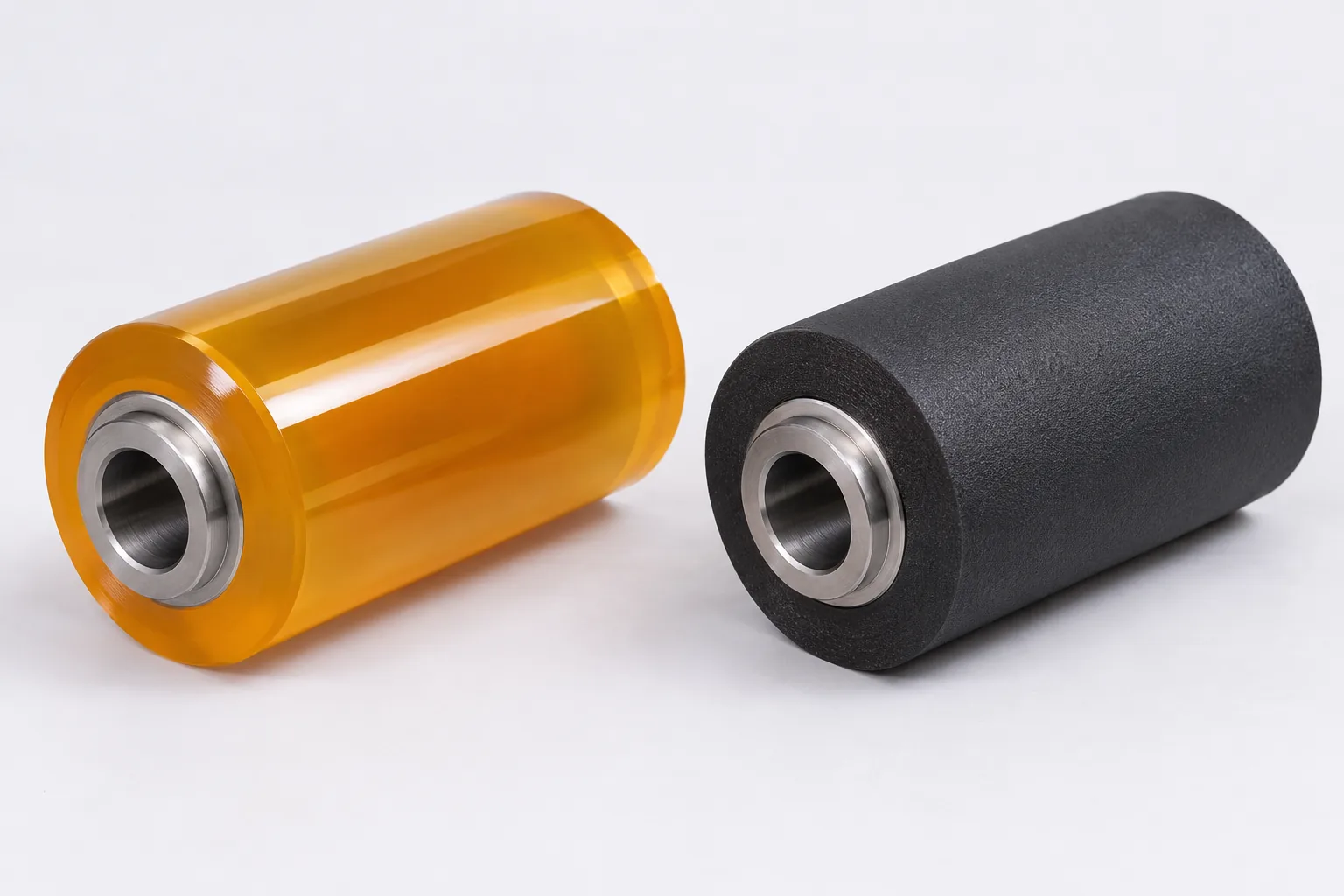
Evaluate the supplier’s ability to cast or machine polyurethane to the required profile, tolerance, surface finish, crown, and concentricity. Supplier tolerance and surface-finish capability should be stated in the quotation or capability sheet, not left to a general catalog claim.
For metal-to-polyurethane rollers, verify core preparation and bonding control, including surface treatment, adhesive system, cure control, and bond inspection. Ask how the supplier detects voids, unbonded areas, or contamination at the interface. Then check inspection equipment and reports: dimensional layout, runout measurement, surface finish, and dynamic balancing where required.
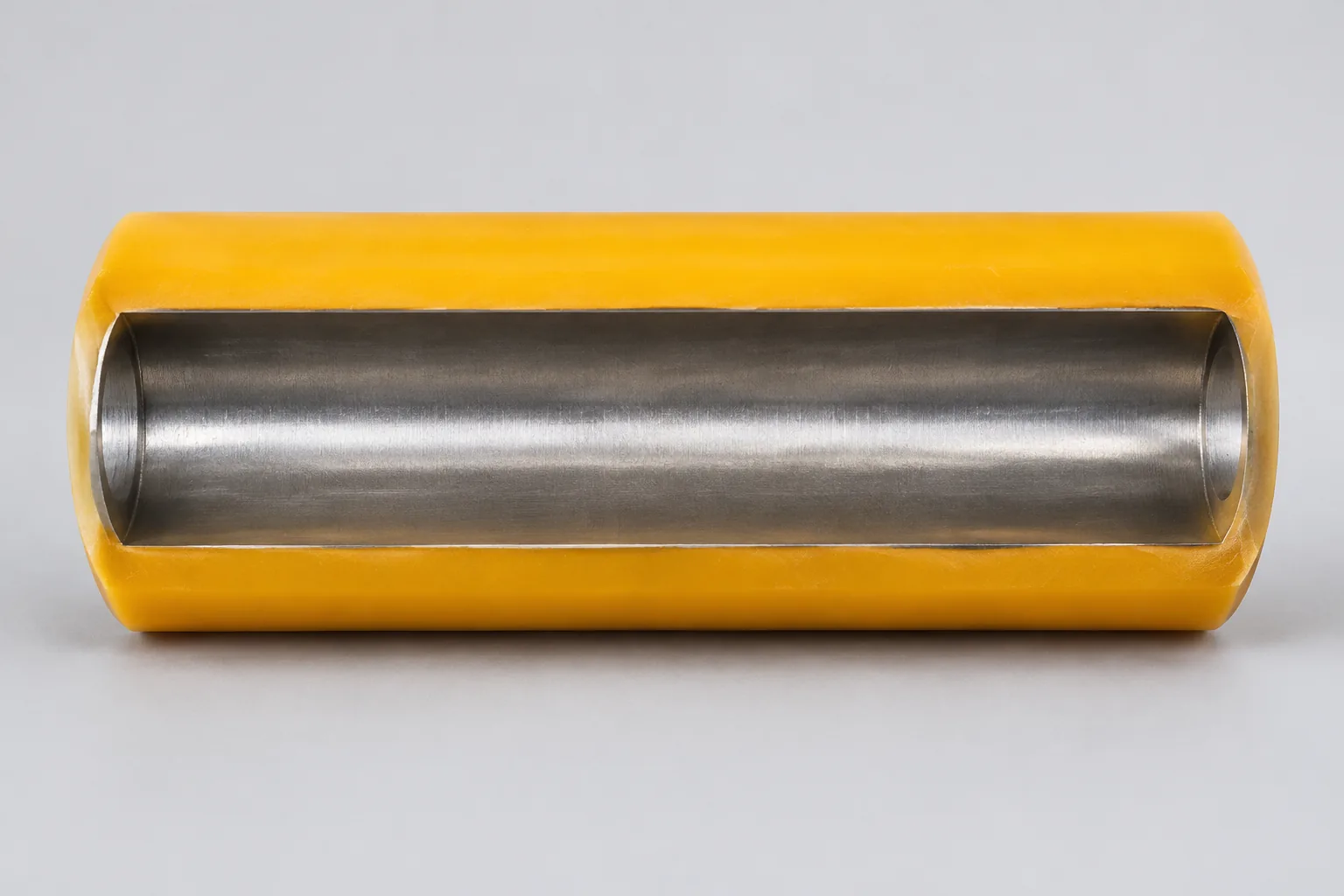
Large rollers may require on-site machining or special transport planning, so confirm that before order. Very large or heavy rollers may not fit standard inspection equipment; agree on an alternative inspection plan.
Technical Criterion 4: Process Control And Quality Management
Verify the quality management system, certificate scope, and site coverage. ISO 9001 certification alone does not prove roller-specific capability. Record certificate number, certification body, scope, and expiry date, then check that the certificate covers the actual production site.
Review incoming inspection, in-process controls, calibration, nonconforming-material handling, corrective action, batch release, and traceability. Ask how the supplier controls compound changes, cure records, and rework. Assess production capacity, scheduling discipline, and contingency plans for equipment downtime or raw-material shortages.
Automotive or regulated supply chains may require IATF 16949 or additional customer-specific approvals. Smaller specialist suppliers may lack formal certifications but can still be qualified through audit, sample testing, and batch traceability; compensate with extra verification.
Commercial Criterion 1: Cost Structure And Total Cost Of Ownership
Compare total cost, not unit price. Include tooling or mold cost, sample cost, packaging, freight, duties, payment terms, currency exposure, inspection cost, and downtime risk. A low piece price can lose its advantage when a roller fails early or when freight and inspection are added later.
- Price breakdown: request separation by material, size, hardness, tolerance, volume, and finishing operation to identify cost drivers.
- Validity and escalation: confirm quotation validity, raw-material indexation, and how exchange-rate changes are handled.
- Tooling: document tooling ownership and amortization in the quotation or contract.
Urgent orders may justify air freight or expedite fees; evaluate the total cost impact rather than rejecting the quotation on unit price alone.
Commercial Criterion 2: MOQ, Lead Time, And Supply Flexibility
Clarify minimum order quantity by compound, hardness, size, and color. Custom formulations often carry higher MOQs. Compare sample lead time, first-article approval time, production lead time, and expedite capability, and request MOQ and lead time by roller family and order volume because benchmarks vary by region and supplier size.
Assess capacity headroom, inventory or vendor-managed inventory options, and dual-sourcing feasibility for critical rollers. For critical spares, calculate the reorder point and safety stock from the quoted lead time plus its variability, not from the best-case lead time.
Low-volume custom rollers may be quoted with batch-production slots rather than standard lead times. That can be acceptable if the delivery window and approval steps are documented.
Commercial Criterion 3: Commercial Terms And Risk Allocation
Review payment terms, Incoterms, warranty period, liability limits, confidentiality, intellectual-property protection, and tooling ownership. Require written change notification for material, process, sub-supplier, or production-site changes. These terms decide who carries the risk when a batch does not match the approved sample.
Define acceptance criteria, rework or replacement policy, and freight responsibility for nonconforming product. Cross-border purchases add currency, customs, compliance, and logistics risk that should be assigned explicitly in the contract. Low-value trial orders may use simplified terms, but change control and acceptance criteria should still be documented.
Build A Weighted Supplier Scorecard
Convert the qualification criteria into a scorecard with pass/fail gates and weighted scores. Use pass/fail gates for must-have items such as material traceability, dimensional capability, sample approval, and quality-system evidence. Score the remaining criteria on a defined scale, require evidence for each score, and set the decision threshold before supplier discussions begin.
An example weighting is technical capability 40 percent, quality systems 25 percent, commercial terms 20 percent, and service and supply flexibility 15 percent. Calibrate the weights to application risk rather than copying the example. Define score anchors internally so two reviewers score the same evidence consistently.
Safety-critical rollers should increase the technical and quality weighting and may require a mandatory audit regardless of score.
Validate With Samples And A Pilot Run
Define the sample request package: drawings, application data, acceptance criteria, test methods, and required documentation. Require a first-article inspection report, dimensional layout, material certificate, hardness results, bond inspection, and, where relevant, on-machine trial results. Approve the sample through a documented sign-off before releasing a pilot or production order.
Destructive testing may require additional sample pieces, so agree on sample quantity and cost before ordering. Low-volume custom parts may combine sample and pilot approval into one lot if the acceptance criteria are clearly defined.
Red Flags That Should Trigger Disqualification Or Escalation
Some answers should stop the evaluation or force an escalation before more money is spent.
- No material traceability, vague tolerance statements, missing test reports, or refusal to provide samples.
- Inconsistent hardness results, uncalibrated inspection equipment, unclear change control, or hidden costs in the quotation.
- Unrealistic lead times, no capacity evidence, poor technical communication, or reluctance to document acceptance criteria.
A missing formal certificate is not automatically disqualifying for a small specialist supplier, but it requires compensating verification through audit and testing.
Qualification Checklist And Decision Record
Summarize the final checklist across application requirements, technical evidence, quality system, commercial terms, sample approval, and risk controls. Record the decision, open actions, evidence references, approved deviations, and re-evaluation date. Use the record to support repeat orders, dual sourcing, and future supplier benchmarking.
The record should be short enough to use. A table with criterion, evidence reviewed, score or gate result, owner, and due date is usually enough. Keep the approved sample and its inspection report with the record so later batches can be compared against the same baseline.
Conclusion
Qualifying a polyurethane roller supplier comes down to evidence matched to the roller duty. Define the application envelope, set pass/fail gates for traceability, dimensional capability, sample approval, and quality-system evidence, then score technical, quality, commercial, and supply factors. Validate the selected supplier with a documented sample and pilot run before releasing volume. That sequence turns supplier qualification into a repeatable sourcing decision rather than a price comparison.
FAQs
Q1: What documents should I request from a polyurethane roller supplier?
A: Request drawings, material grade and batch traceability, certificate of analysis, test reports with methods and acceptance limits, dimensional layout, bond inspection results, and the quotation with commercial terms. For regulated use, add the specific compliance documents the end user requires.
Q2: How can I verify hardness and material consistency?
A: Compare hardness results with the agreed method, test location, and tolerance, and check whether the reading was taken on a slab or the finished roller. Material consistency is supported by batch records, COA traceability, cure records, and change notification, not by a single hardness number.
Q3: What tolerances are realistic for custom polyurethane rollers?
A: Realistic tolerances depend on size, profile, material, and machining method, so the supplier must state capability in the quotation or capability sheet. Do not accept a general catalog tolerance for a critical fit; agree on the inspection method and acceptance limit before sampling.
Q4: What MOQ and lead time should I expect?
A: MOQ and lead time vary by compound, hardness, size, color, and order volume, so request them by roller family rather than as one general figure. Custom formulations usually carry higher MOQs and longer first-article approval time than repeat standard orders.
Q5: Is ISO 9001 certification enough to qualify a supplier?
A: No. ISO 9001 supports quality-system review but does not by itself prove roller-specific material, bonding, machining, or inspection capability. Check the certificate scope and production site, then verify process controls and sample performance.
Q6: Should I pay for samples?
A: Paying for samples is common when the part is custom, destructive testing is needed, or tooling is involved. Free samples can still be useful for a first screen, but the decision should be based on the documented sample report and not on whether the sample was free.
Q7: How do I compare total cost instead of unit price?
A: Add tooling, samples, packaging, freight, duties, inspection, payment terms, currency exposure, and downtime risk to the unit price. Request a price breakdown by material, size, hardness, tolerance, volume, and finishing so the comparison uses the same scope.
Q8: What are common red flags in a supplier quotation?
A: Vague tolerances, no material traceability, missing test reports, unexplained low prices, unclear change control, and lead times that cannot be supported by capacity evidence are common red flags. Also treat refusal to provide samples or acceptance criteria as a reason to escalate.
Q9: Can a supplier custom-formulate polyurethane for chemical resistance?
A: A supplier can formulate for chemical resistance, but the claim must be supported by performance evidence for the specific chemical, concentration, temperature, and exposure time. Ask for documented compatibility and change-control commitments rather than a general chemical-resistant statement.
Q10: What warranty and change-control terms should be agreed?
A: Agree on warranty period, liability limits, acceptance criteria, rework or replacement policy, and freight responsibility for nonconforming product. Change control should require written notification before any material, process, sub-supplier, or production-site change.