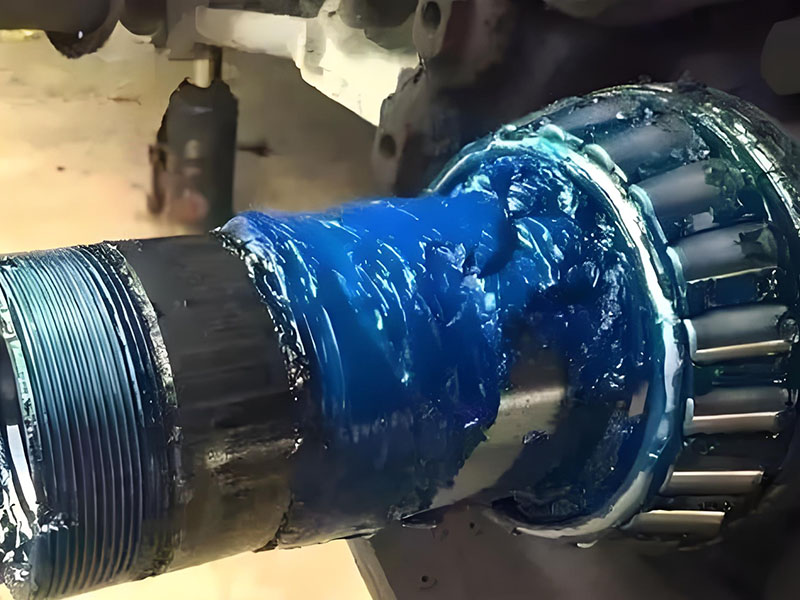
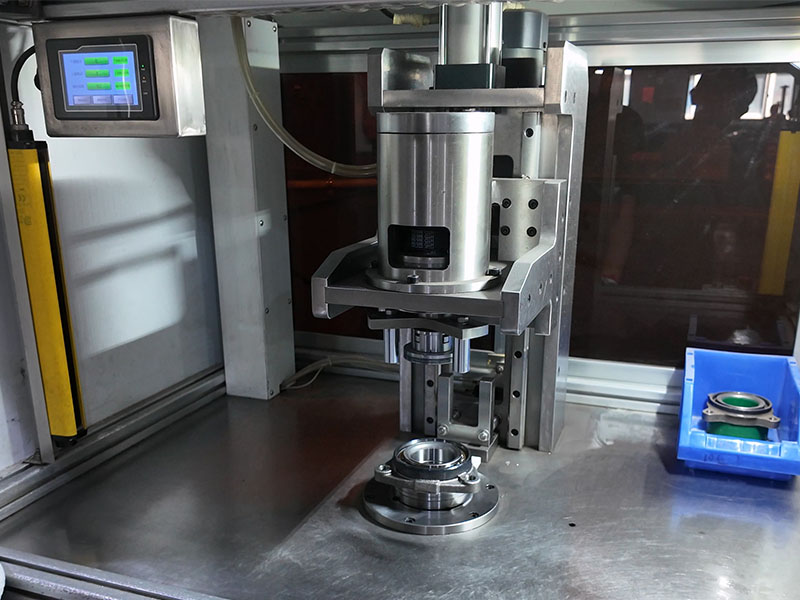
Quick Answer
A bad wheel bearing typically produces a grinding, growling, or humming noise that gets louder with speed and changes pitch when you turn. Other symptoms include steering wheel vibration, loose or wandering steering, vehicle pulling to one side, uneven tire wear, and sometimes an illuminated ABS warning light. Wheel bearings generally last 85,000-100,000 miles (136,000-160,000 km) under normal conditions. Replacement costs vary by vehicle – eonomy cars run $270-$540 per wheel, while luxury SUVs can reach $730-$1,250. The national average falls between $350 and $900 per wheel. Driving on a failed bearing is unsafe and can lead to wheel separation. Replacement typically takes 1-3 hours per wheel.
It starts quietly. With the radio on and wind from the windows, you might ignore it at first. But over time, that subtle noise grows into a metal-on-metal grinding sound you can’t miss.
You might also notice wobbly steering or uneven tire wear. These are signs your wheel bearing is failing – and they should be taken seriously. Ignoring them could mean losing a wheel while driving.
Wheel bearings allow your wheels to spin with minimal friction while supporting your vehicle’s entire weight. They are located in the wheel hub, between the drive axle and the brake disc.
Most modern vehicles use sealed hub bearing assemblies that contain roller bearings. These require no maintenance – only replacement when they fail.
This guide covers how to diagnose and replace a bad wheel bearing, so you can identify the problem and get it fixed.
Bad Wheel Bearing Symptoms: Noise, Vibration and More
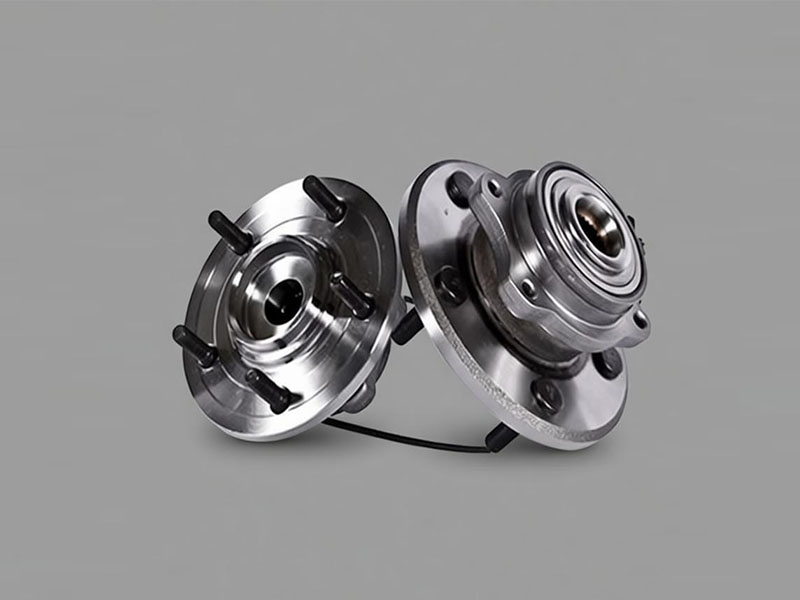
Bad wheel bearing symptoms are relatively straightforward to recognize. Here is what to look for.
You will hear a grinding noise until you are driving fast enough that road noise masks it – typically at 50 mph and faster. The noise indicates metal-on-metal rubbing at a fast rate, coming from the faulty bearings scraping against their housing and the wheel hub around them.
Types of Noises
A failing wheel bearing can produce several distinct sounds:
- Grinding – The most well-known symptom. A grinding noise from the axle heard only when the vehicle is in motion typically means a bad bearing. It suggests loss of integrity such as roller or raceway damage.
- Growling or humming – Often described as a low-frequency rumble that increases with speed. It usually presents itself when driving in a straight line or turning slightly at 15 to 50 mph.
- Knocking or clicking – Heard when turning at low to moderate speeds. This can indicate excessive bearing endplay because of inadequate clamping.
- Squealing – A high-pitched sound that worsens during acceleration or turns.
- Snap, crackle, pop – Similar to the cereal, these sounds typically occur during sharp turns and only rarely during straight-line driving.
- Cyclical chirping – A rhythmic chirping or squealing sound that changes proportional to vehicle speed.
Additional Symptoms
Beyond noise, watch for these signs:
- Steering wheel vibration – Shake felt through the steering wheel, especially at low speeds or during turns. Unlike tire balance issues, bearing-related vibration appears at lower speeds and worsens with acceleration.
- Vibration through the seat – You may feel vibration through the seat as well as the wheel.
- Loose or wandering steering – The steering feels less responsive or the vehicle drifts.
- Vehicle pulling to one side – If your car pulls to one side during braking, the side it pulls to is likely the side with the failed bearing.
- Audible or tactile looseness – You may notice a clunk or feel excessive movement when rocking the wheel assembly. The detailed check for this is covered in the shake test below.
- Uneven tire wear – If one tire wears faster than the others, it may be due to a bad wheel bearing throwing off alignment. Look for a single tire – or a pair on the same axle – wearing abnormally.
- ABS warning light – A failing bearing can disrupt the wheel speed sensor signal, triggering the ABS warning light on your dashboard. This is especially common on vehicles with integrated wheel speed sensors in the hub assembly.
Front vs. Rear Wheel Bearing Symptoms
If it is the front hub bearings, turning the steering wheel may cause the noise to get worse or change in pitch. Front wheel bearing noise is often more noticeable because it travels through the steering column.
Why Do Wheel Bearings Fail? Common Causes Explained
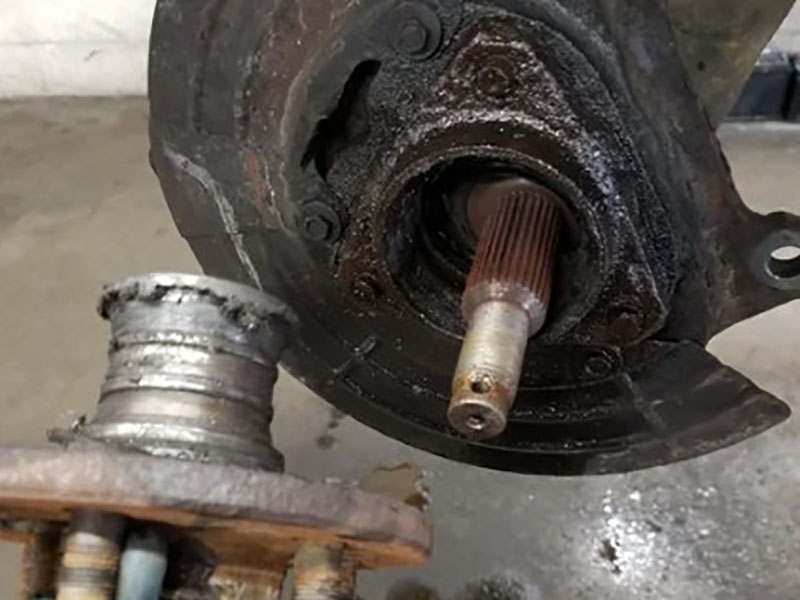
Understanding why wheel bearings fail can help you prevent premature failure. Here are the most common causes.
Impact Damage
The most common cause for wheel hub bearing failure is impact. When the tire and wheel hit an object or road defect hard – such as a pothole or curb – the bearings can be damaged.
One rule of thumb: if you strike something hard enough to damage a rim, you have likely damaged your wheel bearing and will need it replaced soon.
Seal Failure
Broken or worn seals allow moisture or debris into the hub, causing the bearings to deteriorate. Water, dirt, and road salt can contaminate the lubricant and accelerate wear.
Check for grease leaks near the bearings inside the wheels – this is a clear sign of seal damage.
Other Contributing Factors
Other things that can cause premature bearing failure include:
- Out-of-balance tires or wheels
- Worn or broken suspension components (ball joints, tie rods, struts)
- High-performance, low-profile tires
- Vehicle misalignment (wheel alignment out of specification)
- Lifted or oversized wheels that put extra load on bearings not engineered for them
These types of long-term wear-and-tear symptoms will also cause damage to ball joints, tie rods, struts, and other chassis and suspension components.
Two Often-Overlooked Problems
Two problems frequently left undiagnosed when wheel bearings repeatedly fail are:
1. Worn bearing hub – If the bearings were grinding for any period of time, the bearing hub likely took damage. When removed, it will show signs of scraping, dimpling, or being out of round. Any of these means the hub should be replaced.
2. Electrical current damage – In certain applications – particularly hybrid and electric vehicles – stray electrical currents can pass through rolling element bearings.
Fast-switching inverters enable precise motor control but can also allow current leakage into mechanical components. These currents seek the path of least resistance through the bearing’s lubricating film. When they cross that film, a destructive electrical arc can form, causing irreversible damage to bearing surfaces.
This failure mechanism, sometimes referred to as electrical discharge machining (EDM) or white etching crack (WEC) damage, is more commonly documented in electric motor bearings but remains a recognized risk in bearings exposed to electrical currents. Wheel bearings on hybrid and electric vehicles can be susceptible to this type of damage.
Installation Errors
Even the best bearing will fail prematurely if installed incorrectly. Common installation mistakes include:
- Improper pressing – Pressing the bearing in at an angle causes early failure.
- Incorrect axle nut torque – Over-tightening crushes the inner races; under-tightening leads to excessive play.
- Using the wrong tools – Using a hammer instead of a press damages internal components.
- Reusing old hardware – Old retaining bolts, axle nuts, or clips are often torque-to-yield components that lose clamping force once removed.
How to Diagnose a Bad Wheel Bearing – 3 Simple Tests
Diagnosing a bad wheel bearing involves three main approaches. Each method targets different aspects of bearing behavior.
Professional Methods
In a shop, technicians use directional microphones or ultrasound to pinpoint bad wheel hub bearings. A noise detector with sensitive clamp-on sensors is one of the fastest, most accurate ways to identify bearing noises.
DIY Method 1: Listening While Driving
In a DIY garage, simpler methods are just as effective. Have someone drive the vehicle at 10-20 mph while you listen carefully to pinpoint which wheel the grinding sound is coming from. If you can narrow it down to at least one axle, you will save time.
DIY Method 2: The Shake Test
Safely lift the vehicle and remove the tire and wheel. Then rock the hub with your hands on the top and bottom (12:00 and 6:00 positions).
If there is any give back and forth – toward or away from the car – the bearing is likely bad. Alternatively, grasp the tire at the top and bottom and rock it back and forth.
The Steering Test (Sway Method)
Here is a practical way to narrow down which side is failing. Take the vehicle for a drive and weave gently from side to side at a steady speed.
As the vehicle leans, the weight distribution shifts – more load lands on the outside wheels during each turn. A worn bearing will respond to that added stress: the sound will intensify or shift in tone when the affected side takes on extra weight.
Use this rule to interpret what you hear:
- Louder when the vehicle leans left -> the right-side bearing is the problem
- Louder when the vehicle leans right -> the left-side bearing is failing
The logic is straightforward: turning left throws more weight onto the right wheels. That extra load makes a failing right bearing work harder – and complain louder.
Wheel Bearing Noise vs. Tire Noise
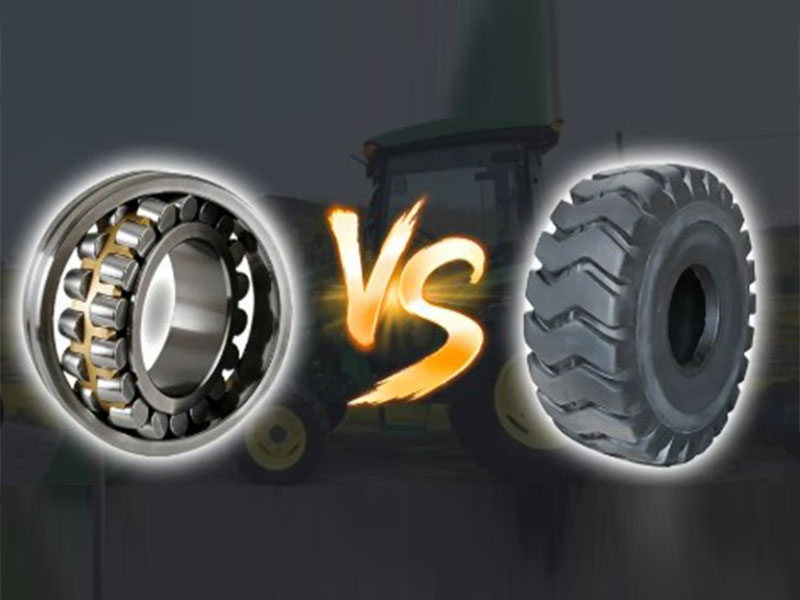
Distinguishing between bearing noise and tire noise is important:
| Characteristic | Wheel Bearing Noise | Tire Noise |
|---|---|---|
| Changes with steering | Yes – gets louder or changes pitch when turning | No – sound stays consistent |
| Changes with speed | Yes – increases with speed | Yes – increases with speed |
| Sound location | Localized to one wheel | Often generalized |
| Vibration pattern | Steering wheel shake at low speeds | Vibration that changes with speed |
Tire noise often results from chopped or cupped tread, under-inflated tires, or improper alignment. Run your hand over the tire surface to check for cupping, sharp edges, or flat spots.
Limitations of the Spin Test
Many DIYers spin the wheel while it is raised to listen for noise. But there is a catch: with the wheel off the ground, there is no load on the bearing.
Many failing bearings only make noise when supporting the vehicle’s weight – so they may be completely silent when spun in the air.
How to Replace a Wheel Bearing – Bolt-On vs Pressed-In
When it comes to wheel bearing troubleshooting and repair, the replacement phase is where you put your diagnosis to the test.
Luckily, bearings are not difficult to replace, and most modern vehicles use either bolt-in or pressed-in bearings. With the right tools, you can perform this replacement yourself.
Note: For vehicles with over 75,000 miles, it is often recommended to replace wheel bearings in pairs. When one side fails, the other has endured the same mileage and conditions and is likely nearing the end of its service life.
Bolt-On (Hub Assembly) Replacement
Bolt-on bearings come as a complete hub assembly that bolts directly to the steering knuckle. Here is the step-by-step process:
- Park your car on a safe, flat surface and secure the wheels you are not working on with wheel chocks.
- Loosen the lug nuts (while the vehicle is on the ground) and use a jack to lift the wheel.
- Remove the lug nuts and take off the wheel.
- Remove the brake caliper and hang it securely with wire – do not let it hang by the brake hose.
- Remove the brake rotor.
- Unplug the ABS sensor connector from the hub if equipped.
- Remove the hub retaining bolts and pull the wheel bearing unit outward.
- Install the new hub assembly – clean all mating surfaces on the knuckle and hub first.
- Torque all bolts to manufacturer specifications using a calibrated torque wrench.
- Reinstall all components in reverse order.
Critical installation tips:
- Cleanliness is king – Use a wire brush or abrasive pad to clean all mating surfaces on the knuckle and the hub. Clean all parts and housings thoroughly before reassembly. Any debris trapped between surfaces can cause misalignment.
- New hardware only – Never reuse old retaining bolts, axle nuts, or clips. These are often torque-to-yield components that lose clamping force once removed.
- The torque wrench is your best friend – Always torque the axle nut to exact manufacturer specifications. Over-tightening crushes the inner races; under-tightening leads to excessive play. For a more precise check, some service manuals recommend using a spring scale to measure rotational torque of the hub after installation, verifying that the preload is within specifications.
- Avoid the hammer – Never use a hammer to seat a bearing. Use a press or an approved hub puller and installer tool.
- Check the seals – Inspect the seals and replace any that are damaged, leaking, or showing signs of wear. A failed seal allows contaminants to enter the new bearing, shortening its life significantly.
Torque specifications vary by vehicle. For example, some applications require M14 bolts tightened to 85 ft-lbs (115 Nm) plus an additional 180 degrees, while others require 133 ft-lbs. Always consult your vehicle’s service manual for exact specifications.
After installation: Always perform a road test to confirm the noise is gone. Drive at various speeds, turn left and right, and listen for any remaining sounds. Also check that the ABS warning light (if previously on) has turned off.
Pressed-In Bearing Replacement
Some vehicles use pressed-in bearings that are installed into the steering knuckle using a hydraulic press.
Location: In this design, the bearing is pressed directly into the steering knuckle housing. It sits between the wheel hub and the CV axle shaft, with the outer seal on one side and the CV joint on the other.
Key considerations:
- Specialized equipment required – Removal and installation require a hydraulic press capable of thousands of pounds of force.
- Not a typical DIY job – You can remove the knuckle and take it to a machine shop or mechanic to have the bearing pressed.
- Proper support is critical – The wheel knuckle must be properly supported during pressing to avoid damage.
- Keep it level – The wheel bearing housing must remain as horizontal as possible when pressing in. If the bearing is tilted in the housing, early damage can occur.
- Pressing at an angle is one of the primary causes of early bearing failure.
Advantage: Pressed-in bearings are often replaced as pre-sealed, pre-lubricated assemblies, eliminating variables like improper greasing.
Conclusion
Wheel bearing failure typically starts with a subtle noise that grows into a grinding sound younnot ignore. Other symptom include steering vibration, loose steering, pulling to one side, uneven tire wear, and sometimes an ABS warning light.
Most failures are caused by impact damage, seal failure, contamination, or improper installation. Diagnosis involves listening for noise changes during turns, performing the shake test, and distinguishing bearing noise from tire noise.
Replacement methods vary by vehicle – bolt-on hub assemblies are straightforward DIY projects, while pressed-in bearings typically require a hydraulic press.
The bottom line: Do not ignore the signs. A failing wheel bearing is a safety risk that can lead to wheel separation. If you suspect a problem, diagnose it promptly and replace the bearing before it fails completely. For high-mileage vehicles (over 75,000 miles), consider replacing bearings in pairs.
FAQs
Q1: What does a bad wheel bearing sound like?
A bad wheel bearing can produce grinding, growling, humming, knocking, clicking, squealing, or cyclical chirping sounds. The noise typically gets louder with vehicle speed and changes pitch when you turn.
Q2: How do I tell which wheel bearing is bad?
Drive the vehicle and turn left and right. If the noise gets louder when turning left, the right bearing is likely bad. If it gets louder when turning right, the left bearing is likely bad.
Q3: How long do wheel bearings last?
Under normal driving conditions, wheel bearings typically last 85,000-100,000 miles (136,000-160,000 km). Harsh conditions – potholes, off-roading, heavy loads – can shorten this significantly.
Q4: Is it safe to drive with a bad wheel bearing?
No. Driving on a failed bearing is unsafe and can lead to wheel separation. If you hear grinding or feel significant instability, stop driving and get it repaired immediately.
Q5: How much does wheel bearing replacement cost?
Costs vary significantly by vehicle type. For a typical economy car (e.g., Civic, Corolla), expect $270-$540 per wheel. Midsize SUVs (e.g., RAV4, Rogue) run $370-$720, while full-size trucks (e.g., F-150, Silverado) cost $430-$830. Luxury SUVs and AWD vehicles can reach $730-$1,250 or more. The national average falls between $350 and $900 per wheel. Parts typically run $50-$380 depending on the vehicle, labor is $80-$200 per hour, and replacement takes 1-3 hours. Dealerships generally charge 20-40% more than independent shops.
Q6: Can a bad wheel bearing cause uneven tire wear?
Yes. A bad bearing creates play in the wheel assembly, causing the wheel to wobble and wear tires unevenly. Look for a single tire – or tires on the same axle – wearing faster than others.
Q7: Do I need to replace both wheel bearings at the same time?
For high-mileage vehicles (over 75,000 miles), it is often recommended. If one bearing has failed, the other has endured the same mileage and conditions and is likely near the end of its life.
Q8: Can a wheel bearing be bad without making noise?
It is possible but unusual. Most failing bearings make noise before they fail completely. However, some bearings fail due to seizure or catastrophic damage without prolonged noise.
Q9: What is the most common mistake when installing a wheel bearing?
Incorrect axle nut torque – over-tightening or under-tightening – is one of the most common mistakes. Others include pressing the bearing in at an angle, using a hammer instead of a press, and reusing old hardware.
Q10: How do I tell the difference between wheel bearing noise and tire noise?
Wheel bearing noise changes when you turn – it gets louder or changes pitch. Tire noise stays consistent when turning but increases with speed. Tire noise often comes from cupped tread, under-inflation, or alignment issues.