Quick Answer
The most common CV joint types are the Rzeppa (ball‑type) for outer wheel positions, the tripod for inner axle locations, and the double Cardan for off‑road vehicles. Rzeppa joints handle steering angles up to 48°, tripod joints allow axial plunge (≈22°), and double Cardan joints manage extreme angles up to 40°. Selecting the right type depends on required angle and whether axial movement is needed.
In modern front‑wheel‑drive, all‑wheel‑drive, and independent rear‑suspension vehicles, constant velocity (CV) joints transmit engine torque to the wheels while accommodating steering and suspension travel. Unlike conventional universal joints, a CV joint maintains a constant output speed regardless of operating angle. For engineers, technicians, and procurement specialists, understanding the common types of CV joints is essential for correct selection, diagnosis, and replacement. This guide covers seven major designs, their working principles, typical applications, and how they compare to traditional U‑joints.
What Are CV Joints and How Do They Work?
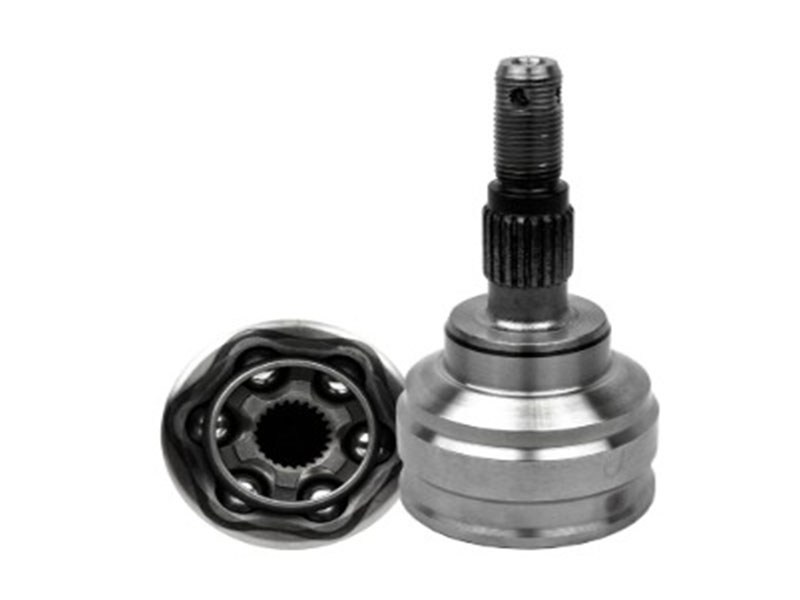
A CV joint is a flexible coupling that allows a driveshaft to transmit torque through variable angles without speed fluctuation. A typical half‑shaft uses two CV joints: an outboard joint (wheel side) that handles steering angles up to about 50°, and an inboard joint (transmission side) that permits axial movement to accommodate suspension travel, usually with a maximum angle below 22°.
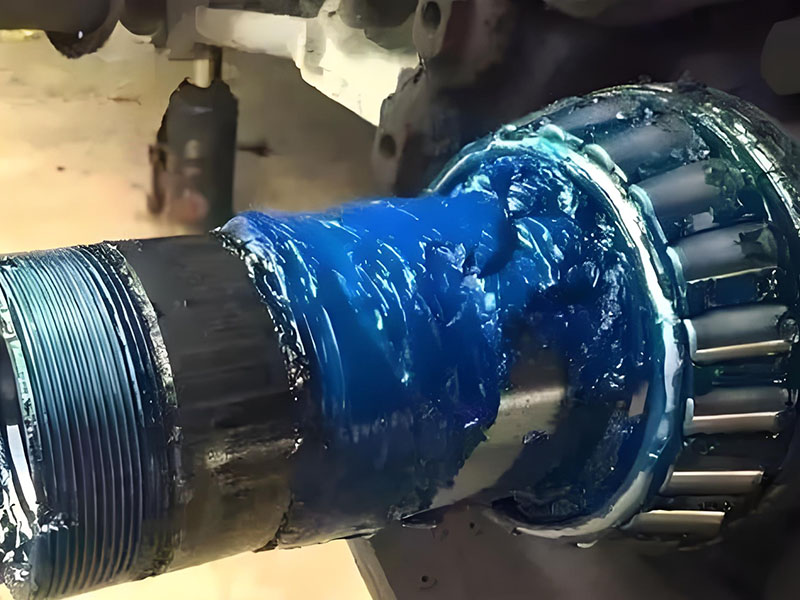
Different mechanical arrangements achieve constant velocity. In ball‑type designs, steel balls held in a cage always lie in a plane that bisects the joint angle. In tripod designs, rollers slide within grooves to maintain speed uniformity while allowing plunge motion. All CV joints are permanently lubricated with specialised grease and sealed by a flexible rubber or silicone boot – the boot’s integrity is the single most important factor for joint longevity.
Seven Common Types of CV Joints
The following seven designs cover the vast majority of CV joints found in passenger cars, trucks, and industrial vehicles.
Ball‑Type (Rzeppa) CV Joint
Invented by Alfred H. Rzeppa in the 1920s, this is the most common outboard CV joint in front‑wheel‑drive vehicles. It consists of an inner race, an outer race with six curved grooves, six steel balls, and a cage that positions the balls. When the joint articulates, the cage forces the balls into a plane that always bisects the angle between input and output shafts, eliminating speed variation.
- Key features: Maximum operating angle 45°–48°, low friction, quiet operation.
- Typical application: Outer driveshaft position in front‑wheel‑drive and many all‑wheel‑drive vehicles.
- Advantages: Excellent angular capacity, compact size, and long service life when the boot remains intact.
Tripod CV Joint
The tripod (or “triaxe”) joint is primarily used as an inboard (plunging) joint. Instead of balls, it uses three roller assemblies mounted on needle bearings, arranged 120° apart on a central spider. The rollers sit inside three corresponding tracks machined into a tulip‑shaped housing. As the suspension moves, the rollers slide axially within the tracks, allowing the driveshaft to change length without binding.
- Key features: Simple construction, lower manufacturing cost, effective plunge travel up to 50 mm, maximum operating angle typically 20°–22°.
- Typical application: Inner CV joint on most Asian and American front‑wheel‑drive vehicles produced after 1983.
- Advantages: Excellent axial movement capability and good torque capacity for its size.
Double Offset CV Joint
The double offset joint is a six‑ball design variant that combines angular flexibility with plunging ability. Its inner and outer races have offset ball tracks, and the cage is shaped to allow axial movement while the joint is articulated. This design is often grouped under “cross‑groove” joints, though subtle differences exist in track geometry.
- Key features: Allows both angle change and axial plunge; smoother operation than tripod joints at higher angles. Maximum angle ≈22°.
- Typical application: Inner CV joint in rear‑wheel‑drive and all‑wheel‑drive vehicles with independent suspension.
- Advantages: Capable of handling larger angles and higher torque loads compared to basic tripod designs.
Fixed CV Joint
A fixed CV joint permits angular movement but no axial movement – the effective length of the shaft does not change when the joint is bent. The most common example is the Rzeppa joint described above. Fixed joints are always used on the outboard side where steering angle is required but shaft length variation is not needed. Some manufacturers use slightly different cage geometries for fixed applications.
- Key features: No plunge capability, compact axial length, angular capacity up to 48°.
- Typical application: Outboard (wheel‑side) position.
- Advantages: Excellent stability and durability under high steering angles; responsible for the “clicking” noise when worn during cornering.
Plunging CV Joint
Plunging CV joints allow axial movement (plunge) while transmitting torque at an angle. They are always installed on the inboard side of a driveshaft, near the differential or transaxle. Common plunging designs include the tripod joint, the double offset joint, and the cross‑groove joint. The axial movement compensates for length changes in the half‑shaft as the suspension compresses and rebounds, preventing excessive thrust loads on transmission bearings.
- Key features: Variable effective length, lower angular capacity than fixed joints (typically ≤22°).
- Typical application: Inner joint on front‑wheel‑drive, rear independent suspension, and many AWD systems.
- Advantages: Accommodates large suspension travel without binding; reduces vibration from plunge forces.
Double Cardan Joint
Strictly speaking, a double Cardan joint is a “constant velocity” joint by assembly rather than by individual geometry. It consists of two single Cardan (universal) joints connected by a centring yoke. The first joint introduces a speed fluctuation; the second joint, operating at the same angle but phased 90°, cancels that fluctuation, resulting in near‑constant output velocity. A centring ball or spring keeps the two joints synchronised.
- Key features: Very high torque capacity, large operating angles (up to 40°), robust construction.
- Typical application: Off‑road vehicles, trucks, SUVs where extreme driveline angles are encountered.
- Advantages: Excellent reliability under heavy loads and severe angles; widely used in lifted vehicles and heavy equipment.
CV Joint with Spherical Roller Bearings
For heavy‑duty industrial and commercial vehicle applications, some manufacturers use spherical roller bearings instead of steel balls in a CV joint housing. The spherical rollers have a larger contact area and can accommodate both angular misalignment and limited axial movement. This design is less common in passenger cars but found in large trucks, buses, and off‑highway machinery.
- Key features: Roller elements with crowned surfaces; robust cage and race design for high‑load environments.
- Typical application: Industrial driveshafts, large commercial vehicles, heavy construction equipment.
- Advantages: Superior load‑carrying capacity and durability compared to ball‑type joints under high stress.
Comparison of Common CV Joint Types
| CV Joint Type | Angular Capacity | Plunge Capability | Typical Application |
|---|---|---|---|
| Ball‑Type (Rzeppa) | Up to 48° | No | Outboard joint, FWD/AWD |
| Tripod | Up to 22° | Yes (≈50 mm) | Inboard joint, most FWD |
| Double Offset | Up to 22° | Yes | Inboard joint, IRS/RWD |
| Fixed (function class) | Up to 48° | No | Outboard joint (all layouts) |
| Plunging (function class) | Up to 22° | Yes | Inboard joint (all layouts) |
| Double Cardan | Up to 40° | No | Driveshaft, off‑road/trucks |
| Spherical Roller | Up to 20° | Limited | Heavy‑duty industrial |
Note: Fixed and plunging are functional classifications; Rzeppa is a fixed type, while tripod and double offset are plunging types.
CV Joint vs. U‑Joint: Key Differences
Many driveline applications require a choice between a CV joint and a conventional universal joint (U‑joint). Understanding their differences helps in specifying the correct component.
- Speed uniformity – A single U‑joint operating at an angle produces a cyclical speed variation: the output shaft speeds up and slows down twice per revolution. A CV joint maintains true constant velocity regardless of angle.
- Angle tolerance – At 0°, both perform identically. At 10°, a U‑joint already shows measurable fluctuation; at 20°, the fluctuation becomes significant. CV joints work smoothly up to 40°–50°.
- Torque capacity – U‑joints have a simpler, more compact cross‑and‑bearing design that can handle very high peak torques, which is why they dominate heavy truck and commercial vehicle drivelines.
- Maintenance – Most modern CV joints are sealed and grease‑filled for life; failure usually follows boot damage. U‑joints may be sealed or feature grease zerks for periodic lubrication.
- Application – Use CV joints when angular movement is large or constant (steering, independent suspension). Use U‑joints when angles are small and torque is extreme, or when cost is a primary constraint.
Conclusion
Selecting the correct CV joint type depends on the specific driveline position, required angular range, axial movement needs, and torque load. The common types of CV joints – Rzeppa, tripod, double offset, fixed, plunging, double Cardan, and spherical roller – each have distinct mechanical characteristics that suit different applications. Regularly inspect CV boots for cracks or tears; replace them immediately if damaged. For most passenger vehicles, a Rzeppa outer joint combined with a tripod or double offset inner joint provides reliable performance. When extreme angles are expected (lifted trucks or off‑road vehicles), double Cardan joints are a solid choice. DUHUI Bearing manufactures a full range of CV joints and driveshaft components, certified to IATF 16949 and ISO 9001, supplying both aftermarket and OE customers worldwide.
Frequently Asked Questions (FAQs)
Q: How long do CV joints typically last?
A: There is no fixed replacement interval. With intact boots and normal driving, many CV joints last over 150,000 km (90,000 miles). Boot integrity is the single most important factor – once the boot tears, grease escapes and contaminants enter, leading to rapid wear (often within 1,000 km).
Q: What are the symptoms of a failing outer CV joint?
A: A worn outer joint produces a rhythmic clicking or popping noise when turning at full lock, especially during slow manoeuvres like parking. The noise becomes faster with wheel speed. An inner joint failure typically causes vibration or a clunk during acceleration or deceleration, not necessarily linked to steering angle.
Q: Can I drive with a torn CV boot?
A: Only for a very short distance. Once the boot is torn, dirt and water will damage the joint within a few hundred kilometres. If the joint has not yet started making noise, prompt boot and grease replacement may save it. If noise already exists, replacement of the entire half‑shaft is usually required.
Q: What is the cost difference between boot replacement and axle replacement?
A: Boot replacement (preventative) involves labour and a boot kit: approximately $120–250 in parts and labour. Replacing a complete half‑shaft (after joint damage) ranges from $300–500 for most mainstream vehicles, and can exceed $1,500 for premium European models. Early detection of boot damage is clearly economical.
Q: Are aftermarket CV axles reliable?
A: Quality varies. Premium new units from Tier‑1 suppliers offer similar or even improved performance over original parts. Remanufactured axles can be a budget option but some low‑cost imports suffer from poor heat treatment, undersized bearings, or incorrect ABS tone rings. For professional use, choose reputable brands and verify spline count, shaft length, and tone ring compatibility.
Q: Do I need an alignment after replacing a CV axle?
A: Yes, it is recommended. Any disassembly of suspension components (ball joints, tie rods) to remove the axle can alter wheel alignment. Misalignment will accelerate CV joint wear and uneven tyre wear. A four‑wheel alignment after axle replacement ensures optimal service life.
Q: Why are silicone CV boots better than rubber?
A: Silicone boots remain flexible at very low temperatures (down to –60°C) and resist ozone cracking better than standard neoprene or polyurethane. They also withstand higher under‑hood temperatures. For vehicles in extreme climates or off‑road use, upgrading to silicone boots (about $35 each) can triple boot life.
Q: Is the double Cardan a true CV joint?
A: Technically, it is a “near‑constant velocity” joint because it uses two U‑joints to cancel each other’s speed variation. In practice, it performs as a CV joint for most off‑road and truck applications and is widely accepted as a CV design in industry standards.
Q: Can I use a tripod joint as an outer CV joint?
A: Rarely. Some older vehicles (e.g., certain AMC, Toyota Tercel, Nissan Sentra) used tripod joints on the outer side, but this is uncommon. Tripod joints have lower angular capacity and produce more sliding friction, making them less suitable for steering applications.
Q: How does DUHUI Bearing ensure CV joint quality?
A: As a professional automotive bearing and CV joint manufacturer, DUHUI Bearing applies strict process controls, heat treatment protocols, and 100% dimensional inspection on critical features. Our products are designed to meet or exceed OEM specifications for fit, performance, and durability – serving both aftermarket and OE customers worldwide.