
Besic Design
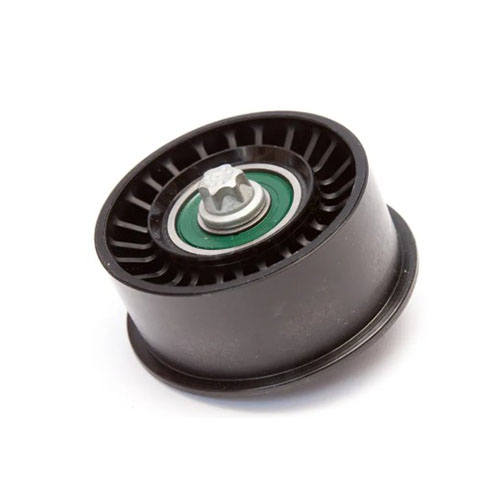
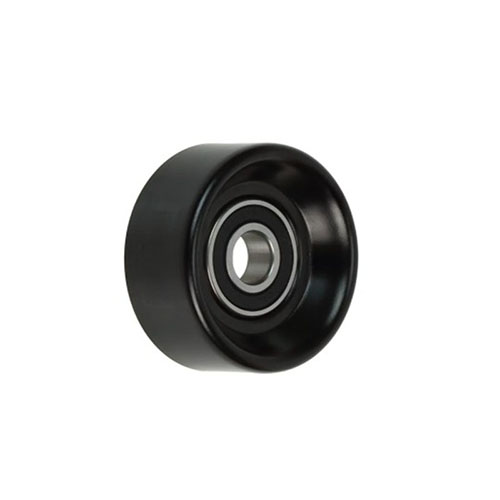
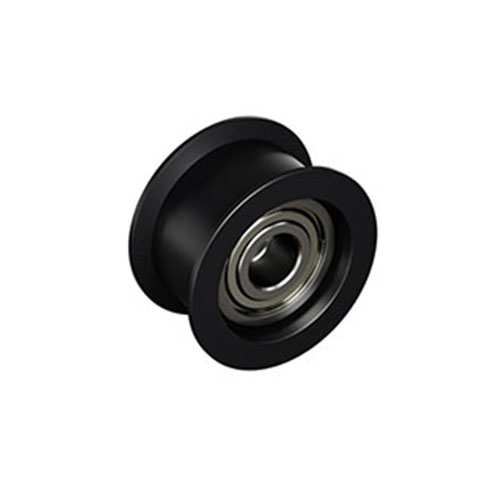
An idler pulley is a non‑driven pulley that guides a belt along a prescribed path in an engine‘s serpentine or accessory drive system. Unlike a tensioner pulley, an idler pulley does not adjust belt tension; it redirects the belt, increases wrap angle around driven components, or prevents belt flutter.
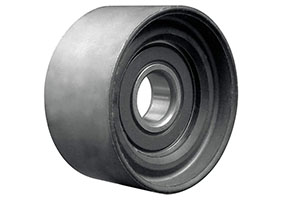
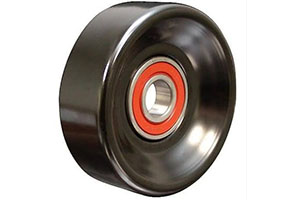
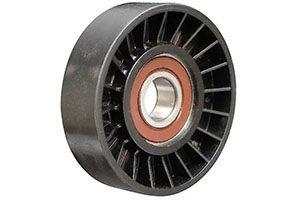
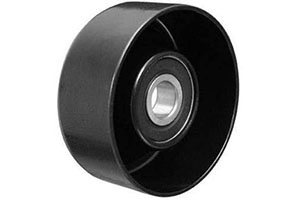
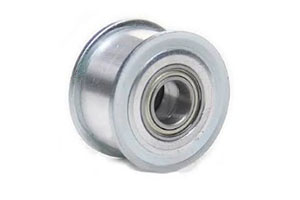
Idler pulleys are manufactured in four principal designs: stamped halves surrounding a bearing, moulded polymer, split formed, and fully machined. Steel or engineered polymer rims are riveted or pressed over the bearing. The entire unit is designed for drop‑in replacement without modification.
Performance Features
- Low‑friction sealed ball bearings – Pre‑lubricated with high‑temperature grease, double lip seals retain lubricant while blocking dirt, salt, and moisture.
- Cooler operation – Optimised internal clearance and raceway geometry reduce heat generation, extending bearing life beyond standard OEM bearings.
- Material‑specific contact surfaces – Flat pulleys for belt backside contact, grooved pulleys for V‑ribbed belts, and toothed pulleys for timing belts.
- Corrosion resistance – E‑coated steel or glass‑filled polymer options resist under‑hood chemicals and road salt.
- Tighter dimensional tolerances – Reduced radial and axial runout minimises belt vibration and noise, improving overall drive system efficiency.
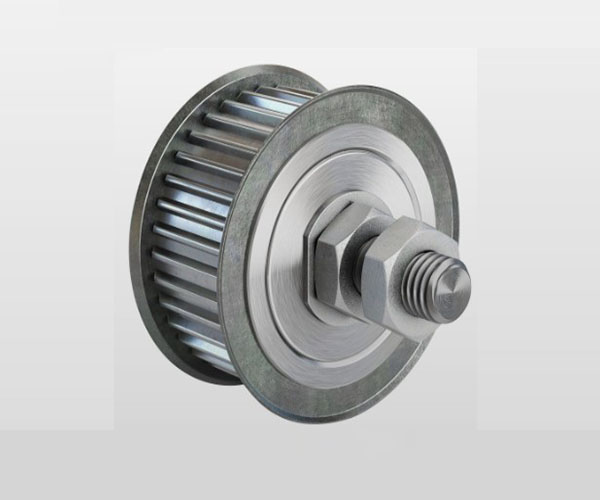
Your Reliable Idler Pulley Supplier
Since 2003, we have supplied engine belt idler pulleys and tensioners to aftermarket distributors, fleet maintenance centers, and OEM dealers. We understand that a failed idler pulley can stop a truck in extreme heat or freezing cold. That downtime costs real money. Our goal is to keep your belts running and your vehicles moving.
Over 4,000 idler pulley models are in our catalog. We cover Asian, European, and American passenger cars as well as heavy-duty trucks and agricultural machinery. Most items match OEM part numbers directly. You save sourcing time and eliminate fitment guesswork.
Built for severe conditions
We use GCr15 bearing steel and CNC heat treatment to reach 58–62 HRC. Seals are 2RS (contact) for dirty environments or 2RZ (non-contact) for high-speed applications. High-temperature lithium grease works up to 120°C. Each pulley is noise-tested and vibration-checked. That means fewer comebacks and more satisfied end users.
Quality you can verify
Our factory holds IATF 16949:2016. Batch traceable material certificates and in-process records are open for your audit. Monthly capacity exceeds 200,000 units. Complaint rate stays below 0.5% for three years. On-time delivery is above 97%. We do not hide behind marketing words — we show you the numbers.
Why B2B buyers choose us
- One order, mixed models – reduce your inventory SKUs
- Small quantity acceptable for trial or emergency restock
- OEM and ODM custom tooling from drawings or samples
- Lead time: 15–45 days after approval, with rush options
- 12-month warranty against manufacturing defects
Customization and support
Tell us your application or send a sample part. We help you cross-reference OE numbers and recommend seal/grease upgrades for extreme duty. Technical support from our engineers is included — no extra charge for consultation.
If you need a reliable idler pulley supplier that backs up claims with data and service, request our latest catalog and quote today.
Idler Pulley Classifications
Idler pulleys are classified by belt contact surface profile, construction material, and aftermarket series compatibility. The sections below detail each classification for accurate parts selection.
- By Surface
- By Material
- Aftermarket Series Compatibility
By Belt Contact Surface
Idler pulleys are manufactured with different belt-contacting surfaces to match specific belt types and drive configurations. Selecting the correct surface profile prevents belt slip, reduces wear, and ensures proper power transmission.
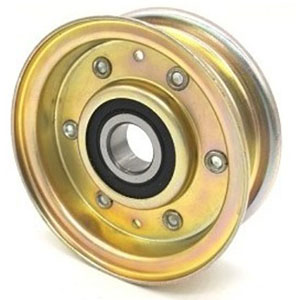
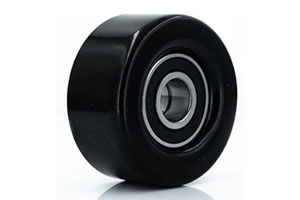
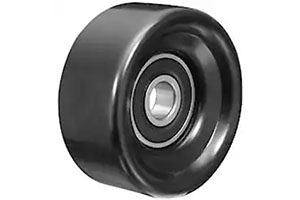
Flat Idler Pulley-Smooth cylindrical surface designed for belt backside (non‑ribbed) contact. Flat pulleys should always be used as external idlers. Used in serpentine belt systems where the belt‘s smooth side rides over the pulley. Common in GM LS and Ford modular engines. Some flat pulleys include a moulded‑in crown to centre the belt and prevent rubbing against flanges.
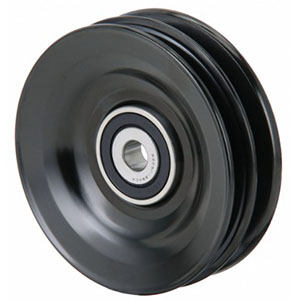
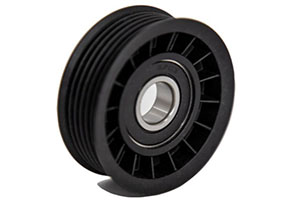
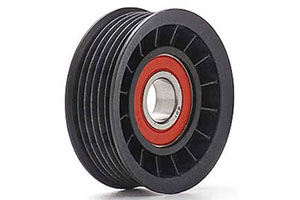
Grooved (V‑Belt) Idler Pulley-Multi‑ribbed grooves match the underside of a micro‑V serpentine belt. The ridges help ensure the belt does not slip off the pulley. Provides positive belt engagement and prevents slip under high alternator or AC compressor load. Available in 4‑, 5‑, 6‑, 7‑groove configurations. Typical outer diameters from 54mm to 80mm.
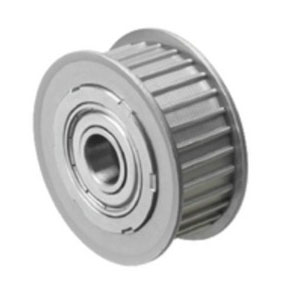
Toothed (Timing) Idler Pulley-External teeth that mesh with timing belt cogs. Timing pulleys and idlers are toothed gears that mesh with a belt rather than each other. Maintains crankshaft‑to‑camshaft synchronisation in interference engines. Used as deflection pulleys or guide pulleys in timing belt kits. Precision‑machined steel or sintered metal. Bore sizes vary by engine family.
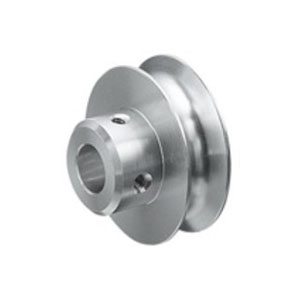
Round Belt / Cable Idler Pulley-Deep‑grooved profile for round belts, urethane belts, ropes, or cables. Typically used in industrial and agricultural equipment rather than automotive. DUHUI offers these primarily for off‑highway and specialty vehicle applications where round cross‑section belts are used.
By Construction Material
Idler pulleys are produced in either steel or engineered polymer variants. The choice of material affects load capacity, heat resistance, weight, and corrosion protection.
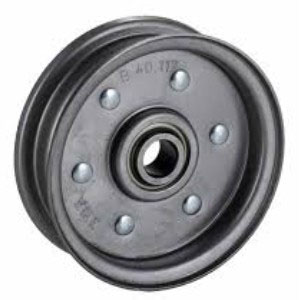
Steel Idler Pulley-Stamped, deep‑drawn, or machined from carbon steel, powdered metal, or stainless steel. Higher load capacity and heat dissipation than polymer. Preferred for heavy diesel engines, high‑torque accessory drives, and applications where belt tension exceeds 500N. Many steel pulleys feature e‑coating (electro‑deposited epoxy) or zinc plating for superior corrosion resistance. Crowned running surfaces aid proper belt tracking.
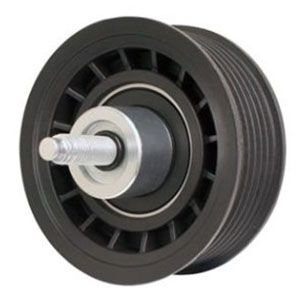
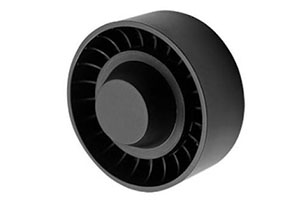
Plastic (Polymer) Idler Pulley-Injection‑moulded from glass‑fibre reinforced Nylon 6/6 (PA66-GF) or PBT. Glass‑reinforced thermoplastic provides ideal dimensional control and running surface durability. Lightweight, corrosion‑proof, and lower rotational inertia. Ideal for passenger car FEAD systems where NVH (noise, vibration, harshness) reduction and cost efficiency are priorities. Typically used with serpentine belts up to 8 rib width.
Aftermarket Series Compatibility
DUHUI idler pulleys are manufactured to directly interchange with major aftermarket brands including Gates, Dayco, INA, and SKF. Each series below lists the compatible brand, key materials, bearing specifications, and target vehicle applications.
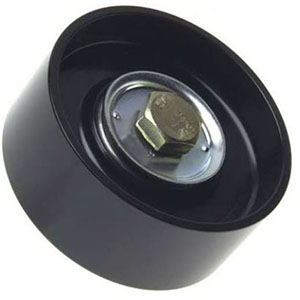
36 Idler Series-Aftermarket idler pulley series compatible with Gates 36 series, ACDelco and OE replacements. Available as locked center tensioning pulley, automatic belt tensioner pulley or idler pulley for passenger cars and light trucks. Features high‑quality bearings that run cooler and last longer than original bearings. Designed for GM LS engines (4.8L, 5.3L, 6.0L, 6.2L) and GMT800 truck platforms, providing reliable belt routing and vibration reduction in serpentine drive systems.
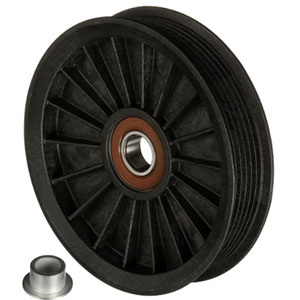
38 Idler Series-Aftermarket idler pulley series compatible with Gates DriveAlign 38 series and ACDelco Professional pulleys. Built to resist dirt, salt and under‑hood contaminants. Features high‑strength bearings that run cooler and last longer than original bearings. Serves as locked center tensioning pulley, automatic belt tensioner pulley or idler pulley for passenger cars and light trucks.
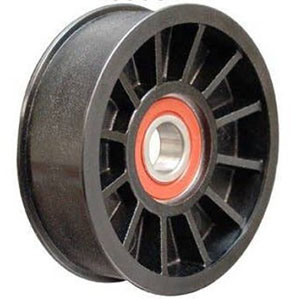
89 Idler Series-Aftermarket idler pulley series compatible with Dayco No Slack 89 series. Features specially formulated glass‑filled polymer or steel construction with smoother surfaces and tighter dimensional tolerances for less vibration and longer belt life. Lifetime‑lubricated bearings with double high‑temperature seals ensure peak bearing performance. Meets or exceeds OEM specifications.
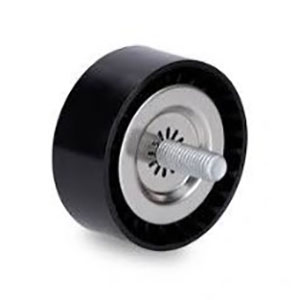
532 Idler Series-Aftermarket idler pulley series compatible with INA 532 series deflection/guide pulleys. Ready‑to‑fit units comprise deep drawn, profiled sheet steel pulley halves riveted together with deep groove ball bearings. Available as deflection/guide pulleys for V‑ribbed belts in FEAD systems, ensuring outstanding vibration damping in the smallest of installation spaces.
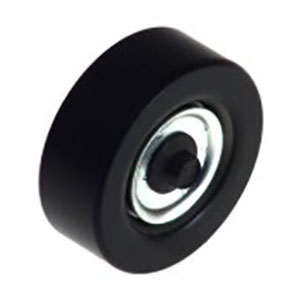
VKM Idler Series-Aftermarket idler pulley series compatible with SKF VKM idler pulleys. Available as deflection/guide pulleys for V‑ribbed belts in accessory drive systems. Features high‑quality steel construction with sealed deep groove ball bearings. Manufactured with low friction ball bearings and high performance grease and seal for OE‑quality performance.-
Other Related Types
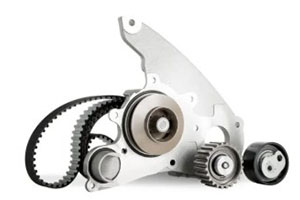
Additional drivetrain components available for comprehensive engine repair.
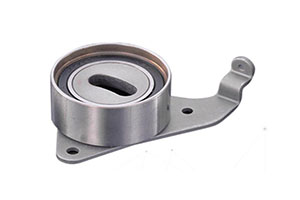
A spring‑loaded or hydraulic pulley that automatically maintains belt tension. Unlike a fixed idler pulley, the tensioner pulley moves to compensate for belt stretch and thermal expansion.
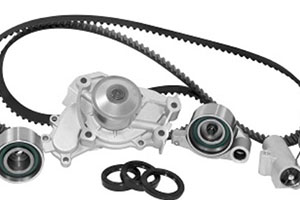
Complete kits including timing belt, tensioner pulley, idler pulleys, and sometimes water pump. Engineered for interference engines requiring precise valve timing.
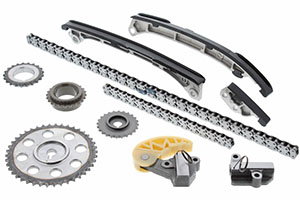
Roller chain kits with guides, tensioners, and sprockets for engines where chain drives replace belts. Limited overlap with idler pulley product line.
Automotive and Light Truck Applications
Idler pulleys are used in every modern internal combustion engine. This section outlines key automotive applications.

Serpentine belt systems on 4‑cylinder, V6, and V8 engines driving alternators, AC compressors, power steering pumps, and water pumps. Belt loads range 200‑400N, speeds up to 10,000 rpm. Polymer pulleys with glass‑filled nylon are common for weight and NVH benefits. DUHUI covers Honda, Toyota, BMW, Mercedes, and VAG platforms.
Higher belt loads from larger alternators (150A+), dual AC systems, and auxiliary fans. Platforms include GM GMT800 (Silverado, Sierra), Ford F‑150, Dodge Ram. Belt tension often exceeds 500N, requiring steel or reinforced polymer pulleys. DUHUI’s 36, 38, and 89 series are validated on these vehicles.
Class 6‑8 trucks with 6.0L to 15L diesel engines (Ford Powerstroke, GM Duramax, Cummins). Steel pulleys with larger bearings (35mm+ bore). Operating temperatures up to 150°C continuous. Belt loads exceed 800N. DUHUI’s 89214 and select 89 series use dual sealed bearings and high‑temperature grease. Applications: Ford F‑Series Super Duty 6.0L/6.7L, Ram 3500.
Ford Transit, Mercedes Sprinter, Ram ProMaster. Long service intervals (150,000+ miles) require high‑durability bearings. Idler pulleys must handle high cyclic thermal stress from stop‑start delivery driving. DUHUI offers interchange pulleys matching INA 532 and SKF VKM series. Steel for diesel variants; polymer for gasoline engines.

Combine harvesters, tractors, skid steers. Belt drives often use round belts, urethane belts, or cables. Idler pulleys feature deep grooves or flat profiles with flanges to prevent belt throw. Sealing must resist dust, mud, and chemicals. DUHUI produces custom idler pulleys for off‑highway applications upon request.
Technical Comparisons for Repair Professionals
Below are linked articles that compare idler pulley types, materials, and brand interchanges. These guides assist in accurate parts identification and replacement decisions.
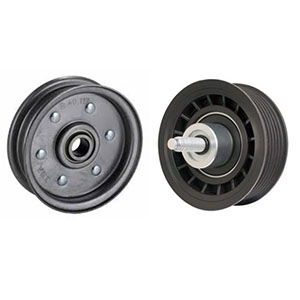
Steel resists heat and impact; polymer resists corrosion and reduces weight. Load capacity, heat dissipation, and operating environment determine which material outlasts the other. Fleet data comparing bearing life, rim wear, and failure modes across driving conditions is presented in this article.
For more details, please read “Steel vs. Polymer Idler Pulleys”.
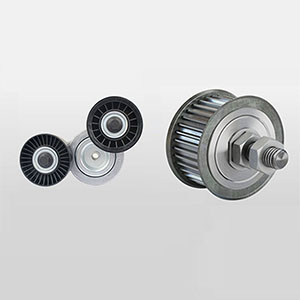
The main functional difference: an idler pulley guides the belt without providing tension, while a tensioner pulley applies adjustable force to maintain belt tension. Idler pulleys are fixed‑center mounted; tensioner pulleys are spring‑ or hydraulically actuated. Visual identification based on adjustability helps avoid misdiagnosis. This article details both.
For more details, please read “Tensioner Pulley vs Idler Pulley: What is the Difference?”.
Recommended Related Products
The following idler pulleys are direct‑fit replacements for original equipment and major aftermarket brands. Each listing includes bore size, outer diameter, width, material, interchange numbers, and confirmed vehicle applications.
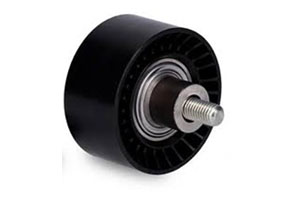
5320660100 – Aftermarket drive belt idler pulley that guides serpentine belt and helps maintain tension. Interchanges with INA 5320660100, OE 11287589361. For BMW S58 and N55 engines across X5, X6, 5 Series, 6 Series, 7 Series. Works with tensioner assembly to guide belt around engine accessories.
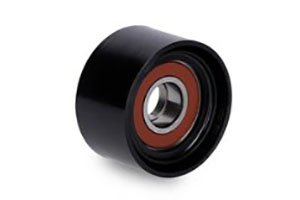
5320234100 – Aftermarket idler pulley for V‑ribbed belt deflection applications. Steel construction with double‑sealed bearing. Interchanges with INA 5320234100 (Global), cross‑referenced as IFE‑FP02341. For European passenger car accessory drive systems requiring reliable belt guidance.
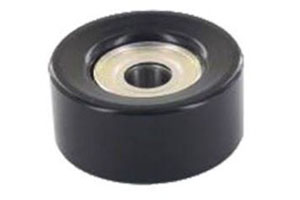
VKM63033 – Aftermarket deflection/guide pulley for V‑ribbed belt with 70mm outer diameter, 30.5mm width. Hydraulic actuation design. Interchanges with SKF VKM63033. Alternative repair kits VKM63018, VKM63019, VKM63030. For European and Asian passenger car accessory drive applications.
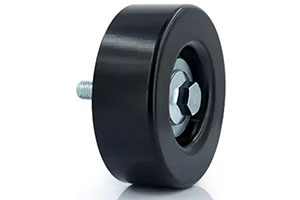
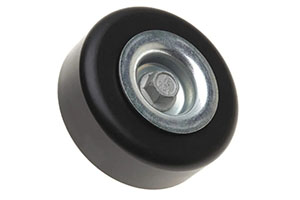
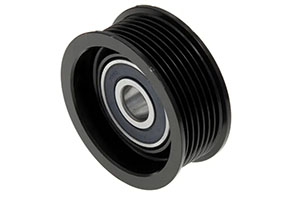
Aftermarket Idler Pulleys: Selection, Failure Diagnosis, and Replacement Guide
Have you ever heard a chirping, rumbling, or screeching noise from under the hood? That’s often a failing idler pulley bearing. These small components keep your serpentine belt routed correctly around the alternator, AC compressor, water pump, and power steering pump. A seized pulley can shred the belt and leave you stranded. This guide covers how aftermarket idler pulleys are built, how to spot different failure modes, and what to look for when buying replacements.
What’s Inside an Idler Pulley Assembly
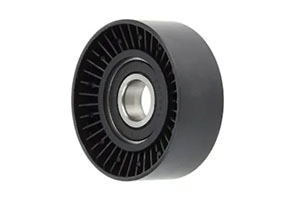
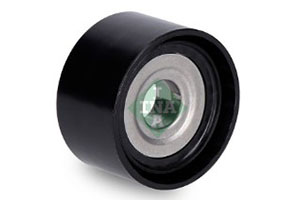
An idler pulley comes as a single, non‑serviceable unit with four main parts:
- Hub – The central mounting point with a through bore. Some hubs taper inversely so they flex under load and help retain lubricant. In other designs, the hub acts as a tubular bearing carrier pressed between the pulley body and the bearing outer race.
- Bearing assembly – A single or double‑sealed deep‑groove ball bearing (typically ABEC‑1 rated) pressed into the pulley body. It handles high rotational speeds with minimal friction. Precision, pre‑lubricated bearings are standard for automotive demands.
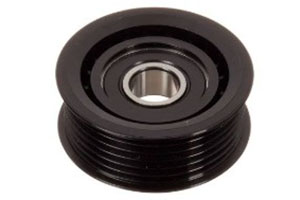
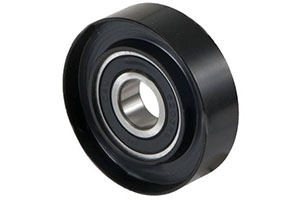
- Outer rim – The belt‑contacting surface, which can be flat (smooth), grooved (V‑ribbed), or toothed. The rim connects to the hub through a web that often includes radial strengthening ribs. In some designs, the belt bearing surface attaches to the bearing’s inner race with a fastener.
- Seals – Double high‑temperature contact seals keep lubricant in and block dirt, salt, and moisture. Service‑free sealed bearings are standard for extended life.
These four components are assembled into a single replacement unit.
Why Bearing Quality Is the Real Differentiator
The bearing determines how long the entire pulley lasts. Original equipment bearings are typically designed for 60,000 to 100,000 miles. Better aftermarket pulleys use deep‑groove ball bearings with C3 internal clearance. That extra space allows for thermal expansion and higher rotational speeds. The grease matters too: lithium‑complex or polyurea formulations stay stable from -40°C to over 150°C. Double‑lip contact seals offer ingress protection close to IP6X standards, meaning fine dust and water spray won’t easily reach the raceway.
Steel vs. Polymer – Matching Material to the Job
Manufacturers make idler pulleys from either steel or engineered polymers, and each has its place.
- Steel pulleys (stamped, deep‑drawn, or machined) are stronger and handle extreme belt loads, making them the choice for heavy‑duty diesel engines. They also shed heat better.
- Polymer pulleys – typically glass‑filled nylon or PBT – are lighter, resist corrosion, and reduce rotational inertia. You’ll find them in most passenger car serpentine systems where weight reduction and noise control are priorities.
A good aftermarket supplier offers both variants with matching bearing specifications.
Belt Surface Profiles – Flat, Grooved, or Toothed
The belt‑contacting surface must exactly match your belt type. Here’s a breakdown:
- Flat (smooth) pulleys – Used against the backside (non‑ribbed side) of serpentine belts. Common on GM LS engines, Ford modular V8s, and many European designs.
- Grooved (V‑ribbed) pulleys – Feature multiple V‑shaped grooves that engage the ribbed side of the belt. Groove count (typically 4, 5, 6, 7, or 8) and pitch (standard 3.5mm for automotive micro‑V belts) must match the belt. Grooved pulleys provide positive drive and prevent belt slip.
- Toothed pulleys – Exclusively for timing belts. The teeth engage belt cogs to keep crankshaft‑to‑camshaft timing accurate. These are often called timing belt idlers or deflection pulleys.
How Interchangeability and Cross‑Reference Work
A large part of the aftermarket business relies on part number cross‑referencing. Many aftermarket pulleys directly replace major brands like Gates, Dayco, ACDelco, INA, and SKF. For example, the 36169 series works on GM LS accessory drives, replacing Gates 36169 and ACDelco 36169. The 89 series matches Dayco No Slack part numbers like 89006 and 89157. The 532 series fits INA deflection pulleys on BMW, Chrysler, and Mercedes‑Benz FEAD systems. A reliable aftermarket pulley will be physically tested for bolt hole alignment, offset, outer diameter, width, and bearing bore tolerance – with torque specs matching OE requirements.
Three Bearing Failure Modes You’ll Encounter
When an idler pulley starts making noise, the bearing is almost always the culprit. But not all failures sound or look the same. Knowing the difference between a rumble, a chirp, and a screech tells you whether the problem is normal wear, heat damage, or dirt intrusion.
Fatigue spalling
Fatigue spalling is what eventually happens to any bearing that runs long enough. After millions of stress cycles, microscopic cracks form on the raceway. Those cracks propagate, and small flakes of metal break off – that’s spalling. The result is increased radial clearance and a low‑frequency rumbling noise. In the early stages, you might only hear it with a mechanic’s stethoscope or a vibration sensor. Once the noise becomes audible inside the cabin, replacement is overdue. Spalling typically appears after 80,000–120,000 miles in normal passenger car use.
Lubricant degradation
Engine bay heat accelerates grease breakdown. The grease separates into base oil and thickener. The base oil evaporates or oxidizes, leaving a dry, soapy residue that no longer lubricates. At that point, the bearing overheats and can seize within 100–500 kilometers. You’ll notice this failure mode earlier on pulleys mounted near exhaust manifolds – especially on the turbocharger side. The noise is often a chirping or squealing sound that changes with engine RPM. On inspection, you might see a dark, baked‑on residue around the seal area. The solution is a grease with a higher temperature rating, such as polyurea or high‑grade lithium‑complex.
Contamination ingress
Contamination ingress happens when seals harden from age or get damaged during installation. Road salt, washing detergent, fine sand, or dust enters the bearing and acts as an abrasive. The acoustic signature is distinct: a high‑pitched screech rather than a low rumble or chirp. Visual inspection may reveal rust bleeding past the seal lip or a gritty feel when you spin the pulley by hand. This failure mode can happen at any mileage – sometimes within weeks if a seal was nicked during a belt replacement. Double‑lip contact seals and careful installation (avoiding prying against the pulley) are the best prevention.
Case Study: GM LS Engine Idler Pulley (36169)
The GM LS engine family provides a clear example. Original equipment idler pulleys on LS engines typically fail between 80,000 and 120,000 miles. The dominant failure mode is lubricant degradation, not fatigue spalling. Why? The exhaust crossover pipe runs close to the idler pulley, baking the bearing. Aftermarket pulleys that use polyurea grease and a double‑lip seal have extended service life to over 150,000 miles in controlled fleet tests. That’s a 25–50% improvement purely from better grease and sealing – no changes to the bearing geometry or steel.
Bearing Selection Criteria – What Engineers Specify
For any given idler pulley application, engineers specify four things: bearing series (typically 6200 or 6300 series), internal clearance (CN or C3), grease type, and seal configuration. C3 clearance is a smart choice for most aftermarket applications because it allows for thermal expansion without increasing preload. Grease fill should be about 30–35% of internal free volume – higher than many OEM fills, which keeps the bearing lubricated longer under high heat. Seal contact angle also matters: too much contact increases friction, too little lets contamination in. The right balance depends on the operating environment.
Installation Errors That Cause Premature Failure
Even a perfect bearing won’t last if installed incorrectly. Watch out for these common mistakes:
- Over‑torquing the mounting bolt – Distorts the bearing inner ring, increases ball stress, and generates heat. For M8 bolts, stick to 25–35 Nm; for M10, use 40–50 Nm.
- Under‑torquing – Lets the pulley wobble, causing uneven load distribution and seal damage.
- Incorrect washer placement – Steel and polymer pulleys often need different washers or spacers. Using the wrong one changes the offset and belt tracking.
A quality aftermarket pulley includes basic torque specifications with each unit. Following them takes two minutes and can double the service life.
Signs Your Idler Pulley Is Failing
Fleet operators and DIY mechanics should inspect idler pulleys when replacing a serpentine belt or when these symptoms appear:
- Rumbling or chirping noise – Usually means bearing wear or loss of lubrication.
- Visible wobble or free rock – Lateral play over 1mm suggests bearing or hub deformation.
- Belt tracking off center – A misaligned pulley causes the belt to ride against flanges or walk off the pulley.
- Cracked or melted polymer rim – Too much heat from a seized bearing or over‑tensioned belt.
- Rust or corrosion around the hub – Seal failure let moisture in.
A good rule of thumb: replace all idler pulleys and the tensioner pulley when you change the serpentine belt. Bearing wear is progressive, and all components tend to fail within a similar mileage window.
What Quality Testing Looks Like
Each production batch of a reputable aftermarket pulley should undergo several standard tests. The table below summarizes key tests and acceptance criteria:
| Test | Description / Standard |
|---|---|
| Bearing noise test | Sound measurement under rotational load (1,000–6,000 rpm) |
| Radial and axial runout check | Tolerance maintained within 0.3mm TIR |
| Torque decay test | Fastener retention after thermal cycling |
| Salt spray test | 96 hours minimum for steel pulleys (ASTM B117) |
| High‑temperature endurance | 500 hours at 120°C continuous rotation |
Test results should be documented and traceable by production lot number. That data supports warranty claims and gives repair professionals confidence.
Which Vehicle Platforms These Pulleys Fit
Aftermarket idler pulleys are available for a wide range of vehicles. Common fitments include:
- GM platforms – LS engines (4.8L, 5.3L, 6.0L, 6.2L) in Silverado, Sierra, Suburban, Tahoe, Corvette; GMT800 truck chassis; GM passenger cars from the 1990s through 2010s.
- Ford – Explorer 5.0L, F‑Series Super Duty with 6.0L/6.7L diesel, modular V8/V10 engines.
- Chrysler – 3.6L Pentastar, 5.7L HEMI, and Mercedes‑derived OM642 diesel.
- BMW – N‑series (N55, N52) and S58 engines; E‑series and F‑series chassis.
- Honda / Acura – Accord, TSX, CR‑V with K‑series and J‑series engines.
- Subaru – EJ22, EJ25 engines in Forester, Legacy, Impreza.
- Toyota – Prius (2001–2009) accessory drive systems.
- European passenger cars – VAG, Mercedes, BMW, PSA, and Renault applications via common cross‑references.
The Economic Case for Replacing Idler Pulleys in Sets
Here’s a fact from fleet maintenance data: replacing all pulleys during a belt service reduces roadside breakdowns by 78% over two years. The labor cost to access a serpentine belt system often exceeds the combined parts cost of the belt, tensioner, and all idler pulleys. If one pulley fails and you replace only that one, you’ll pay that labor again when the next one fails – often within 20,000 miles. That triples the total repair cost. Doing everything at once is simply cheaper and more reliable.
Future Trends – Hybrids and Higher Speeds
Electric vehicles eliminate serpentine belts entirely, but hybrids keep them – and add higher duty cycles. Start‑stop operation means more engine starts and more belt movement. 48V mild hybrid systems are particularly demanding: they require idler pulleys with even lower friction and higher speed capability, up to 18,000 rpm. Standard bearings start struggling above 12,000–14,000 rpm. The next generation of hybrid FEAD systems will need low‑drag seal designs and possibly ceramic hybrid bearings. Several aftermarket manufacturers are already developing these solutions.
Conclusion
Idler pulley bearing failures follow predictable patterns. Fatigue spalling gives you a low rumble after high mileage. Lubricant degradation causes chirping from heat exposure – common near exhaust components. Contamination ingress produces a high‑pitched screech and often shows rust or grit. Listen to the noise, look for visible signs, and match the failure mode to the cause.
When you need to buy an aftermarket idler pulley, look for C3 clearance bearings with high‑temperature polyurea grease and double‑lip seals. Match the surface profile (flat, grooved, or toothed) to your belt type. Always check interchange data against OE or major brand part numbers. Torque bolts correctly – over‑torquing or under‑torquing both shorten life. And when you replace a serpentine belt, replace every idler pulley and the tensioner at the same time. The data shows it cuts breakdowns by nearly 80% and saves you labor costs in the long run. A well‑chosen aftermarket pulley will easily match or exceed the original 60,000‑ to 100,000‑mile service life.
There is no fixed interval independent of the belt. Most manufacturers recommend inspecting idler pulleys at every belt replacement (typically 60,000–100,000 miles) and replacing them if any play, noise, or roughness is detected. For high‑mileage fleets, proactive replacement at the second belt change is common practice.
Chirping (high‑frequency intermittent noise) is typically caused by bearing lubrication starvation or a misaligned belt. A worn bearing produces a rumbling or grinding sound, not chirping. Check belt alignment first; if alignment is correct, replace the idler pulley.
Not recommended for automotive applications. Most idler pulleys are assembled as a permanent unit with the rim pressed over the bearing. Attempting to replace only the bearing often damages the rim or results in incorrect bearing preload. Complete pulley replacement ensures proper fit and safety.
A flat pulley contacts the smooth backside of a serpentine belt. A grooved pulley has multiple V‑shaped ribs that engage the ribbed underside of the belt. Use the wrong type and the belt will slip or wear rapidly. Check your original pulley profile before ordering.
Yes. DUHUI manufactures each series to the same physical dimensions, bolt hole pattern, offset, and bearing specification as the corresponding Gates, Dayco, INA, or SKF part. Cross‑reference numbers are printed on the box and listed on this page.
Use the OE part number stamped on your original pulley, or the aftermarket interchange number (e.g., Gates 36169). DUHUI idler pulleys are listed by series and interchange number. If unsure, contact our technical support with your vehicle make, model, year, engine code, and a photo of the original pulley.
No. Plastic (polymer) idler pulleys have lower mechanical strength and lower thermal conductivity. They are suitable for passenger car FEAD systems with belt loads under 400N. Steel idler pulleys are required for heavy‑duty diesel, commercial van, or high‑torque accessory drives.
A new idler pulley bearing is packed with fresh grease and has a seal drag that makes it feel slightly stiff. This is normal. Compare with the old pulley – if the old one spins freely with zero resistance, its grease has dried out and the bearing was failing. The new pulley will loosen slightly after a few hundred miles of operation.
For M8 bolts (most common), 25–35 Nm. For M10 bolts, 40–50 Nm. Always use a torque wrench. Over‑torquing distorts the bearing; under‑torquing allows wobble. Specific values may vary by vehicle – consult your repair manual if available.
Yes. The 89214 series and select 89 series pulleys are designed for heavy diesel engines. Contact our sales team with your application details for specific recommendations.