Quick Answer: What’s the Difference Between CV Joints and U‑Joints – and Which One Do You Need?
CV joints keep output speed constant at any angle (up to 48°) and need no grease. U‑joints speed up and slow down twice per revolution when angled, max out at 15–25° (low speed) or 3–4° at highway RPM, and require grease every 5,000 miles.
For most front‑wheel‑drive cars and independent suspension vehicles → choose CV joints. For solid‑axle trucks, heavy towing (800+ lb‑ft), or trail repairs → choose greaseable U‑joints.
In any vehicle with an internal combustion engine and driven wheels, power must travel from the transmission to the axles. This path is rarely a straight line. Suspension movement, steering angles, and ride height changes all create variations in the driveline angle. Two common solutions exist to transmit rotary motion through these angles: CV joints (constant velocity joints) and U-joints (universal joints, also known as cross shafts or cardan joints).
Each design has distinct operating characteristics, angle limits, maintenance needs, and failure modes. Understanding these differences helps vehicle owners, repair technicians, and off-road enthusiasts select the correct joint for a given application.
This article compares CV joints and U‑joints across multiple technical criteria – working angles, service life, cost, failure symptoms, and typical vehicle fitments – and answers ten frequently asked questions on the topic.
What Is a U‑Joint?
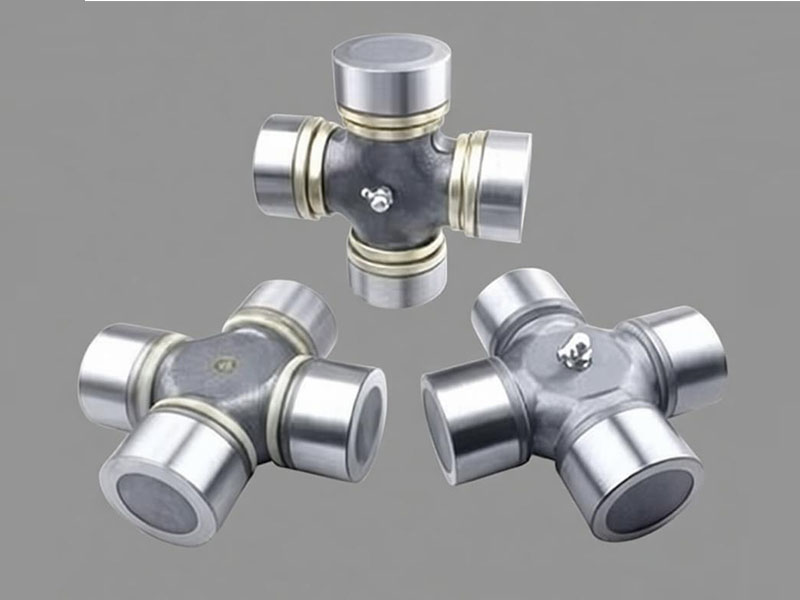
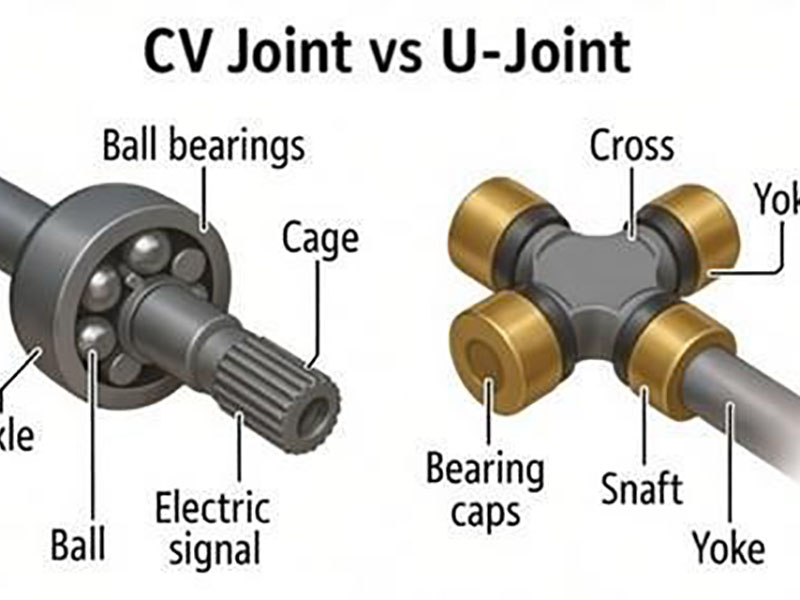
A universal joint, commonly shortened to U‑joint, consists of a cross‑shaped component (the spider or cross) with four bearing caps. Each cap is pressed into a yoke, allowing the joint to pivot in one plane. This simple mechanical arrangement has been used for over a century and remains in widespread production today.
Typical Applications
U‑joints are found in:
- Driveshafts of rear‑wheel‑drive and four‑wheel‑drive vehicles with solid axles
- Connection points between transfer cases and differentials in 4×4 systems
- Heavy‑duty trucks, agricultural machinery, and industrial drivelines
- Steering linkages in some older or commercial vehicle designs
Because solid axle suspensions keep the differential housing at a relatively constant angle relative to the transmission, the U‑joint’s limited angular capacity is not a major drawback in these configurations.
Operating Angle Limits and Velocity Behavior
A single U‑joint does not maintain constant output speed when operating at an angle. For every full rotation of the input shaft, the output shaft accelerates twice and decelerates twice. This phenomenon is known as angular velocity variation.
To cancel out this speed fluctuation, U‑joints are normally installed in pairs on a driveshaft – one at the transmission end and one at the differential end – with the two working angles kept within approximately 3 degrees of each other.
The maximum practical operating angle for a single U‑joint is 15 to 25 degrees at low speeds (e.g., crawling or parking maneuvers). At higher rotational speeds, such as 5,000 RPM on a highway, the allowable angle drops sharply to around 3 to 4 degrees. Exceeding these limits produces a double‑frequency vibration that rapidly wears the needle bearings and yokes.
Advantages and Disadvantages of U‑Joints
Advantages:
- Low manufacturing and replacement cost – a typical U‑joint is $15–50
- Simple replacement procedure – can be done with a press and basic hand tools
- Wide availability across vehicle brands and eras
- Field‑serviceable – repairs possible on the trail or roadside
- High torque capacity – suitable for heavy trucks exceeding 800 lb‑ft
Disadvantages:
- Small operating angle, especially at highway speeds
- Vibration and harshness if angles are mismatched or excessive
- Regular maintenance required on greaseable models (every 5,000 miles)
- Seals can fail, allowing water and dirt into the needle bearings
What Is a CV Joint?
A constant velocity joint, or CV joint, overcomes the speed fluctuation problem inherent in a single U‑joint. Regardless of the operating angle, the output shaft speed remains exactly equal to the input shaft speed. This characteristic is essential for front‑wheel‑drive vehicles and independent front suspensions, where axles must turn at sharp angles while steering and moving up and down.
Common CV Joint Designs
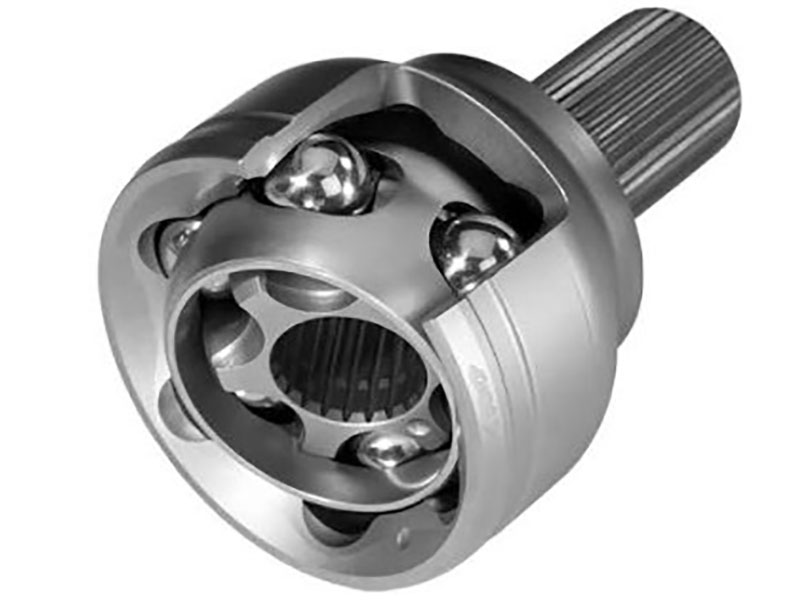
Ball‑type (Rzeppa) CV joint – The most widely used design. Steel balls run in curved grooves between an inner race and an outer housing. This construction allows smooth power transmission at angles up to 45–48 degrees. Ball‑type CV joints are typically found on the wheel side of front drive axles.
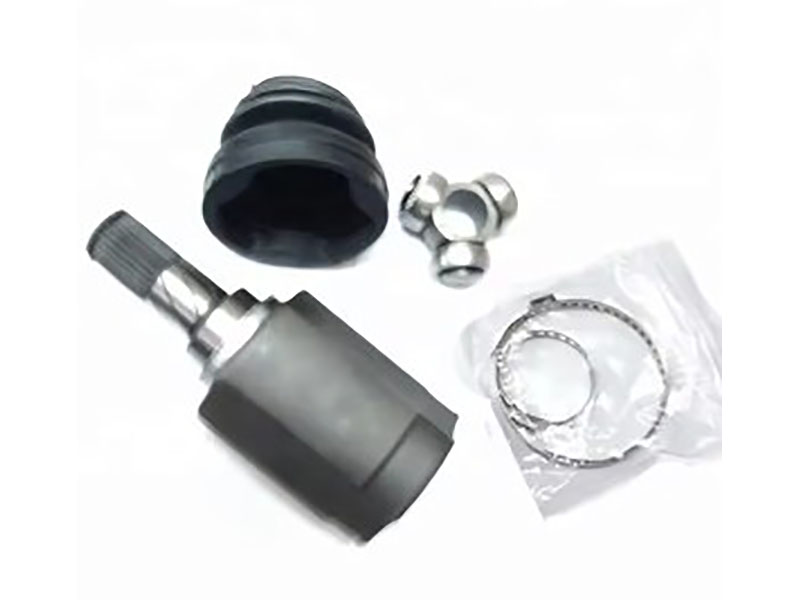
Tripod (tulip) CV joint – Uses three roller bearings mounted on a spider‑shaped inner member. Maximum angle is lower (approximately 26 degrees), but the design allows axial movement of up to 50 mm (about 2 inches). Tripod joints are often installed on the inboard side of front drive shafts, where suspension compression and extension change the shaft length.
Double Cardan joint – Technically not a true CV joint. It uses two U‑joints with a centering yoke to approximate constant velocity. While effective at reducing vibration, it does not achieve zero velocity fluctuation. Double Cardan joints are common on lifted truck front driveshafts and some off‑road applications.
Advantages and Disadvantages of CV Joints
Advantages:
- Zero speed fluctuation – output equals input at any angle
- High angular capacity – up to 48 degrees for ball‑type designs
- Vibration‑free operation at highway speeds
- No routine greasing – sealed lubricant lasts the joint’s service life if the boot remains intact
- Compact form factor – fits within space‑constrained front‑wheel‑drive platforms
Disadvantages:
- Higher replacement cost – complete half‑shaft assemblies range from $60–150 plus $150–350 labor
- Not field‑serviceable – special tools and a clean environment are typically required
- Catastrophic failure mode – a broken CV joint often damages surrounding components (axle housing, differential, brake parts)
- Boot failure leads to rapid joint death – a torn rubber boot allows grease loss and contamination, destroying the joint within hundreds of miles
Key Differences at a Glance
The table below summarizes all major differences between U‑joints and CV joints.
| Comparison Dimension | U‑Joint | CV Joint |
|---|---|---|
| Maximum working angle (low speed) | 15–25° | 45–48° |
| Maximum working angle (high speed, ~5000 RPM) | 3–4° | 45–48° (no reduction) |
| Speed consistency | Fluctuates (two pulses per revolution); requires paired installation | Constant velocity (zero fluctuation) at any angle |
| Routine maintenance | Grease every 5,000 miles (greaseable types) | Visual boot inspection only; no regular greasing |
| Replacement cost (parts + labor) | $80–150 (typical) | $210–500 (half‑shaft assembly) |
| Failure warning | Often provides advance noise/vibration | May fail suddenly with minimal warning |
| Consequence of failure | May still creep at very low speed; damage often localized | Vehicle typically immobile; towing required; collateral damage common |
| Typical applications | Solid‑axle driveshafts, heavy trucks, off‑road (some users) | FWD, IFS front axles, lifted vehicles, passenger cars |
The following sections expand on the three most practically relevant differences.
Difference in Service Life and Maintenance Cost
Expected durability under normal use
- CV joints – With an intact boot, a factory CV joint commonly reaches 70,000 to 130,000+ miles. Most failures trace directly to boot damage, not to internal wear.
- U‑joints – A greaseable U‑joint that receives fresh NLGI #2 grease every 5,000 miles can outlast a sealed “lubed‑for‑life” unit. In heavy‑duty truck applications, properly maintained U‑joints often exceed 100,000 miles.
Cost comparison
| Cost Factor | U‑Joint | CV Joint |
|---|---|---|
| Component cost | $15–50 per joint | $60–150 per half‑shaft |
| Typical labor | $50–100 | $150–350 (1.5–3 hours) |
| Total (parts + labor) | $80–150 | $210–500 |
| Routine maintenance | Grease every 5,000 miles | Visual boot inspection only |
Many professional repair shops choose to replace the entire half‑shaft assembly rather than disassemble and rebuild a CV joint. The assembly replacement is faster, carries less warranty risk, and includes a new boot and joint.
Primary causes of failure differ significantly
- CV joint failure – The rubber boot tears or develops a pinhole crack. Centrifugal force flings grease out of the joint. Within a few hundred miles, contamination enters and the joint begins to wear rapidly. By the time clicking noises appear, the joint is already damaged beyond repair.
- U‑joint failure – Lack of lubrication causes needle bearing galling. Alternatively, the joint is forced to operate beyond its angle limit, or a damaged seal allows water and grit into the bearing caps. Rust‑colored dust around the bearing caps is a telltale sign of failed needle bearings.
Difference in Failure Symptoms and Consequences
Symptoms of a worn CV joint
| Symptom | Probable Cause |
|---|---|
| Clicking or popping noise during turns (especially at full steering lock) | Worn outer ball joint – balls skipping in worn grooves |
| Side‑to‑side vibration or shake during straight acceleration | Worn inner tripod joint |
| Steady vibration at a specific speed range (e.g., 40–50 mph) | Joint imbalance, worn bearings, or bent half‑shaft |
| Brown or black grease splattered on wheel well, control arm, or underbody | Torn CV boot – grease expelled, contamination already inside |
Symptoms of a worn U‑joint
| Symptom | Description |
|---|---|
| Single “clunk” when shifting from Park to Drive or Reverse | Excessive internal clearance; joint has noticeable rotational play |
| Squeaking or chirping at low speed, especially in reverse | Often starts at the differential end because angle is steeper there |
| Cyclical vibration at 30–40 mph or 65–80 mph | Vibration frequency is twice wheel speed – hallmark of U‑joint failure |
| A “bouncing” or “dancing” sensation in the rear under acceleration | High‑speed vibration transmitted through chassis |
Inspection methods
- Checking U‑joints – Raise the vehicle and support the axle safely. Grasp the driveshaft near each joint and try to rotate it by hand while watching the joint. Any perceptible rotational play or clicking indicates wear. Also look for reddish‑brown dust around the bearing caps – this is oxidized needle bearing residue.
- Checking CV joints – Inspect the rubber boots visually. Look for cracks, tears, or areas wet with grease. If a boot is damaged but no clicking noise is present, the joint may be saved by replacing the boot and repacking with fresh grease. Once clicking starts, the joint must be replaced.
Consequences of failure – a critical difference
| Aspect | U‑Joint | CV Joint |
|---|---|---|
| Advance warning | Usually provides noise/vibration before complete breakage | May fail with little or no warning |
| Mobility after failure | May still creep at very low speed | Vehicle typically immobile; towing required |
| Collateral damage | Usually limited to the joint and yokes | Often damages axle housing, differential, brake components |
This difference explains why some off‑road drivers continue to prefer U‑joints in extreme environments – a U‑joint can sometimes be driven out and replaced with hand tools on the trail. A broken CV joint usually means an expensive tow and extensive cleanup.
Difference in Suitable Applications and Vehicle Types
The table below provides application guidance based on vehicle configuration, torque level, ride height, and usage environment.
| Vehicle / Condition | Recommended Joint | Technical Reason |
|---|---|---|
| Front‑wheel‑drive passenger cars | CV joint (ball‑type) | Steering angles exceed 30°; constant velocity required |
| Independent front suspension (IFS) 4x4s – front axle | CV joint | Similar to FWD; wheel moves through large vertical and steering arcs |
| Heavy trucks (800+ lb‑ft torque) – main driveshaft | Greaseable U‑joint | Standard CV joints of comparable size fail under sustained high torque |
| Off‑road / rock crawling (some users) | U‑joint | Failure is often localized; vehicle may still move at low speed after joint breakage |
| Lifted vehicles (ride height increased >2–3 inches) | CV joint or double Cardan | U‑joint operating angles become excessive, causing high‑speed vibration |
| Solid rear axle at original ride height | U‑joints (paired at both ends) | Angles remain small; simple construction is adequate and durable |
Summary of application logic
- CV joints are the default choice for any application where the joint must operate at high angles (above 25 degrees) or at high speeds with significant angles. This includes virtually all front‑wheel‑drive and independent front suspension vehicles, as well as any vehicle with a lift exceeding 2–3 inches.
- U‑joints remain the better choice for high‑torque, low‑angle drivelines – especially heavy trucks, solid‑axle rear driveshafts, and vehicles where field repair capability is a priority. Their lower cost and simpler construction are advantages when operating angles stay within safe limits.
Conclusion
For the vast majority of modern passenger vehicles – front‑wheel‑drive cars, crossovers, and independent‑suspension SUVs – CV joints are the correct engineering choice. They provide smooth, vibration‑free power transmission across the full range of steering and suspension angles, with no routine lubrication required.
U‑joints remain a practical, durable, and cost‑effective solution for solid‑axle trucks, heavy‑duty towing applications, and older or classic vehicles. For owners who perform their own repairs or operate in remote areas where simplicity and field serviceability matter most, the U‑joint continues to be a proven design.
When selecting replacement joints, choose components from a manufacturer with documented quality control – proper material grade, heat treatment, and sealing directly affect service life.
Frequently Asked Questions (FAQs)
Q: Which is more durable – a CV joint or a U‑joint?
A: Durability depends on conditions. A CV joint with an intact boot commonly exceeds 100,000 miles. A greaseable U‑joint that is lubricated every 5,000 miles can also reach 100,000+ miles. The leading cause of premature failure for both is contamination – dirt in a U‑joint or a torn CV boot.
Q: How can I tell which type my vehicle uses?
A: Check the factory configuration:
– Front‑wheel‑drive cars: CV joints on both ends of each front axle.
– Rear‑wheel‑drive with solid rear axle: U‑joints on the driveshaft.
– Independent rear suspension: CV joints on rear axles.
– 4×4 with independent front suspension: CV joints on front axles; U‑joints on driveshaft(s).
Q: Can I drive with a failing CV joint?
A: No. A worn CV joint can break without warning, leaving the vehicle stuck. Broken pieces frequently damage the axle housing, differential, or transmission. Replace the joint or half‑shaft as soon as symptoms appear.
Q: My U‑joint is squeaking – what should I do?
A: If the joint has a grease fitting, apply NLGI #2 lithium grease until old grease purges from the seals. If squeaking continues, or if you feel a “clunk” when changing gears, the joint is worn and must be replaced.
Q: Do I need to switch to CV joints after lifting my vehicle?
A: Not necessarily. Lifts up to 2–3 inches may still work with properly angled U‑joints. Above 3 inches, the driveshaft angle often exceeds the safe limit for U‑joints, causing vibration. A double Cardan joint (which approximates constant velocity) or a true CV joint is the correct solution for taller lifts.
Q: Can I convert a U‑joint system to CV joints?
A: Yes, but the conversion typically requires replacing the entire driveshaft or axle shaft assembly. Conversion kits exist for popular off‑road vehicles (for example, RCV high‑angle CV axles). Cost is significantly higher than replacing U‑joints, but the benefit is smoother operation at extreme angles.
Q: My CV boot is torn but the joint does not click yet. Do I need a new axle?
A: Not necessarily. If detected early – before dirt enters and before any noise develops – you can replace only the boot and repack the joint with fresh grease (a “reboot” job). However, many shops recommend replacing the complete half‑shaft because the labor cost is similar, and a new assembly comes with a new joint and boot.
Q: Why do heavy trucks and some SUVs still use U‑joints instead of CV joints?
A: Heavy trucks often transmit 800 lb‑ft of torque or more. A standard CV joint of similar physical size would fail quickly under that sustained torque. Large, heavy‑duty U‑joints are simpler, more robust, and lower in cost for high‑torque applications. Additionally, solid axles keep driveline angles small, minimizing the disadvantages of U‑joints.
Q: For off‑road use, should I choose U‑joints or CV joints?
A: The choice depends on driving style and conditions:
– Rock crawling / extreme angles: High‑angle CV joints (e.g., RCV) provide smooth power at full steering lock.
– Mud, high torque, remote trails: Some drivers prefer U‑joints because they are cheaper and can be replaced on the trail with hand tools.
– Mixed use (daily driver plus weekend trails): CV joints offer better on‑road refinement.
Q: Is a double Cardan joint the same as a true CV joint?
A: No. A double Cardan joint uses two U‑joints and a centering ball to approximate constant velocity. It reduces vibration significantly but does not achieve zero velocity fluctuation. True CV joints (ball‑type) have exactly zero fluctuation. In practice, double Cardan joints are often used on lifted truck front driveshafts, while true CV joints are used on half‑axles in steering applications.