
Thrust Needle Roller Bearings
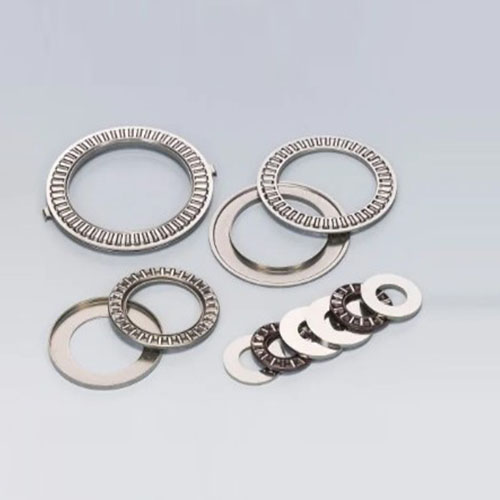
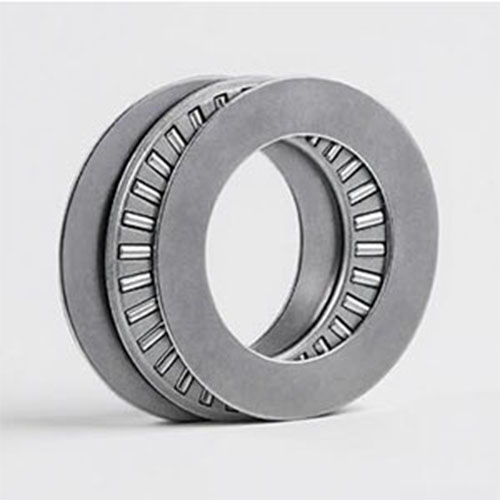
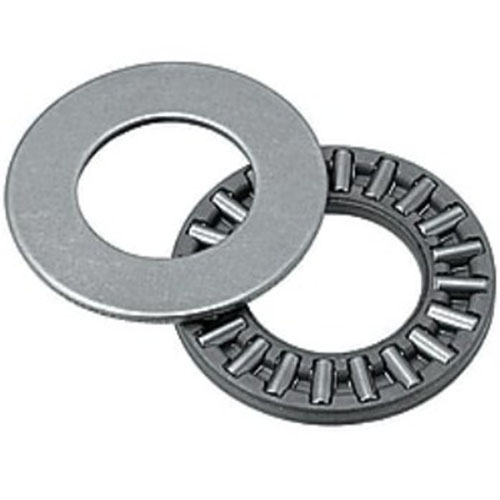
A thrust type needle roller bearing comprises a steel cage and multiple needle rollers oriented radially around the bearing axis. Its function is to transmit axial forces between two rotating parts while generating low friction.
The cage is stamped or machined from surface-hardened sheet steel. Needle rollers are produced with a diameter tolerance within 2μm. When the mating shaft or housing surfaces are not sufficiently hard, separate thrust washers (LS, AS, GS, WS designs) are applied.
Performance Features
- Extremely low sectional height – the smallest among all thrust bearing categories
- High axial capacity through line contact geometry
- Rigid structure due to precision rollers (2μm accuracy)
- Low friction coefficient for improved energy efficiency
- Option of cage-only or pre-assembled unitized versions
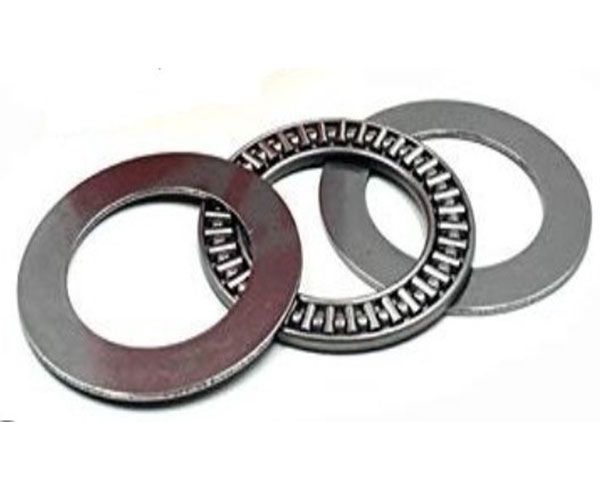
Detailed Technical Reference
Axial needle roller bearings are a specialized category of rolling bearings engineered to sustain high thrust loads while occupying minimal axial space. In contrast to radial bearings that handle forces perpendicular to the shaft, thrust needle roller bearings are designed for loads acting parallel to the shaft axis. Their defining feature is needle rollers with a length-to-diameter ratio typically between three and ten, enabling high load capacity within a compact cross-sectional area.
The core components of such a bearing are a cage and a set of needle rollers. The cage, usually stamped from case-hardened steel sheet, positions the needle rollers in a radial pattern around the bearing centerline. This spoke-like arrangement ensures each roller makes line contact with the raceway surfaces, distributing the axial load evenly across the bearing. During operation, the needle rollers roll between two hardened surfaces – either the machine’s own shaft and housing faces or separate thrust washers.
Several performance characteristics derive directly from this construction. The line contact between needle rollers and raceways yields high axial load capacity, while the low height of the cage and rollers keeps the overall bearing profile to a minimum. Needle rollers are manufactured with diameter variation controlled within 2μm, which promotes uniform load distribution and reduces localized stress. This precision translates into extended service life under fluctuating axial loads. Moreover, the rolling motion generates a low coefficient of friction, thereby improving mechanical efficiency and reducing heat generation.
Thrust needle roller bearings come in two principal configurations. The first is cage-only assemblies (e.g., AXK series) that require separate bearing washers. The second is unitized bearings (e.g., AXW series) that incorporate the washers as part of the package. Cage-only designs depend on properly hardened and ground adjacent machine components to act as raceways. Unitized designs remove the need for heat treatment of mating parts and simplify installation procedures.
For B2B buyers active in the automotive aftermarket, selecting a thrust needle roller bearing involves evaluating dimensional accuracy, load ratings, and interchangeability with existing assemblies. The most frequently replaced metric types include AXK, AS, and WS series, while inch-type designs such as NTA, TWA, and TRA are common in North American applications. Understanding cross-references between different brand designations is essential for distributors and repair workshops.
The demand for thrust needle roller bearings continues to rise, driven by the need for lightweight, high-performance components in vehicle transmissions, gearboxes, and powertrain systems. As automotive manufacturers pursue improved fuel economy and reduced emissions, the low-friction and compact nature of these bearings makes them integral to modern drivetrain engineering.
Product Types and Series
Thrust needle roller bearings are offered in four primary variants, each addressing different installation and loading requirements. The following section first describes each variant, then lists the most popular aftermarket part numbers for each category.
- Product Types
- Needle Roller and Cage Thrust Assemblies
- Unitized Thrust Needle Roller Bearings
- Combined Needle Roller Bearings
- Full Complement Thrust Needle Roller Bearings
Product Types
Thrust needle roller bearings fall into four categories based on their assembly structure: needle roller and cage thrust assemblies, unitized thrust bearings, combined radial-thrust needle roller bearings, and full complement (cageless) designs. Each type serves specific application needs related to load level, rotational speed, installation convenience, and the requirement for separate raceway washers.
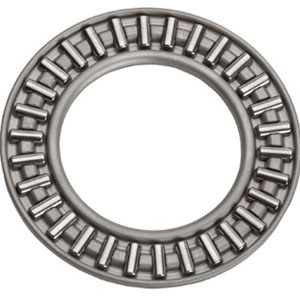
This variant includes only the cage and needle rollers – no washers are integrated. It depends on properly hardened and ground adjacent components to function as raceways. When the mating parts are not suitable for that role, separate thrust washers must be purchased.
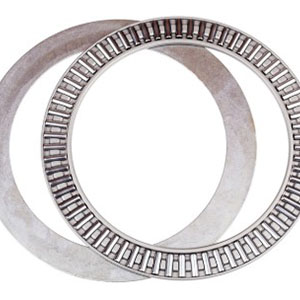
Unitized bearings combine the needle roller and cage assembly with one or both raceway washers into a single inseparable unit. This simplifies handling during installation and removes the need to heat-treat adjacent machine components.
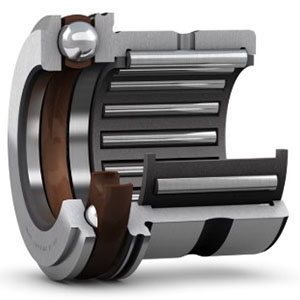
Combined bearings integrate a radial needle roller bearing with an axial needle roller or cylindrical roller thrust bearing. They support both radial and axial forces simultaneously within a compact footprint, eliminating the need for two separate bearings.
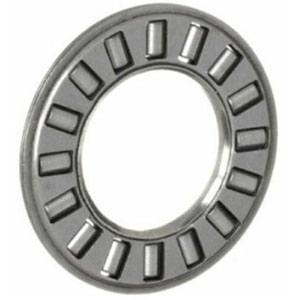
Unlike caged designs where needle rollers are spaced apart, full complement bearings fill the available space with the maximum possible number of rollers. This increases load capacity but reduces allowable speed due to roller-to-roller contact.
Needle Roller and Cage Thrust Assemblies
This configuration is the most commonly used thrust needle roller type in automotive transmissions and industrial gear reducers. The models listed below are high-turnover SKUs in the aftermarket, supplied with full interchangeability.
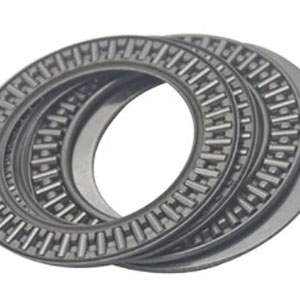
AXK 0414 Axial Needle Roller Assembly Metric series cage assembly – 4 mm bore, 14 mm outside diameter, 2 mm thickness. Requires AS 0414 washers. Applied in small gearboxes and transmission pumps.
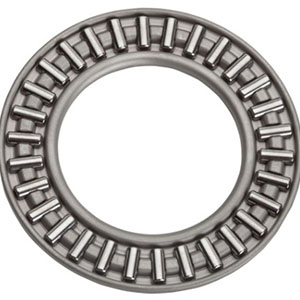
AXK 0515 Thrust Cage Assembly 5 mm bore, 15 mm OD, 2 mm thick. Suitable for automotive accessory drives and miniature compressor units where space is tight.
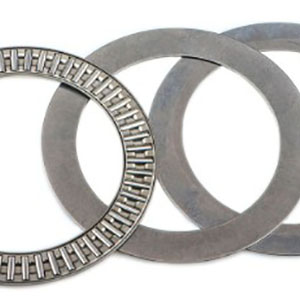
AXK 1024 Axial Needle Bearing Assembly 10 mm bore, 24 mm OD, 2 mm thick. One of the highest-volume aftermarket models, commonly used in automatic transmission valve bodies.
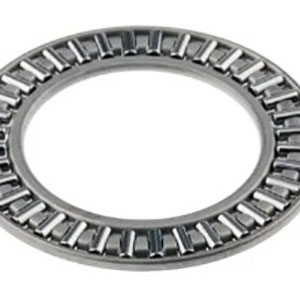
AXK 110145 Heavy-Duty Thrust Assembly 110 mm bore, 145 mm OD, 4 mm thick. Designed for large commercial vehicle transmissions and industrial gearboxes with substantial axial loads.
Unitized Thrust Needle Roller Bearings
Unitized designs are chosen when separate washers are inconvenient or when fast installation is required. The following models come with integrated raceway washers and are ready for direct fitment.
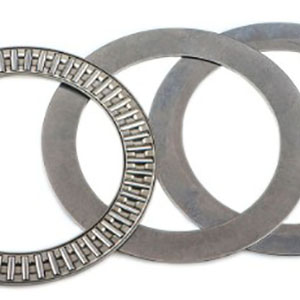
AXW 1024 Unitized Axial Needle Bearing Complete bearing with built-in shaft and housing washers. 10 mm bore, 24 mm OD, 6 mm overall height. Suited for automotive air conditioning compressor mounting.
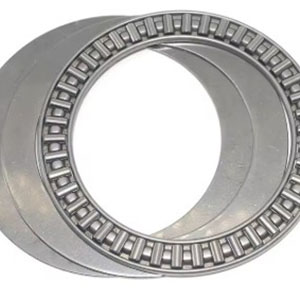
AXW 1226 Pre-Assembled Thrust Bearing 12 mm bore, 26 mm OD, 6 mm height. Pre-greased and sealed. Used in small electric motor axial positioning applications.
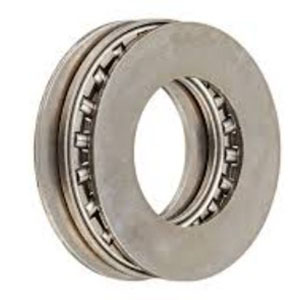
AXW 1528 Integrated Thrust Needle Bearing 15 mm bore, 28 mm OD, 6 mm height. Offers high axial stiffness within a fully enclosed package. Found in agricultural equipment transmissions.
Combined Needle Roller Bearings
Combined bearings manage both radial and axial loads in one component. These models are often replaced in automotive planetary gear sets and industrial rotary actuators.
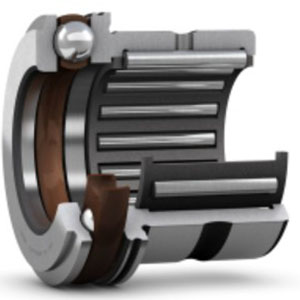
NKXR 15 Combined Radial-Thrust Bearing 15 mm bore, 24 mm OD, 26 mm width. Contains radial roller complement plus axial needle roller assembly. Supports loads in two directions.
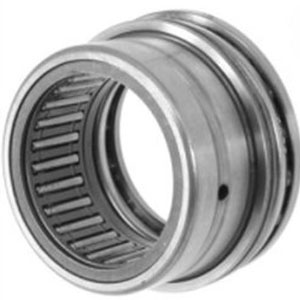
NKXR 20 Dual-Purpose Needle Bearing 20 mm bore, 30 mm OD, 30 mm width. Factory-lubricated with grease. Common in robot wrist joints and automotive steering column modules.
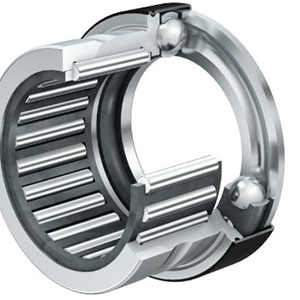
NKXR 25 High-Load Combined Bearing 25 mm bore, 37 mm OD, 35 mm width. Suitable for machine tool turrets and indexing mechanisms requiring combined load handling.
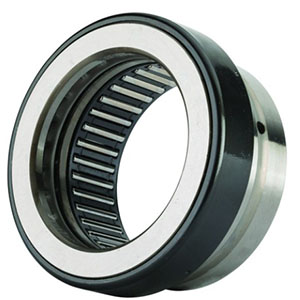
NKXR 30 Heavy Combined Needle Bearing 30 mm bore, 42 mm OD, 40 mm width. High radial and axial load ratings. Used in heavy-duty rotary tables and construction machinery slewing rings.
Full Complement Thrust Needle Roller Bearings
Full complement (cageless) designs are selected for maximum axial load capacity in low-speed or oscillating applications. These models are regularly stocked for heavy equipment and off-highway vehicle repairs.
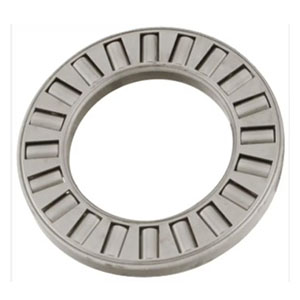
NTA-411 Full Complement Thrust Needle Bearing
Inch series – 3/8 inch bore, 7/8 inch OD, 1/16 inch thickness. No cage, maximum roller count. Used in small power tools and light-duty transmission assemblies.
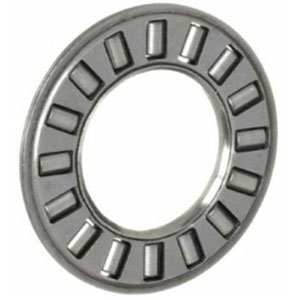
NTA-815 Cageless Axial Needle Bearing 1/2 inch bore, 1 inch OD, 1/16 inch thickness. Suitable for automotive accessory drives and lawn equipment gearboxes.
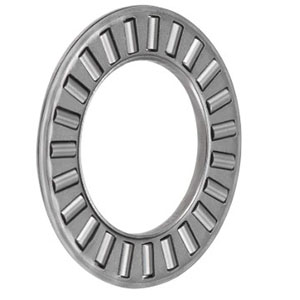
NTA-1220 High-Capacity Full Complement Bearing
3/4 inch bore, 1-1/4 inch OD, 1/16 inch thickness. Common in agricultural balers and conveyor drive systems.
Industrial Applications
These bearings are deployed across automotive, industrial, and agricultural fields. Key application areas and specific use cases are listed below.

Axial needle roller bearings are installed in automatic and manual transmissions, planetary gear systems, torque converters, and continuously variable transmissions to support shaft thrust loads while maintaining low friction.
They are found in air conditioning compressors, power steering gear assemblies, and water pumps, where axial space is limited and thrust management is critical.
These bearings deliver reliable performance in construction machinery, agricultural gear drives, and off-highway vehicles, where high loads and contaminant exposure are common.
Machine tool spindles, printing presses, textile machinery, and industrial gear reducers use thrust needle roller bearings for precise axial positioning and high-speed rotation.
Comparing Thrust Needle Roller Bearing Series
Understanding the differences between metric vs. inch series, caged vs. full complement designs, and component vs. unitized configurations is essential for aftermarket buyers. The following internal articles provide detailed comparisons.
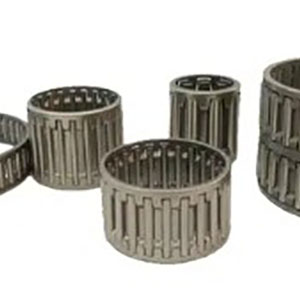
Metric series (AXK, AS, WS, GS) dominate European and Asian aftermarkets, while inch series (NTA, TWA, TRA) prevail in North America. This article provides a complete size cross-reference and interchange guide for aftermarket buyers.
For more details, please read“Metric vs. Inch Thrust Needle Roller Bearings”
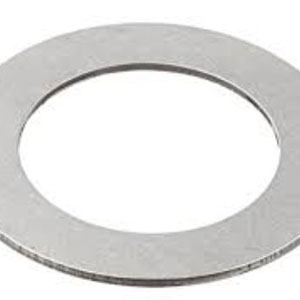
Thrust washers are a critical but often misunderstood component of axial needle roller bearing systems. This article explains the differences between stamped and machined washers and provides selection recommendations.
For more details, please read“What Are Thrust Washers?”
Other Related Thrust Bearing Types
Although thrust needle roller bearings excel in space-constrained applications, other thrust bearing types may be preferable for different load conditions or misalignment tolerance. Brief descriptions are provided below.
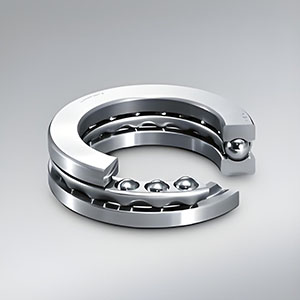
Thrust ball bearings use spherical rolling elements to support axial loads. They perform well in low-speed, low-load applications where cost is a primary factor. They can handle axial loads in either direction but have lower load capacity than roller-type thrust bearings of comparable dimensions.
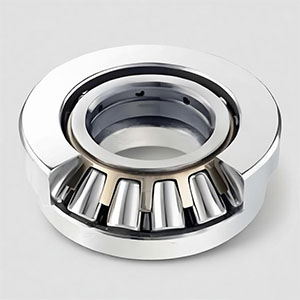
Thrust tapered roller bearings employ tapered rollers between tapered raceways. This design supports high axial loads while also accommodating a radial load component. Commonly used in heavy truck transmissions and machine tool spindles.
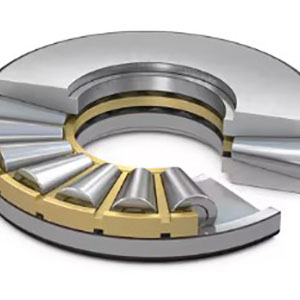
Thrust cylindrical roller bearings use cylindrical rollers that make line contact with flat raceways. They offer high axial rigidity and are available in single-row, double-row, and three-row configurations for increasing load capacities. Ideal for heavy loads but intolerant of radial loads or misalignment.
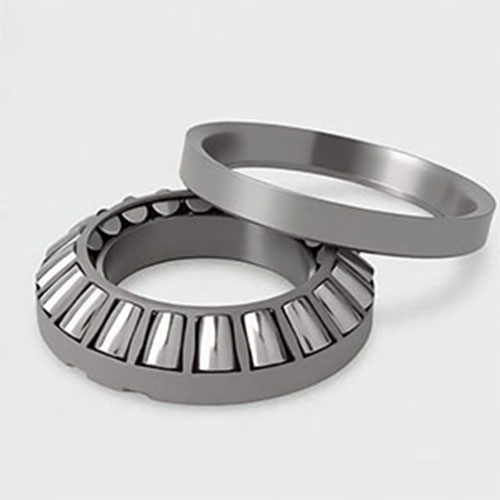
Thrust spherical roller bearings feature barrel-shaped rollers and a spherical raceway on the housing washer. This arrangement provides self-alignment, permitting angular misalignment between shaft and housing. Typical applications include wind turbine main shafts and heavy industrial gearboxes.
Technical Resources for Thrust Needle Roller Bearing Selection
The following in-depth articles assist engineers and procurement professionals in selecting the correct axial needle roller bearing for their applications.
How to Select the Correct Thrust Needle Roller Bearing for Your Application
This selection guide covers key parameters including shaft diameter, axial load rating, speed requirements, space constraints, and the need for separate bearing washers. A step-by-step selection procedure is provided for both metric and inch series bearings.
Understanding Load Ratings and Service Life of Axial Needle Roller Bearings
This technical article explains the relationship between basic dynamic load rating (Ca), basic static load rating (Coa), and L10 service life calculation. Factors affecting bearing life such as lubrication, alignment, and operating temperature are also discussed.
Installation Best Practices for Thrust Needle Roller Bearings
Correct installation techniques are necessary to achieve rated performance and service life. This article covers housing and shaft preparation, washer alignment, axial play adjustment, and common installation errors to avoid.
A thrust needle roller bearing supports loads parallel to the shaft (axial direction), with needle rollers arranged radially around the axis. A radial needle roller bearing supports loads perpendicular to the shaft, with rollers aligned parallel to the shaft axis.
No. Thrust needle roller bearings are designed exclusively for axial loads and have no radial load capacity. Applications requiring both axial and radial loads must incorporate a separate radial bearing.
Not always. AXK series (cage + rollers) require separate washers such as AS, LS, WS, or GS. Unitized bearings like AXW series or certain inch-series bearings with integrated washers do not need additional washers.
Oil lubrication is preferred for most applications as it provides continuous supply. For bearings with a Z suffix (capped and greased), they come pre-lubricated and require no initial grease. When relubrication is necessary, a high-quality lithium-based EP bearing grease is suitable.
No. Thrust needle roller bearings require perfectly parallel mounting surfaces. Any misalignment leads to uneven load distribution and premature failure. For misalignment tolerance, thrust spherical roller bearings are the correct choice.
Service life depends on load, speed, lubrication, and operating conditions. Using the L10 calculation method, bearing life is the number of revolutions after which 90% of an identical bearing group is expected to remain operational. Proper installation and lubrication significantly extend actual service life.
Yes. DUHUI Bearing manufactures axial needle roller bearings with dimensional and performance specifications fully interchangeable with leading global brands. All products conform to ISO standards, ensuring compatibility in aftermarket replacement applications.
Automotive (transmissions, torque converters, steering systems, compressors), industrial machinery (gearboxes, machine tools), agricultural equipment, and heavy-duty off-highway vehicles are the primary users.
The bore diameter must match the shaft diameter. The outside diameter and width must fit within the housing envelope. Load rating and speed capability must meet or exceed application requirements. Refer to the selection guide in Section 10 for detailed methodology.
Thrust needle roller bearings offer the lowest sectional height among all thrust bearing types. For maximum space saving, select an AXK series assembly mounted directly on hardened and ground shaft and housing surfaces, thereby eliminating the thickness of separate bearing washers.