In the world of mechanical engineering, the ability to achieve smooth, precise, and reliable rotation under significant load is paramount. This is where the turntable bearing, a crucial component in countless applications, comes into play. From the lazy Susan in your kitchen cabinet to the massive crane constructing a skyscraper, these specialized bearings enable rotational movement with unparalleled efficiency.
DUHUI will explain everything you need to know about turntable bearings, helping you understand their function, types, and how to select the perfect one for your specific needs.
What is a Turntable Bearing?
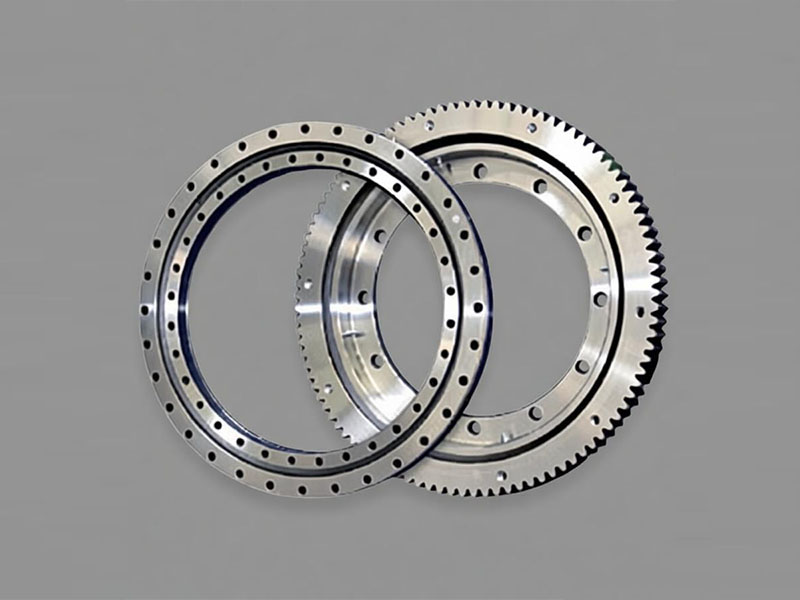
At its core, a turntable bearing is a large-sized rolling-element bearing designed to accommodate simultaneous axial and radial loads, as well as tilting moment loads. Its primary function is to provide smooth, low-friction rotational movement between two parts, typically a stationary base and a rotating structure.
Think of it as a heavy-duty, precision-engineered rotating platform. It is the critical component that allows a crane to swing its load, a wind turbine to face the wind, and a solar panel to track the sun.
Key Components and Materials of a Turntable Bearing
Understanding the anatomy of a turntable bearing is the first step in appreciating its capabilities.
Basic Structural Components
A standard turntable bearing consists of four main elements:
- Inner Ring: Typically the stationary ring, mounted to the equipment’s base.
- Outer Ring: Usually the rotating ring, which supports the machinery’s moving part. Rings can also be customized with internal or external gears.
- Rolling Elements: The balls or rollers that facilitate rotation by reducing friction between the rings.
- Spacer / Cage: A component that evenly spaces the rolling elements, preventing them from contacting each other and ensuring smooth, uniform motion.
Common Materials
The choice of material is dictated by the application’s environmental and load demands.
- Steel: The most common material, offering high strength and durability for general industrial applications.
- Stainless Steel: Provides superior corrosion resistance, making it ideal for marine environments, food processing equipment, and medical devices.
- Aluminum: Used in applications where weight reduction is critical, such as in aerospace or certain types of robotic arms.
Main Characteristics and Advantages
Why are turntable bearings the preferred choice for rotational systems?
- Exceptional Load Capacity: Their unique design allows them to handle immense axial, radial, and moment loads simultaneously, a feat that single-row bearings cannot achieve.
- Smooth and Precise Rotation: Manufactured to high tolerances, they ensure minimal runout and friction, which is essential for precision applications like machine tools and medical scanners.
- High Durability and Longevity: Made from hardened steel and designed for robust performance, they offer a long service life even in harsh operating conditions.
- Integrated Design and Low Maintenance: Many turntable bearings come pre-drilled with mounting holes and can include integrated gears, simplifying equipment design. They are also designed for easy lubrication and long-term reliability.
Special Types of Turntable Bearings and Clarifying the
Terminology
The world of turntable bearings includes specialized variants for different needs. There is also frequent confusion between the terms “turntable bearing” and “slewing bearing.”
Lazy Susan Bearings
These are the lightweight, often smaller versions of turntable bearings. Used in furniture, display stands, and cabinets, they prioritize smooth, effortless rotation over extreme load capacity.
Crossed Roller Bearings
This type features cylindrical rollers arranged perpendicularly in a single raceway. This design provides high rigidity and rotational accuracy in a compact form, making it ideal for industrial robots and machine tool turntables.
Turntable Bearings vs. Slewing Bearings: What’s the Difference?
In many contexts, these terms are used interchangeably. However, in engineering and industrial supply, a subtle but important distinction often exists. At DUHUI Bearing, we view it this way:
- A turntable bearing generally refers to the component focused on enabling precise rotation in applications like machine tools or medical equipment.
- A slewing bearing (or slew ring) is a broader category, typically encompassing larger, heavy-duty designs built to withstand extreme forces in applications like excavators and cranes.
Here is a practical comparison to guide you:
| Feature | Turntable Bearing | Slewing Bearing |
| Primary Focus | High precision and smoothness | High load capacity and ruggedness |
| Typical Applications | Machine tools, medical CT scanners, radar systems, Lazy Susans | Construction cranes, excavators, wind turbines, port machinery |
| Design Variants | Often cross-roller or four-point contact ball | Wide range: single-row ball, double-row ball, crossed roller, three-row roller, etc. |
| Load Capacity | Moderate to High | High to Very High |
| Precision Grade | High (P5, P4 grades common) | Moderate to High (often P6, P5 grades) |
| Environmental Adaptability | Can be designed for cleanliness or moderate exposure | Built to withstand dust, debris, and extreme weather |
Ultimately, the choice depends entirely on your application’s specific demands. A heavy-duty construction machine requires a rugged slewing bearing, while a precision manufacturing tool demands a high-accuracy turntable bearing.
Diverse Applications Across Industries
The versatility of turntable bearings means they are found in a vast array of equipment.
- Consumer Applications: From the Lazy Susan in your corner cabinet to rotating display racks in retail stores.
- Industrial & Heavy-Duty Applications: The backbone of excavators, truck cranes, concrete pump trucks, wind turbines, and port handling equipment.
- Specialized Applications: Critical components in medical CT scanners, military radar systems, satellite dishes, and the rotary tables of CNC machines.
How to Choose the Right Turntable Bearing
Selecting the correct bearing is a critical engineering decision. Here are key factors to consider and common pitfalls to avoid.
Critical Factors to Consider
- Load Analysis: You must accurately calculate the combined axial, radial, and moment loads that the bearing will experience in operation.
- Rotational Speed & Precision: Is the application for slow, intermittent rotation (like a crane) or continuous, high-speed, precise rotation (like a machine tool)?
- Environmental Conditions: Will the bearing be exposed to water, dust, chemicals, or extreme temperatures? This dictates the need for seals, corrosion-resistant materials, and specific lubricants.
- Mounting & Integration: Consider the required mounting hole patterns, the need for internal or external gears, and the space available.
Common Mistakes to Avoid
- Underestimating Loads: This is the most common and costly mistake, leading to premature bearing failure and equipment downtime.
- Ignoring the Environment: Choosing a standard steel bearing for a corrosive environment is a recipe for disaster.
- Prioritizing Price Over Value: The cheapest bearing often comes with hidden costs—more frequent replacements, unexpected failures, and lower precision.
Leverage Our Expertise: With 20 years in the field, DUHUI Bearing can simplify this process. Our engineering team can analyze your application’s requirements, perform load calculations, and recommend the most reliable and cost-effective solution, even if it requires a custom-designed bearing.
Installation and Maintenance Best Practices
Even the highest quality bearing will fail prematurely if not properly installed and maintained.
Proper Installation Guidelines
- Ensure Cleanliness and Alignment: The mounting surfaces on the shaft and housing must be clean, flat, and rigid. Misalignment is a primary cause of excessive stress and failure.
- Use Correct Bolts and Torque: Always use high-strength bolts specified by the manufacturer and tighten them to the precise torque in a cross-pattern sequence.
- Consider the Operating Environment: Install appropriate seals if the bearing will be exposed to contaminants.
- Initial Lubrication: Ensure the bearing is properly lubricated from the start, following the manufacturer’s specifications.
Key Maintenance Practices
- Regular Inspection: Periodically check for unusual noise, vibration, or play in the rotation. This can be an early indicator of wear or damage.
- Lubrication is Key: For bearings without integral seals, a regular lubrication schedule with the correct grease is vital to reduce friction, remove contaminants, and prevent corrosion.
- Preventative Maintenance: A proactive maintenance routine is far more effective than reactive repairs. It prevents small issues from escalating into major breakdowns, extending the operational life of your equipment significantly.
Conclusion
Turntable bearings are masterpieces of engineering that provide the critical function of smooth, powerful rotation in equipment ranging from delicate medical devices to colossal construction machines. Understanding the differences between types, such as precision turntable bearings and heavy-duty slewing bearings, is the first step toward making an informed purchase.
We understand that the right bearing is not just a component—it’s a foundation for your equipment’s performance and reliability. We are dedicated to providing not only high-quality, durable products but also the expert guidance to ensure you get the perfect fit for your application.