Quick Answer
A ball bearing race is one of the two precision rings that form the track on which the balls roll. The inner race mounts to the rotating shaft and transfers load from the shaft to the balls. The outer race is fixed to the housing and distributes load to the housing. Together, the inner and outer races contain the balls and provide the smooth rolling surfaces that enable low-friction rotation. Most bearing races are manufactured from SAE 52100 chrome steel per industry standards. DUHUI Bearing, with over 20 years of experience in automotive bearing manufacturing, produces precision races that meet IATF 16949 quality management requirements.
If you have ever taken apart a ball bearing or looked closely at one, you have probably noticed that it is more than just a set of balls. At the core of every ball bearing are two rings that make everything work: the races. But what exactly is a race in a ball bearing? And why does it matter for performance, durability, and load capacity?
Whether you are selecting bearings for an automotive drivetrain, designing a new piece of industrial equipment, or simply trying to understand how a wheel bearing works, understanding the race is essential. A bearing’s race is not just a ring–it is a precision-engineered component that determines how loads are carried, how smoothly the bearing rotates, and how long the bearing will last.
In this article, we will break down what a ball bearing race is, how inner and outer races work together, the key geometric parameters that define raceway performance, the materials and manufacturing processes behind quality races, and how races influence overall bearing performance.
Understanding the Ball Bearing Race
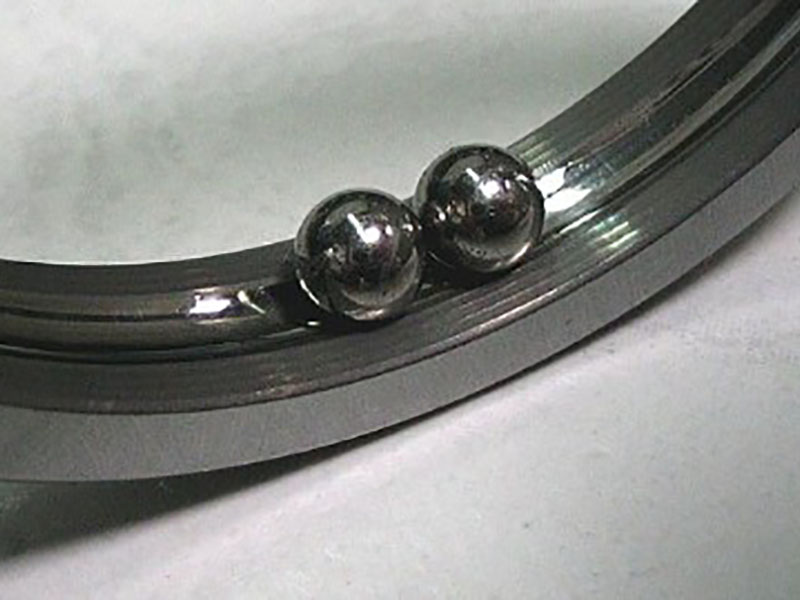
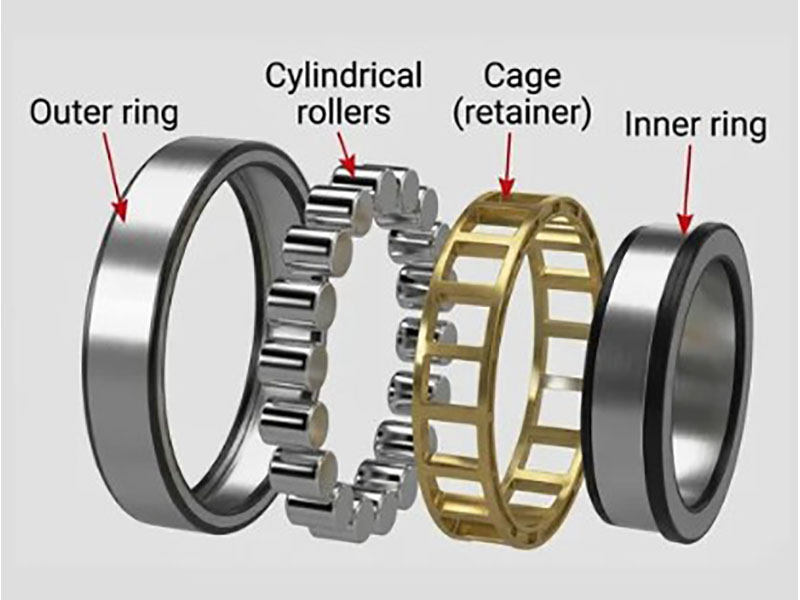
A ball bearing race is a precision ring that provides the track on which the bearing’s balls roll. In most ball bearings, there are two races: an inner race and an outer race. The balls are sandwiched between these two races, and each race has a groove–often called a raceway–that guides the balls along a fixed path.
Think of the race as the “track” for the balls. Without races, the balls would have no guidance; they would simply scatter under load. The races not only contain the balls but also provide a smooth, low-friction surface for them to roll against. This is what allows a ball bearing to reduce friction so effectively.
Race vs. Raceway vs. Ring: What Is the Difference?
These three terms are often used interchangeably, but they have distinct meanings in engineering:
- Ring refers to the entire circular component–either the inner ring or the outer ring. This is the physical part.
- Raceway is the specific groove or track surface on the ring where the balls make contact and roll. The raceway is the functional surface.
- Race is often used to describe the entire ring assembly (inner or outer) that contains the raceway. In practice, “race” and “ring” are frequently used synonymously, while “raceway” refers specifically to the grooved track.
In short: the ring is the part, the raceway is the surface, and the race is the ring with its raceway. For most practical purposes, you will hear “inner race” and “outer race” to describe the two rings.
Inner Race vs. Outer Race
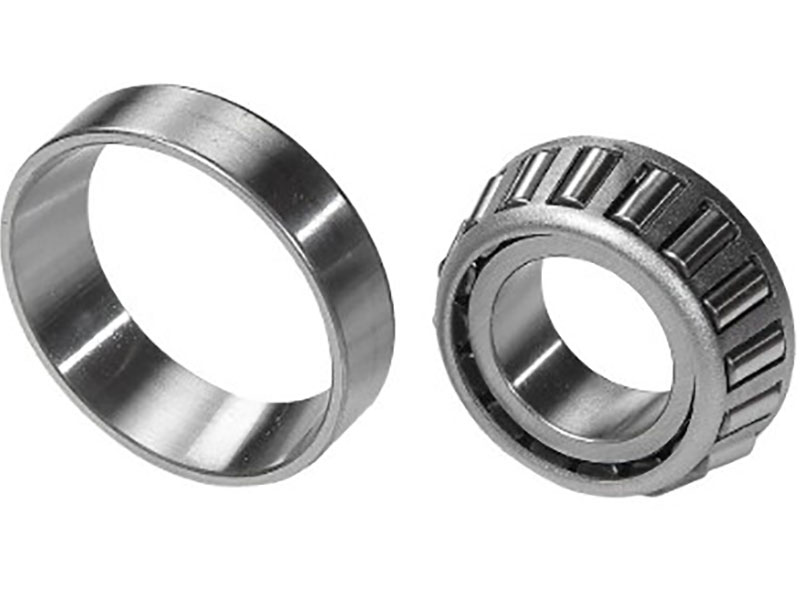
Every standard ball bearing contains two races: an inner race and an outer race. They work together as a pair, and each has a distinct role.
Inner Race
The inner race is the smaller ring, located on the inside of the balls. It is mounted directly onto the rotating shaft. As the shaft rotates, the inner race rotates with it. The inner race transfers the load from the shaft to the balls, which then transmit that load to the outer race.
Outer Race
The outer race is the larger ring, located on the outside of the balls. It is fixed to the bearing housing or casing. The outer race does not rotate–it stays stationary in the housing. Its job is to provide a surface for the balls to roll against and to distribute the load from the balls to the housing.
How They Work Together
The inner and outer races are positioned concentrically (one inside the other), with the balls rolling in the space between them. The inner race rotates with the shaft, the outer race remains fixed, and the balls roll along the raceways of both rings.
Together, the inner and outer races form a container for the balls. Key functions include:
- Containment: If a bearing only had one race, the balls would not be contained and the bearing could not function.
- Guidance: The two races ensure that the balls roll along a fixed, controlled path, which minimizes friction.
- Spacing: In most assembled bearings, a cage or retainer is also used to separate the balls and maintain consistent spacing between them as they roll along the raceways. This further improves smooth operation and reduces wear.
Raceway Parameters: Track Diameter, Track Radius, and Play
The performance of a ball bearing depends heavily on the geometry of its raceways. The most important parameters are track diameter, track radius, and internal play (radial and axial).
Track Diameter
Track diameter is the diameter of the imaginary circle that runs along the deepest portion of the raceway groove. This measurement is taken along a line that is perpendicular to and intersects the bearing’s axis of rotation. The track diameter defines the size of the path that the balls follow as they roll around the bearing.
Track Radius
Track radius describes the cross-sectional arc of the raceway groove. It is measured when viewing the raceway in a direction perpendicular to the axis of rotation. In ball bearing terminology, track radius has no mathematical relationship to track diameter–these two dimensions are independent of each other because track diameter defines the orbital path while track radius defines the cross-sectional contact profile between the ball and the raceway. Together they define the shape of the raceway.
The track radius is particularly important because it determines how closely the raceway conforms to the ball:
- Higher conformity (radius closer to the ball radius): creates a larger contact area, which reduces contact stress but increases friction.
- Lower conformity (larger radius): reduces friction but increases contact stress.
Bearing designers must balance these factors based on the application’s load and speed requirements.
Radial Play and Axial Play
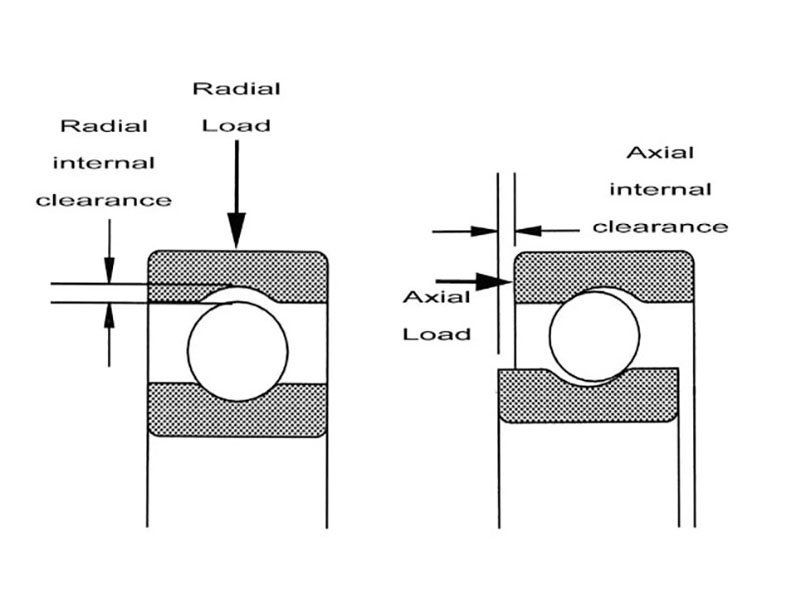
Most ball bearings are assembled with a small amount of looseness between the balls and the raceways. This looseness is called play or internal clearance. Per bearing engineering references, these clearances are critical to bearing function.
Radial play is the maximum distance that one bearing ring can be displaced relative to the other in a direction perpendicular to the bearing axis. Radial play typically ranges from 0.0002 inches to 0.002 inches.
Axial play (also called end play) is the maximum relative displacement between the two rings in a direction parallel to the bearing axis. Axial play is typically about 8 to 10 times the radial play value, and it can range from 0.001 inches to 0.020 inches.
Radial play and axial play are interdependent–they both result from the same degree of looseness between the bearing components. The amount of play directly affects:
- Load distribution
- Running noise
- Heat generation
- Service life
Race Materials and Design Considerations
The design and material of bearing races directly affect the bearing’s performance, durability, and reliability.
Design Considerations
Race design involves selecting the appropriate groove curvature, depth, and surface finish based on the intended application:
- Deeper raceways generally provide higher load capacity.
- Shallower raceways are better suited for high-speed applications.
- The raceway curvature radius must be carefully chosen to balance contact stress and friction.
- Surface finish is another critical design factor. A smoother raceway surface reduces friction and wear, while a rougher surface increases friction and accelerates fatigue. Precision grinding and polishing are used to achieve the required surface quality.
Materials
The most widely used material for bearing races is SAE 52100 chrome steel–a high-carbon alloy steel with chromium as the primary alloying element. The typical composition includes roughly 1.0% carbon and 1.5% chromium. This material accounts for the majority of rolling bearing production because it responds well to heat treatment, achieving a hardness range of approximately 60-64 HRC while delivering strong resistance to wear and fatigue. These specifications align with standard bearing industry references.
SAE 52100 steel holds its dimensional stability up to about 250°F (121°C), with the exact upper limit depending on the specific heat treatment cycle applied. The material also provides good elasticity and structural uniformity across the component.
For specialized applications, other materials may be selected:
- AISI 440C stainless steel: offers corrosion resistance as its primary advantage. However, its load-carrying capability is approximately 15% lower than that of 52100 steel, and it requires more costly machining processes.
- AISI M50 steel: reserved for demanding aerospace applications. Under aircraft engine operating conditions, M50 has demonstrated twice the reliability of 52100, though its material cost is roughly ten times higher.
- Ceramic materials: may be chosen for their lightweight properties and corrosion resistance in high-speed or specialty environments.
Manufacturing Process
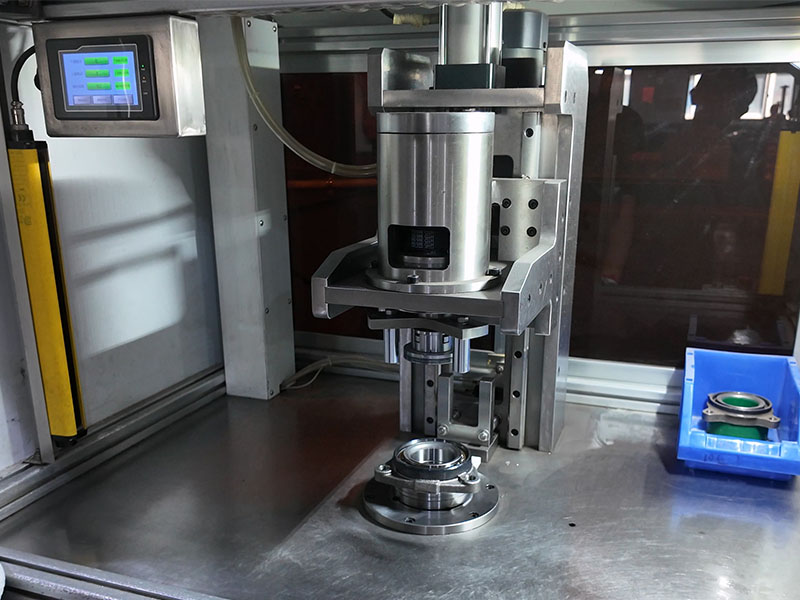
Manufacturing a bearing race is a multi-step precision process. At DUHUI Bearing, these processes are carried out under strict quality control per IATF 16949 standards:
- Machining: The race is initially shaped through precision turning and milling to achieve the desired dimensions.
- Heat treatment: The race is hardened and tempered to increase hardness and durability. For 52100 steel, the typical austenitization temperature is 840°C, followed by quenching and tempering at approximately 160°C.
- Grinding: This critical process ensures the surface finish and dimensional accuracy of the raceway.
- Finishing: Polishing and honing achieve the final high-quality surface finish that reduces friction and wear during operation.
How Races Affect Bearing Performance
The design and quality of bearing races have a direct impact on overall bearing performance across four key areas:
Load Distribution
Properly designed races ensure that loads are distributed evenly across the balls. This minimizes stress concentrations, which in turn extends bearing life. Uneven load distribution can lead to premature failure–a particular concern in demanding applications like automotive wheel bearings and transmissions.
Smooth Operation
High-quality surface finishes and precise alignment between the inner and outer races reduce friction and enable smoother rotation. This improves the efficiency of the bearing and reduces energy losses.
Durability
Material selection is key to durability. The right material ensures resistance to wear, corrosion, and fatigue–all essential for reliable long-term performance. For automotive applications, where bearings must withstand high loads and varying speeds, the race material and heat treatment are especially critical.
Temperature and Clearance Management
The operating clearance of a bearing changes with temperature. For chrome steel bearings, thermal expansion can be calculated as approximately 0.0000125 times the temperature difference times the raceway diameter. Proper clearance selection ensures that the bearing maintains optimal performance across its full operating temperature range.
Conclusion
The race is one of the most critical components of any ball bearing. Whether you call it a race, a ring, or a raceway, this precision component provides the track that guides the balls, contains them under load, and enables the low-friction rotation that makes ball bearings so valuable in mechanical systems.
To summarize the key points:
- A ball bearing has two races: an inner race (mounted to the rotating shaft) and an outer race (fixed to the housing).
- The raceway is the grooved surface on each race where the balls roll.
- Track diameter and track radius define the raceway geometry and influence load capacity and friction.
- Radial play and axial play are the small clearances between the balls and raceways, typically ranging from 0.0002″ to 0.002″ for radial play and 0.001″ to 0.020″ for axial play.
- Most races are made from SAE 52100 chrome steel, which offers excellent hardness, wear resistance, and fatigue strength.
- Race quality directly affects load distribution, smooth operation, and durability.
For engineers, procurement professionals, and maintenance teams, understanding races is essential for selecting the right bearing for the right application. When choosing a ball bearing, pay close attention to the race material, geometry, and manufacturing quality–these factors will determine how well the bearing performs and how long it lasts.
FAQs
Q: What is the difference between a race and a raceway in a ball bearing?
A: A race (or ring) is the entire circular component–either the inner ring or the outer ring. A raceway is the specific grooved track surface on that ring where the balls make contact and roll. In practice, “race” and “ring” are often used interchangeably, while “raceway” refers specifically to the groove.
Q: What are the two types of races in a ball bearing?
A: Every standard ball bearing has an inner race and an outer race. The inner race is mounted on the rotating shaft, while the outer race is fixed to the bearing housing.
Q: What material are bearing races made from?
A: The most common material is SAE 52100 chrome steel, which contains approximately 1.0% carbon and 1.5% chromium. This steel can be heat-treated to a hardness of approximately 60-64 HRC. For corrosion-resistant applications, AISI 440C stainless steel is also used.
Q: What are track diameter and track radius?
A: Track diameter is the diameter of the imaginary circle running along the deepest part of the raceway groove. Track radius is the cross-sectional arc radius of the raceway groove. These two dimensions define the shape of the raceway and influence bearing performance.
Q: What is radial play in a ball bearing?
A: Radial play is the maximum distance that one bearing ring can be displaced relative to the other in a direction perpendicular to the bearing axis. It typically ranges from 0.0002 inches to 0.002 inches.
Q: What is axial play in a ball bearing?
A: Axial play (or end play) is the maximum relative displacement between the two rings in a direction parallel to the bearing axis. It is typically about 8 to 10 times the radial play value and can range from 0.001 inches to 0.020 inches.
Q: Why is the race so important to bearing performance?
A: The race provides the track for the balls, contains them under load, and distributes loads evenly across the balls. Race quality–including material, surface finish, and geometry–directly affects load capacity, smooth operation, friction, and bearing life. Without properly designed races, a ball bearing cannot function effectively.
Q: How are bearing races manufactured?
A: Bearing races are manufactured through a multi-step process that includes precision machining, heat treatment (hardening and tempering), grinding, and final polishing or honing. Each step is critical to achieving the dimensional accuracy and surface quality required for optimal performance.