Quick answer: A dynamic load is a force that varies with time, direction, or location—unlike a static load which stays constant. In bearings, the basic dynamic load rating (C) is the load a bearing can handle for 1 million revolutions. Dynamic equivalent load (P) combines radial and axial forces in real applications. Bearing life is calculated as L₁₀ = (C/P)ᵖ, where p=3 for ball bearings and 10/3 for rollers.
What happens when a bearing handles moving loads instead of stationary ones? How do engineers determine if a component can survive years of vibration and impact? This guide answers these questions by providing a comprehensive overview of dynamic loads, from fundamental definitions to practical applications in bearing selection and system design.
Understanding Loads in Engineering
Defining Force in Mechanical Contexts
In physics and engineering, a force is defined as any influence that changes or maintains the motion of an object. Forces can be pushes, pulls, tensions, compressions, or torsions, and they govern how mechanical systems behave under various operating conditions.
Static Load vs. Dynamic Load: Key Differences
A static load is applied gradually and remains constant in magnitude and direction. The weight of a stationary vehicle on a bridge or a tank of water resting on its base are typical examples of static loads. Because static loads are constant, their effects can be analyzed using relatively straightforward equilibrium principles.
Dynamic loads, by contrast, vary with time. They may change in magnitude, direction, point of application, or all three simultaneously. A dynamic load is generally defined as a load that is not applied “infinitely slowly” but rather with significant acceleration or time variation. Unlike static loads, dynamic loads introduce inertial effects and can cause significantly higher stresses and deflections than a static load of the same magnitude.
What Are Dynamic Loads?
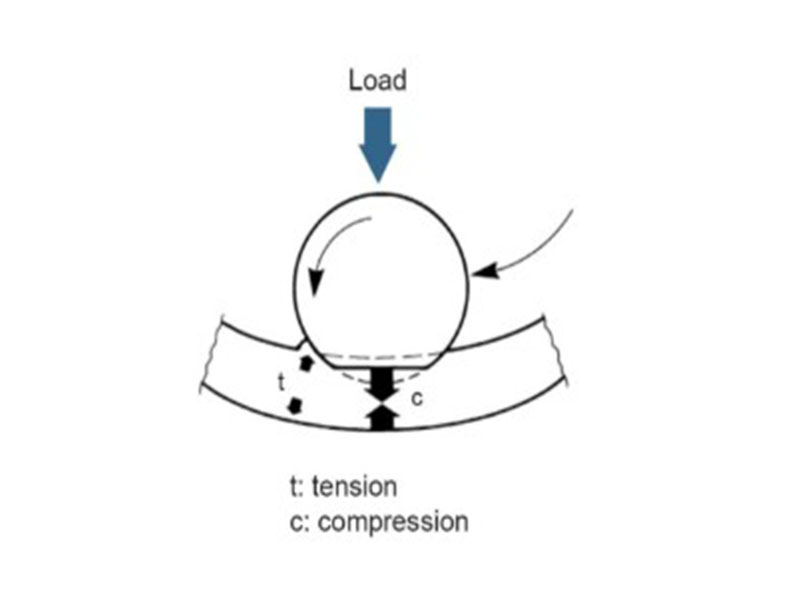
Dynamic loads refer to forces applied to a structure or system that vary with time, often involving sudden impacts, vibrations, or oscillations. In bearing applications, a load is considered dynamic when sliding or rolling movement takes place in the loaded component.
Classification of Dynamic Loads
Dynamic loads can be categorized into three main types:
- Cyclic (Periodic) Loads — These loads vary in a repeating pattern over time. Examples include the forces acting on an air compressor crankshaft or the alternating stresses in a rotating machine shaft. Cyclic loads are particularly significant because they can lead to fatigue failure over time.
- Impact (Shock) Loads — These loads act over an extremely short duration, such as those generated by a hammer striking a workpiece or a forklift setting down a heavy load. Impact loads can produce stresses several times higher than static loads of the same magnitude.
- Random Loads — These loads vary unpredictably without a defined pattern. Earthquake ground motions, wind gusts on a turbine blade, and road-induced vibrations in an automotive suspension system are examples of random dynamic loads.
Dynamic Load Ratings in Bearings and Mechanical Systems
Basic Dynamic Load Rating (C)
The basic dynamic load rating, denoted as C (Cr for radial bearings, Ca for thrust bearings), is the most fundamental parameter for bearing load capacity. According to ISO 281, C is defined as the constant load that a rotating bearing can theoretically endure for one million revolutions without developing spalling damage on its raceways.
This rating serves as the basis for virtually all bearing life calculations. It is calculated using methods specified in ISO 281, which take into account bearing geometry, the number of rolling elements, material properties, and manufacturing quality.
Dynamic Equivalent Load (P)
In real-world applications, bearings rarely experience purely radial or purely axial loads. More commonly, they are subjected to combined loads and variable conditions. The dynamic equivalent load, denoted as P, is a calculated value that represents the constant radial load (or constant axial load for thrust bearings) that would produce the same effect on bearing life as the actual combination of forces.
The general form of the calculation is:
P = X·Fr + Y·Fa
Where Fr is the radial load, Fa is the axial load, and X and Y are bearing-specific factors provided by manufacturers in accordance with ISO 281. The values of X and Y depend on the bearing type, contact angle, and the ratio Fa/Fr.
Static Load Rating (C₀) vs. Dynamic Load Rating (C)
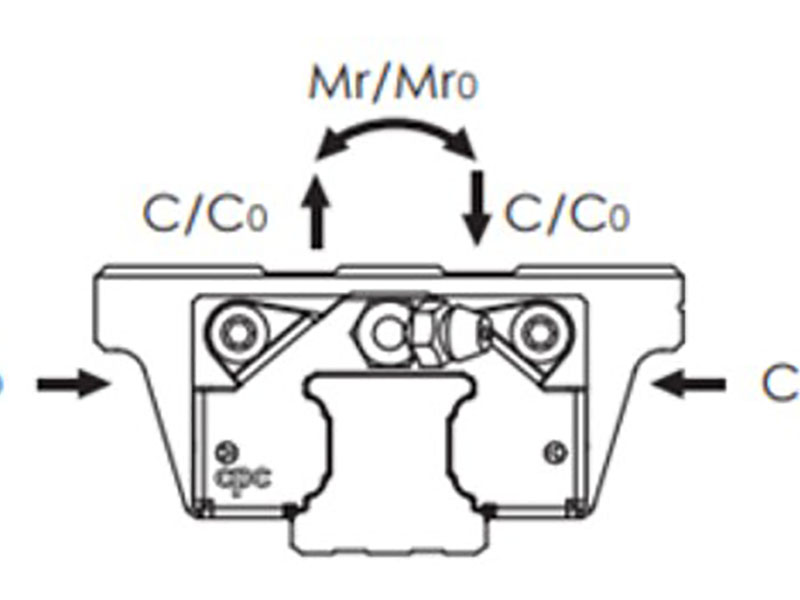
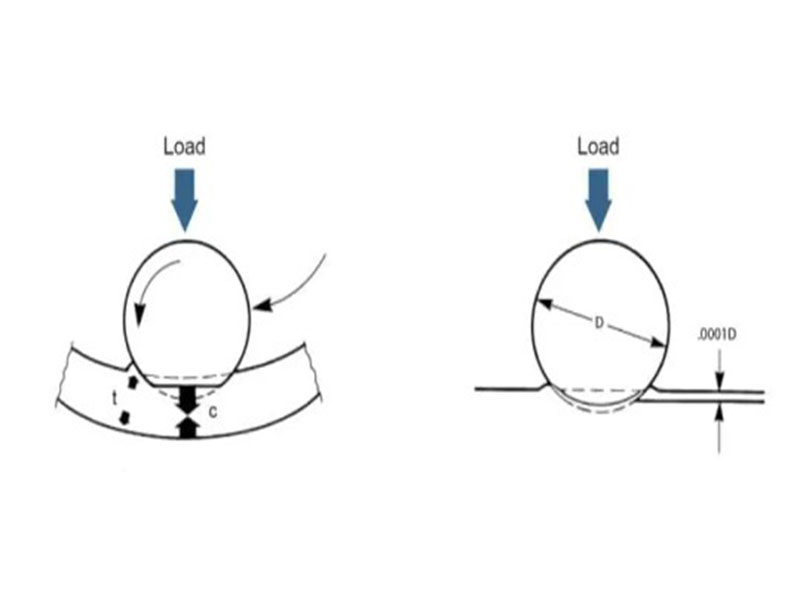
Static load capacity, denoted as C₀, represents the maximum load a bearing can support while stationary or moving very slowly without causing permanent deformation exceeding 0.01% of the rolling element diameter.
Dynamic load capacity C, by contrast, is not a standalone load rating but a parameter used to calculate the theoretical service life of a bearing system under continuous motion. The key distinction is that static capacity determines whether a bearing will be damaged by peak loads during stops or start-ups, while dynamic capacity determines how long a bearing will last under normal operating conditions.
When to Use Dynamic Load Ratings
Dynamic load ratings are not always the appropriate selection criterion. Understanding when to apply them versus static ratings is essential for proper bearing selection.
- Moving Systems and Rotating Machinery — When components are in continuous motion—such as conveyor rollers, electric motor shafts, or vehicle wheels—dynamic load ratings must be used for life prediction. For rotating speeds above approximately 10 revolutions per minute, dynamic loading conditions apply.
- Variable and Cyclic Forces — Applications involving fluctuating loads, such as gearboxes, pumps, and compressors, require dynamic load analysis because the alternating stresses directly affect fatigue life.
- Fatigue Analysis and Life Prediction — The L₁₀ basic rating life (the life that 90% of identical bearings will achieve or exceed) is calculated using L₁₀ = (C/P)p, where p = 3 for ball bearings and p = 10/3 for roller bearings. This formula is specified in ISO 281.
- Environmental Dynamic Forces — Wind loads, seismic activity, and wave action are inherently dynamic. Structures such as wind turbine towers, offshore platforms, and bridge supports require dynamic load analysis that accounts for time-varying force magnitudes and frequencies.
- High-Speed Operations — As rotational speeds increase, centrifugal forces on rolling elements grow significantly. These forces can alter load distribution and may reduce effective capacity, especially in applications exceeding the bearing’s reference speed.
Factors Influencing Dynamic Load Capacity
Material Properties
The fatigue behavior of bearing steel directly determines the dynamic load carrying capacity of a rolling bearing. Factors such as steel cleanliness, hardness uniformity, and inclusion content significantly affect how long a bearing can withstand cyclic stresses before fatigue failure occurs. Bearings manufactured from contemporary, high-quality hardened bearing steel in accordance with good manufacturing practices achieve the basic dynamic load ratings specified in ISO 281.
Design and Geometry
Bearing geometry—including the number and size of rolling elements, contact angles, and raceway curvature—directly influences dynamic load capacity. Larger rolling elements distribute loads over greater contact areas, while optimized internal geometries reduce stress concentrations and improve fatigue life.
Operating Conditions
Several operational factors affect how dynamic load capacity translates into actual service life:
- Lubrication — Proper lubrication maintains an elastohydrodynamic film between rolling elements and raceways, reducing friction and wear. Contaminated or degraded lubricant significantly reduces effective life.
- Temperature — High-temperature operation reduces material hardness and, consequently, dynamic load capacity.
- Misalignment — Angular misalignment causes uneven load distribution, increasing stress on individual rolling elements and reducing overall capacity.
- Contamination — Particulate contaminants in the lubricant can cause surface indentations, creating stress concentrations that initiate fatigue.
Applications of Dynamic Load Analysis
- Automotive Wheel Hub Bearings — Modern vehicle wheel hub bearings must withstand a complex combination of dynamic loads, including radial forces from vehicle weight, axial forces from cornering, and oscillating loads from road irregularities. Dynamic load ratings are essential for predicting bearing service life under these varying conditions.
- Conveyor Systems — Industrial conveyor systems subject bearings to continuous rotational motion under varying load conditions. Dynamic load ratings determine the expected service life of conveyor rollers, sprockets, and drive shafts, enabling maintenance planning and reducing unplanned downtime.
- Wind Turbine Main Shaft Bearings — Wind turbine bearings operate under highly dynamic conditions, with loads that can shift direction significantly within fractions of a second. A modern 10-megawatt wind turbine main shaft bearing may weigh approximately 15 tons and withstand dynamic loads as high as 5000 kN (approximately 510 metric tons-force). Dynamic load analysis for such applications requires sophisticated modeling that accounts for wind speed variations, rotor dynamics, and operational duty cycles.
Dynamic Loads in Pressure Vessels and Structural Systems
While bearings are the primary focus of dynamic load analysis, pressure vessels and structural systems also experience dynamic loading conditions that engineers must address. These include:
- Pressurization cycling — Repeated pressurization and depressurization creates cyclic stresses that can lead to fatigue failure over time.
- Seismic events — Earthquake ground motions impose random dynamic loads on vessels and supporting structures.
- Vibration from nearby machinery — Pumps, compressors, and other rotating equipment transmit vibrations that can cause fatigue damage.
Engineers performing dynamic load analysis for pressure vessels must consider these time-varying forces in addition to static pressure loads.
Summary
Dynamic loads are time-varying forces that significantly affect how mechanical components—particularly bearings—perform and fail. Understanding the distinction between static and dynamic loading, the meaning of basic dynamic load rating C, and the factors that influence dynamic load capacity is essential for proper component selection and system design.
For bearing selection, dynamic load ratings provide the foundation for life prediction through established standards such as ISO 281. When choosing bearings for applications involving continuous motion, variable forces, or high-speed operation, careful attention to dynamic load ratings will ensure reliable performance and predictable service life.
Frequently Asked Questions (FAQ)
Q1: What is the difference between dynamic load and static load?
A1: Static loads are constant and unchanging over time, while dynamic loads vary in magnitude, direction, or location. Dynamic loads introduce inertial effects and generally require more complex analytical methods than static loads. In bearing applications, dynamic load ratings (C) are used for life prediction under continuous motion, while static load ratings (C₀) are used to prevent permanent deformation during stationary conditions.
Q2: How is dynamic load capacity C calculated?
A2: The basic dynamic load rating C is calculated according to ISO 281 standards based on bearing geometry, material properties, and manufacturing quality factors. The calculation incorporates the number and size of rolling elements, contact angles, raceway curvatures, and a material rating factor that accounts for modern bearing steel quality.
Q3: Why is dynamic load rating important for bearing selection?
A3: Dynamic load rating directly determines the expected service life of a bearing under rotating conditions. By comparing the required dynamic load rating (calculated from application loads and desired life) with published C values in bearing specification tables, engineers can select bearings that will achieve the required operational life.
Q4: What happens if a bearing is subjected to loads exceeding its dynamic rating?
A4: Operation at loads exceeding the dynamic load rating C does not cause immediate failure, but it dramatically reduces service life. Because the life equation L₁₀ = (C/P)p is highly nonlinear (p = 3 for ball bearings, p = 10/3 for roller bearings), a load increase of 20% can reduce bearing life by nearly 50%.
Q5: How does vibration affect dynamic load capacity?
A5: Vibration increases the effective dynamic load on bearings by introducing additional oscillatory forces and potentially disrupting the lubricant film between rolling elements and raceways. In severe cases, vibration can lead to false brinelling—surface damage caused by small oscillatory movements that wear through the lubricant film and create indentations in raceways.