Quick Answer: Linear bearing shaft pairing means matching a round shaft to a linear ball bushing so the shaft works as the bearing’s inner raceway. Confirm the same nominal diameter first, then use the bearing maker’s shaft tolerance table for the exact series and clearance class. Specify hardness, case depth, surface finish, roundness, straightness, material, and support method. A matching diameter alone does not prove compatibility.
Round-shaft linear ball bushings depend on the shaft as a rolling raceway, not just as a guide rod. The pairing decision therefore combines diameter, tolerance, hardness, finish, material, and support. This guide covers linear ball bushings such as THK Linear Bushing, NB Slide Bush, and Thomson Ball Bushing. Polymer plain bearings use a separate set of shaft rules, which are covered near the end.
Use the steps in order. Each step narrows the shaft specification, and each manufacturer table remains the final authority for the exact bearing series and clearance class.
Why Shaft Pairing Determines Bearing Life and Smoothness
In a linear ball bushing, the balls run directly on the shaft surface. That makes the shaft the inner raceway. Its hardness, roughness, diameter accuracy, roundness, and straightness all affect load capacity, service life, friction, noise, and smoothness.
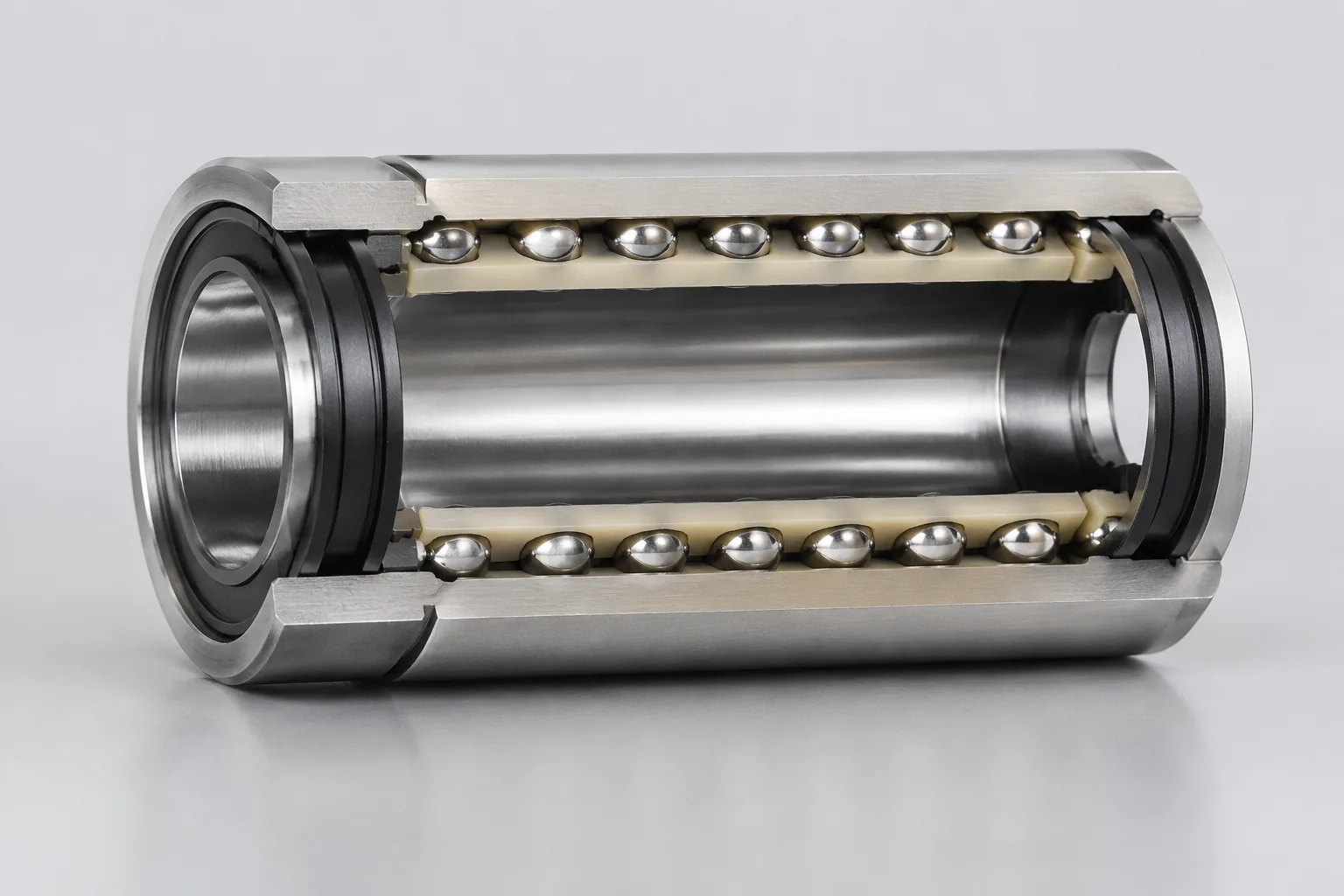
A correct pairing keeps the specified clearance or preload. It also helps prevent play, unintended preload, fretting, and early raceway damage. THK states that shaft surface hardness, roughness, and diameter accuracy directly influence running performance and life.
Step 1: Match Nominal Diameter and Verify the Tolerance System
The bearing bore and shaft nominal diameter must be identical before any tolerance band is considered. ISO 286-1 and ISO 286-2 provide the tolerance system for mating holes and shafts. ISO 286-2:2010 specifies limit deviations for common hole and shaft tolerance classes and was reaffirmed in 2026 as the current standard.
After confirming nominal size, use the bearing manufacturer’s shaft tolerance table for the exact bearing series. A generic diameter rule is not enough.
Same Diameter Does Not Guarantee Compatibility
Two bearing series from the same maker can call for different shaft bands. THK’s LM series and LME series are a direct example. The LM series uses one set of recommendations, while the LME series uses another. Never infer compatibility from a matching nominal diameter alone.
Step 2: Select the Shaft Tolerance Band for the Bearing Series
Select the shaft tolerance band from the bearing manufacturer’s table for the specific series and clearance class. Standard clearance, small clearance, and precision grades often need different shaft bands.
Do not use an oversized shaft to create preload. Choose the specified clearance class through the bearing, then machine the shaft to the matching band. A shaft that measures larger than nominal is not a substitute for a low-clearance or preloaded bearing design.
THK LM Series Shaft Tolerance Recommendations
- Normal clearance: f6 or g6.
- Small clearance: h6.
- Precision P: f5/g5 for normal clearance and h5 for small clearance.
These values apply to the LM series. Check the catalog before transferring them to another series.
THK LME Series Shaft Tolerance Recommendations
- Normal fit: h7.
- Small clearance: k6.
The LME series differs from the LM series, so confirm the exact series before machining or ordering a shaft.
MISUMI Linear Bushing Shaft Recommendations
- Standard linear bushing: hardened g6 shaft.
- Short-type linear bushing: hardened h5 shaft.
The recommendation assumes a hardened shaft. It does not replace the hardness requirement in Step 3.
Thomson Ball Bushing Shaft Recommendations
- Super Smart Ball Bushing with LinearRace: h6 shaft tolerance.
- Metric MM shaft class: ISO h6.
Tolerance Numbers for Sizing Examples
The following values are sizing examples for common metric shafts. Confirm the final tolerance against the selected bearing series and the shaft supplier’s drawing.
| Shaft size | g6 | h5 |
|---|---|---|
| Ø8 to Ø12 mm | -0.005/-0.014 mm | 0/-0.006 mm |
| Ø20 to Ø25 mm | -0.007/-0.020 mm | 0/-0.009 mm |
| Ø35 mm | -0.009/-0.025 mm | 0/-0.011 mm |
Step 3: Confirm Shaft Surface Hardness
Ball bushing shafts must be hard enough to act as a rolling raceway. THK recommends at least 58 HRC, approximately 653 HV, for LM shafts. For full load capacity of linear bushings, THK states 58-64 HRC. Its Power Linear Bushing requires 58-65 HRC, and the NB Slide Rotary Bush SRE requires at least 58 HRC.
Specify hardness together with case depth and material. A surface hardness number alone does not define a durable raceway.
Minimum Hardness and Load Derating
Below the specified hardness, load capacity and service life decrease. NB states that below 58 HRC a hardness factor must be introduced into the life calculation. THK Power Linear Bushing allows lower load and life below 58 HRC.
Use the hardness limit for the exact product family. Do not apply one family’s minimum to another without checking its catalog.
Case Depth for Hardened Shafts
Induction-hardened shafts need a hardened layer deep enough that rolling contact stress does not crush the case. THK gives approximately 2 mm as a general-purpose recommended hardening depth for LM shafts.
Check case depth for the application load. Do not assume that surface hardness alone proves adequate depth.
Stainless and Corrosion-Resistant Shafts
Corrosion resistance does not automatically mean the same raceway hardness as carbon steel. Thomson 60 Case carbon steel shaft has a minimum of 60 HRC, while its 440C stainless shaft has a minimum of 50 HRC. MISUMI’s EN 1.4125 equivalent stainless shaft is listed with a minimum of 56 HRC.
Hardened martensitic stainless such as 440C/SUS440C can be used for corrosive ball bushing applications, but load and life must be rechecked. Soft 300-series stainless should not be used directly as a ball bushing raceway. igus notes that balls damage soft stainless steel surfaces, so ball bearings need hardened raceways.
Step 4: Specify Surface Finish, Roundness, and Straightness
Surface roughness affects friction, noise, and raceway wear. Roundness affects clearance variation and ball load distribution around the shaft. Straightness affects binding risk, especially over long strokes and with multiple bearing supports.
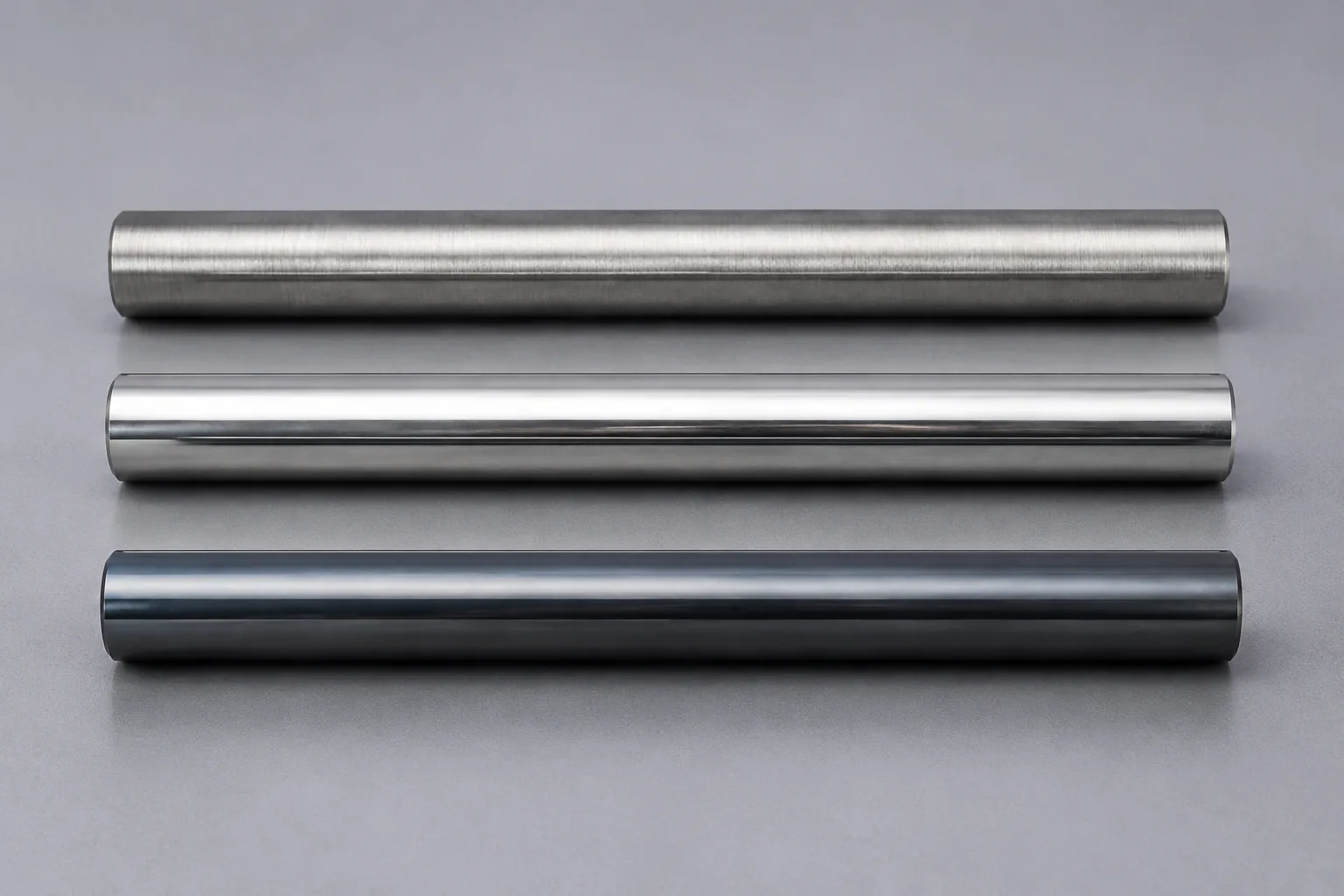
- THK LM shaft roughness: Ra 0.40 μm or better.
- Thomson 60 Case standard shaft: maximum 8 μin Ra, approximately 0.20 μm Ra.
- Thomson Class L, S, D, and M roundness: within 0.000080 in, approximately 2 μm.
- Thomson standard straightness: 0.001 in per foot, approximately 0.083 mm/m.
- Thomson T-Case: 60-63 HRC, diameter tolerance h6/h7, with the chrome-plated version at h7.
These values show the level of control expected in a precision shaft. They are not interchangeable across product families; confirm the shaft drawing and the bearing catalog together.
Step 5: Choose Shaft Material and Heat Treatment
Common ball bushing shaft materials include high-carbon chromium bearing steel, carbon tool steel, medium-carbon structural steel, and martensitic stainless steel. Material selection must support the required hardness, case depth, corrosion resistance, and grindability. Specify the material standard and heat treatment on the shaft drawing.
- THK: SUJ2 per JIS G 4805, SK3-SK6 per JIS G 4401, S55C per JIS G 4051, and SUS440C for corrosion resistance.
- MISUMI: EN 1.3505 equivalent bearing steel with a minimum of 58 HRC, and EN 1.4125 equivalent stainless with a minimum of 56 HRC.
- Thomson T-Case: 1.1213/CF53 solid steel or 1.1221/C60E hollow shaft steel at 60-63 HRC.
For wet or corrosive environments, select a hardened stainless grade and recheck load rating and life. A material change is a new pairing decision, not a cosmetic substitution.
Step 6: Match Bearing Structure to Shaft Support
Closed linear ball bushings suit shafts supported at the ends and can bridge openings or gaps. Open linear ball bushings suit continuously supported shafts and are preferred where higher stiffness is needed.
Long spans, high loads, and deflection-sensitive applications should use open bearings with full-length supported shaft rails. End-supported solid shafts must be checked for deflection, not selected only by bearing load rating.
Self-alignment can compensate small misalignment but does not replace parallelism and deflection checks. Thomson Super Smart bearings allow approximately 0.5° of self-alignment of the bearing plate relative to the outer ring. That allowance does not cancel the need to check shaft deflection and support spacing.
Quick-Reference Pairing Rules by Bearing Type
| Application condition | Recommended pairing |
|---|---|
| Standard linear ball bushing | Same nominal diameter; g6 or f6 shaft; at least 58 HRC; Ra 0.40 μm or better. |
| Low-clearance or precision positioning | Select h6 or h5 from the manufacturer table for the exact series and clearance class; do not create preload with an oversized shaft. |
| Long stroke or high stiffness | Open bearing plus full-length supported shaft. |
| End-supported span | Closed bearing plus a separate shaft deflection check. |
| Corrosive environment with a ball bushing | Hardened 440C/SUS440C shaft with load and life re-rated. |
| Soft 300-series stainless or lubrication-free operation | Consider a polymer plain bearing instead of a ball bushing. |
These rules summarize the manufacturer recommendations cited above. They do not replace the exact table for the selected series.
When the Shaft Pairs With a Polymer Plain Bearing, Not a Ball Bushing
Polymer plain bearings do not use the same 58 HRC ball-raceway requirement as linear ball bushings. Their liners pair with different shaft materials, so start from the polymer bearing manufacturer’s shaft table.
- igus drylin R shaft options: hard-anodized aluminum, hardened steel, hard-chrome-plated steel, and stainless steel.
- iglide J/J200 with hard-anodized aluminum shaft: low wear, with J200 specifically for this pairing.
- iglide X with hardened stainless or hard-chrome-plated stainless shaft: for high temperature and high load.
- iglide E7 with steel or stainless shaft.
- iglide A180 with stainless shaft: FDA-compatible material option.
- Metric hard-anodized aluminum shaft: h8/h9, Ra below 0.6 μm, 450-550 HV.
- Hardened steel and hard-chrome-plated steel shaft: h6/h7, Ra 0.15-0.3 μm, 60+4 HRC.
Do not apply the ball bushing 58 HRC minimum to polymer plain bearing shafts without checking the polymer bearing manufacturer’s own shaft specification. The liner grade and environment decide the pairing.
Final Selection Checklist and Common Pairing Mistakes
Use this checklist before releasing a shaft drawing:
- Confirm the bearing series, nominal diameter, and clearance class.
- Confirm the shaft tolerance band from the exact manufacturer table.
- Check the measured shaft size against the drawing, not only the nominal size.
- Specify hardness and case depth with the material and heat treatment.
- Specify Ra, roundness, straightness, and any coating.
- Confirm the support type and check shaft deflection.
Common pairing mistakes include:
- Assuming that the same nominal diameter means the shaft is compatible.
- Using an oversized shaft to remove bearing clearance.
- Pairing a soft 300-series stainless shaft with a ball bushing.
- Ignoring surface roughness or shaft deflection.
- Applying ball bushing hardness rules to polymer plain bearings.
Verify the final shaft drawing against both the bearing catalog and the shaft supplier’s tolerance and hardness certificate.
Conclusion
Linear bearing shaft pairing is a chain of checks, not a single diameter match. Confirm nominal size, then the series-specific tolerance band, then hardness, case depth, finish, roundness, straightness, material, and support. The shaft is the inner raceway in a ball bushing, so a soft or rough shaft can shorten life even when it fits. Use the manufacturer table for the exact series and clearance class, and recheck load and life whenever the material or support method changes.
FAQs
Q1: Can a g6 shaft be used with an h6 bearing-bore recommendation?
A: A g6 shaft is a common recommendation for normal-clearance linear ball bushings. Whether it is acceptable depends on the bearing series and clearance class, not on the bore tolerance alone. Confirm the manufacturer shaft table before machining.
Q2: What surface hardness should a linear bearing shaft have?
A: For many linear ball bushings the minimum is about 58 HRC, with 58-64 HRC commonly specified for full load capacity. Some product families specify a different range, such as 58-65 HRC for THK Power Linear Bushing. Stainless grades may have lower minimum hardness and require load and life re-rating.
Q3: Is 304 stainless steel suitable for a ball bushing shaft?
A: Soft 300-series stainless, which includes 304, is not a suitable rolling raceway for ball bushings because the balls damage the soft surface. Use a hardened martensitic stainless such as 440C/SUS440C when corrosion resistance is required, and recheck load and life. If a soft stainless shaft is mandatory, consider a polymer plain bearing instead.
Q4: Do I need a hardened shaft for a short-stroke application?
A: Hardness is a raceway requirement, not a stroke-length requirement. Even short-stroke ball bushings rely on the shaft as the inner raceway. Check the bearing manufacturer’s hardness requirement for the specific series and load.
Q5: Can I use an oversized shaft to remove bearing clearance?
A: No. Clearance class should be selected through the bearing clearance specification, not by forcing an oversized shaft. An oversized shaft can create unintended preload, higher friction, and reduced life. Use the manufacturer’s recommended shaft band for the required clearance class.
Q6: How do I pair a shaft with a polymer plain bearing?
A: Start from the polymer bearing manufacturer’s shaft table, because liner grades pair with different shaft materials. Hard-anodized aluminum, hardened steel, hard-chrome-plated steel, and stainless steel are common options. Do not apply the 58 HRC ball bushing rule to polymer plain bearings.