Quick Answer
Heat treatment for automotive bearing parts controls hardness, toughness, wear resistance, fatigue support, stress condition, and dimensional stability. The main differences are whether a process softens steel, hardens the full section, hardens only the surface, or balances hardness with toughness. Process selection should follow the steel grade, drawing, load condition, machining sequence, and inspection requirement.
Heat treatment for automotive bearing parts can be confusing because several processes use similar equipment but aim for very different results. In bearing and powertrain parts, the wrong heat treatment can leave a surface too soft, a core too brittle, or a finished part too distorted for reliable assembly.
Heat treatment should therefore be understood as a controlled engineering step, not a generic heating operation. The correct process depends on steel grade, part size, required hardness, wear pattern, load direction, machining sequence, and the drawing or customer specification.
What Heat Treatment Does To Metal Parts
Heat treatment changes mechanical properties by changing microstructure, residual stress, or surface chemistry. In steels, heating can transform the structure to austenite, and controlled cooling can form harder or softer structures depending on the alloy and cooling rate.
The purpose is not simply to make every part hard. Some parts must be softened before machining, some must be tough enough to absorb impact, and some need a hard wear surface with a core that can still carry shock load. For bearing-related components, this balance matters because contact fatigue, wear, dimensional accuracy, and fracture resistance often compete with each other.
- Hardness: resistance to indentation and wear, especially at raceways, rolling contact surfaces, and loaded shoulders.
- Toughness: resistance to cracking or sudden fracture under shock or bending load.
- Ductility: ability to deform without cracking during forming or further processing.
- Residual stress control: reduction or redistribution of stresses from machining, forming, grinding, welding, or quenching.
- Dimensional stability: control of distortion so rings, rollers, shafts, and hubs can meet final geometry requirements.
Main Differences Among Heat Treatment Processes
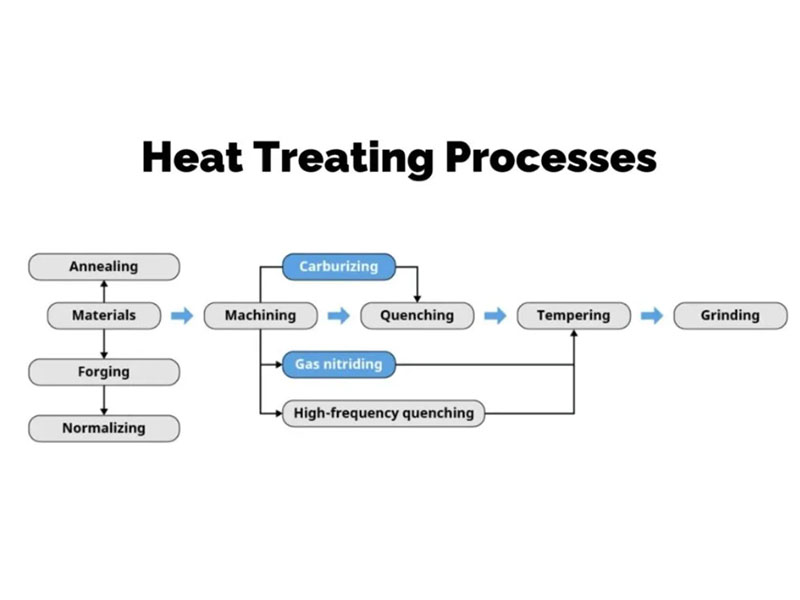
The key difference among heat treatment methods is the target property. Some methods change the whole section of the part. Others change only the surface layer. Some are used before machining, and others are used near the end of production.
| Process | Main Purpose | Typical Result | Common Use In Automotive And Bearing Parts |
|---|---|---|---|
| Annealing | Soften the material and reduce internal stress | Lower hardness, better ductility, easier forming or machining | Preparing steel before forming, machining, or later hardening |
| Normalizing | Refine and even out structure after hot working | More uniform structure and improved machinability compared with untreated steel | Preparing forgings, blanks, and rough-machined parts for later operations |
| Hardening and quenching | Increase hardness and strength through rapid cooling | High hardness but lower toughness before tempering | Bearing rings, rolling elements, shafts, tools, and other loaded steel parts when the steel grade is suitable |
| Tempering | Reduce brittleness after hardening | Better hardness and toughness balance | Almost always paired with hardening where a hardened steel part must resist cracking |
| Carburizing | Add carbon to the surface before quenching | Hard wear-resistant case with a tougher low-carbon core | Gears, shafts, and parts needing contact wear resistance plus impact strength |
| Nitriding | Diffuse nitrogen into the surface | High surface hardness, wear resistance, and fatigue support with relatively low distortion | Finished or near-finished ferrous parts such as gears, crankshafts, camshafts, springs, and dies |
Annealing: Softening For Processing
Annealing is used when the part is too hard, too stressed, or too brittle for the next manufacturing step. In steels, it commonly reduces hardness, increases ductility, and helps remove internal stresses. It can restore ductility after cold working so the material can be formed again without cracking.
Annealing is usually a preparation process rather than a final wear-resistance process for bearing components. For example, a blank may be annealed before machining so tools cut more predictably and the part has a better starting condition for later hardening.
Normalizing: Making The Structure More Uniform
Normalizing is used mainly on steels after forging, rolling, casting, or other hot processes. The purpose is to refine and even out the microstructure before machining or later heat treatment. Compared with annealing, it generally aims for a more uniform, refined structure rather than maximum softness.
For automotive bearing supply chains, normalizing is most relevant before precision finishing. It is not a substitute for final raceway hardening, case hardening, or the exact process named on the drawing.
Hardening And Quenching: Creating High Hardness
Hardening and quenching are used when steel must gain high hardness and strength. The part is heated to the hardening temperature, held so the structure transforms, and then cooled fast enough in a suitable medium to form a hard structure. Depending on steel type, industrial neutral hardening may use hardening temperatures from about 800 to 1220 degrees C.
The purpose is high strength and wear resistance, but quenching can create stress and distortion. A hardened part can also be brittle if it is not tempered correctly. For bearing rings and rolling elements, final hardness must match the steel grade, part geometry, contact stress, and applicable specification rather than a universal value.
Tempering: Balancing Hardness And Toughness
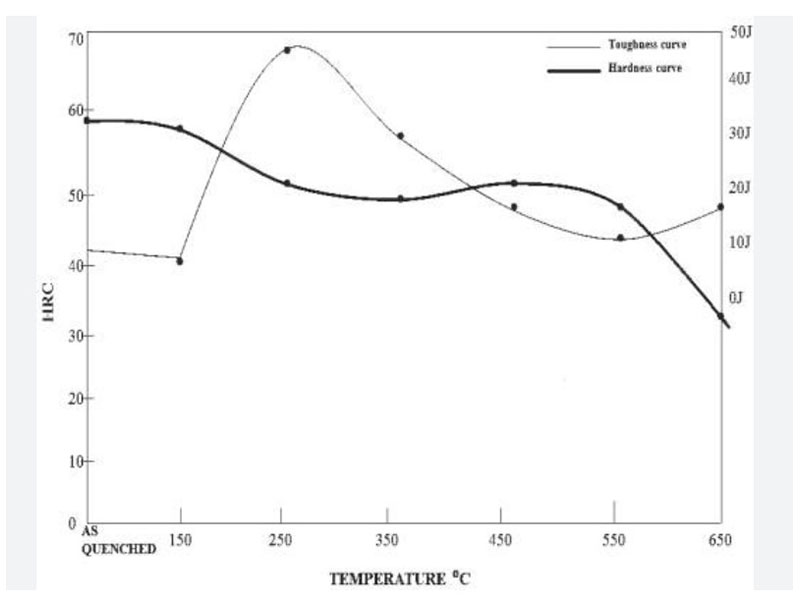
Tempering is performed after hardening, carburizing, carbonitriding, or induction hardening to adjust the hardness and toughness ratio. It reduces brittleness, improves ductility, and relieves some internal stress while retaining useful hardness.
Tempering temperature depends on material and hardness requirement. A low-temperature tempering range of 160 to 300 degrees C is often used for case-hardened components and cold-work tooling, while higher tempering ranges are used for spring steels, quenched and tempered steels, hot-work tooling, and high-speed steels. The correct range must come from the steel supplier data, part drawing, or process specification.
Carburizing: Hard Surface With A Tougher Core
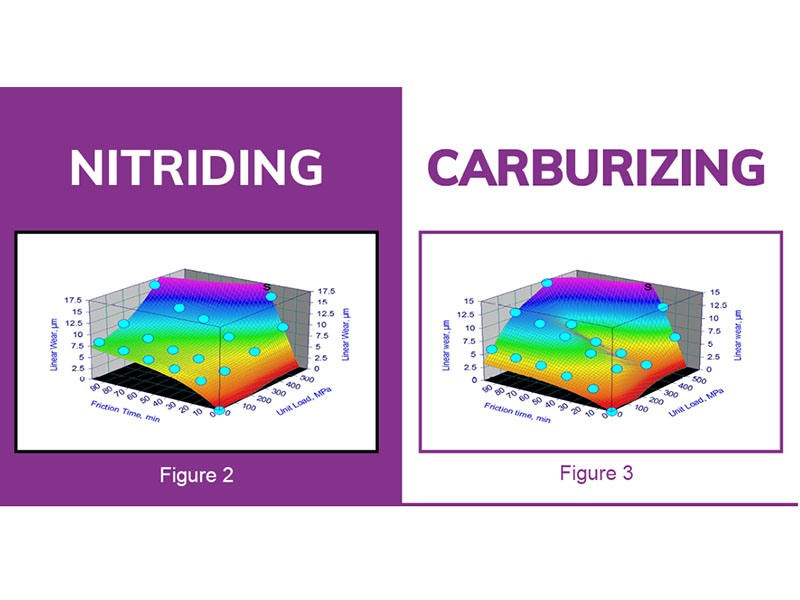
Carburizing is a case-hardening process for ferrous alloys. It introduces carbon into the surface of a low-carbon steel, then uses quenching to harden the enriched surface layer. The purpose is to create a hard, wear-resistant case while keeping a tougher core.
Atmospheric carburizing is commonly performed in a carbon-rich atmosphere above the transformation temperature. One industrial reference gives 880 to 980 degrees C for the carburizing phase and notes that effective case hardening depth can range from shallow, often less than 2 mm, to deeper depths of 4 to 6 mm depending on process requirements. Those figures are process examples, not universal bearing specifications.
In automotive parts, carburizing is often associated with transmission gears and shafts because these parts need surface wear resistance and a core that can handle impact load. For a bearing component, carburizing is selected only when the design calls for that surface-core property combination.
Nitriding: Surface Hardness With Low Distortion
Nitriding is another case-hardening family, but it adds nitrogen rather than carbon. Gas nitriding is a thermochemical process used to increase surface hardness, wear resistance, and fatigue life by forming nitrogen-enriched surface layers and hard nitride precipitates.
An important difference is distortion control. Gas nitriding is typically a low-temperature process around 520 degrees C and is often used on finished or near-finished ferrous parts. Because the process does not normally rely on a final high-speed quench in the same way as carburizing, it can be attractive when final dimensions are difficult to correct after treatment.
How Heat Treatment Supports Bearing Performance
Bearings work under repeated rolling contact. That means the surface must resist wear and fatigue, while the body of the part must keep its geometry and avoid cracking. Heat treatment supports these goals by giving each steel component the properties required by its function.
- Raceways and rolling elements: need controlled hardness, microstructure, and residual stress so rolling contact can be carried repeatedly.
- Rings and shoulders: need stable dimensions after grinding, assembly, and service loading.
- Hub units and related shafts: may require different treatments in different zones depending on load path and design.
- Gears, shafts, and adjacent transmission parts: may use case hardening when surface wear resistance and core toughness must work together.
This is why heat treatment should follow the material grade and engineering drawing. A process that works well for a gear tooth may not be suitable for a bearing ring, and a treatment used for a finished shaft may be wrong for a part that still needs heavy grinding.
Choosing The Right Heat Treatment
The right heat treatment is chosen by required property, material, geometry, and production sequence. The question is not which process is strongest in general. The better question is which process creates the required property at the right location without creating unacceptable distortion, cracking risk, or cost.
Start With Material And Drawing Requirements
Steel grade controls what heat treatment is possible. Low-carbon steels are often chosen for carburizing because carbon is added to the surface. Alloy steels with nitride-forming elements such as chromium, molybdenum, vanadium, and aluminium are better candidates for nitriding. Through-hardening bearing steels require their own hardening and tempering route.
For production, the drawing, purchase specification, or customer standard should define the required hardness range, case depth if applicable, microstructure, inspection method, and any distortion limits. Do not infer these values from a similar vehicle, bearing size, or process name.
Match The Process To The Failure Risk
If the main risk is poor machinability, annealing or normalizing may be appropriate before finishing. If the main risk is abrasive wear or rolling contact fatigue, hardening or surface hardening may be needed. If the main risk is cracking after hardening, tempering becomes essential. If the main risk is surface wear with impact load, carburizing may be considered. If final size control is critical and the alloy is suitable, nitriding may be considered.
Control Heating, Cooling, And Inspection
Heat treatment quality depends on controlled temperature, soak time, atmosphere, quench medium, loading method, and post-treatment inspection. Poor control can cause decarburization, retained stress, excessive distortion, soft spots, cracking, or a case depth that does not match the drawing.
Inspection should match the specification. Common checks may include hardness testing, case-depth verification, microstructure review, dimensional inspection, and crack detection. The article title asks about the purpose of heat treatment, but in production the purpose is only achieved when the process is verified.
Avoid Common Heat Treatment Defects
Common heat treatment defects in bearing parts include overheating, underheating, overburning, quenching soft spots, quenching cracks, oxidative decarburization, deformation, and cracking. These defects can reduce surface hardness, wear resistance, fatigue strength, impact resistance, dimensional stability, or service life.
Defect prevention starts before quenching. Heating temperature, holding time, furnace atmosphere, part cleanliness, preheating, quench medium condition, cooling uniformity, and timely tempering all need control. Some defects may be corrected by rework when the specification allows it, but overburned, cracked, or deeply decarburized parts may need to be scrapped.
Common Misunderstandings About Heat Treatment
- Heat treatment does not fix the wrong steel grade. A steel must be suitable for the selected process and property target.
- Higher hardness is not always better. Excess hardness with low toughness can increase cracking risk.
- Case depth is application-specific. A carburized or nitrided layer must match the part design and load, not a generic catalog value.
- Surface hardening and through hardening are different choices. One changes the surface layer most strongly, while the other aims to harden the section more broadly.
- Heat treatment defects are not cosmetic issues. Soft spots, quenching cracks, decarburization, and severe deformation can directly affect bearing reliability.
- Final inspection matters. A process name alone does not prove that hardness, structure, or dimensions meet specification.
Conclusion
Heat treatment for automotive bearing parts comes down to the property target. Annealing and normalizing prepare material for processing, hardening and quenching create high hardness, tempering restores a usable hardness and toughness balance, carburizing creates a hard carbon-enriched case, and nitriding creates a nitrogen-hardened surface with relatively low distortion.
For automotive bearing parts, the correct heat treatment should be selected from the steel grade, part drawing, working load, manufacturing sequence, and inspection requirements. When specifications are unclear, confirm them with the bearing or vehicle manufacturer before treating, purchasing, or installing the part.
FAQs
Q1: What is the main purpose of heat treatment?
A: The main purpose is to change mechanical properties such as hardness, toughness, ductility, wear resistance, fatigue resistance, stress condition, or dimensional stability so the metal part can perform its intended job.
Q2: What is the difference between hardening and tempering?
A: Hardening increases hardness and strength by heating and rapid cooling. Tempering is performed after hardening to reduce brittleness, improve toughness, and adjust the final hardness to the required range.
Q3: Is carburizing the same as nitriding?
A: No. Carburizing adds carbon to the surface and usually includes quenching to harden the case. Nitriding adds nitrogen and is commonly used at lower temperature on suitable ferrous materials, often when surface hardness and low distortion are important.
Q4: Why are bearing parts heat treated?
A: Bearing parts are heat treated to obtain controlled hardness, wear resistance, fatigue resistance, toughness, and dimensional stability. The correct process depends on whether the part is a raceway, rolling element, ring, hub, shaft, or related component.
Q5: Can heat treatment cause distortion?
A: Yes. Heating, quenching, phase transformation, and stress release can change part dimensions. Process design, fixturing, quench control, material selection, and post-treatment inspection are used to manage this risk.
Q6: How should I choose heat treatment for an automotive bearing component?
A: Start with the steel grade and the engineering drawing. Confirm required hardness, case depth, microstructure, distortion limit, and inspection method from the manufacturer specification instead of choosing from a generic process description.