Quick Answer
Tapered roller bearings use tapered rollers and conical raceways that converge at a common point on the bearing axis, enabling them to handle combined radial and axial loads simultaneously. Key advantages include extremely high load capacity (far exceeding ball bearings of the same size), adjustable clearance/preload, high rigidity, and long service life—optimized designs deliver over five times the fatigue life of angular contact ball bearings. However, they have speed limitations (lower than ball bearings and cylindrical roller bearings), are very sensitive to misalignment (just a few arc minutes), generate higher friction, and require complex installation with precise adjustment. Choose them for moderate-speed, heavy-duty applications like automotive wheel hubs, gearboxes, differentials, and construction equipment.
Not all bearings are built the same. When your application demands heavy combined loads—both radial and axial—in a compact, rigid package, tapered roller bearings are often the answer. They’ve been a cornerstone of industrial and automotive design for over a century.
Unlike cylindrical roller bearings, which handle primarily radial loads, tapered roller bearings are engineered for multi-directional loading. Their unique conical geometry allows them to support heavy thrust and radial loads simultaneously—a capability that surpasses spherical, cylindrical, or needle roller bearings. They are used in demanding applications such as agriculture, construction and mining equipment, axle systems, gear boxes, motors and reducers, propeller shafts, railroad axles, differentials, and wind turbines.
What makes tapered roller bearings different from ball bearings? Can they handle axial loads? How fast can they run? This article answers these questions by breaking down what tapered roller bearings are, how they work, and—most importantly—their advantages and disadvantages.
What Is a Tapered Roller Bearing and How Does It Work?
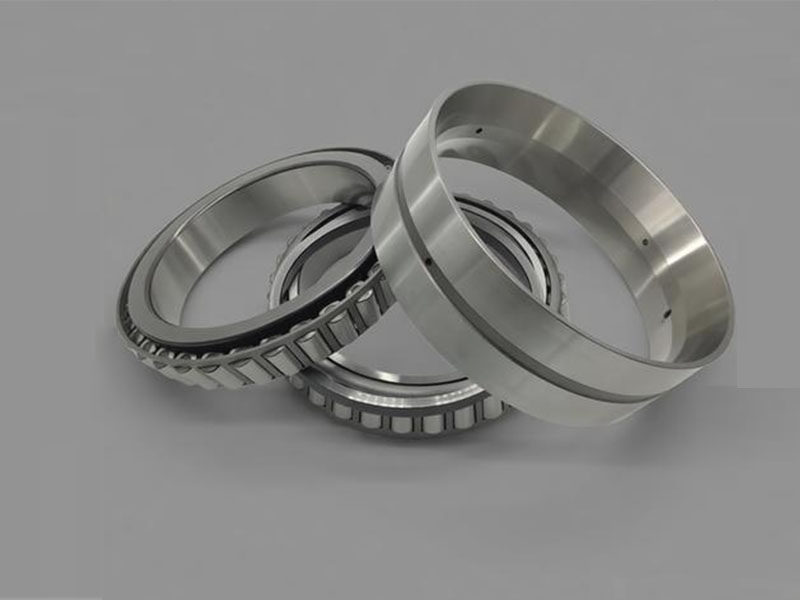
A tapered roller bearing is a rolling-element bearing that uses tapered rollers—rollers shaped like truncated cones—arranged between tapered inner and outer ring raceways.
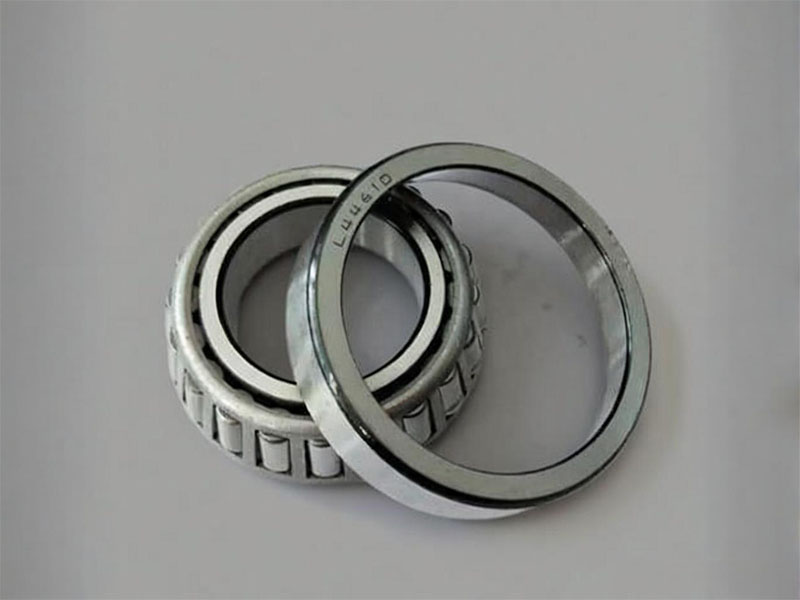
Basic structure: Instead of an inner ring and outer ring, tapered roller bearings have a cone (inner ring with rollers and cage) and a cup (outer ring). The rollers are profiled to distribute the load evenly, and a cage keeps them properly spaced.
Core geometric principle: The defining feature of a tapered roller bearing is that the projection lines of the raceways and the roller apices all meet at a common point on the bearing axis. This conical geometry provides true rolling motion—the rollers roll without sliding between the raceways—which reduces component wear and fatigue.
Main types:
- Single-row: The most widely used type. Handles radial and axial loads in one direction simultaneously. Single-row bearings are usually used in pairs so that axial forces are supported equally in both directions.
- Double-row: Provides greater radial load capacity and can handle thrust loads in both directions. Commonly used in gearboxes, tunnel machines, and hoisting equipment.
- Four-row: Consists of four rows of alternating converging and diverging rollers. Used for extreme radial loads in applications like rolling mills.
Contact angle: The axial load carrying capacity of a tapered roller bearing is determined by the contact angle—the larger the contact angle, the greater the axial load carrying capacity. Contact angles typically range from 10° to 30°, with bearings divided into normal-, medium-, and steep-angle types.
Installation and adjustment: Single-row tapered roller bearings are typically adjusted against a second tapered roller bearing so that axial forces are supported equally in both directions. The cup and cone assembly are separable, allowing for the creation of end play (axial clearance) or preload (axial interference) by moving the cup or cone axially during installation. The ideal operating setting is generally near-zero, to maximize bearing life. A slight preload maximizes bearing performance and life by increasing rigidity and reducing deflection. However, excessive preload can drastically reduce bearing life or generate high temperatures that quickly lead to failure.
Load handling:
- Radial loads: Primary function—high radial load capacity due to line contact
- Axial loads: Can support combined radial and axial loads (unilateral). Cannot support purely axial loads—purely axial loads should be avoided; these bearings are not designed for thrust-only applications. Single-row tapered roller bearings can typically handle an axial load up to approximately 60% of the radial capacity.
- Multi-directional loading: Can support pure radial, pure axial (with caution), and any combination of the two
Speed capability: Tapered roller bearings have speed limitations—they have lower limiting speeds than ball bearings and cylindrical roller bearings. The friction at the roller end/rib interface is the primary reason for speed limitations. They are typically used for moderate-speed, heavy-duty applications. As a general industry guideline, limiting speeds are approximately 65% of deep groove ball bearings, 70% of cylindrical roller bearings, and 60% of angular contact ball bearings of comparable size.
Separability: Tapered roller bearings are separable—the cone assembly (inner ring with rollers and cage) can be mounted separately from the cup (outer ring). This facilitates mounting, dismounting, and maintenance inspection routines. Components with the same designation are interchangeable.
Advantages of Tapered Roller Bearings
Pro 1. Extremely high combined radial and axial load capacity
Tapered roller bearings can simultaneously support heavy radial and axial loads—a capability that surpasses spherical, cylindrical, or needle roller bearings. They offer higher load-carrying capacities when compared to ball bearings of the same size. Tapered roller bearings can handle higher degrees of axial load to radial load than a spherical roller bearing or deep groove ball bearing. They are the best choice for applications with high axial and radial loads.
Pro 2. Adjustable clearance and preload
Tapered roller bearings have the inherent advantage of being adjustable—they can be set to approach optimum performance in almost any application. Engineers can create end play (axial clearance) or preload (axial interference) by moving the cup or cone axially during installation. A slight preload maximizes bearing performance and life by increasing rigidity, while end play accommodates thermal expansion.
Pro 3. High rigidity and shock resistance
Line contact between each roller and raceway provides excellent rigidity—tapered roller bearings offer significantly higher rigidity than ball bearings of similar size. They also offer improved resistance to shock loads and vibrations, making them ideal for applications with heavy impact loading. Premium manufacturers note that more robust cages, high-strength materials, and design optimizations reduce the risk of unplanned stops, increase service life, and improve energy efficiency.
Pro 4. Separable design for easy installation and maintenance
The cone assembly (inner ring with rollers and cage) can be mounted separately from the cup (outer ring). This facilitates mounting, dismounting, and maintenance inspection routines. The separable components are also interchangeable—components with the same designation can be used interchangeably, simplifying replacement and reducing inventory costs.
Pro 5. Long service life
Tapered roller bearings offer long service life when properly selected, installed, and maintained. SAE research shows that enhancements to tapered roller bearing internal geometry significantly increase fatigue life performance—with optimized designs delivering over five times the life of angular contact ball bearings. This superior performance provides designers with significant reliability advantages.
Pro 6. Compact design
Line contact provides a wider load-bearing surface than ball bearing point contact. The practical result: the same load capacity can be achieved in a more compact envelope—tapered roller bearings are smaller than ball bearings for equivalent load ratings. This compactness is particularly valuable in space-constrained applications like automotive gearboxes, transmissions, and differentials. Power-dense designs demonstrate that compact tapered roller bearings can deliver heavier loads and help extend bearing life within restricted envelope dimensions.
Disadvantages of Tapered Roller Bearings
Con 1. Speed limitations
Tapered roller bearings have lower limiting speeds than ball bearings and cylindrical roller bearings. The friction at the roller end/rib interface is the primary reason for speed limitations. As a general industry guideline, limiting speeds are approximately 65% of deep groove ball bearings, 70% of cylindrical roller bearings, and 60% of angular contact ball bearings of comparable size. Ball bearings can exceed the tapered bearing’s speed limitations and generate less heat at elevated speeds. Tapered roller bearings are typically used for moderate-speed applications where load capacity is more critical than speed.
Con 2. Sensitivity to misalignment
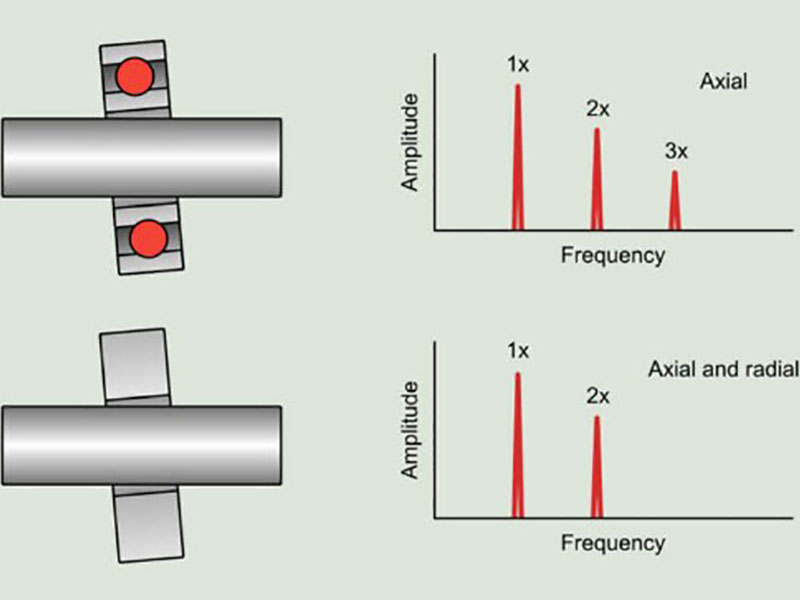
Tapered roller bearings are very sensitive to misalignment and do not tolerate dynamic misalignment well. Standard single-row tapered roller bearings can tolerate just a very slight angular misalignment (a few arc minutes). When the load ratio P/Cr is below 0.2, the angular displacement between the bearing rings is limited to a maximum of 4 arc minutes. Misalignment causes uneven load distribution and edge stresses that significantly reduce bearing life. For applications where misalignment cannot be avoided, other bearing types—such as spherical roller bearings—are more suitable.
Con 3. Higher friction than ball bearings
Tapered roller bearings generate more friction compared to a ball-bearing design. The large contact area between the rollers and the rings, while beneficial for load capacity, does have a downside—it can generate higher rolling friction. A large amount of sliding contact exists at the interface between the large roller end and the rib face, which is subject to significant friction. This results in higher friction and frictional heat compared to ball bearings. (Note: leading manufacturers have made significant strides in reducing friction with optimized roller end designs and surface finishes that promote lubricant film formation, but friction remains inherently higher than ball bearings.)
Con 4. Complex installation requiring precise adjustment
Tapered roller bearings are characterized by complex installation that demands skill and care. Single-row bearings must be used in pairs and require precise adjustment of end play or preload. The setting procedure must ensure the desired preload is achieved and the amount of end play is within acceptable parameters. Improper adjustment—whether excessive preload or excessive end play—drastically reduces bearing life. Installation requires skilled technicians and careful measurement.
Con 5. Higher cost
Precision manufacturing, matched pairs, and the complexity of adjustment make tapered roller bearings more expensive than ball bearings and some other roller bearing types. The separable components must be manufactured to close dimensional and geometrical tolerances to ensure proper interchangeability, adding to production cost. Tapered roller bearings are cost-effective and widely available as standard products, but precision-grade and matched sets command premium pricing.
Con 6. High lubrication requirements
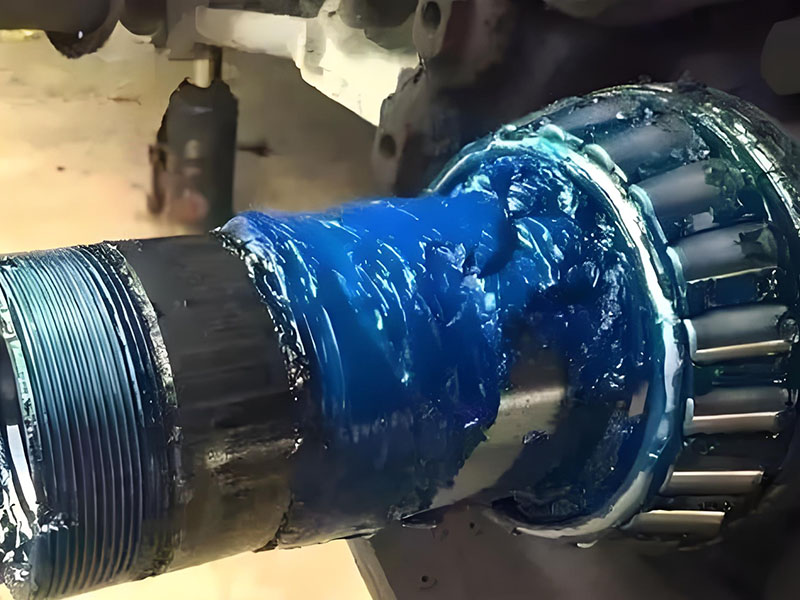
Tapered roller bearings require more attention to lubrication due to higher friction and the sliding contact at the roller end/rib interface. Tapered wheel bearings hardly ever wear out on their own—end play and noise are usually indicators of inadequate lubrication, faulty installation, or improper adjustment. Low viscosity lubricants, high preload, or poor lubricant delivery can all cause premature failure. Lubrication failure leads to smearing (scuffing) on roller surfaces and raceways.
Conclusion
Tapered roller bearings are the go-to choice for applications demanding heavy combined radial and axial loads in a compact, rigid package. Their unique conical geometry, adjustable clearance, and high load capacity make them indispensable in automotive, industrial, and heavy machinery applications.
Choose tapered roller bearings when:
- Loads combine significant radial and axial components
- High rigidity and shock resistance are required
- Compact design is important—they offer smaller size for equivalent load capacity
- Adjustable clearance/preload is needed to optimize performance
- Moderate speeds are acceptable—they are not the best choice for ultra-high-speed applications
- Applications include automotive wheel hubs, transmissions, differentials, axle systems, gearboxes, construction and mining equipment, railroad axles, and wind turbines
Consider alternatives when:
- Ultra-high speeds are required—use ball bearings or cylindrical roller bearings
- Misalignment cannot be avoided—use spherical roller bearings
- Lowest possible friction is critical—use ball bearings
- Installation expertise is unavailable—tapered roller bearings require precise adjustment
- Cost is the primary constraint—ball bearings are more economical
Understanding the trade-offs—combined load capacity vs. speed limitations, adjustability vs. installation complexity, and rigidity vs. friction—is the key to making the right selection.
At DUHUI Bearing, we have been manufacturing automotive and industrial bearings since 2003, serving customers in over 60 countries. Our tapered roller bearings are produced to international standards with precision grades up to P5 and above. Whether you need standard sizes or custom configurations, we are here to help you find the right bearing solution for your application.
Frequently Asked Questions (FAQs)
Q1: Can tapered roller bearings handle pure axial loads?
Not recommended. Tapered roller bearings can support a combination of radial and unilateral axial loads, although purely axial loads should be avoided—these bearings are not designed for thrust-only applications. They are designed for combined loads—if your application requires pure axial loads, consider thrust bearings instead.
Q2: What is the main difference between tapered roller bearings and ball bearings?
The core differences are contact type and load direction. Tapered roller bearings use line contact (rollers) and can handle combined radial and axial loads in one direction. Ball bearings use point contact (balls) and can handle radial loads with limited bidirectional axial capacity but cannot support high loads without risk of premature failure. Tapered roller bearings offer significantly higher load capacity and rigidity but have lower speed limits and higher friction than ball bearings. Tapered roller bearings are the best choice for high axial and radial loads; ball bearings shine in high-speed environments with less demanding load conditions.
Q3: What is the difference between tapered roller bearings and cylindrical roller bearings?
Cylindrical roller bearings are designed for high radial loads in well-aligned systems and have limited axial load capacity (except ribbed designs). Tapered roller bearings are designed for combined radial and axial loads and can handle significant thrust loads in one direction. Tapered roller bearings have lower limiting speeds than cylindrical roller bearings due to higher friction at the roller end/rib interface. Tapered roller bearings also offer the unique advantage of adjustable clearance/preload.
Q4: How much misalignment can a tapered roller bearing tolerate?
Very little. Standard single-row tapered roller bearings can tolerate just a very slight angular misalignment (a few arc minutes). When the load ratio P/Cr is below 0.2, the angular displacement between the bearing rings is limited to a maximum of 4 arc minutes. Even small misalignments cause edge stresses between rollers and raceways, leading to reduced fatigue life, increased vibration, and premature failure. For applications where misalignment is unavoidable, consider spherical roller bearings.
Q5: What is the speed capability of tapered roller bearings?
Tapered roller bearings have lower limiting speeds than ball bearings and cylindrical roller bearings. They are typically used for moderate-speed, heavy-duty applications. As a general industry guideline, limiting speeds are approximately 65% of deep groove ball bearings, 70% of cylindrical roller bearings, and 60% of angular contact ball bearings of comparable size. However, with specialized cooling, lubrication, and surface treatments, they can operate successfully at higher speeds in some applications.
Q6: What is the difference between single-row, double-row, and four-row tapered roller bearings?
Single-row: Most common; handles radial and axial loads in one direction; usually used in pairs. Double-row: Provides greater radial load capacity; can handle thrust loads in both directions. Four-row: Consists of four rows of rollers; used for extreme radial loads in applications like rolling mills.
Q7: What are the typical applications of tapered roller bearings?
Tapered roller bearings are used in automotive wheel hubs, transmissions, differentials, and pinion shafts, gearboxes and reducers, construction and mining equipment, railroad axles, machine tool spindles, agricultural machinery, propeller shafts, wind turbines, and rolling mills.
Q8: What is the difference between preload and endplay?
Preload is axial interference (negative clearance) within a mounted bearing—it increases rigidity of highly stressed parts that would otherwise be adversely affected by excessive deflection and misalignment, but increases heat generation. Endplay is axial clearance (positive clearance)—it accommodates thermal expansion and is safer for temperature fluctuations. The ideal operating setting is generally near-zero, to maximize bearing life.
Q9: What are the common failure modes of tapered roller bearings?
Common failure modes include: Inadequate lubrication—end play and noise are usually indicators of lubrication issues. Faulty installation—improper adjustment or handling. Improper adjustment—excessive preload or excessive end play drastically reduces bearing life. Misalignment—edge stresses from angular misalignment reduce fatigue life. Contamination—abrasive particles accelerate wear. Overload—exceeding rated capacity causes premature fatigue failure.