Quick Answer
Rubber seals (2RS) contact the inner ring, blocking dust and moisture but reducing max speed by about 40%. Metal shields (ZZ) leave a tiny gap, allowing very high speeds with low friction but minimal contamination protection. Choose shields for clean, high‑speed applications like electric motors. Choose seals for dirty, wet, or maintenance‑free environments like wheel hubs or farm equipment.
When you select a bearing closure type – metal shield or rubber seal – you face a direct trade‑off between speed and protection. Many engineers pick the wrong one simply because they don’t know how much performance they lose. Can a sealed bearing handle your RPM? Will a shielded bearing survive a dusty factory floor?
This guide explains exactly how metal shields and rubber seals work, their real‑world limits, and a simple step‑by‑step decision process. You’ll also learn about non‑contact seals (RZ) – a lesser‑known middle option. By the end, you’ll know which bearing to specify for your next project.
What Are Metal Shielded Bearings? (Suffix: ZZ / 2Z)
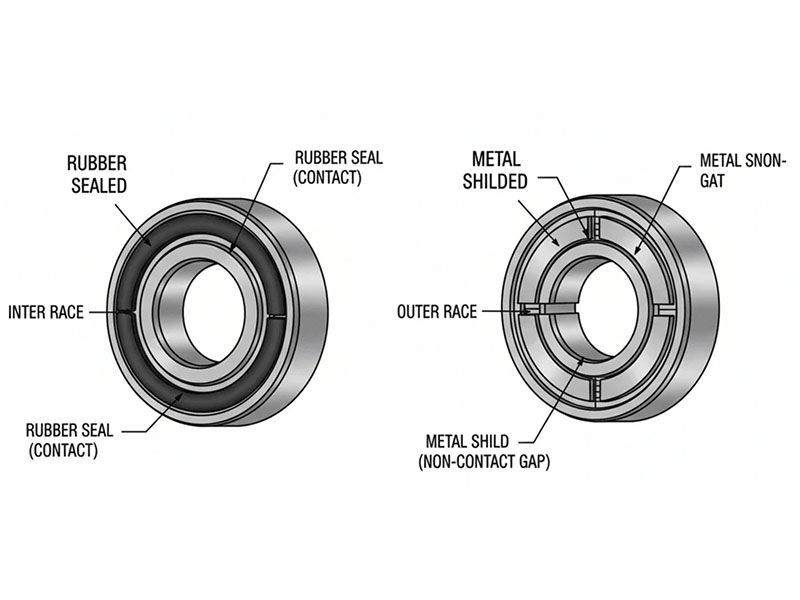
Metal shielded bearings use a thin steel or stainless steel disc fixed to the outer ring. The shield does not touch the inner ring – there’s a controlled gap of about 0.1–0.3 mm. This non‑contact design creates zero friction, allowing the bearing to run at speeds nearly as high as an open bearing.

Key Advantages
- Very high speed capability – No frictional drag means the speed limit is set only by the cage and lubrication, not the shield. For many ball bearings, shields allow speeds equal to open bearings (e.g., up to 20,000–30,000 rpm for small sizes).
- Wide temperature range – Steel shields withstand continuous heat from -40°C up to 250°C or more, far beyond rubber’s limit.
- Lowest cost – Simple stamping makes ZZ bearings slightly cheaper than sealed versions.
- Serviceable – You can pry off the shield, clean the bearing, and regrease it. Sealed bearings are normally disposable.
Limitations You Must Know
- Poor contamination protection – The gap lets fine dust, water spray, and process liquids enter. In a humid or dusty environment, a shielded bearing can fail within weeks, whereas a properly sealed bearing may last years under the same conditions.
- Grease leakage – The same gap allows grease to slowly escape, especially under vibration or high temperature. Over time, the bearing runs dry.
Where Metal Shields Excel
Clean, dry, high‑speed applications:
- Small electric motors (fans, pumps, power tools)
- Office equipment (printers, 3D printers)
- High‑speed spindles in clean rooms
- Automotive alternators (in protected engine bays)
What Are Rubber Sealed Bearings? (Suffix: 2RS / RS)

Rubber sealed bearings have a flexible lip made of nitrile rubber (NBR) bonded to a steel insert. The seal snaps into a groove on the outer ring, and the lip contacts the inner ring. This contact creates a physical barrier. Note: RS means one side sealed, 2RS means both sides.
Key Advantages
- Superior contamination exclusion – Rubber seals keep out fine dust (<10 µm), water jets, and even mild chemicals. In wet or muddy conditions, sealed bearings last 3–5 times longer than shielded ones.
- Grease retention – The seal holds factory‑filled grease for life. No regreasing needed, which is critical for sealed motors or hard‑to‑reach equipment.
- Quieter operation – Rubber dampens vibration and rolling noise. In consumer products (e.g., skateboard wheels, office chairs), sealed bearings feel more premium.
Limitations You Must Accept
- Speed reduction – Contact friction lowers the maximum speed by approximately 40% compared to an open or shielded bearing of the same size (according to SKF’s general catalog). For a 6202 bearing rated at 20,000 rpm open, a 2RS version will be limited to ~12,000 rpm under grease lubrication.
- Higher torque – Starting and running torque increase, which can matter in low‑power or precision applications (e.g., small drones, torque‑sensitive instruments).
- Temperature restriction – Standard NBR seals degrade above 100–120°C. For higher temperatures, you need special materials like Viton (fluoroelastomer) – but that adds cost.
Where Rubber Seals Are Mandatory
Dirty, wet, or hard‑to‑access environments:
- Automotive wheel bearings (exposed to road spray, salt, dust)
- Agricultural machinery (tractors, harvesters)
- Food processing equipment (washdown requirements)
- Conveyor rollers in dusty plants
- Outdoor power tools (chainsaws, lawn mowers)
Performance Comparison: Metal Shields vs Rubber Seals
| Property | Metal Shield (ZZ) | Non‑Contact Seal (RZ) | Contact Rubber Seal (2RS) |
|---|---|---|---|
| Max speed | 100% (same as open) | 100% | ~60% of open |
| Dust protection | Poor – coarse particles only | Moderate – fine dust still passes | Excellent – keeps out fine dust |
| Water resistance | None – water enters freely | Low – resists splashes | Good – withstands jets (not submersible) |
| Starting torque | Very low | Very low | Moderate to high |
| Temperature range (standard) | -40°C to +250°C | -40°C to +100°C (rubber limits) | -40°C to +100°C |
| Grease retention | Leaks slowly over time | Retains better than shield | Outstanding – no leakage |
| Regreasable? | Yes (shield removable) | No (seal damages upon removal) | No |
| Relative cost | Lowest | Medium | Highest |
Note: Speed reduction depends on bearing size and lubrication. The 40% figure is a practical rule for grease‑lubricated ball bearings. With oil or special low‑drag seals, the gap can be smaller.
Non‑Contact Seals (RZ / 2RZ): A Practical Middle Ground
Many engineers don’t know about non‑contact rubber seals. These look like rubber seals but are molded with a labyrinth gap – the seal doesn’t touch the inner ring. They offer:
- Speed equal to metal shields – No friction, so no speed penalty.
- Better protection than shields – The labyrinth path traps coarse dust and resists splashing better than a straight gap.
- Lower torque than contact seals – Ideal for applications where both speed and light contamination protection matter.
If your environment has moderate dust but requires full speed, RZ seals are a smarter choice than either ZZ or 2RS.
Suffix: RZ (single seal) or 2RZ (both sides). Common brands use similar codes – SKF uses RSL for light‑contact seals, but true non‑contact is RZ.
Typical use: Electric motors in dusty factories, conveyor rollers, and general industrial equipment where full rubber seals would limit speed but shields are too leaky.
How to Choose: A Step‑by‑Step Decision Process
Stop guessing. Run through these four questions in order.
Step 1: Is water or fine dust present?
- Yes, constant exposure (outdoor equipment, food washdown, mining) → Choose contact rubber seals (2RS). Shields will fail quickly.
- Occasional splashes or coarse dust only → Non‑contact seals (RZ) or even shields may work.
- Clean, dry environment (indoor machinery, office equipment) → Shields are acceptable.
Step 2: What is the required operating speed?
- Near the bearing’s limit (e.g., >70% of open bearing speed) → Avoid contact seals. Use shields or non‑contact seals.
Example: A spindle running at 18,000 rpm where the open rating is 20,000 rpm – shields are mandatory. - Moderate speed (≤60% of open rating) → Contact seals are fine.
Step 3: What is the maximum temperature?
- Continuous >110°C → Rubber seals (even NBR) will harden and crack. Use metal shields or specify Viton seals (costly).
- Below 100°C → All options work thermally.
Step 4: How critical is maintenance access?
- Equipment is easy to reach and you have a lubrication schedule → Shields allow regreasing, extending bearing life.
- Bearing is sealed inside a motor or hard to access → Use contact seals for lifetime lubrication.
Quick Selection Table for Common Automotive Applications
| Automotive Component | Recommended Closure | Why |
|---|---|---|
| Wheel hub bearing | Contact rubber seal (2RS) | Road spray, dirt, high contamination |
| Alternator (engine bay) | Metal shield (ZZ) | Clean, dry, high speed |
| Tensioner pulley | Non‑contact seal (RZ) or metal shield | Moderate dust, high RPM – shield only if very clean |
| Electric power steering motor | Non‑contact seal (RZ) | Balance of speed and dust protection |
| Suspension ball joint (integrated bearing) | Contact rubber seal (2RS) | Grease retention under mud and water |
Conclusion
Choosing between rubber seals and metal shields comes down to a single trade‑off: speed vs protection.
- Metal shields (ZZ) give you maximum RPM and wide temperature range but protect only against coarse particles. Use them in clean, dry, high‑speed applications.
- Rubber contact seals (2RS) block dust and moisture effectively but reduce maximum speed by about 40%. Use them in dirty, wet, or maintenance‑free designs.
- Non‑contact seals (RZ) offer a middle path – shield‑like speed with better contamination resistance than shields.
For most automotive bearing applications, contact rubber seals work best on wheel hubs and exposed chassis parts, while metal shields suit under‑hood rotating equipment where heat and speed dominate.
At DUHUI Bearing, we manufacture IATF 16949 certified automotive bearings for these exact conditions. If you need help selecting the right seal type for your application, contact our engineering team through our website for free support.
FAQs
Q1: What does “ZZ” and “2RS” mean on a bearing?
A: ZZ means a metal shield on both sides. 2RS means a contact rubber seal on both sides. A single shield is Z, and a single seal is RS. These suffixes follow ISO and ABMA standards, so they are universal across brands.
Q2: Can I replace a shielded bearing with a sealed one?
A: Yes, if the speed requirement drops by ~40% and the housing has room for the slightly wider seal (seals sometimes add 0.5–1 mm width). Also check temperature – sealed bearings run hotter due to friction.
Q3: Do rubber sealed bearings need grease?
A: No. Factory‑filled grease is sealed inside for life. Do not attempt to regrease a 2RS bearing – prying off the seal usually damages it, and adding grease can cause overheating.
Q4: Why do some bearings have both a shield and a seal?
A: Rarely, you’ll see a shield on one side and a seal on the other (suffix Z/RS). This is used where one side faces a clean cavity and the other faces contamination. However, most standard bearings are symmetrical.
Q5: How do I know if my bearing failed because of the wrong seal type?
A: Look at the failed bearing:
– Rust or dried grease → Moisture ingress (need rubber seal).
– Fine grit inside the raceway → Dust ingress (need seal or non‑contact).
– Blue discoloration on rings/balls → Overheating (shield may be better or use high‑temp grease).
– Grease leaked out completely → Shield gap allowed loss (try a seal).
Q6: Are rubber seals always made of NBR?
A: Standard rubber seals use NBR (nitrile) for good oil resistance and temperature range up to 100°C. For higher temperatures (up to 200°C) or chemical exposure, you can get seals in Viton (FKM) or silicone. Always check the bearing datasheet.
Q7: When should I use a single seal (RS) instead of 2RS?
A: Use single seal (RS) when one side of the bearing faces a clean, enclosed cavity (e.g., inside a gearbox) and the other side faces potential contamination. For most exposed applications, 2RS is safer.