When a rotating or sliding shaft passes through a housing, direct metal-to-metal contact causes rapid wear, excessive heat, and eventual component failure. Bushings—also known as sleeve bearings or plain bearings—solve this problem by providing a low-friction interface between moving parts. This article explains how bushings work, what they are made of, and how to select, lubricate, and install them correctly.
What Are Bushings?
A bushing is a cylindrical component that serves as a bearing surface for rotating or sliding shafts. Unlike rolling element bearings that use balls or rollers, bushings operate through sliding contact between the bushing inner diameter and the shaft outer diameter.
Bushings are also referred to as sleeve bearings, plain bearings, or journal bearings. They are used to constrain, guide, or reduce friction in rotary or linear applications, and can be found in virtually every type of machinery, from automotive suspension systems to industrial conveyors.
How Bushings Work
Bushings work by providing a controlled sliding interface between two moving components. Instead of relying on rolling elements, the bushing material—selected for its low friction and wear resistance—slides against the shaft surface. The working mechanism involves several key functions:
Vibration Dampening and Isolation
Bushings absorb shock and dampen vibrations that would otherwise transfer through the mechanical system. Elastomeric bushings, commonly used in vehicle suspension systems, are specifically designed to isolate road vibrations from the chassis, improving ride comfort and protecting other components from shock loads.
Friction Reduction and Wear Management
By providing a low-friction surface, bushings significantly reduce the resistance between moving parts. This friction reduction minimizes energy loss and prevents premature wear of both the bushing and the mating shaft. Self-lubricating bushings achieve this through lubricants—either liquid oil or solid materials such as graphite, MoS₂, or PTFE—embedded into the bearing’s sliding layer.
Controlled Movement Guidance
Bushings constrain and guide the motion of shafts or other moving components, ensuring they follow the intended path with minimal deviation. In linear motion applications, bushings maintain precise alignment between sliding surfaces. In rotary applications, they maintain proper clearance between the shaft and the housing.
Load Distribution
Unlike rolling element bearings that concentrate loads on small contact points, bushings distribute applied loads across a larger surface area. This distributed load capacity makes bushings particularly suitable for heavy-load, low-speed applications. The PV value—the product of specific load (P) and sliding speed (V)—is a key parameter that influences bushing service life. The PV value must not exceed the material’s maximum permissible PV limit. Within that limit, lower PV values generally correlate with longer service life, but other factors such as lubrication, temperature, and contamination also play significant roles.
Bushing Materials and Construction
The material composition of a bushing determines its load capacity, wear resistance, operating temperature range, and lubrication requirements. Common bushing materials include:
- Rubber – Widely used in automotive suspension systems, engine mounts, and vibration isolation applications. Offers excellent shock absorption and noise reduction but has limited load capacity and can degrade when exposed to oil, ozone, or extreme temperatures. Note: Not suitable for rotary sliding friction applications; intended for vibration isolation only.
- Polyurethane – Provides higher durability and better resistance to wear compared to rubber. Commonly used in performance automotive applications where improved handling precision is required. Withstands exposure to oils and chemicals better than rubber.
- Metal Bushings (Bronze, Steel, and Composite) – Used in high-load industrial applications. Bronze bushings offer good wear resistance and are often oil-impregnated for self-lubricating properties. Steel-backed bushings with a sintered bronze layer and PTFE overlay (a common type of PTFE composite bushing) provide mechanical strength combined with low friction. Graphite-plugged bronze bushings can handle high static loads (depending on the alloy and design), while composite PTFE-lined bushings offer excellent dry-running performance with load capacity determined by the steel backing.
Note on specialty designs: Some advanced bushings, such as hydraulic bushings used in premium automotive suspensions, incorporate fluid-filled chambers to provide controlled damping. These are specialized components rather than a separate material category.
Common Applications of Bushings
Bushings serve critical functions across multiple industries:
- Automotive – Suspension control arms, engine mounts, stabilizer bar links, transmission components, and steering linkages. Worn suspension bushings can cause uneven tire wear and “toe-in” conditions as the vehicle travels down the road. Hydraulic bushings are found in some premium vehicles for enhanced vibration isolation.
- Industrial Machinery – Conveyor systems (pulleys, pillow block housings, idler rollers), pumps, motors, agricultural equipment, hydraulic cylinders, and mining machinery. Tapered bushings are commonly used to mount sprockets and pulleys onto shafts.
- Electrical and Electronic Equipment – Insulating components where a conductor passes through a grounded barrier (transformer bushings, cable entry fittings). Small bushings also protect wiring from sharp edges in electronic enclosures.
Factors Affecting Bushing Wear
Understanding the factors that cause bushing wear is essential for maximizing service life. Common wear factors include:
Lubrication-Related Issues
- Insufficient lubricant volume – Leads to increased friction and accelerated wear.
- Overheated lubricant – When operating temperatures exceed the lubricant’s viscosity rating, results in insufficient film thickness to support the load, generating additional frictional heat.
- Contaminated lubricant – Abrasive particles, water, or corrosive substances accelerate wear and may lead to pitting or corrosion.
Installation and Process Issues
- Rough shaft surface finish – Acts like a file against the bushing surface, separating small particles during movement. Conversely, a shaft that is too smooth (e.g., <0.1 µm Ra for PTFE composites) may prevent the formation of a transfer film, also reducing performance.
- Misalignment – Between the shaft and bushing is a leading cause of one-sided wear and premature failure.
- Improper clearance – Either too tight or too loose affects lubricant film formation and load distribution.
- Metal fatigue – From improper metallurgy or excessive cyclic loading.
Lubrication for Bushings
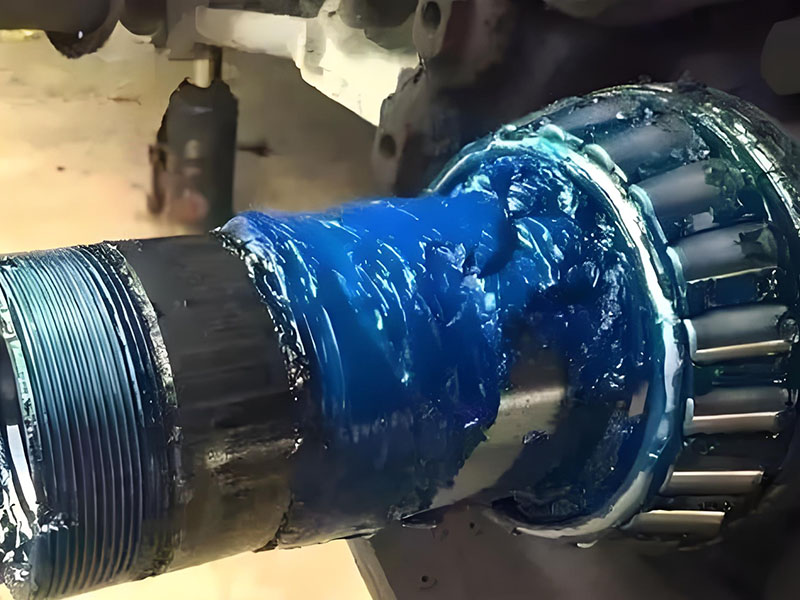
Proper lubrication is critical for bushing performance. Oil is commonly used for sleeve bearings, particularly in continuous rotation or high-speed applications. Grease is often preferred for slow-speed equipment, hard-to-access bearings, applications with frequent starts and stops, or where sealing against contamination is important.
Self-Lubricating Bearings
Self-lubricating bearings operate by injecting lubricant—either liquid oil or solid materials like graphite, MoS₂, or PTFE—into the bearing’s sliding layer. The lubricant is released through pores as the bushing operates, maintaining low friction even as the sliding layer wears.
Selecting Lubricants for Bushings
When selecting lubricants, the following factors should be considered:
- Oxidation stability – Resistance to chemical breakdown under operating temperatures
- Corrosion resistance – Protection against rust and chemical attack
- Wear protection – Ability to maintain a protective film between sliding surfaces
- Water separation properties (for circulating oil systems) – Capability to shed water contamination
For heavy-duty applications, solid additives such as molybdenum disulfide or graphite may be added to prevent metal contact under high load and low-speed conditions.
Step-by-Step Guide to Installing Bushings Correctly
Note: The following steps apply to tapered split bushings (such as QD or ST bushings) commonly used for mounting pulleys, sprockets, and similar components onto shafts. For plain cylindrical bushings (solid sleeves), installation typically involves press-fitting, thermal expansion/contraction, or using an arbor press. Always consult the manufacturer’s instructions for the specific bushing type.
Proper installation significantly affects bushing performance. An incorrectly installed bushing can cause vibrations, uneven rotation, and damage to mating components. Follow these steps for correct installation of tapered split bushings:
- Step 1 – Pre-Installation Inspection
Verify that the shaft is within tolerance specifications and inspect both the housing bore and shaft for burrs, nicks, or damage that could affect fit. - Step 2 – Clean All Surfaces
Remove all dust, dirt, paint, oil, and grease from the shaft, housing bore, and bushing. Bushings rely on controlled friction and interference fits; foreign matter on any surface will prevent proper operation. - Step 3 – Insert the Bushing
Insert the bushing into the component hub. Align the bushing’s non-threaded mounting holes with the threaded holes of the mating component. (The bushing also features threaded jacking holes, which will be used during removal.) - Step 4 – Hand-Thread Bolts
Insert bolts through the bushing’s non-threaded holes and thread them into the counterpart by hand, leaving the assembly loose. - Step 5 – Install Key and Mount Assembly
If the application uses a keyed shaft, install the key onto the shaft and mount the assembly as required. Tighten the setscrew over the key to secure it once final alignments are completed. - Step 6 – Progressive Torquing
Alternate tightening bolts gradually until specific torque values are reached. Progressive tightening allows the bushing to seat correctly and squarely. Tighten bolts evenly and alternately, as uneven tightening can distort the bushing and create high spots.
Conclusion
Bushings are fundamental mechanical components that reduce friction, guide motion, dampen vibration, and distribute loads in rotating and sliding applications. Understanding how bushings work requires knowledge of their sliding interface principle, the materials from which they are constructed, and the factors that influence their wear and service life.
Proper lubrication and correct installation are essential for maximizing bushing performance. Whether selecting a rubber bushing for automotive suspension, a bronze bushing for industrial machinery, or a PTFE-lined composite bushing for self-lubricating applications, the key to reliable operation lies in matching the bushing type to the specific load, speed, and environmental conditions of the application.
Frequently Asked Questions
Q1: What is the difference between a bushing and a bearing?
A1: A bushing is a type of plain bearing that operates through sliding contact. In everyday engineering language, “bearing” often refers to rolling element bearings (balls or rollers), but technically all bushings are bearings, while not all bearings are bushings. Bushings offer a cost-effective, quieter alternative for low-speed, heavy-load applications.
Q2: How do self-lubricating bushings work?
A2: Self-lubricating bushings contain lubricant—liquid oil or solid materials such as graphite or PTFE—embedded in the sliding layer. As the bushing operates, lubricant is released through pores to maintain low friction without external lubrication.
Q3: What causes bushings to wear out?
A3: Common causes include insufficient lubrication, contaminated lubricant, rough shaft surface finish, misalignment between the shaft and bushing, excessive load, and improper clearance.
Q4: How do I know if a bushing needs replacement?
A4: Signs of bushing wear include increased vibration, unusual noise (squeaking or clunking), uneven tire wear in automotive applications, reduced precision in machinery operation, and visible wear or deformation of the bushing upon inspection.
Q5: What lubricant should I use for bushings?
A5: Oil is commonly used for sleeve bearings, particularly in continuous rotation or high-speed applications. Grease may be preferred for slow-speed equipment, hard-to-access bearings, or applications with frequent starts and stops. Selection should consider oxidation stability, corrosion resistance, wear protection, and—for circulating oil systems—water separation properties.