Electric motor bearings are fundamental components that directly impact motor efficiency, reliability, and service life. Industry studies indicate that bearing-related issues account for up to half of all electric motor failures. Understanding the selection, lubrication, and maintenance of these components is essential for engineers, maintenance professionals, and procurement teams. This overview covers the definition, components, types, lubrication methods, and best practices for electric motor bearings.
What Are Electric Motor Bearings?
Electric motor bearings are precision-engineered rolling element components that support the rotating shaft within an electric motor, reduce friction, and maintain proper alignment between stationary and moving parts. Their primary functions include:
- Supporting radial loads (forces perpendicular to the shaft axis) and axial loads (forces parallel to the shaft)
- Enabling smooth rotation with minimal friction and heat generation
- Maintaining the air gap between rotor and stator for optimal motor performance
- Dissipating heat away from critical contact surfaces
Unlike general-purpose bearings, electric motor bearings must meet stricter criteria for noise emission, vibration levels, and operational lifespan. They are commonly referred to as EMQ (Electric Motor Quality) bearings.
Key Components of Electric Motor Bearings
Electric motor bearings consist of several precision-machined components that work together to enable smooth rotation:
Inner and Outer Rings. The inner ring mounts onto the motor shaft and rotates with it. The outer ring fits into the motor housing and remains stationary. Both rings feature precision-ground raceways that guide the rolling elements.
Rolling Elements. Balls or cylindrical rollers positioned between the inner and outer rings. Balls provide point contact suitable for high speeds, while rollers offer line contact for higher radial load capacity.
Cage or Retainer. The cage maintains proper spacing between rolling elements, prevents metal-to-metal contact, and ensures uniform load distribution. Common cage materials include stamped steel (cost-effective for high-volume production), machined brass (superior durability and natural lubricity), and high-performance polymers (lightweight, corrosion-resistant, low noise).
Seals or Shields. Seals and shields protect the bearing internal components from contaminants. Shielded bearings use metal shields that allow relubrication, while sealed bearings incorporate elastomeric seals that provide better contamination protection but cannot be regreased after installation.
Advantages of Electric Motor Bearings
Properly selected and maintained electric motor bearings offer several operational benefits:
Efficiency. Bearings with low rolling resistance reduce frictional losses, improving overall motor energy efficiency. Deep groove ball bearings are particularly effective at high rotational speeds with minimal friction.
Reliability. High-quality bearings rated for extended service life help maintain motor uptime. Proper bearing selection can double motor life by reducing frictional heat and wear.
Quiet Operation. Precision-ground raceways and optimized internal geometries minimize vibration and acoustic emissions, which is critical for applications such as HVAC systems and household appliances.
Low Maintenance. Many modern electric motors utilize sealed bearings that are lubricated for life, eliminating the need for routine regreasing. For regreasable bearings, proper lubrication intervals can extend service life significantly.
Limitations and Selection Considerations
While electric motor bearings offer significant advantages, their performance depends on correct selection and operating conditions. The following limitations should be considered before specifying a bearing type:
Speed Limitations. Sealed bearings have reduced speed limits due to seal friction. Cylindrical roller bearings generally have lower speed limits compared to equivalent ball bearings.
Load Constraints. While ball bearings handle combined radial and axial loads effectively, roller bearings are designed primarily for radial loads and should not be used for significant axial loading. Thrust loads require angular contact or dedicated thrust bearing configurations.
Environmental Sensitivity. Contamination ingress remains a leading cause of premature bearing failure. Harsh environments with moisture, dust, or chemical exposure require appropriate sealing strategies.
Electrical Erosion. In variable frequency drive (VFD)-driven motors, stray shaft currents can discharge through bearings, causing pitting damage to raceways and rolling elements (commonly known as fluting). Electrically insulated bearings or ceramic hybrid bearings provide protection against this failure mode.
Selection factors include load type and magnitude, operating speed, temperature range, environmental conditions, alignment needs, and cost-effectiveness.
Types of Electric Motor Bearings
Electric motors primarily utilize rolling element bearings. The most common types of rolling element bearings used in electric motors include the following categories. Note that shielded and sealed configurations refer to sealing methods and can be applied across multiple bearing types.
Ball Bearing Types
- Deep Groove Ball Bearings. The most widely used bearing type in electric motors. Deep raceway grooves accommodate both radial and moderate axial loads. These bearings operate effectively at high speeds (15,000+ RPM), require minimal maintenance, and offer low noise and vibration characteristics. They are suitable for locating and non-locating bearing positions on small and medium-sized electric motors.
- Angular Contact Ball Bearings. Designed to handle high axial (thrust) loads along with radial loads. The contact angle determines axial load capacity—larger angles provide greater thrust capability. These bearings are commonly used as locating bearings in motors with high thrust loads or vertical axis configurations. They are available in single or double-row configurations and can be paired to accommodate thrust loads in both directions.
Roller Bearing Type
- Cylindrical Roller Bearings. Used primarily as non-locating bearings on the drive side of medium to large-sized motors. These bearings are suitable for applications with high radial loads and medium to high rotational speeds. Their line contact design offers greater load capacity than ball bearings of equivalent dimensions. They are typically used with gear or belt-driven motors.
Sealing Configurations
- Shielded Bearings. Metal shields protect against contamination while allowing relubrication. Internal pressure must be relieved during regreasing to prevent shield deformation against rolling elements.
- Sealed Bearings. Elastomeric seals provide superior contamination protection but cannot be relubricated after installation. These “lubricated for life” bearings have predetermined service lives and require replacement at end of life.
Quick Reference: Bearing Type Comparison
| Bearing Type | Radial Load Capacity | Axial Load Capacity | Speed Capability | Typical Application |
|---|---|---|---|---|
| Deep Groove Ball | Moderate | Moderate (both directions) | High | General-purpose motors, fans, pumps |
| Angular Contact Ball | Moderate | High (one direction) | High | Thrust-loaded motors, vertical shafts |
| Cylindrical Roller | High | Low (none) | Medium | Heavy radial loads, gear drives |
| Shielded (any type) | Depends on rolling element | Depends on rolling element | Moderate to high | Clean environments requiring regreasing |
| Sealed (any type) | Depends on rolling element | Depends on rolling element | Moderate | Contaminated environments, maintenance-free |
Applications of Electric Motor Bearings
Electric motor bearings serve diverse industries and applications:
Automotive and Electric Vehicles. Bearings are used in drive motors, traction systems, electric compressors for air conditioning, cooling system pumps, and EPS (electric power steering) motors. EV applications require bearings capable of high-speed operation with minimal maintenance over vehicle lifetime.
Industrial Motors. Pumps, fans, blowers, compressors, conveyor drives, and industrial ventilation systems rely on bearings that handle continuous duty cycles with high reliability.
HVAC Systems. Fan and blower motors in heating, ventilation, and air conditioning equipment require quiet operation and contamination resistance, particularly in sealed versions that prevent dust and moisture ingress.
Household Appliances. Washing machines, dishwashers, and other domestic appliances utilize bearings that balance cost, noise control, and durability.
Renewable Energy. Wind turbine generators use insulated bearings to prevent current corrosion and extend equipment life in demanding outdoor environments.
Electric Motor Bearing Lubrication
Proper lubrication is essential for reducing friction, preventing wear, protecting against corrosion, and extending bearing service life.
Grease Lubrication
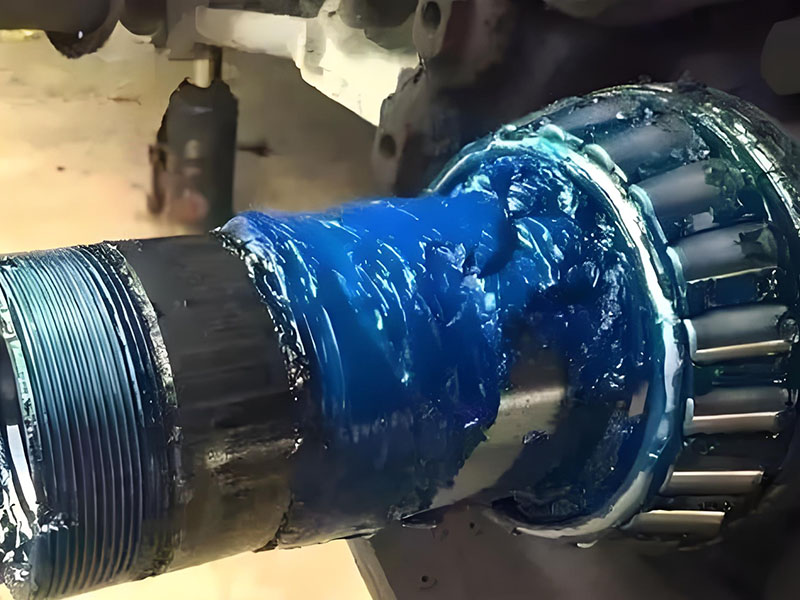
Grease is the most common lubricant for electric motor bearings due to its simplicity of application and ability to remain in place. Key considerations include:
Viscosity. The base oil viscosity should be appropriate for load and speed at operating temperature. Typical mineral oil viscosity ranges from 90–120 cSt at 40°C.
Consistency (NLGI Grade). NLGI 2-grade grease is standard for horizontal shaft configurations, while NLGI 3-grade grease is preferred for vertical shaft arrangements to prevent migration.
Grease Formulations. Common thickener types for electric motor applications include:
- Lithium-based greases. General-purpose formulations with good mechanical stability and water resistance.
- Polyurea greases. Particularly valued for long service life, thermal stability, and extended lubrication intervals in electric motor bearings.
- Molybdenum (Moly) greases. Include molybdenum disulfide additives for extreme pressure applications.
- Silicone greases. Suitable for wide temperature ranges and dielectric applications.
- Dielectric greases. Provide electrical insulation properties for specific applications.
- Marine greases. Enhanced corrosion resistance for humid or marine environments.
Oxidation Resistance. Electric motors often operate at elevated temperatures, making oxidation resistance critical for long grease life. ASTM D3336 high-temperature grease life testing provides indication of oxidation performance.
Oil Lubrication Systems
Oil lubrication is typically used in larger motors or high-speed applications where grease cannot provide adequate cooling:
Splash Oil Feed Systems. Oil splashes onto moving parts as the motor rotates. Not recommended for high-speed motors as oil churning can reduce cooling effectiveness.
Drip Oil Feed Systems. Oil is metered and dripped onto bearing surfaces at controlled rates.
Forced Oil Feed Systems. Circulating oil systems that provide both lubrication and cooling for high-performance applications.
Automated Lubrication Systems. Centralized systems including single-line parallel, double-line parallel, and multipoint direct configurations for consistent lubrication delivery across multiple points.
Best Practices for Electric Motor Bearing Maintenance
Effective maintenance programs significantly extend bearing service life and reduce unplanned downtime.
Regular Inspection. Inspect bearings for signs of wear, contamination, or unusual noise. Vibration analysis and temperature monitoring are effective condition monitoring techniques. Combining temperature and vibration analysis provides reliable early detection of bearing issues.
Proper Lubrication Scheduling. For open bearings, establish preventive maintenance frequency based on runtime. Industry practice recommends relubrication intervals of approximately 6,500 hours (nine months continuous duty, calculated as 6,500 ÷ 24 ÷ 30 ≈ 9) with motors at operating temperature and running when possible.
Clean Application Practices. Clean grease fittings and remove bottom grease relief valves before applying new grease. Use designated grease guns for specific lubricants to prevent cross-contamination.
Proper Installation. Use pullers or hydraulic-assisted techniques to remove bearings without damaging motor shafts. Align motor shafts carefully during installation—misalignment introduces excessive vibration and loads that shorten bearing life.
Contamination Prevention. Maintain clean operating environments. For idle motors, rotate shafts periodically to reestablish protective lubricant films and prevent false brinelling (vibration-induced depressions in raceways).
Monitor Operating Parameters. Track bearing temperature and vibration levels for early detection of developing issues. Use specified bearing types and lubricants to maintain warranty coverage.
Electrical Protection for VFD-Driven Motors. For motors controlled by variable frequency drives, implement protection strategies to prevent bearing damage from stray shaft currents. Options include:
- Electrically insulated bearings (with ceramic coating on outer or inner ring)
- Ceramic hybrid bearings (steel rings with ceramic rolling elements)
- Shaft grounding brushes or rings
- Conductive grease designed for VFD applications
Industry Standards for Electric Motor Bearings
Electric motor bearings are manufactured according to international standards that define dimensional tolerances, running accuracy, and performance characteristics:
ISO 492:2014. The International Organization for Standardization standard specifying dimensional and running accuracy tolerances for rolling bearings, including radial bearings and thrust bearings.
ABEC Rating System. Developed by the American Bearing Manufacturers Association (ABMA), the ABEC scale ranges from ABEC 1 to ABEC 9, with higher numbers indicating tighter tolerances. ABEC 3 (equivalent to ISO Class 6) is standard for general-purpose electric motors. ABEC 5 (ISO Class 5) may be specified for higher precision applications such as machine tool spindles.
ISO 15. Defines dimensional and operational parameters for deep groove ball bearings.
IEC 60034-14. Specifies noise testing requirements for electric motors.
Manufacturers and procurement teams should verify bearing quality certifications, including ISO 9001 for quality management systems and IATF 16949 for automotive supply chain applications.
Conclusion
Electric motor bearings are precision components that support shaft rotation, reduce friction, and maintain alignment in electric motors. Key types include deep groove ball bearings (suitable for high speeds and combined loads), angular contact ball bearings (designed for axial loads), cylindrical roller bearings (for high radial loads), and shielded or sealed configurations for contamination protection. Proper lubrication—whether with NLGI 2 or 3 grease or oil systems—and adherence to maintenance best practices, including regular inspection, condition monitoring, and electrical protection for VFD motors, are essential for maximizing bearing service life. Industry standards such as ISO 492 and ABEC ratings provide benchmarks for quality and precision. For specific applications, consult manufacturer specifications and consider load requirements, operating speeds, and environmental conditions.
FAQs
Q1: How often should electric motor bearings be replaced?
A1: Replacement intervals vary by application, load, and operating conditions. For sealed “lubricated for life” bearings, replacement is required at end of service life. For regreasable bearings, typical regreasing intervals range from 6,500 hours (nine months continuous duty) with replacement as dictated by condition monitoring results.
Q2: Can I use any grease for electric motor bearings?
A2: No. Electric motor bearings require greases with specific viscosity (typically 90–120 cSt at 40°C), appropriate NLGI consistency (grade 2 for horizontal shafts, grade 3 for vertical shafts), and good oxidation resistance. Polyurea-thickened greases are commonly recommended for extended service life.
Q3: What is the difference between shielded and sealed bearings?
A3: Shielded bearings use metal shields that allow relubrication but provide less contamination protection. Sealed bearings use elastomeric seals that offer superior protection but cannot be regreased after installation and have limited service lives.
Q4: How do I know if an electric motor bearing is failing?
A4: Common indicators include unusual noise (grinding, squealing, or rumbling), increased vibration levels, elevated operating temperatures, and visible contamination or lubricant degradation. Vibration analysis and temperature monitoring provide quantitative assessment of bearing condition.
Q5: What causes bearing noise in electric motors?
A5: Bearing noise can result from contamination ingress, inadequate lubrication, improper installation (misalignment), electrical fluting from stray currents, false brinelling from vibration during idle periods, or normal wear reaching end of service life.
Q6: Are ceramic hybrid bearings better for electric motors?
A6: Ceramic hybrid bearings (steel rings with ceramic rolling elements) offer advantages in VFD-driven motors by preventing electrical erosion from stray shaft currents. They also operate at higher speeds with lower friction but come at higher cost. For standard applications without electrical concerns, conventional steel bearings are typically sufficient.
Q7: How do I select the right bearing for my electric motor?
A7: Selection depends on load type (radial, axial, or combined), operating speed, temperature range, environmental conditions (contamination, moisture), alignment requirements, and lubrication method. Consult manufacturer specifications and consider ISO/ABEC tolerance grades appropriate for the application.
Q8: Can I regrease a sealed bearing?
A8: No. Sealed bearings are designed as “lubricated for life” and cannot be regreased after installation. Attempting to regrease a sealed bearing may damage the seal and introduce contamination. When a sealed bearing reaches end of life, replacement is required.