When designing mechanical systems that require support for axial loads, selecting the appropriate bearing type is critical. Engineers often ask: How do thrust roller bearings differ from thrust ball bearings in load capacity? And what factors determine the right bearing for a specific application? This article provides a technical overview of thrust roller bearings—their construction, working principles, advantages, limitations, and selection criteria.
What Is a Thrust Roller Bearing?
A thrust roller bearing is a type of rolling-element bearing designed specifically to accommodate axial loads—forces that act parallel to the shaft axis. Unlike radial bearings, which support forces perpendicular to the shaft, thrust roller bearings use cylindrical, tapered, spherical, or needle rollers as rolling elements to transmit axial forces between rotating and stationary components.
Types of Thrust Roller Bearings
Thrust roller bearings are classified into four main types based on roller geometry:
- Cylindrical roller thrust bearings: Use cylindrical rollers arranged radially around the shaft axis. These bearings offer high axial load capacity and rigidity but operate best at low to moderate speeds (typically 2,000–3,000 rpm for a 50 mm bore under grease lubrication). They are separable, simplifying installation and maintenance.
- Tapered roller thrust bearings: Employ tapered rollers that converge at a common point on the shaft axis. These bearings can accommodate combined axial and radial loads to a limited extent and offer higher speed capability than cylindrical types.
- Spherical roller thrust bearings: Feature asymmetrical spherical rollers that allow self-alignment, making them tolerant of shaft deflection and mounting errors. These bearings accommodate the heaviest axial loads among all thrust bearing types, with some radial load capacity under axial loading conditions.
- Needle roller thrust bearings: Use slender needle rollers for applications with extreme axial space constraints. These bearings provide high load capacity in a compact axial profile.
How Do Thrust Roller Bearings Work?
The fundamental working principle of a thrust roller bearing involves rolling elements positioned between two raceways—commonly referred to as shaft washers and housing washers. When an axial load is applied, the rollers rotate between the washers, converting sliding friction into rolling friction.
Load Distribution Mechanism
Thrust roller bearings achieve axial load transmission through line contact between the rollers and raceways. This line contact—as opposed to the point contact found in ball bearings—provides a larger contact area, enabling the bearing to support significantly higher axial loads.
During operation, the rolling elements are guided and separated by a cage or retainer, which maintains proper roller spacing, prevents roller-to-roller contact, and ensures uniform load distribution across all rolling elements. The cage material may be machined brass, stamped steel, or reinforced polymer, depending on application requirements.
It is important to note that with the exception of spherical roller thrust bearings, most thrust roller bearings are designed exclusively for axial loads and have minimal radial load capacity. When radial loads are present, separate radial bearings should be used in the assembly.
Key Components of Thrust Roller Bearings
A thrust roller bearing consists of three primary components: rollers, a cage (retainer), and two washers (raceways). Each component plays a specific role in load transmission and operational stability.
Rollers are the rolling elements that directly transmit axial loads from the shaft washer to the housing washer. Roller geometry determines the bearing’s load capacity, speed capability, and alignment tolerance. Cylindrical rollers provide the highest stiffness and are suitable for heavy, pure axial loads. Tapered rollers offer limited combined load capacity. Spherical rollers allow self-alignment. Needle rollers minimize axial space while maintaining high load capacity. Rollers are typically made of through-hardened bearing steel (e.g., GCr15 or equivalent) with high hardness and wear resistance.
Cage (retainer) maintains proper spacing and alignment of rollers around the bearing axis. It prevents roller-to-roller contact, reduces friction, and ensures even load distribution. Cage materials include stamped steel for standard applications, machined brass for high-speed or high-temperature conditions, and reinforced polymer for lightweight or electrically insulating requirements. The cage design also affects lubrication flow and speed capability.
Washers (raceways) consist of two separate rings: the shaft washer (mounted on the rotating shaft) and the housing washer (mounted in the stationary housing). These washers provide the flat or profiled rolling surfaces for the rollers. They are case-hardened to resist indentation and wear under high axial loads. The shaft washer features a tighter bore fit to ensure secure mounting on the shaft, while the housing washer has a looser fit to allow self-centering. The raceway surfaces are ground and superfinished to reduce friction and extend service life.
Advantages and Limitations
Thrust roller bearings offer several distinct advantages for axial load applications. Their most significant benefit is high axial load capacity. Because rollers make line contact with raceways (rather than point contact in ball bearings), the contact area is larger, allowing the bearing to support substantially higher axial forces without excessive stress or deformation. This makes thrust roller bearings suitable for heavy machinery, transmissions, and rolling mills.
Another advantage is compact design. Relative to their load-carrying capability, thrust roller bearings require minimal axial space. Needle roller thrust bearings, in particular, provide very high load capacity in an extremely low axial profile, which is valuable in space-constrained assemblies such as automotive torque converters or robotic joints.
High rigidity is another key benefit. Thrust roller bearings exhibit minimal axial deflection under load due to the large contact area and robust roller geometry. This stiffness is critical for precision applications such as machine tool spindles or measuring equipment, where axial positioning must be maintained accurately under fluctuating loads.
Low friction relative to plain thrust bearings is also notable. The rolling action of the rollers converts sliding friction into rolling friction, reducing heat generation and energy loss. When properly lubricated, thrust roller bearings operate efficiently and maintain stable temperatures even under continuous duty cycles.
Separable design facilitates inspection and replacement. The shaft washer, roller-cage assembly, and housing washer can be handled separately, simplifying maintenance in tight installations. This also allows mixing and matching of components from different manufacturers, though this is generally not recommended for precision assemblies.
Despite these advantages, thrust roller bearings have limitations that engineers must consider. The most notable is limited speed capability, especially for cylindrical roller thrust bearings. Due to differential sliding between the roller ends and the raceways, heat generation increases rapidly with speed. For a typical cylindrical thrust roller bearing with a 50 mm bore, the maximum grease-lubricated speed is around 2,000–3,000 rpm. Higher speeds require oil lubrication and special cage designs.
Another limitation is minimal radial load capacity. With the exception of spherical roller thrust bearings, most thrust roller bearings cannot accommodate significant radial forces. If radial loads are present in the application, a separate radial bearing (such as a deep groove ball bearing or cylindrical roller bearing) must be used in the same assembly to support radial forces while the thrust bearing handles axial loads.
Thrust roller bearings require precise mounting surfaces. The shaft and housing washers must be mounted on flat, parallel surfaces perpendicular to the shaft axis. Any misalignment or lack of flatness leads to uneven load distribution, edge loading, and premature failure. Spherical roller thrust bearings tolerate some misalignment, but cylindrical and tapered types do not.
Higher manufacturing cost compared to thrust ball bearings is another factor. The complex roller profiles, precision grinding, and heat treatment processes make thrust roller bearings more expensive. For light-duty applications where axial loads are moderate, thrust ball bearings may be a more economical choice.
For a direct comparison with thrust ball bearings, see the section below.
Thrust Roller Bearings vs. Thrust Ball Bearings
Engineers often compare thrust roller bearings with thrust ball bearings when selecting axial load components. The table below summarizes key differences.
| Parameter | Thrust Roller Bearing | Thrust Ball Bearing |
|---|---|---|
| Contact type | Line contact (rollers) | Point contact (balls) |
| Axial load capacity | High to very high | Low to moderate |
| Speed capability | Low to moderate (cylindrical types up to ~3,000 rpm for 50 mm bore) | Moderate to high |
| Radial load capacity | Minimal (except spherical types) | None |
| Axial stiffness | High | Low to moderate |
| Wear resistance | High (lower contact stress) | Moderate |
| Typical cost | Higher | Lower |
| Typical applications | Heavy machinery, transmissions, rolling mills | Light-duty axial positioning, small actuators |
Applications of Thrust Roller Bearings
Thrust roller bearings are deployed across industries where heavy axial loads must be managed within constrained spaces.
Automotive Transmissions
Automatic and manual transmissions use thrust roller bearings to support helical gears, which generate axial thrust forces during torque transmission. These bearings ensure smooth gear shifting and prevent axial shaft movement under load. Thrust cylindrical roller bearings are also found in automotive air conditioning compressors and clutch release mechanisms.
Aerospace Systems
Aircraft engines and turbomachinery rely on thrust roller bearings to support high-speed rotating shafts under extreme temperatures and axial loads. Their compact design and high load capacity make them indispensable in safety-critical aviation applications.
Machine Tools
Precision machining equipment such as rotary tables, boring mills, and grinding spindles use thrust roller bearings for axial positioning under heavy cutting forces. Cylindrical and tapered thrust roller bearings in precision grades provide the required stiffness and runout control.
Robotics
Articulated robots and automated manufacturing equipment use thrust roller bearings in joint actuators and rotary mechanisms where axial load support is required within compact envelopes.
Material Handling Equipment
Crane hooks, lifting mechanisms, vertical pumps, extruders, and injection molding machines employ thrust roller bearings to handle substantial axial loads generated during operation.
Choosing the Right Thrust Roller Bearing
Proper bearing selection requires evaluating multiple operating parameters. The following factors should be considered:
Load Capacity
Calculate the expected axial load magnitude, including peak loads and dynamic variations. Select a bearing with a basic dynamic load rating (C) that exceeds the calculated applied load, with an adequate safety margin. For applications with frequent start-stop cycles or shock loading, static load rating (C₀) must also be evaluated.
Speed and Lubrication
Operating speed determines lubrication requirements and cage material selection. Cylindrical roller thrust bearings are suitable for low-to-moderate speeds, while spherical and tapered types offer higher speed potential. As a reference, a cylindrical thrust roller bearing with 50 mm bore diameter, grease-lubricated, typically operates up to 2,000–3,000 rpm. Reference speeds provided by manufacturers indicate thermal speed limits under standard lubrication conditions.
Misalignment Tolerance
When shaft deflection or mounting inaccuracies are anticipated, spherical roller thrust bearings should be selected for their self-aligning capability. For maximum stiffness and precision applications where alignment can be tightly controlled, cylindrical or tapered thrust bearings are preferred.
Temperature and Environment
Operating temperature affects lubricant viscosity and cage material selection. Machined brass cages are suitable for high-temperature applications, while steel cages suffice for standard conditions. For corrosive environments, consider bearings with appropriate surface treatments or stainless steel materials.
Mounting and Installation
Thrust roller bearings require flat, parallel mounting surfaces with precise axial alignment. Critical installation rule: The shaft washer must always be fitted to the rotating component, and the housing washer to the stationary housing. Incorrect orientation will lead to immediate bearing failure. Preload may be required when axial loads are insufficient to maintain proper roller contact.
Space and Weight Constraints
Needle roller thrust bearings provide the smallest axial profile for a given load capacity. Cylindrical and tapered types require more axial space but offer greater rigidity and load capacity.
Thrust Roller Bearing Sizes
Thrust roller bearings are available in both metric and inch series, with bore diameters ranging from approximately 10 mm to over 1,000 mm. The table below provides a simplified size range reference for cylindrical roller thrust bearings. Complete dimension series vary by manufacturer; contact your supplier for full size charts.
| Bore Diameter (mm) | Typical Outer Diameter Range (mm) | Typical Dynamic Load Rating (kN) |
|---|---|---|
| 15–30 | 40–60 | 15–50 |
| 30–60 | 60–100 | 50–150 |
| 60–120 | 100–180 | 150–400 |
| 120–200 | 180–280 | 400–900 |
| 200–320 | 280–440 | 900–1,800 |
For a complete thrust roller bearing size chart with detailed dimensions (height, raceway tolerances, and static load ratings), please request a datasheet from your bearing supplier.
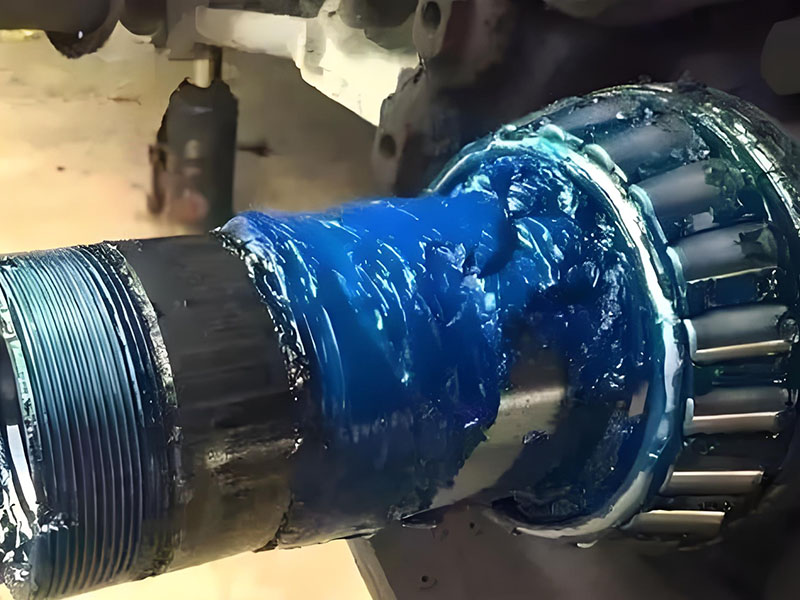
Maintenance and Lubrication
Proper lubrication is essential for thrust roller bearing longevity and performance. The following practices are recommended:
- Lubrication method: Grease lubrication suits low-to-moderate speed applications. Oil bath or circulating oil lubrication is required for higher speeds or elevated temperatures. For horizontal shafts and high-speed applications, oil lubrication is recommended even at lower speeds.
- Lubricant selection: Choose lubricant viscosity based on operating temperature and speed. Higher viscosity lubricants provide better film thickness under heavy loads but increase friction at higher speeds.
- Inspection intervals: Regular inspection should check for temperature rise, abnormal noise, and vibration. Axial play measurements can indicate wear progression.
- Common failure modes: Seat distortion (lack of flatness), starved lubrication (roller end contacts), and contamination account for most thrust roller bearing failures. Addressing these through proper mounting, adequate lubrication, and sealing extends bearing service life.
Conclusion
Thrust roller bearings are specialized rolling-element bearings designed for heavy axial load support across automotive, aerospace, machine tool, robotics, and material handling applications. Their line-contact rolling elements provide higher load capacity and rigidity than thrust ball bearings, though with reduced speed capability. Cylindrical, tapered, spherical, and needle variants address specific load, speed, and alignment requirements.
Proper selection requires evaluation of load magnitude, operating speed, misalignment tolerance, temperature, and space constraints. Regular maintenance and appropriate lubrication are essential for achieving maximum service life. For applications requiring precise axial positioning under heavy loads, thrust roller bearings remain a proven and reliable engineering solution.
Frequently Asked Questions
Q1: What is the difference between thrust roller bearings and thrust ball bearings?
A1: Thrust roller bearings support significantly higher axial loads due to line contact between rollers and raceways, whereas thrust ball bearings use point contact. Ball thrust bearings operate at higher speeds but handle less load. Refer to the comparison table in Section 5 for detailed differences.
Q2: Can thrust roller bearings handle radial loads?
A2: With the exception of spherical roller thrust bearings, most thrust roller bearings have minimal radial load capacity. For applications requiring combined radial and axial load support, spherical roller thrust bearings or separate radial bearing arrangements should be used.
Q3: What lubrication methods are best for thrust roller bearings?
A3: Grease lubrication is suitable for low-to-moderate speed applications. Oil bath or circulating oil lubrication is required for high-speed or high-temperature operation. For horizontal shafts, oil lubrication is often recommended.
Q4: How do I know when a thrust roller bearing needs replacement?
A4: Indicators include abnormal temperature rise, increased vibration or noise, excessive axial play, visible wear or spalling on raceways, and lubricant contamination. Regular condition monitoring helps predict replacement timing.
Q5: Are thrust roller bearings suitable for high-speed applications?
A5: Thrust roller bearings are generally designed for low-to-moderate speed applications. Cylindrical types have the lowest speed capability due to differential sliding (typical maximum ~3,000 rpm for a 50 mm bore). Tapered and spherical types offer higher speed potential, but for very high speeds, thrust ball bearings or fluid film thrust bearings may be more appropriate.
Q6: What is the typical lifespan of a thrust roller bearing?
A6: Service life varies widely based on load, speed, lubrication, and operating conditions. With proper selection, installation, and maintenance, thrust roller bearings commonly achieve L10 lives of thousands to tens of thousands of operating hours. Refer to manufacturer rating calculations for specific estimates.