Selecting the correct bearing installation method directly affects bearing service life and rotational accuracy. Common questions include: Which method suits a press fit? When should heat be used? How to mount a tapered bore bearing without damage? This article will explain standard bearing installation methods based on bearing type and fit, without unnecessary marketing content.
What Determines the Bearing Installation Method?
The choice of installation method depends on:
- Bearing type – Cylindrical bore bearings and tapered bore bearings require different procedures.
- Type of fit – Interference fits (tight fit) need force or thermal expansion; clearance or transition fits may allow light pressing or hand assembly.
- Bearing size – Small bearings are often cold pressed; large bearings are typically shrink fitted.
Always check the manufacturer’s datasheet before selecting a method.
Common Bearing Installation Methods
Press Fitting (Cold Mounting)
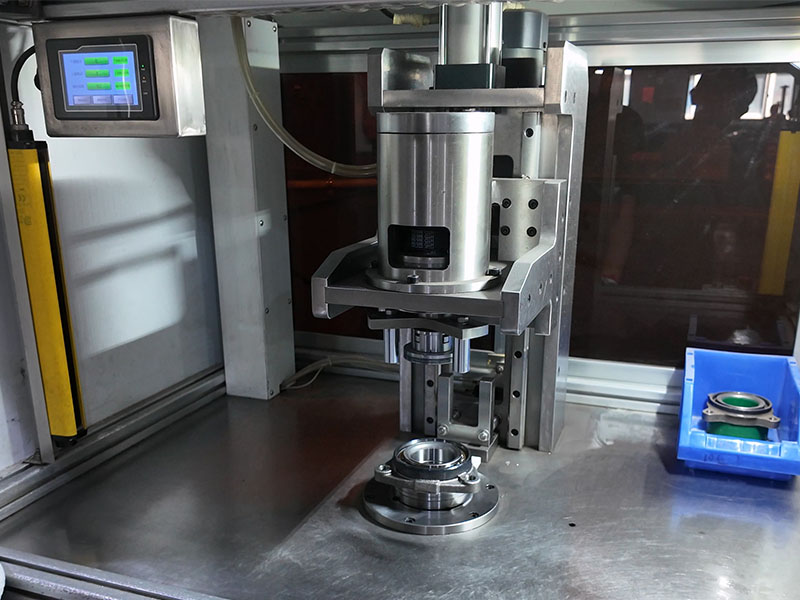
Press fitting is widely used for small bearings with an interference fit. A mechanical or hydraulic press pushes the bearing onto the shaft or into the housing. The pressing force must be applied only to the bearing ring that has the interference fit (inner ring for shaft mounting, outer ring for housing mounting). Applying force through both rings can brinell the raceways or damage rolling elements.
Typical tools: Arbor press, hydraulic press, mounting tubes.
Shrink Fitting (Heat Mounting)
Shrink fitting avoids excessive mechanical force and allows rapid mounting, especially for large bearings. The bearing is heated so its inner diameter expands, then placed onto the shaft. Upon cooling, it contracts into a secure fit.
Precautions for shrink fitting:
- Do not heat bearings above 120°C – higher temperatures may alter steel microstructure and reduce hardness.
- Heat bearings on a wire mesh or suspend them in an oil bath. Never use an open flame.
- Heat the bearing to a temperature 20–30°C above the lowest required fit temperature.
- After mounting, the bearing shrinks both radially and axially. Position the shaft shoulder or locknut before cooling.
Heating methods: Induction heater, oil bath, oven (temperature controlled).
Hammer and Sleeve Method
This method is only for non-critical applications or when a press is unavailable. A soft metal or plastic sleeve contacts only the bearing ring being mounted. The hammer strikes the sleeve, not the bearing directly.
Limitations: Never strike a bearing directly with a steel hammer. Repeated impact can crack rings or indent rolling elements. Use a brass, copper, or plastic hammer.
Hydraulic or Nut‑Driven Method for Tapered Bore Bearings
Tapered bore bearings (commonly mounted on adapter sleeves, withdrawal sleeves, or tapered shafts) require axial displacement to achieve the correct internal clearance. Two standard approaches exist:
- Hydraulic method – A hydraulic nut generates axial force. Oil pressure is applied to expand the inner ring slightly, reducing mounting force.
- Nut‑driven method – A locknut is tightened to a specified torque. Measure the reduction in radial clearance or the axial advance to verify proper fit.
After mounting, the bearing must rotate smoothly without excessive resistance.
Precautions Common to All Installation Methods
- Cleanliness – Shaft, housing, and bearing must be free of dust, burrs, or metal chips.
- Measurement – Check shaft diameter, housing bore, and bearing dimensions before installation.
- Use correct tools – Bearing press, induction heater, sleeves, or hydraulic nut. Avoid improvised tools.
- Avoid overheating – Only for shrink fitting. Do not exceed 120°C.
- Wear PPE – Safety glasses and gloves protect against oil, hot surfaces, and sharp edges.
Frequently Asked Questions (FAQs)
Q1: Which bearing installation method is most common?
A1: Press fitting for small bearings and shrink fitting for large bearings. Tapered bore bearings use nut‑driven or hydraulic methods.
Q2: Can I use a hammer to install a bearing?
A2: Only with a soft hammer and a sleeve that contacts the correct ring. Direct steel‑hammer impact is not acceptable.
Q3: What happens if I overheat a bearing during shrink fitting?
A3: Above 120°C, the bearing steel may lose hardness and dimensional stability, leading to early failure.
Q4: How do I know which method to choose?
A4: Check the fit type (interference vs. clearance), bearing size, and whether the bearing has a cylindrical or tapered bore.
Q5: Do I need to lubricate before installation?
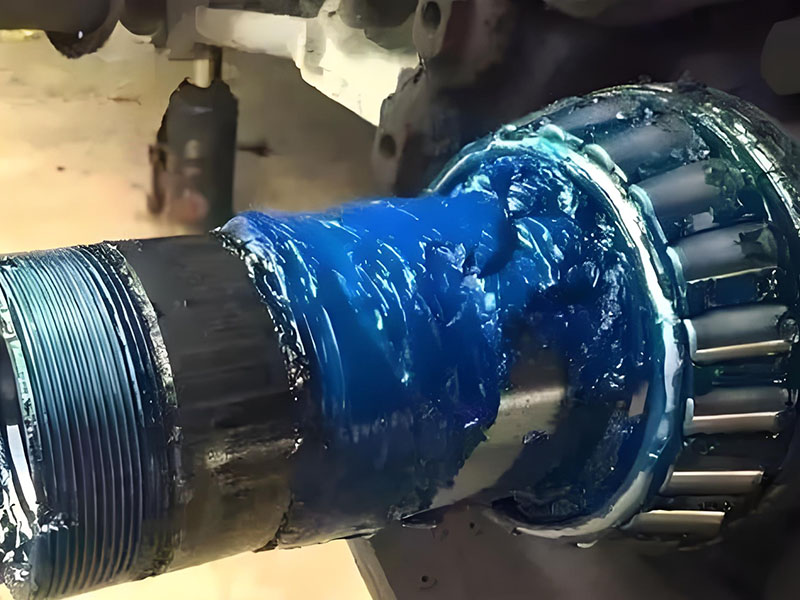
A5: For open bearings, apply a thin layer of clean grease or oil to raceways and rolling elements. Sealed bearings require no additional lubricant.
Comparison of Bearing Installation Methods
| Installation Method | Best For | Key Limitation |
|---|---|---|
| Press fitting | Small bearings with interference fit | Requires a mechanical or hydraulic press |
| Shrink fitting | Large bearings where mechanical force is undesirable | Strict temperature control (≤120°C) |
| Hammer and sleeve | Non‑critical applications when no press is available | Risk of impact damage; not for precision assemblies |
| Hydraulic / nut‑driven | Tapered bore bearings (adapter sleeves or tapered shafts) | Requires hydraulic nut or precise torque measurement |
Conclusion
Understanding bearing installation methods means matching the method – press fitting, shrink fitting, hammer‑and‑sleeve, or hydraulic/nut‑driven – to the bearing type, fit, and size. Press fitting suits small cylindrical bore bearings with interference fits. Shrink fitting is preferred for large bearings to avoid mechanical force. Tapered bore bearings require axial displacement via nuts or hydraulics. Regardless of method, cleanliness, correct tools, and temperature control (for shrink fitting) determine installation success. A correctly installed bearing achieves its full rated life without premature wear or damage.
This guide is for general informational purposes. Always follow the original equipment manufacturer’s instructions for your specific assembly.