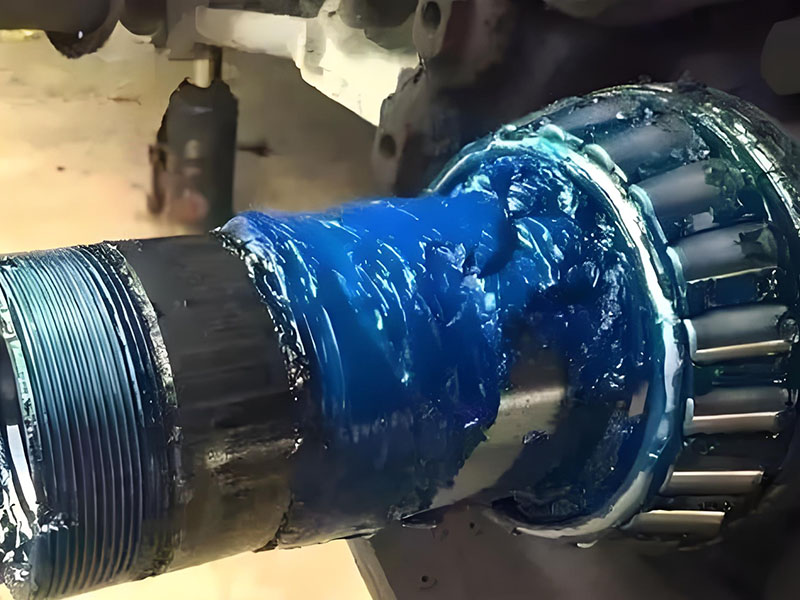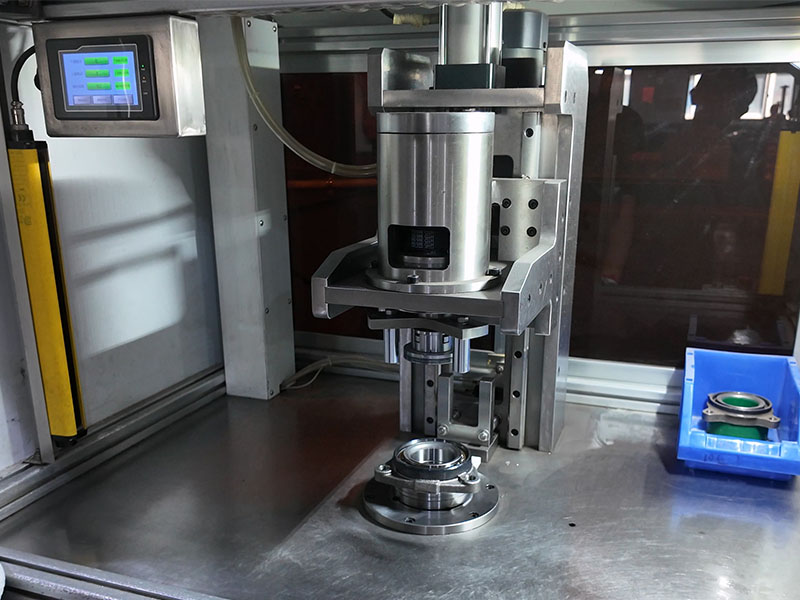
Forklift bearings are precision components used in various parts of a forklift to enable smooth rolling motion, reduce friction, and support radial or axial loads. In a typical forklift, bearings are found in the mast, wheels, chain rollers, and carriage assembly. The most critical ones are the mast guide bearings, which directly affect lifting stability and operational safety. DUHUI will explain their types, key features, inspection methods, lubrication practices, replacement steps, and selection criteria for forklift bearings
What Are Forklift Bearings?
Forklift bearings are engineered to withstand heavy shock loads, misalignment, and harsh environments. Depending on their position in the forklift, they serve different functions. Below are the four common types:
- Mast guide bearings – Mounted between mast rails to guide the up-and-down movement of the carriage and forks.
- Frame bearings – Used in the chassis or axle pivots to support oscillation and steering.
- Side thrust rollers – Positioned laterally on the mast to absorb horizontal forces and keep the mast aligned.
- Chain roller bearings – Located at the mast tips or cylinder ends to guide lift chains and reduce wear.
Among these, mast guide bearings experience the highest cyclic loads and require regular attention. The rest of this guide will therefore focus primarily on mast guide and mast roller bearings, while the inspection and lubrication principles apply broadly to all forklift bearing types.
Key Features of Forklift Mast Guide Bearings
High-quality mast guide bearings are designed with specific engineering features that ensure reliable performance under continuous lifting operations. The following characteristics are essential:
- High stability and safety – Precise radial and axial clearances prevent mast sway, reducing the risk of load instability or tip-over.
- Smooth operation – Hardened raceways and controlled tolerances allow quiet, low-friction movement even when the mast is fully extended.
- Durability – Manufactured from through-hardened or case-hardened bearing steel (e.g., GCr15 or equivalent) with anti-wear properties, capable of withstanding impact loads common in warehouses and construction sites.
- Easy maintenance – Many mast guide bearings feature integrated seals or relubrication grooves, simplifying regular greasing and contamination exclusion.
How to Inspect Forklift Bearings
Regular inspection of forklift mast bearings prevents unplanned downtime and extends component life. Follow these five practical checks, ideally performed during daily or weekly equipment walkarounds:
- Visual inspection – Look for rust, pitting, cracks, or flattened areas on the bearing outer ring. Also inspect seals for damage or extrusion of grease.
- Noise check – Operate the mast through a full lift cycle while listening for grinding, clicking, or rumbling sounds. Unusual noise often indicates internal race or roller damage.
- Free rotation check – With the mast slightly raised and secured, manually rotate the bearing (if accessible). It should turn smoothly without binding or gritty sensation.
- Size check – Measure the outer diameter and width using calipers. Compare to manufacturer specifications; wear beyond 0.5 mm of original dimension may require replacement.
- Lubrication check – For greased bearings, check if old grease has hardened, leaked out, or become contaminated with water or dust. Insufficient lubrication accelerates wear exponentially.
Lubrication and Maintenance Best Practices for Forklift Bearings
Proper lubrication is the single most effective way to maximize the service life of forklift mast bearings. Use the following guidelines:
- Grease selection – Choose a lithium-complex or polyurea-based grease with NLGI grade 2, EP (extreme pressure) additives, and a temperature range of -20 °C to +120 °C. Avoid mixing different grease bases.
- Relubrication interval – For standard warehouse duty, relubricate mast guide bearings every 200–250 operating hours. In dusty or wet environments, shorten the interval to 100 hours.
- Procedure – Clean the grease fitting before applying fresh grease. Pump slowly until clean grease appears at the seal lip, indicating old grease has been purged. Do not overgrease, which can cause seal blowout.
- Seal maintenance – Inspect seals for cuts or hardening. Damaged seals allow debris ingress and lubricant loss — replace bearings with integral seals if contamination is frequent.
Keeping a simple log of lubrication and bearing conditions helps track wear patterns and forecast replacements.
Forklift Mast Bearing Replacement Process
Replacing worn mast guide bearings requires mechanical competence and strict adherence to safety procedures. Below is the standard process for most counterbalance forklifts. Always consult the equipment’s service manual before starting.
- Safety first – Park the forklift on a level surface, engage the parking brake, and block the wheels. Lower the forks completely, then relieve hydraulic pressure by cycling the lift lever. Disconnect the battery.
- Remove forks and carriage – Detach the fork carriage assembly according to the manufacturer’s instructions. Support the assembly with a suitable jack or hoist.
- Disassemble the mast – Remove outer and inner mast chains, then unbolt the mast sections carefully. Mark positions of shims and spacers for reassembly.
- Remove old bearings – Extract the worn mast guide bearings from their pockets or shafts using a puller. Note the orientation and any thrust washers.
- Inspect mast rails – Clean the rail channels and inspect for scoring, burrs, or deformation. Lightly file any high spots and measure rail width to ensure it matches bearing specs.
- Install new bearings – Apply a thin film of grease to the bearing bore and shaft. Press or slide the new bearing into position without hammering on the outer ring. Reinstall all shims to original positions.
- Reassemble the mast – Reverse the disassembly steps, torquing all bolts to factory specifications. Reinstall chains and adjust tension evenly.
- Test the forklift – Reconnect battery, raise the mast slowly to full height several times while listening for abnormal noise. Check that the carriage moves smoothly without side play.
How to Choose the Right Forklift Mast Roller Bearings
Selecting the correct replacement bearings directly impacts mast performance and safety. Evaluate the following four factors before purchasing:
- Load capacity – Calculate the dynamic load rating (C) needed based on the forklift’s rated capacity and mast geometry. As a rule, select bearings with a static load rating at least 1.5 times the maximum expected radial load.
- Material – High‑carbon chrome steel (e.g., AISI 52100) is standard for raceways and rollers. For corrosive environments (cold storage, seafood processing), consider stainless steel or bearings with zinc‑nickel plating.
- Compatibility – Match bearing dimensions (inner diameter, outer diameter, width) and mounting type (flanged, plain, or eccentric). Also verify the mast rail profile — some bearings require a crowned outer ring to distribute edge loading.
- Maintenance requirements – Decide between sealed bearings (pre‑greased, maintenance‑free for up to 2000 hours) and re-lubricatable bearings. Sealed types reduce daily labor but may have lower speed limits; re-lubricatable types are preferred for heavy‑duty, multi‑shift operations.
When in doubt, refer to the OEM part number or measure the existing bearing precisely. Reputable manufacturers provide detailed dimension and load tables to aid selection.
Frequently Asked Questions (FAQ)
How often should forklift mast bearings be lubricated, and what grease type is recommended?
In standard warehouse conditions, lubricating mast guide bearings every 200–250 operating hours is typical. For dusty or outdoor environments with high moisture, the interval should be shortened to approximately 100 hours to prevent abrasive contamination from degrading internal raceways. A lithium-complex or polyurea-based grease with NLGI Grade 2 consistency, extreme pressure (EP) additives, and an operating temperature range of –20 °C to +120 °C is recommended. For cold storage applications where the forklift operates below freezing, a low‑temperature NLGI Grade 1 grease may be required to avoid excessive thickening that can starve the rolling elements of lubrication.
Source: Wanda Bearings, The Engineering Guide to Forklift Mast Guide Bearing Performance and Maintenance (2026); Garlway, 正确的润滑检查如何防止电动葫芦故障
What are the most common signs that a forklift mast bearing needs replacement?
The most reliable indicators of mast bearing failure include audible grinding or rumbling noises during lifting and lowering, uneven mast tracking (the mast does not travel straight vertically), visible scuffing or metal‑on‑metal wear marks on the mast rails, and excessive lateral play or wobbling of the carriage when the mast is extended. A critical failure mode is flattening of the outer ring, which typically occurs if the bearing has seized or if the forklift has been consistently overloaded beyond its rated capacity. If any of these signs appear, immediate inspection and dimensional measurement are recommended.
Sources: Wanda Bearings (2026); CCTY Group, Mast Guide Manufacturer FAQ; TFL Bearing, Forklift Mast Bearings: Types, Rollers & Replacement
Can aftermarket forklift mast bearings be used as replacements for OEM parts?
Yes, aftermarket forklift mast bearings can be used as direct replacements, provided the supplier meets all original engineering specifications for material grade, heat treatment, dimensional tolerances, and internal clearance. Aftermarket bearings typically cost 25–50 percent less than OEM equivalents, making them cost‑effective for older equipment or large fleets where original warranties no longer apply. However, quality varies among suppliers. For critical components affecting lifting, braking, or mast stability, OEM parts are recommended when the forklift is still under factory warranty or when compliance labels (such as CSA, UL, or CE) must be maintained. A hybrid approach—using OEM for safety‑critical parts and aftermarket for routine wear items—is common practice among fleet managers.
Sources: Premier Lift Equipment, OEM vs Aftermarket Forklift Parts (2025); Wanda Bearings, Forklift Combined Roller Bearing Replacement: OEM & Aftermarket Options Compared
How much does it typically cost to replace forklift mast bearings, including labor?
According to industry data, roller servicing on a forklift mast (including bearing replacement) typically ranges from $200 to $500 per mast. This estimate covers the replacement of mast guide bearings, side rollers, or combined roller bearings but excludes additional repairs such as chain replacement ($400–$800 per mast) or fork straightening ($300–$1,200). National average labor rates for forklift repairs were $180 per hour as of 2026, with most dealers charging an additional travel or service call fee equivalent to approximately one extra hour of labor. Consequently, a routine mast bearing replacement on a single mast can total between $380 and $860 when labor and parts are combined, depending on regional rates and the number of bearings replaced.
Sources: Upright Forklift, Understanding Average Repair Costs for Forklift Parts in Houston (2025); Intella Parts, 2026 Forklift Dealer Labor Rate Survey (2026)
What is the correct internal clearance (C3 or C0) for forklift mast guide bearings?
Forklift mast bearings are predominantly radial‑force bearings. While they generally do not require specific axial clearance, radial clearance must be strictly controlled to maintain mast stability and prevent binding. Under normal operating conditions, deep‑groove ball‑type mast bearings are typically selected with C0 (normal) or C3 clearance groups, whereas roller‑type mast bearings mostly use C3 clearance. The selection depends on the mast’s structural dimensions and the forklift’s tonnage rating. C3 clearance provides additional internal space to accommodate thermal expansion and shaft‑to‑housing interference fits, which is particularly important in applications with moderate temperature variations or when the bearing operates under heavy intermittent shock loads. These specifications are defined in industry standards such as JB/T 7360.
Sources: Wanda Bearings, product page for SRxxAx‑x single‑row ball forklift side roller; JB/T 7360‑2019, Rolling bearings—Mast and chain guide bearings for forklift trucks—Specification
How many hours or years do forklift mast bearings typically last before requiring replacement?
Under normal operating conditions with regular lubrication and proper load management, high‑quality forklift mast bearings can last the life of the forklift itself, often exceeding 10,000 operating hours. However, severe operating environments—such as construction sites with high dust exposure, foundries with extreme heat, or cold storage facilities—significantly reduce bearing life. In such conditions, bearing replacement may be required every 2,000 to 4,000 operating hours, or approximately every 1 to 2 years in multi‑shift operations. The primary factors affecting service life include contamination ingress, insufficient or incorrect lubrication, shock loading from uneven floors or overloading, and misalignment of mast rails. Regular inspection at 500‑hour intervals is recommended to detect early wear before catastrophic failure occurs.
Sources: CCTY Group, Ensuring a Long Service Life; Wanda Bearings (2026); Euro‑Bearings, What is a Mast Bearing?
What is the difference between sealed (RS/DDU) and shielded (ZZ) forklift mast bearings?
Sealed bearings (designated RS or DDU) use rubber contact seals that provide superior protection against fine dust, moisture, and liquid contaminants. They also retain grease more effectively, making them suitable for outdoor, dusty, or high‑humidity environments such as construction sites or cold storage warehouses. However, seal contact creates slightly higher friction, which is generally acceptable for the low‑speed, high‑load operation of forklift masts. Shielded bearings (designated ZZ) use non‑contact metal shields that block only large debris while offering very low friction. They are adequate for clean indoor warehouse environments but do not prevent fine particle ingress or moisture penetration. For most forklift applications involving mixed indoor/outdoor use, sealed (RS) bearings are the recommended choice.
Source: Wanda Bearings, The Engineering Guide to Forklift Mast Guide Bearing Performance and Maintenance (2026), Section 3, Table: Sealed vs. Shielded Mast Bearings
What causes uneven lifting or binding of the forklift mast, and how are bearings involved?
Uneven lifting or mast binding is most commonly caused by worn or incorrectly adjusted mast guide bearings. When the outer rings of the bearings become flattened due to overloading or seizure, or when internal raceway fatigue has occurred, the bearing no longer maintains consistent contact with the mast rail. This results in uneven tracking as the mast stages extend and retract. Additionally, improper shimming during bearing replacement—where bearings are either too tight against the rail, causing excessive friction and heat, or too loose, allowing lateral play—directly leads to mast binding or wobbling. If the mast exhibits jerky motion or requires increased hydraulic pressure to lift, the bearings should be inspected and dimensional measurements compared against manufacturer specifications.
Sources: Wanda Bearings (2026); CCTY Group FAQ; TFL Bearing, Mast Guide Bearings: A Complete Guide (2026)
Conclusion
Understanding the types, inspection routines, lubrication needs, replacement steps, and selection criteria for forklift bearings — especially mast guide bearings — helps reduce equipment failures and prolong mast life. Regular visual and noise checks, correct greasing intervals, and timely replacement using dimensionally accurate, properly rated bearings are the pillars of reliable forklift operation. This comprehensive guide has covered the essential practices to keep your mast system running safely and efficiently. Apply these principles to any forklift model, and always refer to the manufacturer’s specifications for torque values and bearing clearances.