Plain bearings, also known as sleeve bearings or bushings, operate without rolling elements. But how are plain bearings constructed that allows them to support heavy loads while sliding directly against a shaft? This article explains the internal structure of five common plain bearing types, their working principles, and the materials that define their performance.
What Are Plain Bearings? A Basic Principle
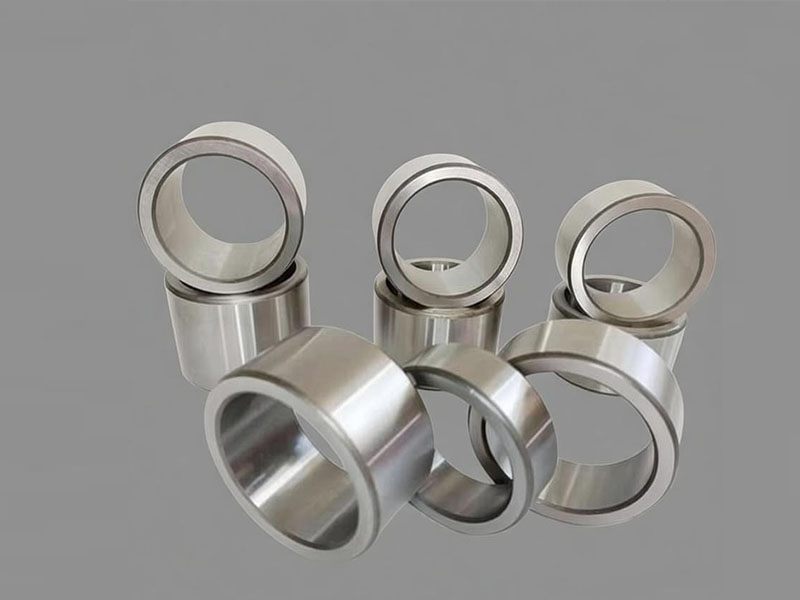
All plain bearings share the same fundamental mechanism: the surface of a rotating or oscillating shaft slides directly over the stationary bearing surface. Unlike ball bearings or roller bearings, plain bearings contain no rolling elements. This simplicity gives them several key characteristics:
- No rolling elements – No balls or cages to fail
- Simple structure – Fewer components, lower manufacturing complexity
- High load‑bearing capacity – Ideal for low‑speed, heavy‑load, or high‑precision applications
The construction of a plain bearing determines its lubrication method, temperature limits, and suitable applications.
Solid Plain Bearings with Lubrication Grooves
Solid plain bearings are machined from a single piece of homogeneous material – typically a metal alloy.
Composition
These bearings are made from solid metal stock, such as bronze, brass, steel, or cast iron. The entire cross‑section has consistent mechanical properties.
Lubrication Grooves: Structure and Function
The inner surface of a solid bearing contains precision‑cut channels or holes. These may include:
- Spiral hydrodynamic grooves that actively pump oil
- Circumferential grooves for even grease distribution
- Axial oil holes for forced‑feed systems
These grooves distribute external grease or oil across the sliding interface. Without them, lubrication would remain localized.
Materials: CuSn8 Bronze
CuSn8 (tin bronze with approximately 8% tin) is a standard material for solid bearings. It offers good strength, wear resistance, and machinability at moderate cost. CuSn8 performs best under low‑speed, high‑load, or oscillating conditions.
Typical Applications
- Heavy machinery bearings
- Agricultural equipment pivots
- Hydraulic cylinder bushings
- Mining equipment
Lubrication requirement: External grease or oil – not self‑lubricating.
Sintered Bearings (Oil‑Impregnated Bearings)
Sintered bearings owe their name to the powder metallurgy process used to create them.
Composition and Manufacturing Process
- Powder mixing – Bronze or iron‑copper powder is prepared.
- Compression molding – The powder is pressed into a bushing shape under high pressure.
- Sintering – The compact is heated to ~700‑800°C in a controlled atmosphere. Metal particles fuse at contact points, leaving behind interconnected pores.
- Oil impregnation – The porous bearing is vacuum‑filled with oil, typically mineral oil or synthetic lubricant.
Final porosity typically ranges from 18% to 25% by volume.
Operating Principle
During operation, friction heats the bearing. Heat lowers the oil’s viscosity, causing it to migrate from the pores to the sliding surface. When the bearing stops and cools, the oil is drawn back into the pores. This self‑regulating mechanism works best at moderate to high rotational speeds. It is less effective under slow oscillation or intermittent motion.
Materials and Performance
- Standard operating temperature: ‑20°C to +120°C
- High‑temperature variants: up to +180°C
- Common material: sintered bronze (CuSn8‑base with iron)
Applications
- Electric motor bearings
- Fans and blowers
- Power tools
- Automotive auxiliary units (alternators, starter motors)
Metal‑Polymer Composite Plain Bearings
Metal‑polymer composite bearings use a multi‑layer structure that combines the strength of steel with the low friction of polymers.
Three‑Layer Construction
| Layer | Material | Function |
|---|---|---|
| Backing | Low‑carbon steel plate | Mechanical strength, dimensional stability |
| Intermediate | Sintered spherical bronze powder | Heat dissipation, mechanical bond |
| Sliding | PTFE or POM with fillers | Low friction, self‑lubrication |
The bronze intermediate layer is not simply an adhesive. Its porous structure mechanically locks the PTFE sliding layer in place – the PTFE mixture is rolled into the bronze pores.
Typical Series: SF‑1 (Steel‑Backed PTFE Bearing)
SF‑1 is the most recognized example of this construction type. Variants include:
- SF‑1B – Bronze backing for corrosive environments
- SF‑1S – Stainless steel backing for food/medical applications
- SF‑1W – Lead‑free PTFE sliding layer
Performance Parameters (SF‑1)
| Parameter | Value |
|---|---|
| Operating temperature | ‑200°C to +280°C |
| Max static load | 250 N/mm² (steel‑backed) |
| Coefficient of friction (dry) | 0.04 – 0.20 |
| Max sliding speed | 5 m/s |
| Max PV value (dry) | 3.6 N/mm²·m/s |
Source: ISO 3547‑1 and manufacturer test reports.
Applications
- Automotive shock absorbers and suspension links
- Hydraulic and pneumatic cylinders
- Textile and printing machinery
- Office equipment and household appliances
Lubrication: Self‑lubricating (maintenance‑free).
Fibre‑Reinforced Composite Plain Bearings
Fibre‑reinforced composite bearings consist of high‑strength fibers wound or woven into a polymer matrix with integrated solid lubricants.
Construction Types
B/E Type (Filament‑wound): Continuous fibers (glass, carbon, aramid, or polyester) are wound around a mandrel at specific angles. The fiber orientation determines load‑carrying direction.
M Type (Multi‑layer): An outer structural fabric layer provides strength, while an inner layer optimized for low friction lines the bore.
Lubrication‑Free Operation
Solid lubricants (graphite, PTFE, or molybdenum disulfide) are uniformly dispersed in the polymer matrix. During sliding, these lubricants are released to the surface – no external grease or oil required.
Advantages & Limitations
| Advantage | Details |
|---|---|
| Lubrication‑free | Eliminates grease fittings and relubrication |
| Corrosion‑resistant | No metal parts to rust |
| Compact | High load capacity in thin walls |
| Extreme temperatures | Typical range ‑50°C to +200°C (resin‑dependent) |
| Oscillating motion | Performs well where sintered bearings struggle |
Limitation: Lower maximum PV compared to metal‑polymer composites.
Applications
- Off‑highway and construction machinery
- Agricultural equipment joints
- Suspension articulation points
- Hydraulic cylinder pivots
Solid Plastic Plain Bearings (Thermoplastic Bearings)
Solid plastic bearings are injection‑molded or machined from a homogeneous thermoplastic material.
Materials
| Material | Key Properties |
|---|---|
| PTFE | Very low friction (μ=0.04‑0.10), wide temperature range, chemical inert |
| POM (Polyoxymethylene) | Higher strength than PTFE, good dimensional stability |
| PA (Nylon) | Good wear resistance, moderate load capacity |
Structural Characteristics
The bearing is a simple cylindrical sleeve without metal backing or fiber reinforcement. Lubrication grooves or flanges may be added by molding.
Features
- Self‑lubricating – PTFE and certain POM grades provide inherent lubricity.
- Corrosion‑resistant – Immune to rust and many chemicals.
- Lightweight – One‑fifth to one‑tenth the weight of a comparable metal bearing.
- Limitations: Lower load capacity, maximum temperature usually ‑40°C to +120°C.
Applications
- Medical devices (sterilization‑friendly)
- Food processing equipment (no lubricant contamination)
- Consumer appliances
- Light‑duty industrial mechanisms
Technical Comparison of Plain Bearing Types
| Bearing Type | Lubrication | Max Load | Temp Range (°C) | Relative Cost | Best For |
|---|---|---|---|---|---|
| Solid (grooved) | External | Very high | -40 to +300 (bronze) | High | Low speed, heavy load |
| Sintered | Oil‑impregnated | Medium | -20 to +120 | Low | Moderate to high speed |
| Metal‑polymer (SF‑1) | Self‑lubricating | High | -200 to +280 | Medium | Clean, maintenance‑free |
| Fibre‑reinforced | Self‑lubricating | High | -50 to +200 (typical) | Medium‑high | Oscillating, heavy load |
| Solid plastic | Self‑lubricating | Low‑med | -40 to +120 | Low | Light load, corrosion‑prone |
Maintenance and Lubrication Considerations
The most critical distinction across plain bearing constructions is lubrication strategy:
- Solid bearings – Require permanent external lubrication. Running dry leads to seizure.
- Sintered bearings – Oil‑impregnated for extended intervals, but not truly maintenance‑free. Oil depletes over time.
- Self‑lubricating types (metal‑polymer, fibre‑reinforced, solid plastic) – No external lubricant needed.
When selecting a bearing, consider total lifetime cost: a self‑lubricating bearing with a higher purchase price often costs less after eliminating grease, labor, and downtime.
Frequently Asked Questions (FAQs)
Q1: What is the difference between plain bearings and rolling element bearings?
A1: Plain bearings have no rolling elements – the shaft slides directly. Rolling element bearings use balls or rollers. Plain bearings handle higher loads at lower speeds; rolling bearings handle higher speeds at lower loads per unit size.
Q2: How do I choose the right plain bearing for my application?
A2: Consider speed, load, temperature, lubrication availability, and environment. Refer to the comparison table above.
Q3: Are all plain bearings self‑lubricating?
A3: No. Solid bearings and most sintered bearings require external oil or grease. Only metal‑polymer, fibre‑reinforced, and solid plastic types are truly self‑lubricating.
Q4: What is the maximum operating temperature of plain bearings?
A4: It varies: solid bronze (~300°C), metal‑polymer SF‑1 (‑200 to +280°C), sintered (‑20 to +120°C, up to +180°C for specials), solid plastic (‑40 to +120°C).
Q5: Can plain bearings be used in high‑speed applications?
A5: Yes for hydrodynamic designs (pumps, turbines) and sintered bearings (up to ~5 m/s). For very high speeds, rolling element bearings are generally preferred.
Q6: What are the main limitations of plain bearings?
A6: Limited speed capability, sensitivity to contamination (for grooved solid bearings), and some types (e.g., sintered) perform poorly under slow oscillation.
Q7: Can plain bearings be used without any lubricant?
A7: Yes – self‑lubricating plain bearings (metal‑polymer, fibre‑reinforced composite, and solid plastic types) operate completely dry. They contain integrated solid lubricants (PTFE, graphite, or molybdenum). Always check the manufacturer’s specification.
Conclusion
Understanding how plain bearings are constructed at the structural level is essential for correct bearing selection. Solid bearings with grooves deliver extreme load capacity but demand external lubrication. Sintered bearings offer a low‑cost, oil‑impregnated solution for moderate speeds. Metal‑polymer composites provide maintenance‑free operation across a wide temperature range. Fibre‑reinforced composites excel in oscillating, heavily loaded applications. And solid plastic bearings are the lightweight, corrosion‑resistant choice for light‑duty environments.
Each construction type has a well‑defined operating window. By matching the structure to your application’s speed, load, temperature, and lubrication requirements, you can achieve reliable, long‑lasting performance.