Anti-friction bearings are fundamental components in rotating machinery, from automotive wheels to industrial gearboxes. Unlike plain bearings that rely on sliding contact, anti-friction bearings use rolling elements to dramatically reduce friction and energy loss. This guide provides a technical overview of what anti-friction bearings are, how they compare to plain bearings, their main types, selection criteria, lubrication importance, and best practices for installation and maintenance. Whether you are an engineer, maintenance professional, or procurement specialist, this article will help you understand the essential aspects of anti-friction bearings.
What Are Anti-Friction Bearings?
Anti-friction bearings are mechanical assemblies designed to support relative motion—typically rotation—while minimizing friction through rolling contact. The term “anti-friction” distinguishes them from plain (sliding) bearings. The rolling motion replaces sliding, which significantly reduces resistance, heat generation, and wear.
A standard anti-friction bearing consists of five main components:
- Rolling elements – Balls or rollers that carry the load and rotate between the rings.
- Inner ring – Mounted onto the shaft, providing the raceway for rolling elements.
- Outer ring – Fits into the housing, also featuring a raceway.
- Cage (retainer) – Separates and guides the rolling elements, preventing contact between them.
- Seals or shields – Protect the internal components from contaminants and retain lubricant.
Common materials for anti-friction bearings include chrome steel (SAE 52100), stainless steel (for corrosion resistance), and ceramic hybrid variants (for high speed or electrical insulation). The precision manufacturing of these components ensures smooth rotation and long service life under specified loads and speeds.
Anti-Friction Bearings vs. Plain Bearings: Key Differences
Plain bearings (also known as sleeve bearings or bushings) operate on a thin film of lubricant that separates the shaft from the bearing surface, creating sliding friction. Anti-friction bearings use rolling friction. The table below summarizes their distinct characteristics.
| Feature | Anti-Friction Bearings | Plain Bearings (Sleeves) |
| Friction Type | Rolling friction | Sliding friction |
| Speed Capability | High (up to several 100,000 rpm with proper lubrication) | Low to medium |
| Load | Medium to high (both radial and axial) | High (mainly radial; thrust types available) |
| Maintenance Requirement | Low (especially sealed and pre-lubricated units) | High (frequent lubrication and wear monitoring) |
| Lubrication | Lower (often grease-packed for life) | Higher (continuous oil supply may be needed) |
| Energy Efficiency | High | Medium to low |
In practice, anti-friction bearings are preferred for high-speed, moderate-load applications where low starting torque and minimal maintenance are desired. Plain bearings excel in heavy-load, low-speed, or high-shock scenarios (e.g., crankshafts in engines) where a large contact area is beneficial.
Main Types of Anti-Friction Bearings
Anti-friction bearings are categorized by the shape of the rolling elements. Each type offers unique load capacity, speed capability, and application suitability.
- Rolling elements: Spherical balls
- Load capacity: Moderate radial and axial (depending on contact angle)
- Speed capability: Very high
- Typical applications: Electric motors, pumps, automotive wheels (angular contact ball bearings), hard disk drives.
- Variants: Deep groove ball bearings (most common), angular contact ball bearings (for combined loads), thrust ball bearings (axial loads only).
- Rolling elements: Cylindrical rollers
- Load capacity: High radial load; limited or no axial load
- Speed capability: Medium to high
- Typical applications: Gearboxes, electric motors with heavy radial loads, rolling mills.
- Feature: Separable rings allow easy mounting.
- Rolling elements: Truncated conical rollers
- Load capacity: High combined (radial + axial) loads
- Speed capability: Medium
- Typical applications: Automotive wheel hubs, gearboxes, differentials, industrial axles.
- Feature: Can be adjusted for internal clearance.
- Rolling elements: Barrel-shaped rollers
- Load capacity: Very high radial and moderate axial
- Speed capability: Medium
- Typical applications: Vibrating screens, conveyors, fans with shaft misalignment.
- Feature: Self-aligning – compensate for angular misalignment up to 2-3 degrees.
- Rolling elements: Long, thin cylindrical rollers (needles)
- Load capacity: High radial load for very compact cross-section
- Speed capability: Low to medium
- Typical applications: Connecting rods, rocker arm pivots, automatic transmissions.
- Feature: No inner ring (often) – uses the shaft as raceway.
Bearing Units (Housed Bearings)
- Description: Pre-assembled bearings with a cast housing (plummer blocks, flanged units).
- Advantages: Simplified mounting, sealed for life, ready-to-install.
- Applications: Agricultural machinery, conveyor rollers, material handling equipment.
How to Select the Right Anti-Friction Bearings
Choosing an anti-friction bearing requires systematic evaluation of operating conditions. Consider the following factors:
Load type and magnitude
- Radial load: force perpendicular to the shaft (e.g., belt tension).
- Axial load: force parallel to the shaft (thrust).
- Combined load: both radial and axial – tapered roller or angular contact ball bearings are suitable.
Speed and precision
- High-speed applications (over 10,000 rpm) favor ball bearings with lightweight cages and precision grades (ABEC 5/7/9).
- Low-speed, heavy loads can use roller bearings with lower speed ratings.
Misalignment accommodation
- If shaft deflection or housing misalignment is expected, choose spherical roller bearings or self-aligning ball bearings.
- For precise alignment, cylindrical or tapered roller bearings require proper alignment.
Environmental conditions
- High temperature (above 120°C) may require special heat-stabilized steel or clearance adjustments.
- Moisture, dust, or chemicals call for sealed bearings with appropriate seal materials (e.g., nitrile rubber, fluoro rubber).
- Corrosive environments: stainless steel rings and rolling elements.
Other practical considerations
- Available space: needle roller bearings provide high load capacity in small radial space.
- Cost and availability: deep groove ball bearings are economical and widely stocked.
- Expected life: calculate required basic rating life (L10) based on load and speed, using ISO 281 standards.
Why Lubrication Is Critical for Anti-Friction Bearings
Lubrication directly impacts bearing life, reliability, and energy efficiency. An anti-friction bearing without proper lubrication will fail rapidly due to metal-to-metal contact.
Importance of Lubrication
- Reduce friction and wear – The lubricant forms an elastohydrodynamic (EHD) film that separates rolling elements from raceways.
- Absorb shocks and vibrations – Enhances operational smoothness.
- Dissipate heat – Prevents overheating and thermal degradation.
- Seal against contaminants – Grease acts as a barrier to dust and moisture.
- Lower operating noise – Dampens vibrations from rolling contact.
- Prevent corrosion – Oil or grease additives protect metal surfaces.
Common Lubricants
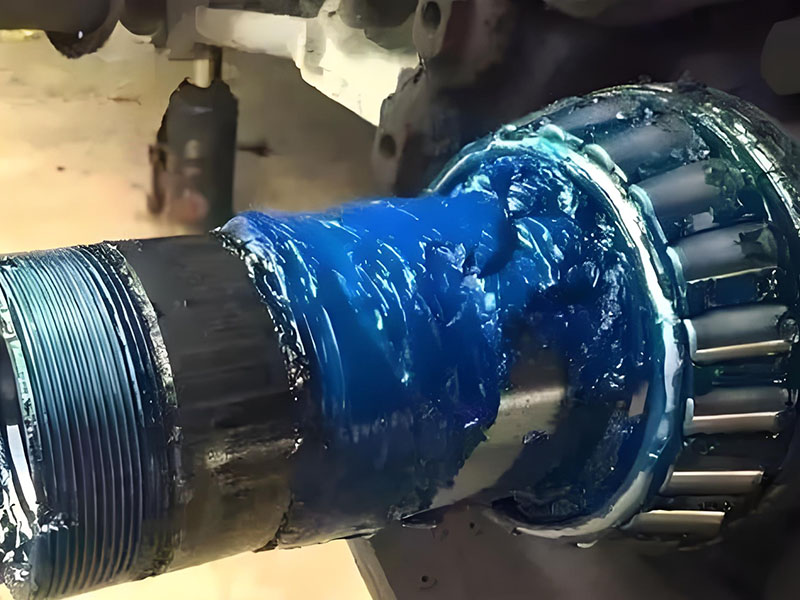
1. Grease – Most widely used for anti-friction bearings (over 80% of applications).
Advantages: Easy to retain, seals against contaminants, suitable for relubrication intervals.
Selection: Base oil viscosity (ISO VG 68 to 220 depending on speed and temperature), consistency (NLGI grades 1–3), operating temperature range.
2. Oil – Used for high-speed, high-temperature, or continuous lubrication systems (oil bath, circulation, mist).
Advantages: Better heat removal, allows higher speeds, easier filtration.
Types: Mineral oils, synthetic oils (PAO, ester).
3. Solid lubricants – For extreme conditions (vacuum, radiation, very high temperature) where grease or oil cannot be used. Examples: MoS₂, graphite, PTFE coatings.
For sealed bearings, the initial grease fill is often designed for the bearing’s entire life. For open bearings, establish a relubrication schedule based on speed, load, temperature, and environment (e.g., every 3–6 months for general industrial motors).
Installation, Maintenance, and Failure Diagnosis
Correct installation and proactive maintenance extend bearing service life and prevent unexpected downtime.
Installation Essentials
- Cleanliness – Even microscopic particles can cause premature wear. Work in a clean area, avoid opening packaging until ready to mount.
- Proper fit – Shaft tolerances (typically j6 or k6) and housing tolerances (H7 or J7) per ISO standards.
- Heating installation – For interference fits, heat the bearing (induction heater recommended) to 80–100°C, never use an open flame. Do not exceed 120°C to avoid tempering.
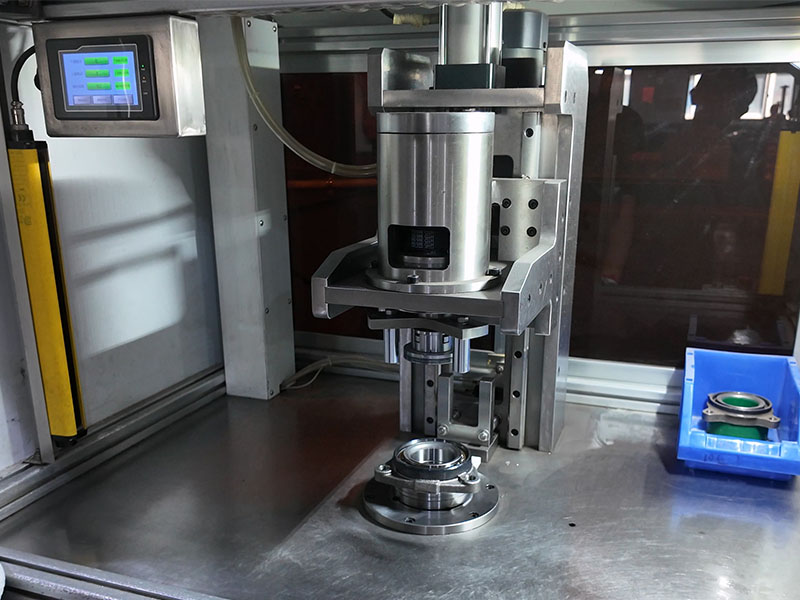
- Mounting force – Apply force only to the ring being press-fitted (never through rolling elements).
Condition Monitoring
Regularly check for abnormal changes:
- Noise – Unusual grinding, clicking, or squealing indicates possible contamination or damage.
- Vibration – Increasing vibration amplitude (measured with accelerometers) suggests developing defects.
- Temperature – Sudden temperature rise often signals lubrication failure or overload.
Common Failure Modes (with possible causes)
| Failure Mode | Typical Appearance | Possible Root Causes |
| Fatigue flaking (spalling) | Irregular pits on raceways or rolling elements | Overload, excessive preload, end of calculated life |
| Abrasive wear | Matt, rough surface | Contamination (dirt, sand, metal particles) |
| Adhesive wear (smearing) | Smoothed or transferred material | Poor lubrication, high speed, momentary overload |
| Corrosion | Rust or etching marks | Moisture ingress, aggressive chemicals, improper storage |
| Overheating discoloration | Blue/brown temper colors | Insufficient lubrication, excessive speed or load |
| Cage fracture | Broken or deformed cage | Vibration, excessive torque, incorrect mounting |
| Brinelling (indentations) | Regular depressions on raceways | Impact mounting (hammer blows), shock loads while stationary |
For any failure, analyze the root cause before replacing the bearing; otherwise, the new bearing may fail prematurely under the same conditions.
Conclusion
Anti-friction bearings are indispensable for modern rotating machinery, offering high efficiency, low maintenance, and long service life when properly applied. Understanding their construction, types, and differences from plain bearings enables engineers and maintenance teams to make informed decisions. Correct selection based on load, speed, misalignment, and environment, combined with adequate lubrication and careful installation, maximizes reliability. Regular condition monitoring and failure analysis further reduce downtime.