When a vehicle develops a driveline issue, many drivers ask: “Is it the inner or outer CV joint?” Understanding the difference is critical because inner CV joint failure typically causes vibration under acceleration, while outer CV joint failure produces a clicking or popping noise during turns. DUHUI will compare the two failure modes, explains why they happen, and provides practical diagnostic and maintenance advice—based on real-world mechanic experience, not marketing claims.
What Is a CV Joint and Why Does It Fail?
Constant velocity (CV) joints transfer engine power to the wheels while accommodating steering and suspension movement. Most front-wheel-drive (FWD) and all-wheel-drive (AWD) vehicles have two types per axle:
- Inner CV joints – located near the transmission or differential. They allow vertical suspension travel and compensate for changes in axle length as the suspension moves.
- Outer CV joints – located near the wheel hub. They enable steering angles and handle the full range of wheel turning.
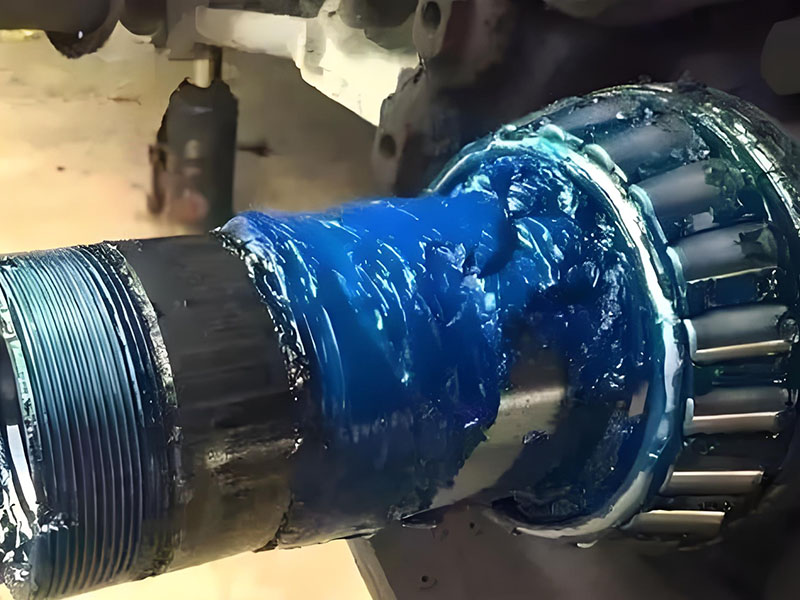
The most common cause of failure is CV boot damage. A torn boot allows dirt, water, and road salt inside, which rapidly degrades the grease. Once lubrication fails, metal-on-metal wear begins. Other causes include lack of maintenance, impact damage from potholes or debris, and high mileage (over 150,000 km).
Why Do Inner and Outer CV Joints Fail Differently?
The difference in failure symptoms comes from their operating angles and load paths. Inner joints operate at relatively constant angles but handle large axial movements. Outer joints operate at extreme angles (up to 45-50 degrees) during turns and experience higher radial loads. Therefore, wear on the inner joint manifests as vibration, while outer joint wear produces noise.
Symptoms of Inner CV Joint Failure
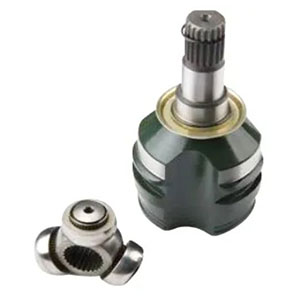
Inner joint failure primarily affects acceleration. Typical signs include:
- Vibration or shuddering when accelerating, especially from a stop or during light throttle between 20-50 km/h. The vibration often feels like a rumble under the floorboard.
- Grease leaking from the inner boot – usually near the transmission. Look for thick, dark grease splattered on the subframe or exhaust.
- Clunking noise when shifting between drive and reverse – this occurs in late stages when the joint has excessive internal clearance.
- Vibration that changes with engine load, not vehicle speed. For example, accelerating uphill worsens it, while coasting or decelerating reduces it.
Technical note: Inner joints (often tripod or plunging types) develop wear in the roller or ball tracks. Under torque, the rollers no longer move smoothly, creating axial vibration transmitted through the halfshaft.
Symptoms of Outer CV Joint Failure
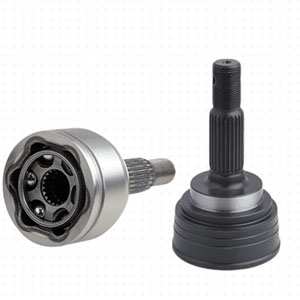
Outer joint failure is most noticeable during steering. Common symptoms:
- Clicking, popping, or snapping noise when turning sharply – typical during parking maneuvers, U-turns, or backing into a driveway.
- Noise becomes louder and more frequent as the joint wears. Early on, you may hear one or two clicks per turn; later, it becomes a rapid series of clicks.
- Grease flung onto suspension components or inside the wheel rim – outer boot tears are easily visible on the wheel side.
- Vibration or shimmy at highway speeds – a severely worn outer joint can also cause wheel vibration, but the primary symptom remains turning noise.
If you hear clicking only when turning left, the right outer joint is often the culprit (loaded side during a left turn). Reverse is true for right turns.
Comparison of Wear Patterns: Inner vs. Outer CV Joint
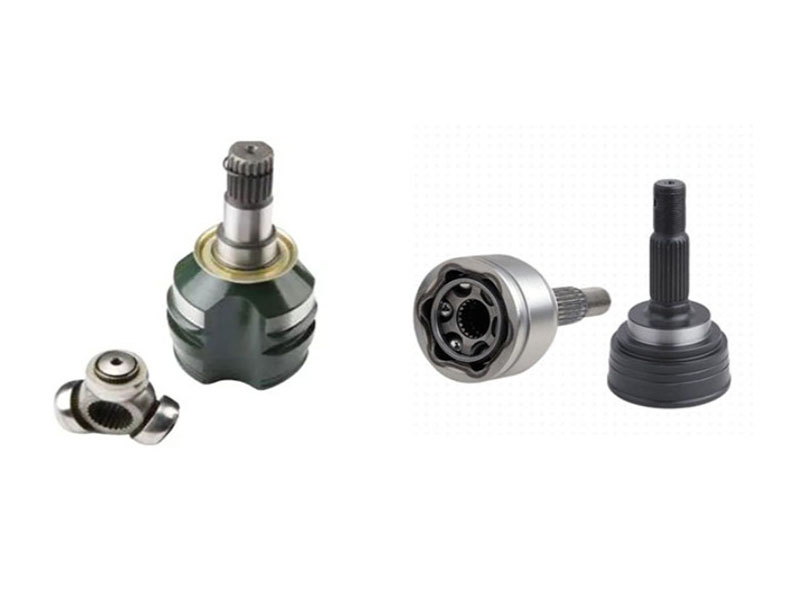
The table below summarizes the distinct failure characteristics for quick reference.
| Feature | Inner CV Joint Failure | Outer CV Joint Failure |
|---|---|---|
| Primary symptom | Vibration under acceleration | Clicking/popping during turns |
| Noise pattern | Clunk when engaging gear (late stage) | Rhythmic clicking proportional to turn angle |
| Grease leak location | Near transmission/differential | Near wheel hub or inside brake dust shield |
| Failure progression | Gradual increase in vibration amplitude | Clicking frequency increases over time |
| Effect on drivability | May cause loss of power delivery if joint separates | Can cause complete axle disconnection while turning |
Prevention and Repair of CV Joint Failure
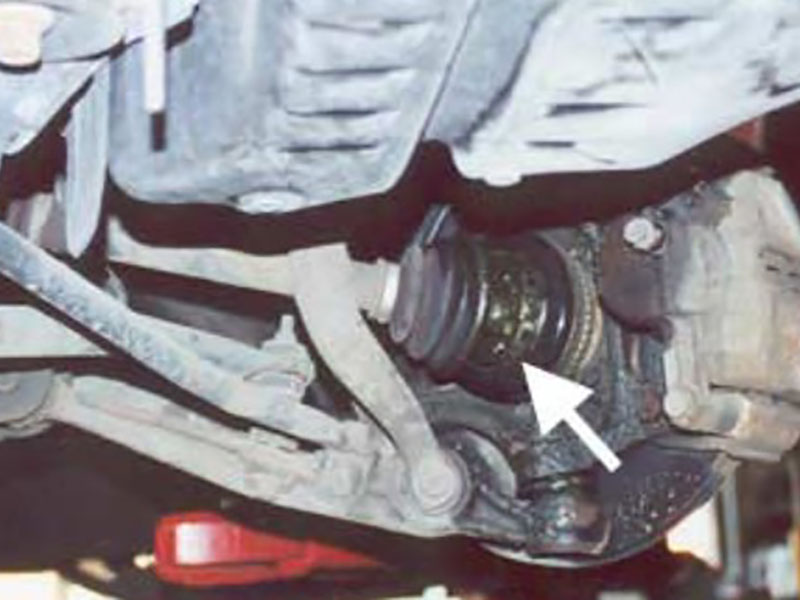
Preventive maintenance is straightforward and far less costly than axle replacement. Follow these steps:
- Inspect CV boots regularly – Check for cracks, tears, or grease leaks every 10,000 km or during oil changes. A small tear can be sealed temporarily, but replacement is the only permanent fix.
- Replace damaged boots immediately – If caught early (no noise, no vibration, and grease still present), a boot replacement and grease repack can save the joint. Labor is moderate but requires removing the axle.
- Replace the entire axle assembly if the joint has been running without grease or already makes noise. Aftermarket axles with quality bearings are widely available. For wheel hub related components, manufacturers such as DUHUI Bearing produce precision-engineered hub units that complement CV axle replacement.
- Do not ignore early symptoms – Driving with a failing CV joint can damage the transmission, wheel bearing, or suspension knuckle.
Typical CV joint lifespan with intact boots is 150,000–200,000 km. In dusty or salty environments, boots may degrade faster.
Frequently Asked Questions
1. How can I tell inner vs. outer CV joint failure without removing any parts?
Perform two simple tests. First, accelerate in a straight line from a stop. If you feel vibration, suspect the inner joint. Second, drive slowly in a parking lot and turn the steering wheel fully left then right. If you hear clicking, it is the outer joint on the opposite side of the turn direction.
2. Can I drive with a failing CV joint?
Not recommended. An inner joint that fails completely may cause the axle to separate from the transmission, resulting in sudden loss of power. An outer joint can break while turning, leading to loss of control. If you must drive, do so only at low speeds and directly to a repair shop. Maximum safe distance after symptoms appear is typically 100-200 km, but failure is unpredictable.
3. Should I replace only the CV boot or the entire halfshaft?
If the joint has no noise, no vibration, and the grease is still clean, replacing just the boot and repacking grease is acceptable. However, most mechanics recommend replacing the entire axle because labor cost is similar and a new axle includes both joints and boots. For a DIY repair on a low-mileage vehicle, boot-only replacement can work.
4. When replacing a CV axle, should I also replace the wheel hub bearing?
Not always required, but it is a good practice if the bearing has high mileage (over 100,000 km) or shows any play or noise. A failing wheel bearing can produce similar vibration or noise, confusing diagnosis. Manufacturers like DUHUI Bearing offer OE-quality hub units that pair well with new axles for a complete front-end refresh.
5. Why does inner joint failure cause vibration while outer joint failure causes clicking?
Inner joints experience axial plunging motion as the suspension moves. When internal components (rollers or balls) wear unevenly, they create a cyclic change in shaft length under torque, which translates to vibration. Outer joints operate at extreme angles during turns; worn ball bearings no longer follow the curved raceway smoothly, creating a clicking sound as each ball skips or impacts.
6. Do all vehicle types (FWD, RWD, AWD) show the same symptoms?
Front-wheel drive and AWD vehicles have CV joints on the front axles and sometimes rear axles. Symptoms are identical. Rear-wheel drive vehicles with independent rear suspension also use CV joints on the rear; symptoms are the same but affect the rear – vibration during acceleration (rear inner) or clicking during turns (rear outer). Solid rear axles use universal joints (U-joints), not CV joints.
7. How much does CV joint repair typically cost?
Boot-only replacement: $150–$300 per axle (labor + parts). Complete halfshaft replacement: $300–$600 per axle for standard vehicles, including alignment if needed. Luxury or AWD models may cost more. DIY parts cost: $50–$150 for a remanufactured axle.
Conclusion
Distinguishing between inner and outer CV joint failure is based on two simple observations: vibration during acceleration suggests inner joint wear; clicking during turns indicates outer joint wear. Regular boot inspections every 10,000 km and prompt repairs prevent most failures. When replacement is necessary, use high-quality components to ensure safe and durable driveline performance. Early diagnosis saves both money and safety risks.