When a shaft rotates inside a machine, something must prevent metal‑to‑metal friction. Ball bearings provide the solution. But how do ball bearings work exactly? Inside every ball bearing, small hardened steel balls roll between two concentric rings, converting sliding friction into rolling friction. This simple mechanism reduces resistance, supports loads, and enables smooth rotation.
What happens inside a bearing when a shaft rotates at thousands of revolutions per minute? How can a small bearing handle radial forces from a heavy rotor? And why are ball bearings not used for extremely heavy thrust loads? DUHUI will answer these questions by explaining the working principle, load types, design variations, and practical limitations of ball bearings.
What Are Ball Bearings?
A ball bearing is a rolling-element bearing that uses spherical balls to maintain separation between moving parts. The basic structure consists of four components:
- Inner ring – mounts onto a rotating shaft.
- Outer ring – fits into a stationary housing.
- Balls (rolling elements) – reduce friction by rolling instead of sliding.
- Cage (retainer) – keeps balls evenly spaced, preventing contact between them.
When the inner ring rotates, the balls roll along the raceways (grooved paths) of both rings. Because rolling friction is significantly lower than sliding friction, ball bearings reduce energy loss and wear.
Main Types of Ball Bearings and Their Working Characteristics
Different applications require different ball bearing designs. The working principle remains the same, but each type handles loads differently.
Deep Groove Ball Bearings
The most common type. Deep, continuous raceways allow the bearing to accommodate radial loads (perpendicular to the shaft) and moderate thrust loads (parallel to the shaft). They are used in electric motors, gearboxes, and pumps.
Angular Contact Ball Bearings
Designed for combined loads – radial and thrust simultaneously. The raceways are offset relative to each other, creating a contact angle. These bearings are often mounted in pairs (back-to-back or face-to-face) for high-speed spindles and machine tools.
Thrust Bearings
These bearings handle pure axial loads (thrust) and are not suitable for radial loads. They consist of two washers (shaft and housing washers) with balls between them. Typical applications include low-speed turntables and vertical shafts.
Self-Aligning Ball Bearings
The outer ring has a spherical raceway, allowing the bearing to tolerate angular misalignment caused by shaft deflection or mounting errors. These are used in conveyor systems, textile machinery, and fans.
How Do Ball Bearings Work? —— Detailed Working Principle
Load Transmission through Rolling Elements
When a shaft rotates without a bearing, the sliding contact between two metal surfaces produces a coefficient of friction between 0.1 and 0.3. This generates heat, noise, and rapid wear. A ball bearing reduces the coefficient of friction to 0.001 – 0.002 by introducing rolling elements.
The load travels from the shaft to the inner ring, then to the balls, then to the outer ring, and finally to the housing. At each ball–raceway contact point, Hertzian contact stress develops – a very high localized pressure over a tiny elliptical area. Because the contact is a point (theoretically) rather than a surface, rolling resistance remains low.
Radial Loads vs. Thrust Loads (Axial Loads)
Radial load acts perpendicular to the shaft axis. In a deep groove ball bearing, the load is transmitted through the balls to the bottom of the raceways. At any given moment, only about 30% to 40% of the balls carry the full radial load, depending on internal clearance.
Thrust load (axial load) acts parallel to the shaft axis. The balls contact the sidewalls of the raceways. Deep groove bearings can handle moderate thrust in both directions, while thrust ball bearings are designed for pure axial loads only.
In many real-world applications, bearings experience combined loads. Angular contact bearings manage this by using a specific contact angle (typically 15°, 25°, or 40°).
Why Ball Bearings Are Suited for Relatively Small to Moderate Loads
The same feature that reduces friction – point contact – also limits load capacity. Because the contact area between a ball and a raceway is very small, the material stress rises quickly under heavy loads. For the same outer dimensions, roller bearings use line contact (cylindrical or tapered rollers) and can support 1.5 to 3 times higher loads than ball bearings.
Therefore, ball bearings are ideal for:
- Moderate radial and axial loads
- High-speed operation (lower centrifugal force than rollers)
- Applications requiring low torque
For extremely heavy or shock loads (e.g., rolling mill stands, large excavators), roller bearings or other designs are preferred.
Key Design Features That Affect Performance
Several design parameters influence how well a ball bearing works in a given application.
- Number of rows: Single-row bearings are most common. Double-row bearings provide higher radial stiffness but take more axial space.
- Cage materials: Steel cages offer strength at high temperatures. Brass cages resist wear and corrosion. Polymer cages (nylon, PEEK) are lightweight and suitable for high-speed, low-noise applications. The cage does not carry load; it only separates balls to prevent friction between them.
- Self‑alignment capability: Only self-aligning ball bearings can compensate for angular misalignment (up to 2–3 degrees). Standard deep groove bearings require precise alignment between shaft and housing.
Common Applications of Ball Bearings
Ball bearings appear in almost every rotating machine. Examples include:
- Automotive: Wheel hubs (hub unit bearings), alternators, water pumps, transmissions, and steering columns.
- Industrial machinery: Electric motors, fans, conveyor rollers, pumps, compressors, and machine tool spindles.
- Household appliances: Washing machine drums, vacuum cleaner motors, ceiling fans, and food processors.
- Medical equipment: Dental handpieces (high-speed miniature bearings), CT scanners, and surgical drills.
In each case, the specific type and precision grade of the ball bearing are selected based on speed, load, and expected life.
Practical Maintenance Tips for Ball Bearings
Proper maintenance extends bearing life and prevents premature failure. While the working principle remains unchanged, external conditions can degrade performance.
- Handle with care: Even invisible dust or dents on raceways or balls cause noise and vibration. Keep bearings in original packaging until installation.
- Inspect housings and shafts: Out-of-round housings or bent shafts introduce additional loads that the bearing was not designed for.
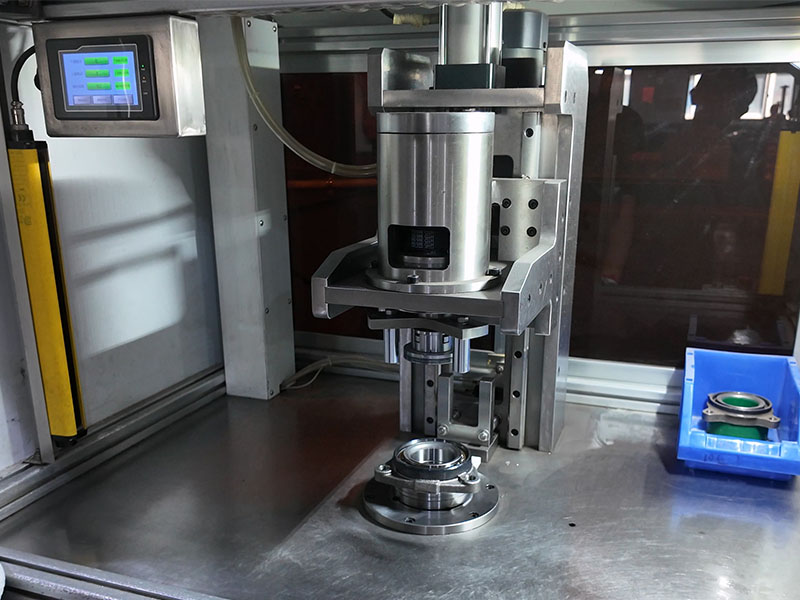
- Use correct installation tools: Never hammer directly on a bearing. Use a press-fit tool applied to the ring that will be mounted with interference fit (inner ring for rotating shaft, outer ring for rotating housing).
- Avoid overheating: Excessive temperature (>120°C for standard grease) degrades lubricant and changes internal clearance.
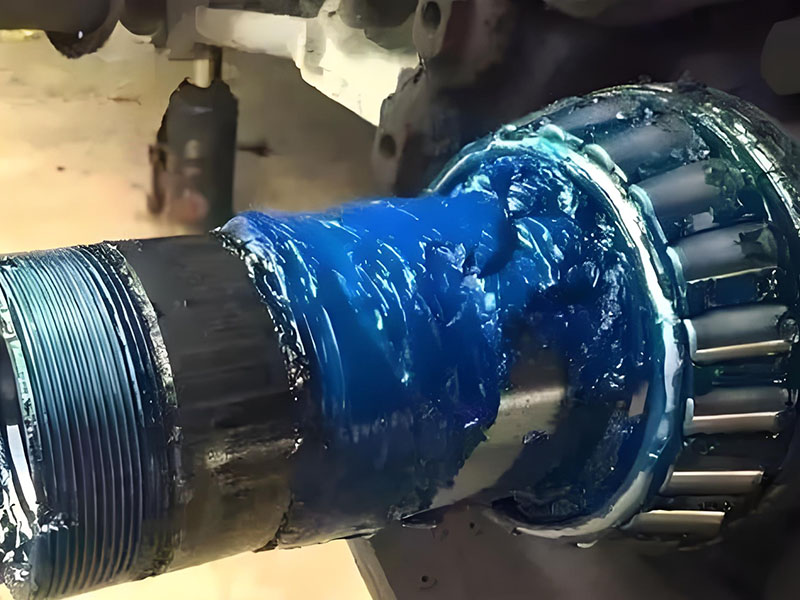
- Prevent corrosion: Use gloves when handling (fingerprint moisture can cause rust). Apply appropriate grease or oil based on operating environment.
Limitations of Ball Bearings
No component is universally optimal. Recognizing the limitations of ball bearings demonstrates technical objectivity and helps engineers make correct selections.
- Lower load capacity than roller bearings of the same size due to point contact vs. line contact.
- Poor tolerance to shock or impact loads – the balls can dent the raceways (brinelling).
- Higher noise and vibration at extremely high speeds (above 1 million DN value) unless special precision grades (ABEC 7 or 9) and ceramic balls are used.
- Sensitivity to misalignment – standard deep groove bearings fail quickly if shaft and housing are not aligned within a few hundredths of a millimeter.
For applications requiring high load, heavy shock, or extreme misalignment, engineers should consider roller bearings, plain bearings, or spherical roller bearings instead.
Conclusion
How do ball bearings work? They work by interposing hardened steel balls between an inner and outer ring, allowing rolling motion instead of sliding. This reduces friction, supports radial and moderate thrust loads, and enables efficient rotation in countless machines – from car wheels to dental drills.
The working principle relies on point contact (Hertzian stress) and load distribution across a limited number of balls. While ball bearings excel at moderate loads and high speeds, they are not suitable for heavy or shock loads, where roller bearings are preferred. Understanding these principles and limitations allows engineers to select, install, and maintain ball bearings correctly for reliable long‑term operation.