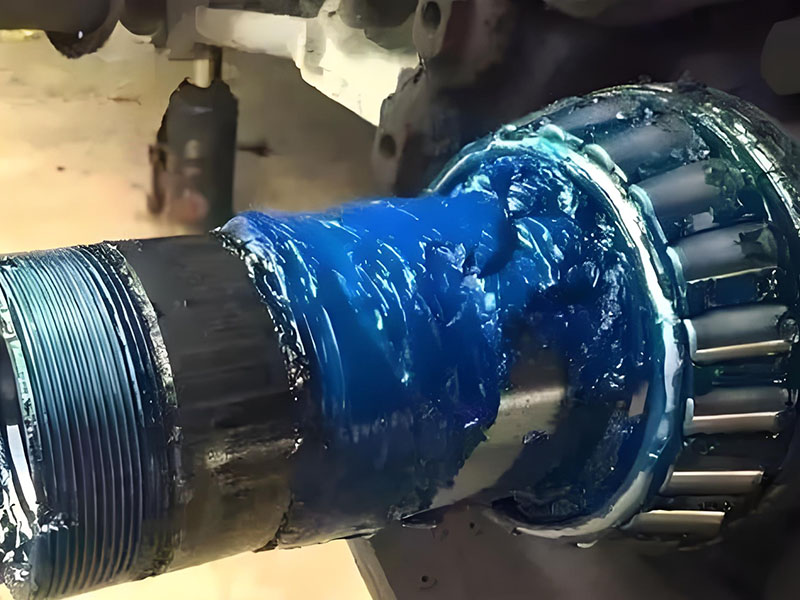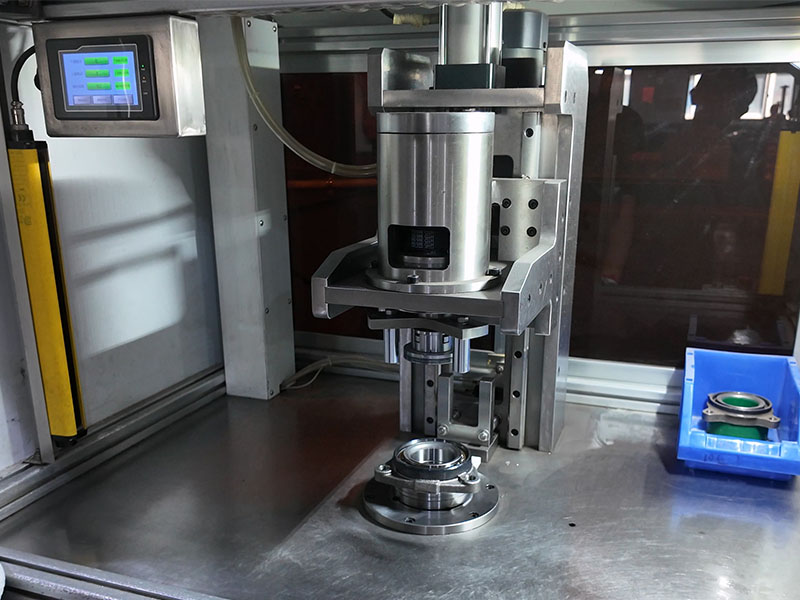
When selecting bearing types for mechanical systems, engineers often compare ball bearing vs thrust bearing to determine which component suits specific load and speed conditions. Ball bearings are designed primarily for radial loads, while thrust bearings accommodate axial loads. DUHUI will explain the definitions, key differences, advantages, disadvantages, and common applications of each type.
What Is a Ball Bearing?
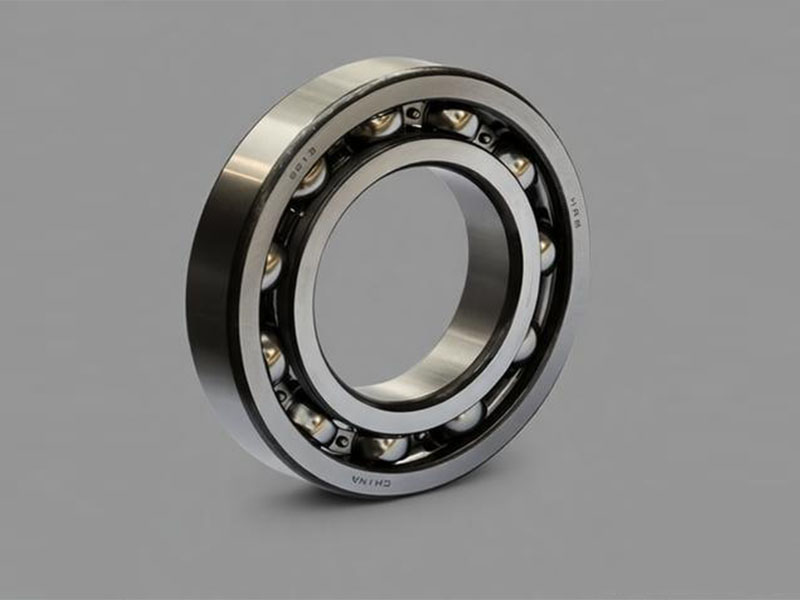
A ball bearing is a rolling-element bearing that uses spherical balls to maintain separation between two concentric rings, known as the inner race and outer race. The balls roll along raceways, reducing friction and enabling smooth rotation of shafts or other moving parts. Ball bearings are optimized for radial loads – forces perpendicular to the shaft axis – but many designs can also support moderate axial loads (parallel to the shaft).
Common configurations include deep groove ball bearings (most versatile), angular contact ball bearings (higher axial load capacity), and self-aligning ball bearings (tolerant to misalignment). The contact between balls and raceways is nearly point contact, which minimizes friction and allows high rotational speeds.
What Is a Thrust Bearing?
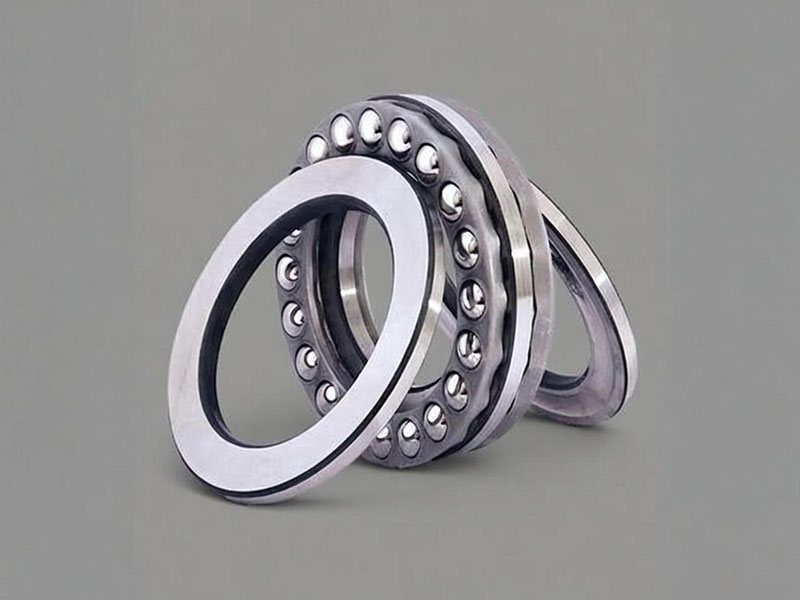
A thrust bearing is a bearing specifically designed to handle axial loads – forces acting parallel to the shaft axis. Unlike ball bearings that prioritize radial support, thrust bearings use rolling elements (balls, rollers, or needles) arranged to resist axial thrust. Common types include thrust ball bearings (for low-speed, light axial loads), thrust roller bearings (for heavy axial loads), and tapered roller thrust bearings (for combined loads).
Thrust bearings typically consist of two grooved washers (raceways) and a set of rolling elements held by a cage. They are not intended for radial loads; applying significant radial force can cause premature failure. Their rolling elements have line or surface contact, which generates higher friction than ball bearings, making them better suited for lower-speed applications.
Ball Bearing vs Thrust Bearing: Key Differences
The table below summarizes the fundamental differences between ball bearings and thrust bearings across six critical parameters.
| Feature | Ball Bearing | Thrust Bearing |
| Load Direction | Radial (perpendicular to shaft) | Axial (parallel to shaft) |
| Speed Capability | Suitable for high-speed applications (up to 10,000+ rpm depending on size) | Suitable for low-speed applications (typically below 2,000 rpm) |
| Friction & Heat Generation | Lower friction, less heat buildup due to point contact | Higher friction, more heat accumulation due to line or surface contact |
| Maintenance Requirements | Low maintenance; requires minimal lubrication (grease or oil) | Requires frequent lubrication and maintenance to manage heat and wear |
| Durability | Longer lifespan under proper radial load conditions | Wears faster under heavy axial loads if lubrication is insufficient |
| Typical Cost | Lower for general-purpose sizes | Higher for heavy-duty axial configurations |
Advantages and Disadvantages of Ball Bearings
Advantages of Ball Bearings
- Support both radial and axial loads – Deep groove and angular contact designs can handle combined loads, simplifying system design.
- Low friction coefficient – Makes them highly efficient in high-speed applications such as electric motors, turbines, and spindles.
- Reduced energy loss and minimal heat generation – Contributes to overall system efficiency and lower cooling requirements.
- Wide availability and standardized dimensions – Easy to source and replace across industries.
Disadvantages of Ball Bearings
- Limited load capacity – Point contact restricts the maximum radial and axial load compared to roller bearings of similar size.
- Sensitive to misalignment – Even small angular errors between shaft and housing can cause uneven load distribution and premature failure (self-aligning types mitigate this but reduce load capacity).
- Poor performance under pure heavy axial loads – For high thrust applications, ball bearings are not recommended.
Advantages and Disadvantages of Thrust Bearings
Advantages of Thrust Bearings
- Strong axial load-bearing capacity – Can handle forces that would quickly destroy a ball bearing. Thrust roller bearings support extremely heavy axial loads in heavy machinery.
- Reduces wear on moving components – In axial load applications (e.g., screw presses, propeller shafts), thrust bearings prevent metal-to-metal contact and extend equipment life.
- Available in multiple rolling-element designs – Balls, cylindrical rollers, tapered rollers, and needle rollers offer flexibility for different load and speed ranges.
Disadvantages of Thrust Bearings
- Cannot support radial loads – A pure thrust bearing will fail if radial forces are present. Some designs (e.g., angular contact thrust bearings) can handle minor radial loads, but dedicated radial bearings are usually required.
- High maintenance requirements – Frequent lubrication is necessary to remove heat and prevent scoring of raceways.
- Sensitive to misalignment – Thrust washers must be perfectly parallel; misalignment leads to edge loading and rapid wear.
- Lower speed capability – Frictional heat limits rotational speed; cooling or oil circulation may be needed for continuous operation.
Common Applications of Ball Bearings
Ball bearings are ubiquitous in machinery where moderate loads and high speeds are typical. Key application areas include:
- Automotive Industry – Wheel hubs (combined radial and axial loads), alternators, water pumps, electric power steering units, and transmission shafts.
- Industrial Machinery – Electric motors of all sizes, conveyor rollers, pumps, compressors, fans, and blowers.
- Wind Turbines and Railway Bearings – Pitch and yaw drives in wind turbines (using angular contact ball bearings); railway axle boxes (often with tapered roller bearings, but ball bearings appear in auxiliary systems).
- Home Appliances – Washing machine drums, vacuum cleaner motors, ceiling fans, and hard disk drive spindles.
Common Applications of Thrust Bearings
Thrust bearings are specified whenever a machine transmits significant axial force. Typical uses include:
- Heavy Machinery and Construction Equipment – Excavator swing drives, bulldozer blade lifts, crane hoists, and hydraulic cylinder mounts.
- Marine and Aerospace Industries – Ship propeller shafts (large thrust roller bearings),
- helicopter rotor hubs, jet engine axial compressors, and aircraft flap actuators.
Power Transmission Systems – Gearboxes with helical or bevel gears (axial thrust from gear teeth), worm drives, and vertical shaft pumps. - Automotive Manual Transmissions – Clutch release bearings (a type of thrust ball bearing) and differential pinion shafts.
How to Choose Between a Ball Bearing and a Thrust Bearing
Select the appropriate bearing type based on three primary factors:
Load direction and magnitude
- If the primary load is radial (perpendicular to shaft), use a ball bearing (or a roller bearing for very heavy radial loads).
- If the primary load is axial (parallel to shaft), use a thrust bearing.
- For combined loads (both radial and axial), consider angular contact ball bearings, tapered roller bearings, or a combination of a radial bearing and a separate thrust bearing.
Rotational speed
- High-speed applications (>5,000 rpm) favor ball bearings due to low friction and heat generation.
- Low-speed, high-axial-load applications (e.g., press screws, turntables) are suitable for thrust bearings.
Maintenance and lubrication access
- Ball bearings in sealed or shielded versions are nearly maintenance-free for many consumer and industrial products.
- Thrust bearings require regular lubrication intervals and are best used where maintenance access is practical.
Space and cost constraints
- Ball bearings are generally more compact and lower cost for radial or light combined loads.
- Heavy-duty thrust bearings may require larger axial space and a higher initial investment.
In many machines, both types are used together: for example, a ball bearing supports the radial load of a rotating shaft while a separate thrust bearing handles the axial load.
Conclusion
Understanding the differences between a ball bearing and a thrust bearing is essential for proper bearing selection in mechanical design. Ball bearings excel at radial loads and high-speed operation, offering low friction and minimal maintenance. Thrust bearings are specialized for axial loads, providing robust performance in low-speed, heavy-thrust applications such as marine propellers and construction equipment. The choice ultimately depends on load direction, speed requirements, and maintenance capabilities. By matching the bearing type to the actual operating conditions, engineers can improve equipment reliability and service life.