Angular contact ball bearings are widely used in machine tool spindles, industrial pumps, and high-speed rotating machinery. Their performance and service life depend significantly on proper lubrication. How do these bearings differ from standard deep groove ball bearings, and what lubrication practices should engineers follow? This article explains the design and operating principles of angular contact ball bearings, the functions of lubrication, available lubrication methods, and key selection criteria.
What Are Angular Contact Ball Bearings and How Do They Work?
Angular contact ball bearings are characterized by a specific contact angle between the balls and the raceways. This contact angle is typically 15°, 25°, or 40°, depending on the series and intended application.
Design and components. The bearing consists of an inner ring, an outer ring, balls (rolling elements), and a cage that maintains uniform spacing. One of the ring raceways has a relieved shoulder, allowing the bearing to accommodate a larger number of balls than a standard deep groove ball bearing of similar size.
Working principle. The contact angle — the angle between the line connecting the ball and raceway contact points and the bearing’s radial plane — enables the bearing to support combined radial and axial loads simultaneously. However, a single angular contact ball bearing can support axial load in only one direction. For bidirectional axial load capability, two bearings are mounted in pairs (back‑to‑back, face‑to‑face, or tandem configurations). A larger contact angle increases axial load capacity but reduces the permissible rotational speed.
Why Lubrication Matters for Angular Contact Ball Bearings
Lubrication performs several critical functions in angular contact ball bearings. First, it separates the rolling elements from the raceways with a thin fluid film, minimizing direct metal‑to‑metal contact and reducing friction and wear.
At high rotational speeds, friction generates heat. Lubrication helps dissipate this heat away from the contact zones, preventing localized overheating and maintaining dimensional stability.
Lubrication also forms a protective barrier against moisture, dust, and corrosive agents. This barrier prevents rust and oxidation on precision‑ground surfaces.
Insufficient or improper lubrication leads to accelerated wear, increased operating temperature, scoring on raceways and balls, and eventually bearing seizure. Contaminated or degraded lubricants cause abrasive wear and premature cage failure, resulting in unplanned downtime and higher maintenance costs.
Types of Lubrication for Angular Contact Ball Bearings
Angular contact ball bearings are lubricated either with grease or with oil. The choice depends on operating speed, load, temperature, and environmental conditions.
Grease Lubrication: Advantages and Applications
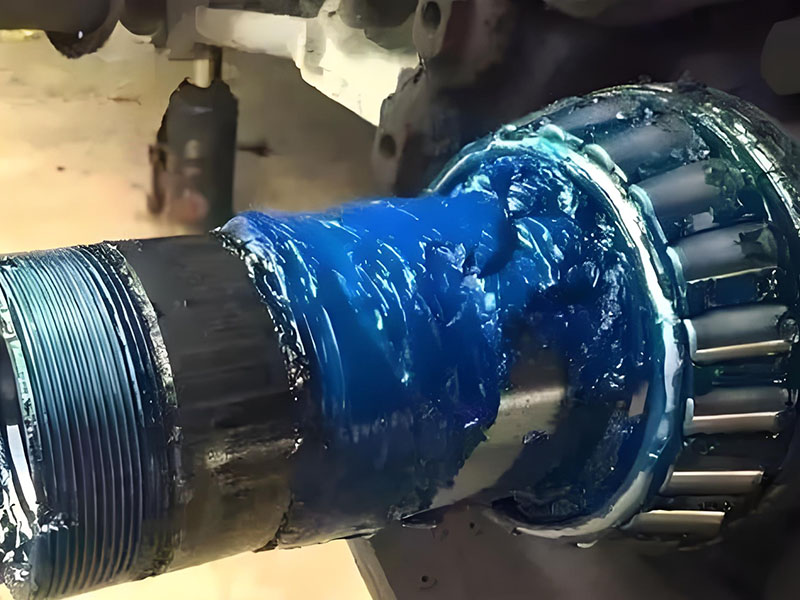
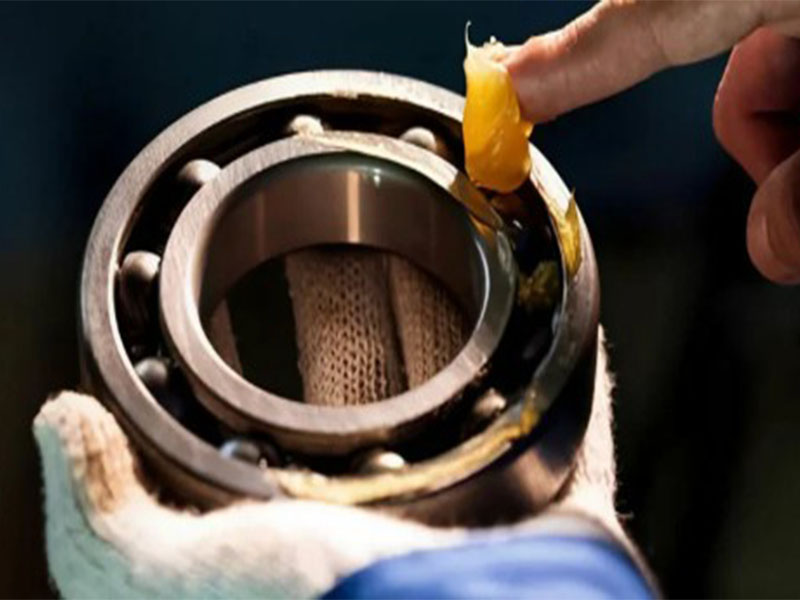
Grease is a semi‑solid lubricant composed of base oil, thickener, and additives. It is often selected when contamination protection is required and maintenance access is limited.
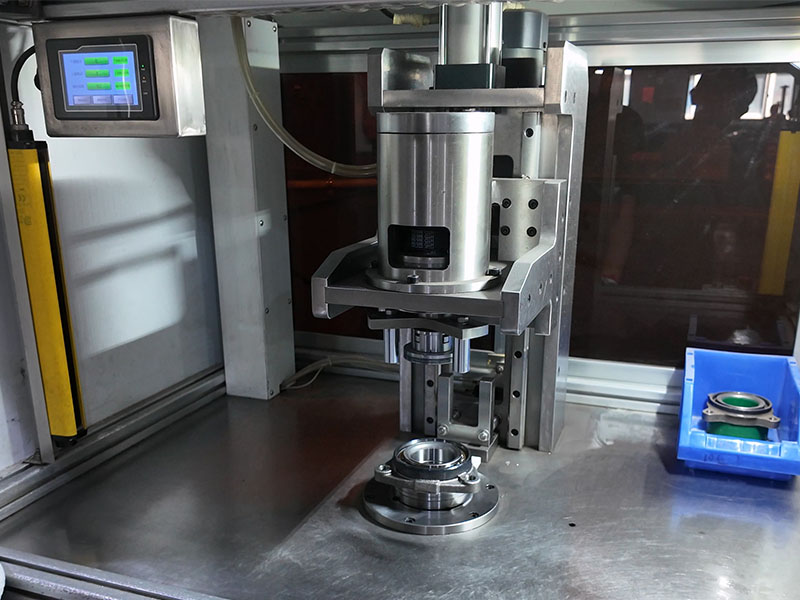
- Easy application. Grease can be factory‑prepacked in sealed or shielded bearings, reducing the need for frequent relubrication. For larger bearings, grease can be replenished through external fittings.
- Effective sealing. The consistency of grease helps exclude dust, dirt, and moisture, acting as an additional sealing barrier.
- Reduced maintenance. Grease generally requires less frequent replenishment than oil. Under normal operating conditions, relubrication intervals range from 3 to 6 months.
Note on grease quantity. Over‑greasing causes churning and excessive temperature rise, while under‑greasing leads to insufficient film thickness. Manufacturers typically recommend filling 20% to 30% of the bearing’s internal free space with grease for most industrial applications.
Oil Lubrication: Systems and Applications
Oil lubrication is preferred for high‑speed or high‑temperature applications because it provides superior cooling and can flush away wear debris.
Common oil delivery systems include:
- Oil bath lubrication. The bearing is partially submerged in an oil reservoir. Simple and economical, but limited to lower speeds.
- Oil mist lubrication. A fine oil mist carried by compressed air is continuously supplied to the bearing. Low oil consumption, minimal churning, and suitable for high‑speed spindles.
- Oil jet lubrication. High‑pressure oil jets are directed precisely at the bearing inlet (typically the inner ring end face or cage entry). Excellent heat removal for ultra‑high‑speed applications such as CNC machine tool spindles and turbine shafts.
- Oil‑air lubrication. Precisely metered oil droplets are delivered via compressed air. This method combines cooling from air with the lubricity of oil, enabling extreme speeds with very low friction and minimal oil usage.
Oil systems require higher initial investment and more monitoring than grease systems, but their thermal management is indispensable for very high speed operations.
How to Choose the Right Lubricant for Angular Contact Ball Bearings
Selecting the optimal lubricant requires balancing several operational parameters.
- Operating speed. High speeds demand low‑viscosity lubricants to reduce frictional drag and churning losses. For precision angular contact bearings operating at extreme speeds, specially formulated low‑viscosity oils or greases are specified.
- Load conditions. Heavy or impact loads require lubricants with high film strength and extreme pressure (EP) additives (e.g., those containing molybdenum disulfide) to prevent localized welding under high contact stress.
- Temperature range. The lubricant must maintain its viscosity across the bearing’s full operating temperature range. For high‑temperature environments, synthetic oils or greases with high dropping points and oxidation resistance are necessary. A grease’s dropping point should be at least 20–30°C above the maximum expected operating temperature.
- Contamination risks. In dusty or moisture‑prone environments, grease with strong sealing properties is often the best choice. The additive package should also provide contamination resistance.
- Environmental conditions. Chemical exposure, washdown processes, or vacuum operation may require specialized lubricants such as perfluoropolyether (PFPE) greases or solid lubricants (graphite, molybdenum disulfide coatings).
- Manufacturer specifications. Always refer to the bearing manufacturer’s technical documentation for specific lubricant recommendations, including base oil viscosity, additive requirements, and relubrication intervals.
Conclusion
Proper lubrication is essential for achieving optimal performance and maximum service life from angular contact ball bearings. The choice between grease and oil must be guided by operating speed, load, temperature, and contamination risks. Grease offers simplicity and sealing effectiveness for general applications, while oil systems provide superior cooling and contaminant removal for high‑speed or high‑temperature conditions. Regular monitoring of lubricant condition and adherence to recommended relubrication schedules prevent premature wear and bearing failure. By understanding the relationship between bearing design and lubrication requirements, maintenance engineers can reduce downtime and extend equipment service intervals significantly.
Frequently Asked Questions (FAQs)
Q1: Why is proper lubrication so necessary in angular contact ball bearings?
A1: Proper lubrication forms a separating film between rolling elements and raceways, reducing friction and wear. It also dissipates heat, prevents corrosion, and directly extends bearing service life and equipment reliability.
Q2: In which way does operating temperature interact with lubricants in ball bearings?
A2: Higher temperatures reduce lubricant viscosity, decreasing film thickness and load‑carrying capacity, while accelerating oxidation. Fluctuating temperatures can affect grease consistency and oil separation.
Q3: What are the recommended lubricants for high‑speed angular contact ball bearings?
A3: Low‑viscosity synthetic oils or greases with high‑speed additives are typically recommended. Many bearing manufacturers offer proprietary high‑speed greases formulated for angular contact spindle bearings. Specific recommendations should be obtained based on your application’s speed factor (dmn value).
Q4: How frequently should I lubricate my angular contact bearings?
A4: Relubrication intervals depend on speed, load, temperature, and lubricant type. For grease‑lubricated bearings under normal conditions, every 3 to 6 months is typical. Continuous or harsh operation may require monthly attention. Oil systems generally require continuous or more frequent replenishment.
Q5: Which lubrication method is better for angular contact ball bearings?
A5: Grease is preferable for most general applications due to simplicity, sealing effectiveness, and ease of maintenance. Oil lubrication is better for high‑speed, high‑temperature, or heavy‑load applications where superior cooling and contaminant removal are required.
Q6: Will old grease affect the performance of angular contact bearings?
A6: Yes. Aged grease loses its base oil through evaporation and separation, leaving thickener that no longer provides effective lubrication. Oxidized grease can become acidic and corrosive. Used grease also accumulates wear debris, accelerating abrasive wear. Regular grease replacement is essential.
Q7: Why is the seal required in bearing lubrication?
A7: Seals retain lubricant inside the bearing cavity, ensuring consistent availability to the contact zones. More importantly, they exclude contaminants (dust, moisture, abrasive particles) that would otherwise degrade the lubricant and accelerate wear.
Q8: Can I switch from oil lubrication to grease lubrication for my angular contact ball bearings?
A8: Switching from oil to grease is not recommended without thorough analysis. Grease requires different internal clearance and cage materials in many high‑speed bearings. Residual oil can interact with new grease, altering consistency and potentially causing separation or degradation. Consult the bearing manufacturer before making such a change.