Selecting the wrong bearing for an application can lead to premature failure, unplanned downtime, and increased operational costs. Among the many bearing types available, deep groove ball bearings and angular contact ball bearings are two of the most commonly used in industrial machinery. While they may appear similar at first glance, their internal geometries, load handling capabilities, and application suitability differ significantly.
This guide provides a technical comparison of these two bearing types, covering their design characteristics, performance differences, and selection criteria to help engineers make informed procurement decisions.
What Are Deep Groove Ball Bearings?
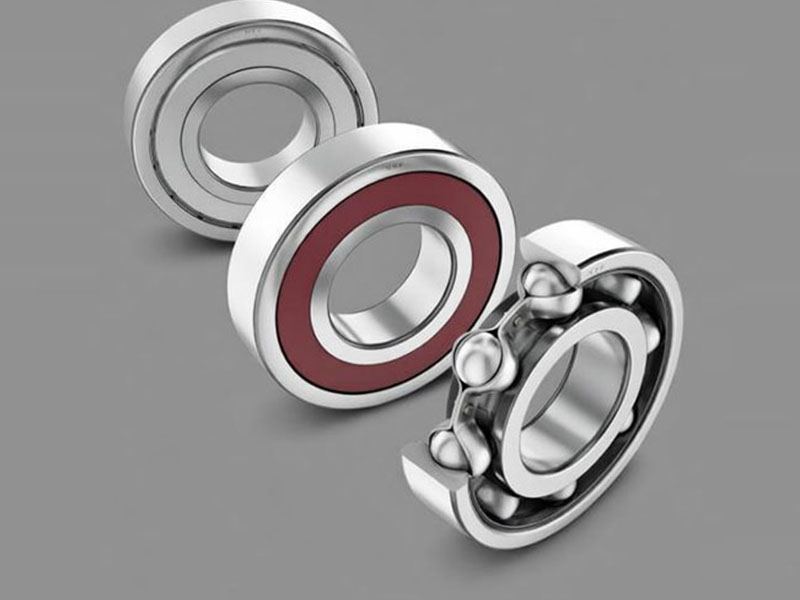
Deep groove ball bearings (DGBBs) are the most widely used type of rolling bearing globally. Their straightforward design and versatility make them a standard choice across numerous industries.
Design
Deep groove ball bearings consist of an inner ring, an outer ring, a set of balls, and a cage. As the name suggests, both the inner and outer rings feature deep raceway grooves whose radius is slightly larger than that of the balls. This creates a close osculation between the balls and raceways. The outer ring has continuous shoulders on both sides of the raceway, making the bearing non-separable.
These bearings are available in single-row and double-row designs, as well as open and sealed variants. Standard sizes range from miniature with inner diameters around 1 mm up to larger bore diameters of several hundred millimeters. The cages are typically made from pressed steel, brass, or polyamide depending on operating conditions.
Features and Characteristics
Load Capacity. Deep groove ball bearings are primarily designed to carry radial loads (perpendicular to the shaft axis). Due to their deep raceway geometry, they can also accommodate axial loads in both directions. Under pure radial load, the contact angle is nominally zero. When an axial load is applied, a contact angle develops, but the axial load capacity typically does not exceed approximately 20-30% of the static radial load rating.
Speed Capability. The low frictional torque of deep groove ball bearings makes them suitable for high-speed applications. Open bearings with grease or oil lubrication can achieve very high limiting speeds, while sealed variants have reduced speed limits due to seal drag.
Maintenance and Cost. Their simple design results in low maintenance requirements and long service life. Deep groove ball bearings are generally the most economical ball bearing option due to mass production.
Applications. Common applications include electric motors, household appliances, pumps, conveyors, office equipment, general industrial machinery, and medical devices.
What Are Angular Contact Ball Bearings?
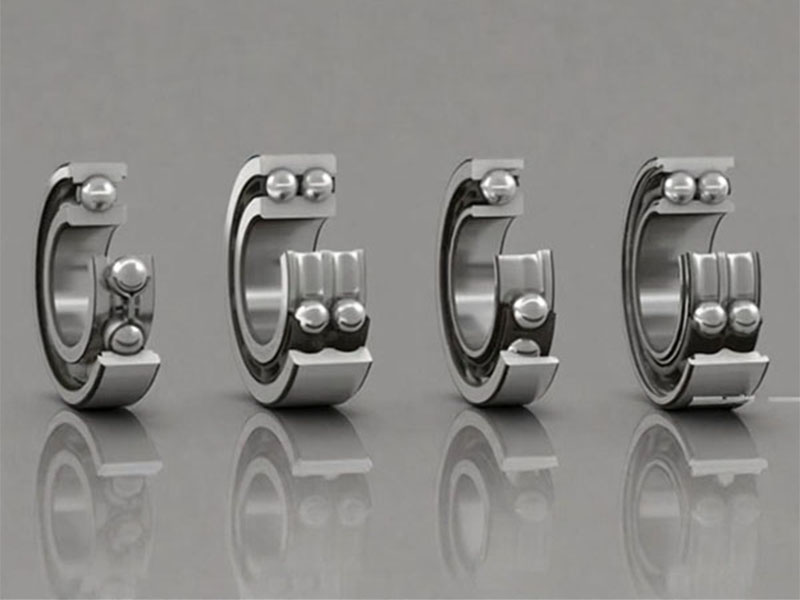
Angular contact ball bearings (ACBBs) are engineered specifically for applications involving combined radial and axial loads. Their distinguishing feature is the contact angle between the balls and raceways.
Design
In angular contact ball bearings, the raceways of the inner and outer rings are offset relative to each other along the bearing axis. This geometry creates a specific angle—known as the contact angle—between the line joining the points of contact of the ball with the raceways and the radial plane.
Standard contact angles are 15°, 25°, and 40°. A larger contact angle provides higher axial load capacity but reduces radial load capacity and speed capability. Conversely, a smaller contact angle supports higher radial loads and speeds with lower axial capacity.
Unlike deep groove bearings, single-row angular contact ball bearings are separable and have an outer ring relieved on one side. This design means they can accommodate axial load in only one direction. For bidirectional axial load applications, two angular contact bearings must be mounted together in a duplex arrangement.
Features and Characteristics
Load Capacity. Angular contact ball bearings can handle significant combined loads simultaneously. The axial load capacity is considerably higher than that of deep groove ball bearings, with the actual capacity determined by the contact angle. For contact angles of 40°, axial load capability is maximized, while 15° bearings typically offer a better balance between radial and axial capacity.
Stiffness and Precision. These bearings provide high axial stiffness, particularly when preloaded. Preloading eliminates internal clearance, increasing rigidity and rotational accuracy—characteristics essential for precision machinery such as machine tool spindles and grinding equipment.
Duplex Arrangements. To handle bidirectional axial loads or achieve enhanced stiffness, angular contact ball bearings are frequently used in pairs. Common configurations include:
- Back-to-back (DB): Offers high moment rigidity, suitable for applications involving moment loads
- Face-to-face (DF): Accommodates angular misalignment between shaft and housing
- Tandem (DT): Doubles axial load capacity by sharing load across both bearings
Applications. Angular contact ball bearings are found in machine tool spindles, woodworking spindles, vacuum pumps, centrifugal pumps, automotive transmissions, semiconductor manufacturing equipment, centrifuges, and high-speed electric motors.
Deep Groove vs Angular Contact Ball Bearings: Comparison Chart
| Feature | Deep Groove Ball Bearings | Angular Contact Ball Bearings |
|---|---|---|
| Typical designations | 6xxx series | 7xxx series |
| Contact angle | Nominally 0° (increases under axial load) | 15°, 25°, or 40° (fixed) |
| Axial load capacity | Low to moderate (bidirectional) | High (single direction per bearing) |
| Radial load capacity | Excellent | Moderate to good (depends on contact angle) |
| Combined load capacity | Limited | Excellent |
| Stiffness | Low to moderate | High (especially when preloaded) |
| Mounting | Single bearing acceptable | Often requires duplex pairs for bidirectional load |
| Speed capability | Very high (low friction) | High (contact angle dependent) |
| Maintenance | Low | Low to moderate |
| Cost | Economical | Higher than DGBB |
For bidirectional axial loads at moderate magnitude (within 20-30% of radial rating), deep groove bearings suffice. For high uni-directional axial loads or combined loads with rigidity demands, angular contact bearings are required.
How to Choose the Right Bearing for Your Application?
Selecting between deep groove and angular contact ball bearings requires careful evaluation of several factors. The following criteria serve as a practical engineering guide.
Load Type
If the application primarily involves radial loads with minimal or intermittent axial loading, deep groove ball bearings are the appropriate and most economical choice. For applications with significant axial loads—particularly if the axial load is directional or combined with radial loads—angular contact ball bearings are required.
Speed Requirements
Both bearing types accommodate high speeds. Deep groove ball bearings generally offer higher limiting speeds due to their lower frictional torque. Angular contact bearings with smaller contact angles (15°) support higher speeds than those with larger angles (40°).
Precision and Rigidity
For general industrial applications where standard tolerances are sufficient, deep groove ball bearings perform adequately. When the application demands high rotational accuracy, minimal shaft deflection, or enhanced system stiffness, angular contact ball bearings—particularly those installed with preload—are necessary.
Temperature and Lubrication
Both bearing types can operate across wide temperature ranges with appropriate lubrication selection. High-temperature applications may require special cage materials (e.g., brass or PEEK) or heat-stabilized components. Lubrication type (grease or oil) and relubrication intervals should align with the expected operating speeds and temperatures.
Installation and Maintenance Constraints
Deep groove ball bearings are simpler to install and can operate individually. Angular contact bearings require careful orientation during installation, and bidirectional load applications demand duplex pairs with appropriate preload. For applications with limited space or simplified maintenance requirements, deep groove bearings may be preferred.
Decision Summary
| Choose Deep Groove Ball Bearings When… | Choose Angular Contact Ball Bearings When… |
|---|---|
| Load is primarily radial | Combined radial and high axial loads present |
| Axial loads are limited (≤20-30% of radial rating) and bidirectional | Significant axial load from one direction |
| Standard precision is acceptable | High precision and rigidity are required |
| Space is limited for matched sets | Space for duplex arrangement is available |
| Simple installation is necessary | Preload is required for stiffness |
Conclusion
Deep groove ball bearings and angular contact ball bearings serve distinct roles in mechanical design. Deep groove bearings offer simplicity, economic efficiency, and versatility for applications where radial loads dominate. Angular contact bearings provide superior axial load handling, higher stiffness, and greater precision for demanding applications with combined loads.
The correct choice depends entirely on the application‘s load profile, speed requirements, precision needs, and installation constraints. Engineers should evaluate these factors systematically to ensure optimal bearing performance and service life.
For applications requiring further guidance—including custom bearing specifications, high-precision requirements, or specialized operating conditions—consultation with bearing engineering specialists is recommended.
Frequently Asked Questions (FAQs)
Q1. Can I use an angular contact bearing as a deep groove replacement?
A1. Not directly. Angular contact bearings have a different internal geometry and cannot accommodate axial loads in both directions unless mounted in pairs. Substituting one type for the other without reviewing the application‘s load profile can lead to premature failure.
Q2. What happens if I use a deep groove ball bearing under high axial load?
A2. Exceeding the axial load capacity of a deep groove ball bearing can lead to increased friction, overheating, premature wear, and eventual failure. The axial load should generally not exceed approximately 20-30% of the static radial load rating for continuous operation.
Q3. How do I identify deep groove vs angular contact bearings?
A3. The outer ring distinguishes them. Deep groove ball bearings have symmetrical outer rings with continuous shoulders on both sides. Angular contact ball bearings have one side of the outer ring relieved or thinner. Additionally, designation numbers indicate the type—6xxx for DGBB and 7xxx for ACBB.
Q4. Do angular contact bearings always need to be used in pairs?
A4. For applications involving axial loads in both directions or requiring high rigidity, yes. A single angular contact bearing can only accommodate axial load in one direction. For bidirectional axial load, a duplex pair with back-to-back or face-to-face configuration is required.
Q5. Which bearing type is better for high-speed applications?
A5. Deep groove ball bearings typically achieve higher limiting speeds due to their low friction design. However, properly lubricated angular contact bearings with 15° contact angles also perform well at high speeds. The choice depends on whether axial load capacity must be maintained at operating speed.
Q6. Can deep groove ball bearings handle any axial load?
A6. Yes, but the axial load capacity is limited. Under pure axial load, the contact angle develops and the bearing can function, but performance degrades significantly as axial load increases beyond recommended levels.