In the world of high-speed machinery and precision engineering, traditional bearings—while reliable and cost-effective—often face limitations. Friction, wear, and the need for lubrication can become significant hurdles in demanding applications. This is where magnetic bearings emerge as a revolutionary technology, offering a paradigm shift from mechanical contact to non-contact suspension. DUHUI provides a comprehensive overview of magnetic bearings, their working principles, types, and key applications.
What Are Magnetic Bearings?
Magnetic bearings represent an advanced support technology that uses magnetic forces to levitate a rotating shaft, or rotor, without any physical contact. Unlike conventional rolling element or fluid film bearings, there is no solid-to-solid contact between the moving and stationary parts .
The core concept is to use controlled magnetic fields to suspend the rotor in a magnetic field, creating an air gap. This fundamental difference eliminates mechanical friction and wear, opening the door for applications requiring extreme speeds, exceptional cleanliness, and operation in harsh environments . The journey of magnetic levitation began in the 19th century with Earnshaw‘s theorem, evolving through key patents in the 1930s to the sophisticated, digitally controlled systems we see today in everything from industrial compressors to space exploration .
Key Components of a Magnetic Bearing System
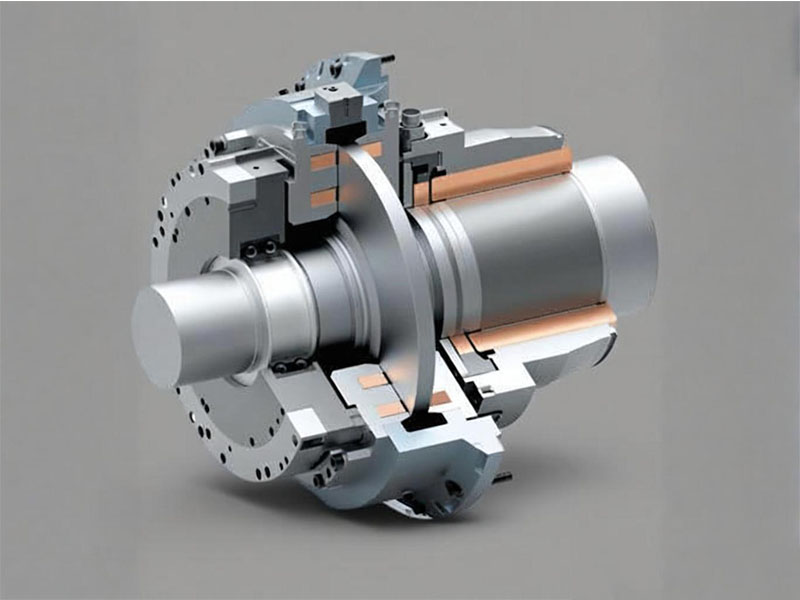
While passive systems exist, the most common and versatile type—the Active Magnetic Bearing (AMB)—is a complex mechatronic product. Its core components work together in a closed-loop feedback system .
- The Actuator (Stator and Rotor): The stator is the stationary part, typically made of laminated electrical steel sheets with copper windings to form electromagnets. The rotor is the rotating part, fitted with a ferromagnetic lamination stack or a solid steel ring that is acted upon by the magnetic field .
- Position Sensors: These are the “eyes” of the system. High-precision sensors, often eddy-current probes, constantly monitor the rotor‘s position with micron-level accuracy, detecting any deviation from its center point .
- The Controller: Acting as the “brain,” this digital signal processor receives position data from the sensors. It compares the actual position to the desired position and, using sophisticated control algorithms (like PID, μ-synthesis, or modern adaptive controls), calculates the exact amount of corrective force needed .
- Power Amplifiers: These are the “muscles.” They take the low-voltage control signals from the controller and convert them into precise, high-current commands that energize the appropriate electromagnets in the stator .
- Auxiliary Bearings (Catcher Bearings): Often a crucial safety component, these are typically conventional rolling element bearings. They provide a physical backup, supporting the rotor and protecting the expensive magnetic bearing components during a power outage, control system fault, or extreme overload .
Types of Magnetic Bearings
Magnetic bearings are generally classified by how they generate the magnetic force and whether they use active control .
- Active Magnetic Bearings (AMBs): AMBs use electromagnets powered by a closed-loop electronic control system. This allows for real-time adjustment of the magnetic field, enabling precise control over the rotor’s position, stiffness, and damping. AMBs are the dominant choice for high-performance and mission-critical applications due to their controllability and high load-carrying capacity .
- Passive Magnetic Bearings (PMBs): PMBs rely solely on permanent magnets, such as Neodymium (NdFeB), to create the suspension force. Their main advantages are simplicity, zero power consumption, and no need for a control system. However, Earnshaw‘s theorem dictates that a purely passive system cannot be stable in all directions, limiting their application to less demanding, often static or lightly loaded systems .
- Hybrid Magnetic Bearings (HMBs): HMBs combine the best of both worlds. They use permanent magnets to provide a constant “bias” magnetic field, which handles a large portion of the load with low energy consumption. Electromagnets are then added to actively control and stabilize the rotor, allowing for a more compact and energy-efficient design compared to a pure AMB .
How Do Magnetic Bearings Work?
The fundamental principle behind all magnetic bearings is the generation of attractive force (Maxwell force) between electromagnets and a ferromagnetic rotor .
In an AMB, the process of achieving and maintaining stable levitation is a dynamic, continuous loop:
- Sensing: The position sensors detect that the rotor has moved slightly off-center.
- Processing: This information is instantly sent to the digital controller.
- Calculating: The controller, running a control algorithm, calculates the precise current adjustment needed for each electromagnet to pull the rotor back to its center.
- Amplifying: The power amplifiers convert these calculations into real electrical currents.
- Actuating: The energized electromagnets generate a corrective magnetic force.
- Re-centering: This force acts on the rotor, nudging it back to its ideal position. This entire sequence happens thousands of times per second, ensuring the rotor remains perfectly suspended even under varying loads . Systems typically use radial bearings to control lateral movement and a thrust bearing (or axial bearing) to manage end-thrust loads on the shaft .
Advantages and Disadvantages of Magnetic Bearings
Understanding the trade-offs is key to selecting the right bearing technology.
Advantages of Magnetic Bearings
- Frictionless Operation & Extreme Speed: Without mechanical contact, speeds are limited only by the rotor material and drive system, not by the bearing itself .
- No Mechanical Wear: This leads to an exceptionally long, theoretically infinite, operational lifespan .
- Elimination of Lubrication: No oil or grease is needed, making them ideal for cleanrooms, vacuum environments (like space), and processes where contamination is unacceptable .
- Controllable Dynamics: The ability to actively adjust stiffness and damping allows for precise vibration control and the ability to pass through critical speeds smoothly .
- High Precision: They can maintain rotational accuracy at the micron level .
Disadvantages of Magnetic Bearings
- High Initial Cost: The complexity of the electronics, sensors, and control system makes magnetic bearings significantly more expensive upfront than conventional bearings .
- Power Dependency: They require a continuous and reliable power supply, often needing a backup like a UPS for safe shutdown .
- System Complexity: They require expertise in multiple disciplines (mechanics, electronics, control engineering), making design and maintenance more complex .
- Auxiliary Bearings: The necessity of mechanical backup bearings adds to the system‘s complexity and cost .
Applications of Magnetic Bearings
Magnetic bearings are the preferred solution in applications where their unique advantages outweigh the higher initial cost.
- High-Speed Turbomachinery: Oil-free turbo compressors, expanders, and gas turbines benefit from high reliability and efficiency .
- Energy Storage and Generation: Flywheel energy storage systems and high-speed generators rely on magnetic bearings for low-loss, high-speed operation .
- Aerospace: From satellite attitude control wheels and rocket engine cryogenic pumps to blowers for the International Space Station, they operate reliably in extreme conditions where lubricants would fail .
- Precision Equipment: Turbo-molecular pumps for creating high vacuums and high-speed spindles for precision machining achieve unparalleled performance .
- Medical Technology: In centrifugal blood pumps (ventricular assist devices), they ensure a clean, wear-free, and highly reliable environment for sensitive biological fluids .
- Transportation: Magnetic levitation (maglev) trains are the most iconic application, using magnetic forces for both suspension and propulsion.
Frequently Asked Questions
1. What is the typical power consumption of an active magnetic bearing (AMB) system compared to conventional bearings?
Active magnetic bearing systems typically consume between 100 W and 2 kW per bearing, depending on rotor mass, rotational speed, and control requirements. At steady-state operation, power consumption is lower than during startup or under variable loads. In contrast, conventional rolling-element bearings consume near-zero electrical power but generate frictional losses. For high-speed applications (e.g., >30,000 rpm), total system energy efficiency of AMBs often exceeds that of oil-lubricated bearings due to elimination of viscous drag, despite the continuous power draw of electromagnets and control electronics.
2. Can magnetic bearings fail catastrophically, and what backup systems are standard?
Magnetic bearings are inherently fail-safe only when combined with auxiliary mechanical bearings. In industry-standard AMB systems, auxiliary (backup) bearings – typically rolling-element or sleeve bearings – are mandatory. If electrical power or control system fails, the rotor lands on these backup bearings at reduced speed. Catastrophic failure without backups is possible only in low-speed or experimental setups. Most industrial turbomachinery (e.g., compressors, expanders) follows API 617 or ISO 14839 standards, which require auxiliary bearings capable of handling at least 30–60 seconds of rotor coast-down and multiple landings under rated load.
3. What is the maximum rotational speed achievable with magnetic bearings?
Magnetic bearings have no theoretical speed limit from mechanical contact or lubrication. Practically, the limiting factors are rotor dynamics (critical speeds), material strength (centrifugal stress), and control electronics bandwidth. Industrial AMBs routinely operate at 50,000–100,000 rpm (e.g., turbo blowers). Laboratory and specialized systems exceed 500,000 rpm for micro-turbines and dental drills. For comparison, conventional ceramic hybrid bearings typically max out at 1.5–2.5 million DN (bore mm × rpm), while AMBs decouple speed from bearing size.
4. Are magnetic bearings more expensive than rolling-element bearings? By how much?
Yes, initial procurement cost for an active magnetic bearing system is 3–10 times higher than an equivalent rolling-element bearing assembly for the same load and shaft diameter. A mid-sized AMB (50 mm shaft, 500 N load capacity) including controller and power amplifiers may cost USD 5,000–15,000, whereas a comparable deep-groove ball bearing costs USD 50–300. However, total cost of ownership (TCO) over 5–10 years can be lower for AMBs in high-speed or continuous-operation applications due to elimination of lubricant changes, reduced maintenance downtime, and higher energy efficiency. Passive magnetic bearings (using permanent magnets) have lower cost but limited load capacity and no active damping.
5. Do magnetic bearings work in vacuum or extreme temperatures?
Yes, magnetic bearings are particularly suited for vacuum, cryogenic, and high-temperature environments where lubricated bearings fail. In vacuum (e.g., turbo pumps for semiconductor manufacturing), they eliminate outgassing from oil or grease. Temperature range depends on materials: standard copper windings and Hall sensors operate from -40°C to +120°C. With specialized materials (PEEK insulation, high-temperature magnets like SmCo), operation up to 350°C is feasible. For cryogenic applications (liquid nitrogen, -196°C), electromagnetic coils increase resistivity (copper R increases ~5x from 300K to 77K), requiring controller compensation; however, superconducting magnetic bearings offer zero resistance below critical temperature.
6. What is the typical lifespan of a magnetic bearing system?
The mean time between failures (MTBF) for industrial AMB systems (excluding external power supplies) is commonly 50,000–100,000 operating hours. This exceeds rolling-element bearings (typically 20,000–50,000 hours under full load) because AMBs have no mechanical wear surfaces. The lifespan-limiting components are power transistors (IGBTs/MOSFETs) in the amplifier, electrolytic capacitors in the DC link (rated 5,000–10,000 hours at 85°C but derated to >50,000 hours with active cooling), and position sensors (eddy-current or Hall sensors, typically >100,000 hours). Auxiliary backup bearings may need replacement after every rotor landing event.
7. Can magnetic bearings be retrofitted to existing machinery?
Retrofit is possible but uncommon and often not cost-effective. Retrofitting requires replacing entire bearing housings, adding a control cabinet (typically 19″ rack, 5–10 kW power), installing position sensors, and rewriting control logic. Shafts must be ferromagnetic (e.g., steel). For existing high-speed machines like spindles, compressors, or flywheels, retrofitting costs 60–80% of a new AMB-equipped system. Most retrofits occur in research settings or when original bearing lubrication is impossible (e.g., cleanroom or hazardous gas environments). OEM-designed AMB integrations are always preferred for reliability.
8. What industries most commonly adopt magnetic bearings?
Magnetic bearings are widely used in:
- Oil & gas: centrifugal compressors (e.g., for gas pipelines, refrigerant compression) – eliminating seal oil systems reduces methane emissions.
- Power generation: microturbines (30–300 kW), flywheel energy storage systems (up to 1,000 kWh).
- Industrial machinery: high-speed spindles (30,000–120,000 rpm for PCB drilling, dental tools).
- HVAC & refrigeration: oil-free centrifugal chillers (Daikin, McQuay, Smardt use AMBs for efficiency gains of 15–30%).
- Aerospace & defense: reaction wheels, control moment gyroscopes, turboexpanders.
- Semiconductor & medical: vacuum turbo pumps, blood pumps (artificial hearts).
Adoption has grown at approximately 8–10% CAGR since 2015, driven by energy efficiency regulations and demand for oil-free processes.
Conclusion
As industries push for higher speeds, greater precision, and cleaner operations, the role of magnetic bearings will only grow. Future trends point towards even smarter control systems using artificial intelligence, further miniaturization, and ongoing efforts to reduce costs .
At DUHUI Bearing, our 20 years of experience in precision manufacturing have given us a profound understanding of bearing applications across countless industries. While magnetic bearings represent the cutting edge, the vast majority of machinery continues to rely on high-quality conventional bearings. Our expertise lies in helping you navigate these choices. Whether your application demands the advanced capabilities of a custom magnetic bearing system or the proven reliability and cost-effectiveness of a precision roller or ball bearing, we have the knowledge and manufacturing capability to support you.