Rudder bearings are critical components in a vessel’s steering system, supporting the rudder stock and enabling smooth rotation of the rudder blade. How often should they be maintained? When should they be replaced? What materials perform best in seawater? DUHUI will answer these questions and provide a complete overview of rudder bearing types, materials, maintenance intervals, replacement procedures, and applications across different vessels.
What is a rudder bearing?
A rudder bearing is a mechanical component that supports the rudder stock, allowing the rudder to turn while withstanding radial and axial loads from water pressure and vessel movement. Most steering systems use two bearings:
- Upper rudder bearing: Located near the steering gear, it maintains shaft alignment and handles lighter radial loads.
- Lower rudder bearing: Positioned at the bottom of the rudder stock, it supports the entire weight of the rudder and resists higher bending moments.
Rudder bearings can also be classified by operating principle: sliding bearings (composite, bronze, or polymer-lined), rolling bearings (roller or ball types, less common in heavy-duty marine applications), and self-lubricating bearings that operate without external grease.
Types of rudder bearings by design
Understanding the design variations helps in selecting the right bearing for a specific vessel:
- Sliding bearings – The most common type, using a shaft rotating against a bearing liner. Materials include bronze, composite, and engineering plastics. They rely on a lubricant or inherent low-friction properties.
- Rolling bearings – Use rollers or balls between inner and outer races. These are typically found in smaller vessels or auxiliary rudders due to lower load capacity compared to sliding designs.
- Self-lubricating bearings – Made from materials such as Thordon SXL or PETP that contain embedded lubricants or have intrinsic low friction. These require no regular greasing and are ideal for environmentally sensitive areas.
Materials used in rudder bearings
The choice of material directly affects bearing life, maintenance frequency, and suitability for different operating conditions.
PETP (Ertalyte)
PETP is a semi-crystalline thermoplastic polyester with high stiffness, low moisture absorption, and excellent wear resistance. It performs well in both dry and lubricated conditions and is often used in upper rudder bearings or applications requiring dimensional stability.
Thordon SXL
A non-metallic, elastomeric polymer that is water-lubricated and completely grease-free. Thordon SXL offers very low friction, high abrasion resistance, and exceptional service life in sandy or silty water conditions. It is commonly specified for lower rudder bearings in commercial vessels.
Composite or bronze-backed bearings
These consist of a bronze backing with a PTFE-based or synthetic liner. They combine the structural strength of metal with the low-friction properties of polymers. Bronze-backed bearings are often used in heavy-load applications where high compressive strength is required.
Material selection guidelines
| Environment / Requirement | Recommended material |
| Freshwater vessels (rivers, lakes) | PETP, composite with PTFE liner |
| Seawater environments | Thordon SXL, bronze-backed with corrosion-resistant coating |
| Heavy-load vessels (large cargo, tankers) | Bronze-backed composite, Thordon SXL XL grade |
| Eco-friendly / grease-free operation | Thordon SXL, PETP |
Cleaning and lubrication intervals for rudder bearings
Rudder bearings should undergo routine cleaning and lubrication every 6 to 12 months. The exact interval depends on the vessel’s usage frequency, operating environment, and bearing material.
- High-usage vessels (tugboats, ferries, offshore support vessels): Every 6 months.
- Standard commercial ships or leisure yachts: Annual maintenance.
- Special materials (self-lubricating bearings such as Thordon SXL or PETP): Every 12 months, with visual inspection rather than regreasing.
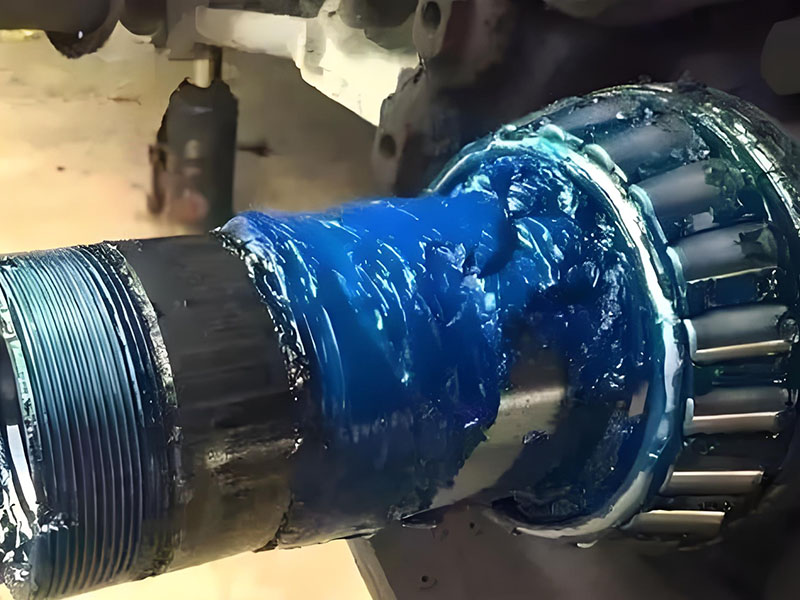
For grease-lubricated bearings, cleaning involves removing old grease, inspecting for contamination (water, salt, debris), and reapplying fresh marine-grade grease such as BIOGREASE EP2. Self-lubricating bearings require only flushing with fresh water to remove abrasive particles.
When should rudder bearings be replaced?
Replacement is necessary when any of the following signs appear:
- Rudder looseness or play – Excessive radial or axial movement detected during steering or manual inspection.
- Noise during steering – Grinding, squeaking, or knocking sounds indicate advanced wear or misalignment.
- Exceeding rated lifespan – Even without visible symptoms, many operators replace bearings after 5–8 years in heavy service, or as per classification society guidelines.
Measurement methods
Quantitative inspection methods include:
- Clearance – Using feeler gauges or dial indicators. Typical maximum allowable radial clearance is approximately 1% of the rudder stock diameter. For a 200 mm stock, 2 mm clearance indicates replacement.
- Wear depth measurement – With ultrasonic thickness gauges or mechanical profilers.
- Visual inspection – Cracking, delamination, or scoring of the bearing surface.
How to replace rudder bearings
Replacement is typically performed during dry-docking. The standard procedure includes:
- Haul and block the vessel – Ensure stable support on dry dock or slipway.
- Disconnect the rudder stock – Remove the steering gear coupling and any hydraulic connections.
- Lower the rudder blade – Support the rudder with slings and lower it carefully.
- Extract the bearing – Use a hydraulic puller or press to remove the worn bearing from the housing.
- Clean and inspect the housing – Remove corrosion, measure housing bore for ovality or damage.
- Install the new bearing – Press or shrink-fit the new bearing into place, ensuring correct orientation.
- Reassemble and align the rudder – Reinstall the rudder blade, reconnect the stock, and verify alignment with feeler gauges.
Always refer to the bearing manufacturer’s installation instructions for interference fits and temperature guidelines.
Rudder bearing applications by vessel type
The table below summarizes typical rudder bearing types and key requirements for different vessel categories.
| Vessel type | Rudder bearing type | Key requirements |
| Merchant ships (cargo, container) | Sliding / composite | High wear resistance, long lifespan, extended maintenance intervals |
| Tankers / LNG vessels | Self-lubricating | Corrosion resistance, leak prevention, grease-free operation |
| Fishing / offshore vessels | Rolling / brass bearings | Compact structure, easy maintenance, quick replacement |
| Cruise ships / passenger vessels | High-precision composite | Quiet operation, shock resistance, safety redundancy |
| Naval / military vessels | High-strength composite | Fatigue resistance, high load capacity, high reliability |
| Tugboats / engineering vessels | Sliding / steel-bronze | Impact resistance, suitable for alternating speed operation |
| Yachts / sailboats | Small self-lubricating | Good waterproof sealing, lightweight, maintenance-free |
| Ro-Ro / car carriers | Rolling / sliding | Durable under heavy load, withstands static pressure |
Frequently asked questions
1. What causes rudder bearing failure?
Poor lubrication, water ingress, misalignment, material fatigue, and lack of maintenance are the most common causes.
2. Can rudder bearings operate without grease?
Yes. Materials such as Thordon SXL or PETP support completely grease-free operation using water lubrication or inherent low-friction properties.
3. What’s the difference between upper and lower rudder bearings?
The upper bearing handles shaft alignment and lighter radial loads, while the lower bearing supports the entire rudder weight and higher bending moments.
4. Are all rudder bearings self-aligning?
No. Only spherical or elastomeric types can accommodate misalignment between the rudder stock and housing.
5. What are the key requirements for rudder bearing installation?
Alignment accuracy (within 0.1 mm/m), proper clearance (as specified by manufacturer), surface roughness (Ra ≤ 0.8 μm for metal housings), and correct lubrication line connection for greased types.
6. What is the best grease for rudder bearings?
BIOGREASE EP2 and BIOGREASE EP0 are commonly specified. They offer excellent corrosion protection, water resistance, and load-carrying capacity.
7. What are the inspection and measurement methods for rudder bearings?
Clearance measurement (feeler gauges), visual inspection, wear depth measurement (ultrasonic), and lubricating oil analysis for grease-lubricated systems.
8. What certifications are required for rudder bearings?
Major classification societies including ABS, DNV, Lloyd’s Register, and CCS provide type approval for rudder bearings used in classed vessels. Always verify certification requirements with your flag state and insurer.
Conclusion
Rudder bearings are essential for safe and efficient steering. Proper material selection — based on vessel type, operating environment, and load conditions — directly affects maintenance intervals and service life. Regular cleaning and lubrication every 6 to 12 months, combined with periodic clearance and wear measurements, help avoid unexpected failures. Replacement should be carried out when looseness, noise, or excessive wear exceeds manufacturer limits. By following the guidelines in this comprehensive guide, vessel operators and maintenance engineers can ensure reliable rudder bearing performance throughout the vessel’s service life.