Hearing a rhythmic clunking noise when you shift gears or a low-frequency vibration that gets worse as you accelerate can be alarming. These are often the first signs of a failing universal joint (u-joint). As a critical component of your vehicle’s drivetrain, a u-joint failure doesn’t just mean a breakdown; a catastrophic failure can damage the driveshaft, transmission, or differential, leaving you stranded with a hefty repair bill.
In this article, DUHUI will analyze the three most common reasons for U-Joint Failure: normal wear and tear, driveline misalignment, and loose connections. Understanding these causes is the first step toward ensuring your vehicle stays safe and reliable.
Reason #1: Normal Wear and Tear
The most common reason for u-joint replacement is simply old age. A u-joint is a mechanical bearing, and like all bearings, it has a finite lifespan.
Inside the u-joint, needle bearings roll between the trunnion (the cross) and the bearing cap. Over hundreds of thousands of revolutions, this constant friction causes metal fatigue. However, the real accelerator of wear is the failure of the seals that keep grease in and contaminants out. Once the seal fails, lubricant leaks out, and dirt, water, and road salt get in. This contamination grinds down the needle bearings and the trunnion surfaces.
Symptoms to Watch For:
- A squeaking noise when moving at low speeds in parking lots.
- Rust-colored dust or residue around the u-joint “ears” on the driveshaft.
- Play or clunking in the driveline when shifting from Drive to Reverse.
How to Prevent It:
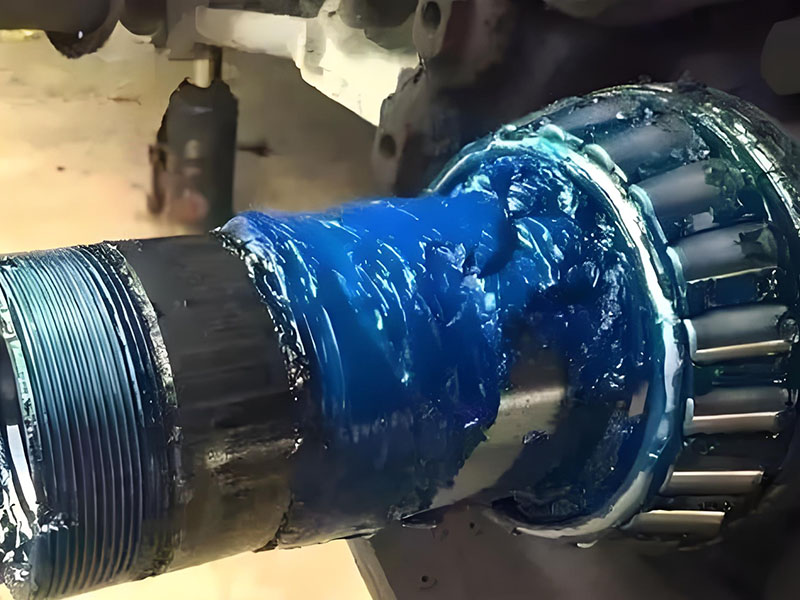
Prevention relies on proactive maintenance. If your u-joints have grease fittings (Zerk fittings), adhere to a strict lubrication schedule. Use a grease gun and pump until you see old, dirty grease purge out from all four bearing seals. This ensures the cavity is full of fresh lubricant, pushing out contaminants and delaying seal failure.
Reason #2: Driveline Misalignment
For a u-joint to operate smoothly, the driveshaft and the component it connects to (like the differential or transfer case) must be at specific, parallel angles. When these angles are off, the u-joint is forced to bind and release with every rotation, leading to rapid destruction.
Misalignment is usually caused by three factors:
- Suspension Modifications: Lifting or lowering a vehicle drastically changes the pinion angle of the differential.
- Accident Damage: A minor collision can bend suspension links or mounting points, altering the geometry.
- Installation Errors: Incorrectly installing a differential or engine/transmission mount can throw the angles out of spec.
When the working angle is too steep or mismatched, the needle bearings cannot roll properly; they slide and slam into the trunnion. This creates “Brinelling” (indentations) on the bearing surfaces, leading to a short, rough life for the component.
Symptoms to Watch For:
- A persistent, low-frequency vibration that is felt through the floorboard or seat.
- Vibration that changes with speed and throttle application (accelerate vs. coast).
- Premature failure of newly installed u-joints.
How to Prevent It:
Replacing the u-joint alone will not fix a misalignment issue. You must correct the geometry. This often involves using angled shims on the differential or adjusting control arms to ensure the transmission output shaft and the differential pinion are parallel. Always measure driveline angles with an angle finder after any suspension work.
Reason #3: Loose Connections
A u-joint is only as strong as the connection holding it to the driveshaft and differential pinion flange. The bearing caps are held in place by straps, U-bolts, or full-circle yokes. If these fasteners are loose, the u-joint cap will move, leading to immediate failure.
Loose connections typically happen due to:
- Improper Torque: The most common mistake is failing to use a torque wrench. Guessing the tightness often results in under-torqued bolts, which allows movement.
- Vibration Fatigue: Even correctly torqued bolts can loosen over time if there is an existing vibration in the driveline.
- Corrosion: Rust on the threads or under the bolt head can give a false torque reading, making you think the bolt is tight when it is not.
The constant micro-movement of a loose cap will oval out the bolt holes in the yoke (a process called “egging”) and hammer the bearing cap retaining grooves. This not only destroys the u-joint but also damages expensive driveshaft components.
How to Prevent It:
Always use a calibrated torque wrench when installing u-joints. Look up the specific torque spec for your vehicle’s strap bolts or U-bolts. Furthermore, inspect the threads on the bolts and in the yoke. If they are rusty or damaged, clean them or replace the hardware to ensure an accurate clamp load.
Conclusion
While U-Joint Failure can seem sudden, it is almost always the result of a predictable process—whether it’s the slow creep of normal wear, the destructive force of misalignment, or the preventable mistake of a loose connection. By recognizing the symptoms of vibration and clunking early, and by understanding the mechanical reasons behind the failure, you can save yourself from a breakdown.