Understanding Thrust Bearings in Mechanical Systems
In rotating machinery, forces act in multiple directions. While radial loads perpendicular to the shaft axis are common, many applications also generate significant axial forces—loads directed parallel to the shaft. These axial forces must be managed effectively to maintain proper component positioning, prevent damaging contact between rotating and stationary parts, and ensure reliable long-term operation.
Single direction thrust ball bearings represent a specialized engineering solution designed specifically to accommodate axial loads in one direction. Unlike general-purpose bearings that may handle thrust as a secondary function, these components are optimized for pure axial loading, offering distinct advantages in friction, speed capability, and design simplicity.
DUHUI provides a comprehensive technical overview of single direction thrust ball bearings, including their design principles, performance characteristics, selection criteria, installation requirements, and maintenance considerations. The information presented is intended to assist engineers, designers, and maintenance professionals in understanding and applying these components effectively.
Fundamentals of Axial Load Management
What Are Axial Loads?
Axial loads, also referred to as thrust loads, are forces applied parallel to the axis of rotation. Common examples include:
- The thrust generated by helical gears in transmissions
- Impeller forces in centrifugal pumps
- Clamping forces in machine tool spindles
- Weight components in vertical shafts
- Forces from worm gear drives
- Propeller thrust in marine applications
These loads must be supported by a bearing surface capable of withstanding continuous or cyclic forces while allowing relative motion with minimal resistance.
Why Specialized Bearings Are Needed
General-purpose bearings such as deep groove ball bearings can accommodate limited axial loads in addition to their primary radial function. However, when applications involve:
- Predominantly axial loading
- High magnitude thrust forces
- Requirements for minimal axial play
- High-speed operation under thrust
Dedicated thrust bearings become necessary. Attempting to use radial bearings for significant axial loads can lead to premature failure, excessive friction, and inadequate system performance.
Classification of Thrust Bearings
Thrust bearings are broadly classified by the type of rolling element and their load direction capability:
| Bearing Type | Rolling Element | Load Direction | Typical Applications |
| Thrust Ball Bearings | Balls | Single or double direction | Moderate loads, higher speeds |
| Cylindrical Roller Thrust Bearings | Cylindrical rollers | Single direction | Heavy loads, lower speeds |
| Tapered Roller Thrust Bearings | Tapered rollers | Single direction | Combined loads, heavy duty |
| Spherical Roller Thrust Bearings | Spherical rollers | Single direction | Heavy loads, misalignment |
| Fluid Film Thrust Bearings | No rolling elements | Single or double direction | Extreme loads, special applications |
Single direction thrust ball bearings occupy the niche requiring moderate to high load capacity, good speed capability, low friction, and compact axial space.
Design and Construction of Single Direction Thrust Ball Bearings
Basic Components
A single direction thrust ball bearing consists of three primary components:
Shaft Washer:
The shaft washer features a precision-ground raceway on one face and a cylindrical bore for mounting on the shaft. Its back face is flat and perpendicular to the bore, designed to seat against a shaft shoulder or locating element. The raceway contains a groove that guides the balls and distributes load.
Housing Washer:
The housing washer similarly has a precision-ground raceway but features an outer cylindrical surface for location in the housing. Its flat back face seats against a supporting surface in the housing structure.
Ball and Cage Assembly:
Between the washers, a complement of precision balls rolls within the raceways. The cage maintains uniform ball spacing, prevents ball-to-ball contact, guides the balls through the load zone, and helps retain lubricant.
Operating Principle
The fundamental operating principle is the conversion of sliding friction to rolling friction. When axial load is applied:
- The load transfers from the rotating shaft to the shaft washer
- The shaft washer transmits force through the balls rolling in the raceways
- The balls transfer the load to the housing washer
- The housing washer passes the load to the supporting structure
Throughout this process, the rolling action of the balls accommodates rotation with minimal frictional resistance, typically an order of magnitude lower than comparably sized sliding bearings.
Key Design Characteristics
Unidirectional Load Capacity:
These bearings are designed to accommodate axial loads in one direction only. The raceway geometry is optimized for loads applied in that specific direction, with the load-bearing raceway typically featuring a deeper groove. For loads in the opposite direction, either:
- A second single direction bearing must be installed opposing the first
- A double direction thrust ball bearing may be used
- An alternative bearing arrangement must be designed
Separable Construction:
The three components—shaft washer, housing washer, and ball assembly—are separable. This feature offers significant practical advantages:
- Independent mounting of washers on shaft and in housing
- Simplified assembly in confined spaces
- Easier inspection and cleaning during maintenance
- Reduced risk of damage during installation
Load Transmission Mechanism:
Under load, the balls contact the raceways at an angle determined by the raceway curvature. This contact geometry creates a stress distribution that must be managed through proper material selection, heat treatment, and surface finish. The load capacity depends on:
- Number and size of balls
- Raceway curvature and conformity
- Material properties
- Lubrication conditions
Standard Configurations and Variations
Single direction thrust ball bearings are available in several standard configurations:
Flat Raceway Design:
The most common configuration, featuring flat washers with grooved raceways. Suitable for most general applications.
Aligning Seat Design:
Includes a spherical seating surface on the housing washer to accommodate minor misalignment between shaft and housing.
With Mounting Accessories:
Some series are designed for use with special washers, sleeves, or other mounting components for specific applications.
Technical Specifications and Performance Characteristics
Load Ratings
Static Load Rating (C0a):
The maximum load a non-rotating bearing can withstand without causing permanent deformation that would impair subsequent operation. Expressed in Newtons or pounds.
Dynamic Load Rating (Ca):
The constant stationary radial load that a rotating bearing can theoretically endure for one million revolutions without material fatigue. Based on standardized calculation methods (ISO 281).
Factors affecting load capacity:
- Ball diameter and number
- Raceway conformity (closeness of fit between ball and raceway)
- Material hardness and cleanliness
- Lubrication film thickness
Speed Capabilities
Permissible operating speeds for thrust ball bearings are influenced by:
- Bearing Size: Larger bearings generate higher centrifugal forces and require more lubrication
- Cage Design and Material: Machined brass cages typically allow higher speeds than stamped steel; polymer cages offer good speed capability with lower inertia
- Lubrication Method: Oil lubrication generally permits higher speeds than grease; oil mist or jet lubrication enables the highest speeds
- Load Magnitude: Higher loads increase contact stress and heat generation, limiting speed
- Cooling: External cooling may be necessary for high-speed, high-load applications
Speed limits are typically expressed as limiting speeds in manufacturer catalogs, based on standardized testing conditions.
Friction and Torque Characteristics
Thrust ball bearings exhibit relatively low friction compared to sliding alternatives. Friction torque depends on:
- Load: Friction increases with applied load
- Speed: Friction varies with speed, typically decreasing slightly then increasing
- Lubricant Viscosity: Higher viscosity increases fluid friction
- Lubricant Quantity: Over-lubrication increases churning losses
- Seal Friction: If seals are present, their contribution must be considered
Typical coefficients of friction for thrust ball bearings range from 0.001 to 0.003 under optimal conditions.
Temperature Operating Range
Operating temperature limits are determined primarily by:
Material Properties: Standard bearing steels maintain hardness up to approximately 150°C (300°F); special materials extend this range
Lubricant Capability: Grease and oil have upper temperature limits; beyond these, degradation accelerates
Cage Materials: Polymer cages have lower temperature limits than metal cages
Dimensional Stability: Heat treatment affects the temperature at which dimensional changes occur
Standard bearings typically operate from -20°C to +120°C, with special designs extending to -50°C to +250°C or beyond.
Precision Grades and Tolerances
Thrust ball bearings are manufactured to standardized precision classes:
ISO/ABEC Grades: ABEC 1 (normal), ABEC 3, ABEC 5, ABEC 7, ABEC 9 (increasing precision)
Critical tolerances include:
- Bore and outer diameter tolerances
- Raceway runout
- Washer thickness variation
- Parallelism of faces
- Surface finish requirements
Higher precision grades are specified when applications demand:
- Minimal runout
- High-speed operation
- Low vibration and noise
- Precise positioning
Materials and Manufacturing Considerations
Bearing Steels
High-Carbon Chromium Steel (e.g., 100Cr6 / AISI 52100 / GCr15):
The most common material for thrust ball bearings, offering:
- Excellent hardness after heat treatment (58-65 HRC)
- Good wear resistance
- High fatigue strength
- Moderate corrosion resistance
Case-Hardening Steels (e.g., 20CrMnTi):
Used when:
- Surface hardness with tough core is required
- Impact loads are present
- Larger bearing sizes benefit from through-hardening limitations
Stainless Steels (e.g., AISI 440C):
Selected for:
- Corrosion resistance in moist or chemically aggressive environments
- Applications requiring minimal lubricant
- Food processing or medical equipment
High-Temperature Steels (e.g., tool steels, M50):
For operating temperatures exceeding standard steel capabilities.
Heat Treatment Processes
Through Hardening:
The entire component is hardened to achieve uniform properties. Standard for most thrust ball bearing washers.
Case Hardening:
A hard surface layer is created while maintaining a tougher core. Used for larger bearings or impact-prone applications.
Tempering:
Following hardening, tempering relieves internal stresses and achieves final hardness. Temper temperature affects the balance between hardness and toughness.
Stabilization Treatment:
Additional thermal processing to ensure dimensional stability over time, important for precision grades.
Cage Materials
Steel Cages (Stamped or Machined):
- Good strength and durability
- Temperature resistant
- Compatible with most lubricants
- Stamped versions economical for volume production
- Machined versions for higher precision and speed
Brass Cages (Machined):
- Excellent wear properties
- Good strength
- Superior speed capability
- Higher cost
- Used in high-performance applications
Polymer Cages (Injection Molded):
- Lightweight (lower inertia)
- Good strength-to-weight ratio
- Excellent wear characteristics
- Quiet operation
- Chemical resistance
- Temperature limited (typically to 120°C)
- Used increasingly in modern designs
Surface Finish and Geometric Accuracy
Raceway Surface Finish:
Typically 0.1 μm Ra or better for precision bearings. Smooth surfaces:
- Promote full film lubrication
- Reduce friction
- Extend fatigue life
- Minimize noise
Geometric Accuracy:
- Raceway roundness and concentricity
- Washer flatness and parallelism
- Ball sphericity and size consistency
These parameters are controlled through precision grinding and lapping operations.
Selection Criteria for Engineering Applications
Load Analysis
Determine Load Magnitude:
Calculate the maximum axial force expected during operation, including:
- Steady-state operating loads
- Starting and stopping loads
- Peak or impact loads
- Vibration-induced loads
Consider Load Direction:
Confirm that loads are consistently in one direction. If loads reverse, consider:
- Two single direction bearings opposed
- A double direction thrust bearing
- Alternative bearing types capable of bidirectional thrust
Load Spectrum:
For variable loads, develop a load spectrum for life calculations rather than using maximum load alone.
Speed Requirements
- Compare required operating speed with bearing limiting speed
- Consider whether speed is constant or variable
- Evaluate starting and stopping frequency
- Assess need for special cage designs at higher speeds
- Determine lubrication method based on speed
Space Constraints
Axial Space:
Thrust ball bearings require axial space for the washers and ball assembly. The overall bearing height is a key dimension.
Radial Space:
The bearing envelope (bore and outside diameter) must fit within available radial space.
Mounting Features:
Consider space required for:
- Shoulders or retaining rings
- Lubrication fittings
- Sealing arrangements
- Assembly access
Environmental Factors
Temperature:
Select materials and lubricants compatible with operating temperature range, including:
- Ambient temperature
- Heat generated by bearing operation
- Heat from adjacent components
- Temperature cycling effects
Contamination:
Evaluate exposure to:
- Solid particles (dust, debris)
- Moisture and liquids
- Process fluids
- Abrasive materials
Consider sealing solutions or bearing with integral seals if contamination risk exists.
Corrosion:
Assess chemical environment:
- Humidity and condensation
- Salt spray
- Acids or alkalis
- Cleaning agents
Select stainless steel or coated bearings when corrosion risk is significant.
Lubrication Conditions
Lubrication Type:
- Grease lubrication: Simpler, suitable for many applications, requires relubrication intervals
- Oil lubrication: Better for high speeds, heat dissipation, may require circulation systems
Relubrication Capability:
- Can the bearing be relubricated in service?
- Are lubrication passages available in the design?
- What is the expected maintenance interval?
Initial Lubrication:
Bearings may be supplied:
- Unlubricated (for customer to lubricate)
- Preserved with rust preventative (to be removed before lubrication)
- Pre-greased (ready for installation)
Life and Reliability Targets
L10 Life Calculation:
Based on ISO 281, the basic rating life (L10) is the life that 90% of a group of apparently identical bearings will achieve or exceed.
Adjusted Life:
For modern bearings, adjusted life calculations incorporate:
- Reliability factors (beyond 90%)
- Material factors (cleanliness, processing)
- Operating condition factors (load, lubrication)
- Contamination factors
Target Life:
Select bearing size and type to achieve the required L10 life for the application, typically 10,000 to 100,000 hours depending on industry and application criticality.
Comparison with Alternative Bearing Types
Single Direction vs. Double Direction Thrust Ball Bearings
| Characteristic | Single Direction | Double Direction |
| Load Direction | One direction only | Both directions |
| Construction | Two washers + ball set | Three washers + two ball sets |
| Axial Space | More compact | Requires more axial space |
| Complexity | Simpler | More complex assembly |
| Typical Use | Pure unidirectional thrust | Reversing thrust applications |
Thrust Ball Bearings vs. Cylindrical Roller Thrust Bearings
| Characteristic | Thrust Ball Bearing | Cylindrical Roller Thrust Bearing |
| Load Capacity | Moderate | Higher (line contact) |
| Speed Capability | Higher | Lower |
| Friction | Lower | Higher |
| Axial Space | Compact | Similar |
| Misalignment Tolerance | Poor | Poor |
| Typical Applications | Moderate loads, higher speeds | Heavy loads, lower speeds |
Thrust Ball Bearings vs. Tapered Roller Bearings
| Characteristic | Thrust Ball Bearing | Tapered Roller Bearing |
| Load Direction | Pure axial only | Combined radial and axial |
| Friction | Lower | Higher |
| Speed Capability | Higher | Moderate |
| Adjustment | Simple preload | Requires careful setting |
| Cost | Lower | Higher |
| Typical Applications | Pure thrust applications | Combined load applications |
Thrust Ball Bearings vs. Angular Contact Ball Bearings (Paired)
| Characteristic | Single Direction Thrust Ball Bearing | Paired Angular Contact Bearings |
| Load Direction | Single direction only | Can handle both directions (when paired) |
| Radial Capacity | None | Good |
| Speed Capability | Good | Excellent |
| Axial Space | Compact | Requires more axial space |
| Radial Space | Moderate | Compact |
| Cost | Lower | Higher |
| Typical Applications | Pure thrust, moderate speeds | High-speed combined loads |
Installation Best Practices
Handling and Storage
Storage Requirements:
- Bearings should remain in original packaging until installation
- Storage environment should be clean, dry, and temperature-stable
- Avoid vibration during storage (can cause false brinelling)
- Observe shelf life for pre-greased bearings
Handling Precautions:
- Handle bearings with clean, dry hands or clean gloves
- Use clean, lint-free materials
- Avoid impact or dropping
- Keep bearings covered when not being installed
Shaft and Housing Fits
Shaft Fit Recommendations:
| Condition | Shaft Fit |
| Rotating shaft load | Tighter fit (j6, k6, m6) |
| Stationary shaft load | Looser fit (g6, h6) |
| Light loads | Looser fits |
| Heavy or shock loads | Tighter fits |
Housing Fit Recommendations:
| Condition | Housing Fit |
| Rotating housing load | Tighter fit (J7, K7, M7) |
| Stationary housing load | Looser fit (H7, H8) |
| Thin-walled housing | Lighter fits |
Surface Finish Requirements:
- Shaft and housing surfaces should be smooth (Ra 0.8-1.6 μm typically)
- Sharp corners should be relieved with undercuts or radii
- Shoulders must be square and true
Mounting Procedures
Preparation:
- Clean shaft and housing thoroughly
- Inspect for burrs, damage, or contamination
- Apply light oil film to mounting surfaces if specified
Mounting Sequence for Separable Bearings:
- Mount shaft washer on shaft
- Mount housing washer in housing
- Insert ball and cage assembly between washers
- Verify correct orientation (raceways facing each other)
- Assemble housing to shaft
Mounting Force Application:
- Apply mounting force only to the ring being mounted
- Never apply force through rolling elements
- Use appropriate mounting tools (sleeves, presses)
- For tight fits, use controlled heating of housing or cooling of shaft
Preload and Clearance Adjustment
When Preload is Applied:
- To eliminate clearance for precise positioning
- To increase stiffness
- To prevent skidding at light loads
Preload Methods:
- Spring preload (constant force, accommodates thermal expansion)
- Fixed preload (using spacers or adjustments)
- Measured preload (using shims or adjustable nuts)
Clearance Considerations:
Operating clearance differs from mounted clearance due to:
- Interference fit expansion/contraction
- Thermal expansion differences
- Load-induced deflection
Common Installation Errors and Their Consequences
| Error | Consequence |
| Incorrect washer orientation | No load capacity, rapid failure |
| Contamination during installation | Abrasive wear, premature failure |
| Misalignment | Uneven loading, reduced life |
| Excessive mounting force | Brinelling, raceway damage |
| Improper lubrication | Early failure, overheating |
| Overtightening locknuts | Excessive preload, overheating |
| Loose fits | Fretting, vibration, noise |
Lubrication Requirements
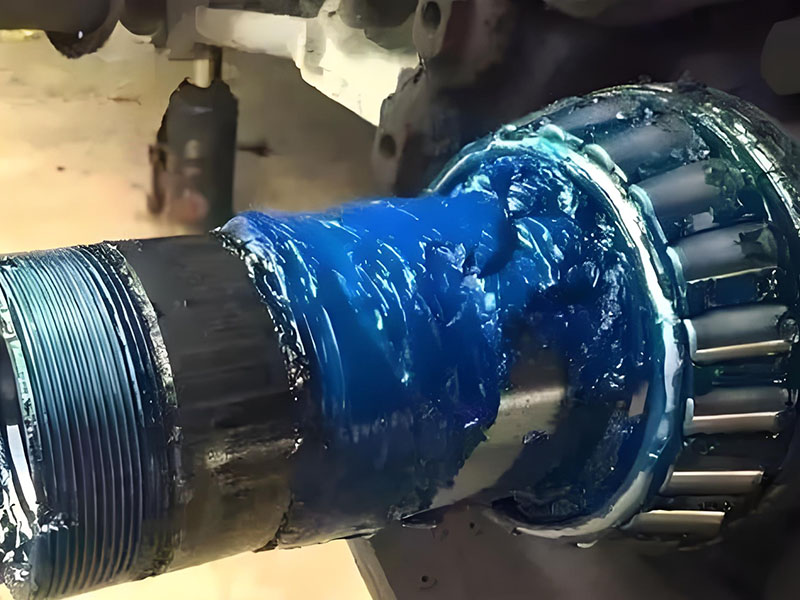
Functions of Lubrication in Thrust Bearings
Lubrication serves multiple critical functions:
- Separates rolling elements from raceways (prevents metal-to-metal contact)
- Reduces friction and wear
- Protects against corrosion
- Dissipates heat (particularly with oil circulation)
- Removes contaminants (with circulating oil systems)
- Provides damping (reduces noise and vibration)
Grease Lubrication
Grease Selection Criteria:
- Base Oil Viscosity: Matched to operating speed and load
- Thickener Type: Lithium, calcium, polyurea, etc., affecting temperature range and water resistance
- Additives: Anti-wear, extreme pressure, corrosion inhibitors
- Consistency (NLGI Grade): Typically #2 for most bearings
Relubrication Intervals:
Relubrication frequency depends on:
- Operating hours
- Temperature
- Contamination exposure
- Bearing size
General guidelines: 3-12 months for moderate conditions; more frequent
for severe conditions
Grease Quantity:
- Initial fill: 30-50% of free space
- Relubrication amount: Small quantities at frequent intervals preferred over large amounts infrequently
Oil Lubrication
Oil Selection:
- Viscosity: ISO VG 32-100 typical for most applications
- Higher viscosity: Heavier loads, lower speeds, higher temperatures
- Lower viscosity: Higher speeds, lower temperatures
- Additives: As required for application
Oil Delivery Methods:
| Method | Description | Typical Application |
| Oil Bath | Housing partially filled with oil | Lower speeds |
| Oil Circulation | Pumped system with cooling/filtration | Higher speeds, heat dissipation |
| Oil Mist | Atomized oil in air stream | Very high speeds |
| Oil Jet | Directed stream at bearing | Extreme speeds and loads |
Oil Level and Flow:
- Oil bath: Level should reach lowest rolling element at rest
- Circulation: Flow rate sufficient for heat removal
Special Lubrication Considerations
High Temperature:
- Synthetic oils (PAO, esters, silicones)
- Special thickeners for grease
- More frequent relubrication
Low Temperature:
- Low-viscosity synthetic oils
- Soft greases with low base oil viscosity
- Ensure lubricant doesn’t solidify at minimum temperature
Food Grade:
- USDA H1 or H2 rated lubricants
- Base oils and thickeners approved for incidental food contact
- Regular verification of lubricant condition
Extended Life:
- High-quality synthetic oils
- Careful contamination control
- Condition monitoring to optimize intervals
Maintenance and Failure Analysis
Routine Inspection Procedures
Visual Inspection:
- Check for lubricant leakage or discoloration
- Look for signs of corrosion or contamination
- Inspect seals for damage
Operational Monitoring:
- Temperature trends (sudden increases indicate problems)
- Vibration levels (changes may indicate damage)
- Noise characteristics (grinding, clicking, roughness)
- Power consumption (increases indicate friction rise)
Periodic Maintenance:
- Sample and analyze lubricant
- Check and restore correct lubricant level
- Clean external surfaces and cooling passages
- Verify mounting bolt torque
Signs of Normal Wear vs. Abnormal Deterioration
Normal Wear Characteristics:
- Smooth, polished appearance on raceways
- Uniform color and finish
- Gradual change in operating parameters
- Predictable life based on L10 calculations
Abnormal Deterioration Indicators:
- Rough or uneven wear patterns
- Discoloration (heat damage)
- Pitting or spalling
- Brinell marks (indentations)
- Cage damage
- Unusual noise or vibration
Common Failure Modes
Fatigue Spalling:
Appearance: Flaking or pitting of raceway surfaces
Cause: Normal fatigue after prolonged operation
Prevention: Correct bearing selection, proper lubrication, contamination control
Abrasive Wear:
Appearance: Matted or worn surfaces, dimensional changes
Cause: Hard particles in lubricant or environment
Prevention: Effective sealing, clean lubricant, clean handling
Corrosion:
Appearance: Rust stains, pitting, etching
Cause: Moisture or chemical attack
Prevention: Corrosion-resistant materials, effective sealing, appropriate lubricant
Skidding Damage:
Appearance: Smearing or scratching on raceways
Cause: Insufficient load to maintain rolling contact, excessive acceleration
Prevention: Proper preload, correct application design
Cage Failure:
Appearance: Cracked, broken, or deformed cage
Cause: High acceleration, vibration, improper handling, lubrication failure
Prevention: Appropriate cage design for application, gentle handling, proper lubrication
Brinelling (True):
Appearance: Permanent indentations at ball spacing
Cause: Impact or excessive static load
Prevention: Careful handling, avoid shock loads
False Brinelling:
Appearance: Elliptical wear marks at ball spacing
Cause: Vibration when stationary (during transport or idle periods)
Prevention: Rotate bearings periodically during storage, isolate from vibration
Root Cause Analysis
When failures occur, systematic investigation should address:
Operating Conditions:
- Were loads within design limits?
- Was speed appropriate?
- Was temperature normal?
Lubrication:
- Correct lubricant type and quantity?
- Proper relubrication interval?
- Contamination of lubricant?
Installation:
- Correct mounting procedure?
- Proper fits and clearances?
- Alignment verified?
Environmental:
- Unexpected contamination?
- Chemical exposure?
- Temperature excursions?
Application Design:
- Bearing correctly selected?
- Adjacent components functioning properly?
- System dynamics as expected?
Industry Standards and Specifications
ISO Dimensional and Tolerance Standards
ISO 104:
Rolling bearings — Thrust bearings — Boundary dimensions, general plan
ISO 113:
Rolling bearings — Thrust bearings — Tolerances
ISO 582:
Rolling bearings — Chamfer dimensions — Maximum values
ISO 15243:
Rolling bearings — Damage and failures — Terms, characteristics and causes
ABEC/ISO Precision Classes
| ISO Class | ABEC Equivalent | Application |
| Class 0 (Normal) | ABEC 1 | General applications |
| Class 6 | ABEC 3 | Improved precision |
| Class 5 | ABEC 5 | Precision applications |
| Class 4 | ABEC 7 | High precision |
| Class 2 | ABEC 9 | Ultra-precision |
Material Standards
ISO 683-17:
Heat-treated steels, alloy steels and free-cutting steels — Part 17: Ball and roller bearing steels
ASTM A295:
Standard Specification for High-Carbon Anti-Friction Bearing Steel
ASTM A756:
Standard Specification for Stainless Anti-Friction Bearing Steel
Conclusion
Single direction thrust ball bearings represent a mature and well-understood technology for managing axial loads in rotating machinery. Their design—featuring separable components, rolling element operation, and unidirectional capacity—provides engineers with a reliable solution for applications requiring:
- Efficient handling of significant axial forces
- Low friction operation
- Good speed capability
- Compact axial packaging
- Simplified installation and maintenance
Successful application of these bearings requires careful attention to:
- Selection: Proper analysis of loads, speeds, environmental conditions, and life requirements ensures the bearing is matched to the application.
- Installation: Correct handling, mounting, and preload adjustment prevent premature failures and optimize performance.
- Lubrication: Appropriate lubricant selection and maintenance intervals are essential for achieving rated life.
- Maintenance: Regular inspection and condition monitoring identify potential issues before they lead to failure.