Securing a rotating shaft precisely within a machine is a fundamental engineering challenge. Traditional methods often require complex machining, like creating shoulders in housings or adding snap ring grooves. However, there is a component engineered to simplify this task significantly: the flanged bearing.
DUHUI will provide a comprehensive overview of flanged bearings, exploring their types, key features, and critical applications to help you make an informed decision for your next project.
What is a Flanged Bearing? Understanding the Basics
Before diving into the various types, it’s essential to understand what makes a bearing “flanged” and why that flange is so important.
Core Definition
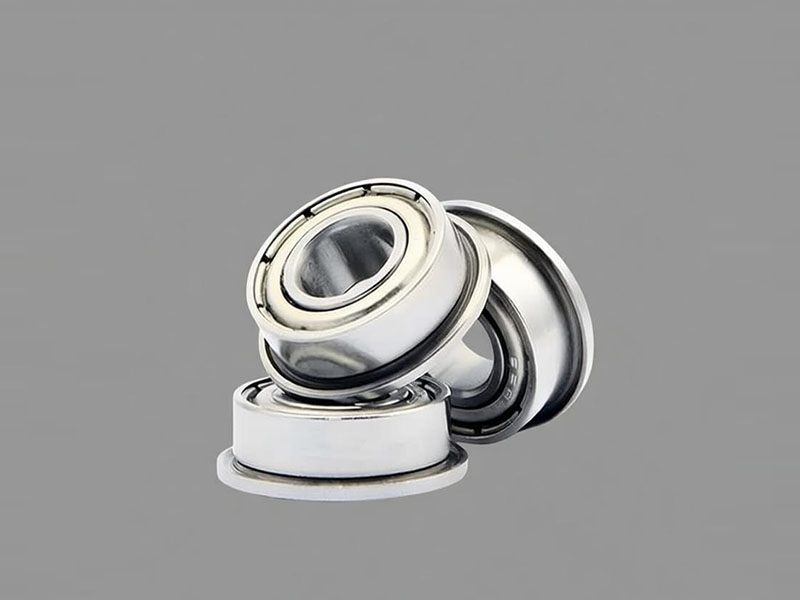
A flanged bearing is a rolling-element bearing that integrates a flange—a lip or extension—on its outer ring . This seemingly small addition transforms the bearing from a simple component into a multifunctional mounting solution. It is also commonly referred to as a “flanged mounted bearing” when pre-assembled in a housing .
The Purpose of the Flange
The flange serves several critical functions:
- Axial Positioning and Location: The primary role of the flange is to act as a positive stop, locating the bearing precisely within a housing. It prevents the bearing from moving axially along the shaft, ensuring components remain in their correct position .
- Withstanding Axial Thrust: By locking the bearing in place, the flange allows the bearing to absorb and transfer axial thrust loads—forces that are parallel to the shaft .
- Simplified Installation: The flange eliminates the need for additional locating features like shoulders, snap rings, or spacers. This simplifies the design of the housing and makes installation quicker and more foolproof .
Exploring the Different Types of Flanged Bearings
Flanged bearings are not a one-size-fits-all solution. They come in various configurations, each designed for specific motion control needs.
Flanged Ball Bearings (Radial)
This is the most common type, typically a deep-groove ball bearing with an integral flange on the outer ring.
- Open: No shields or seals, allowing for maximum speed and easy re-lubrication, best suited for clean environments .
- Shielded (ZZ): Features metal shields on one or both sides to protect against large debris while allowing some airflow, common in electric motors .
- Sealed (RS): Equipped with rubber or synthetic seals for complete protection against contaminants and to retain lubrication, ideal for harsh or maintenance-free applications .
- Material Variations: While standard in chrome steel, they are also available in stainless steel for corrosion resistance and ceramic hybrid versions for high-speed, high-temperature applications .
Flanged Mounted Units (Insert Bearings)
These units consist of a bearing (often called an “insert bearing”) pre-assembled into a flanged housing. The housing provides the flange and mounting holes .
- Two-Bolt Flange: Diamond-shaped with two mounting holes, ideal for light to medium-duty applications where space is limited .
- Three-Bolt Flange: Offers a more secure, triangular mounting pattern, often used in ducting or applications where extra stability is needed .
- Four-Bolt Flange: Typically round or square, providing the most robust and rigid support for heavy-duty applications like large conveyors . Many of these units feature self-aligning inserts that can compensate for minor shaft misalignments .
Flanged Linear Ball Bearings
Designed for linear motion, these bearings (also known as ball bushings) allow components to slide smoothly along a round shaft. The flange on the bearing’s outer housing simplifies mounting to machine surfaces, such as in robotics, industrial printers, and laboratory equipment .
Flanged Wheel Hub Bearings
These are specialized, heavy-duty bearings used in automotive applications. They integrate a flange that allows the entire wheel hub assembly to be bolted directly to the vehicle’s suspension, supporting the immense weight and variable loads of a moving vehicle .
Specialized Types
For niche applications, you can find flanged full-complement roller bearings (for maximum load capacity in a small space) and precision thin-section flanged bearings used in aerospace and medical devices where weight and space are at a premium .
Key Features and Performance Characteristics
Selecting the right bearing requires understanding its performance limits.
Material Diversity and Selection
The bearing material dictates its strength, weight, and environmental compatibility.
- Steel / Cast Iron: Standard for general industrial use, offering high strength and durability at a cost-effective price .
- Stainless Steel: Provides excellent resistance to moisture and mild chemicals, making it a top choice for food processing and medical equipment .
- Ceramics: Handle extreme temperatures and are corrosion-proof. Their low thermal expansion and high speed capability are critical for aerospace and high-precision machinery .
- Polymers (e.g., POM, Nylon): Lightweight, self-lubricating, and quiet, these are used in light-duty applications like office equipment and conveyors .
Load and Speed Ratings
Every bearing is designed to handle specific forces and rotational speeds. The basic dynamic load rating (C) helps calculate the bearing’s L10 life (the number of revolutions 90% of a bearing group will complete before failure) under a given load . Flanged mounted units are particularly good at supporting heavy loads due to their robust housings .
Sealing and Protection
Protecting the internal components from contamination is vital for bearing life.
- Open Bearings allow for easy maintenance but are vulnerable to debris .
- Shielded Bearings offer a good balance of protection and low friction for cleaner environments .
- Sealed Bearings provide the highest level of protection, locking lubricant in and contaminants out, making them essential for harsh or outdoor conditions .
Environmental Resistance: Temperature and Corrosion
Operating conditions heavily influence material choice. Standard steel bearings can rust in wet environments, while stainless steel or specialized coated bearings are required for chemical or marine settings . Similarly, high-temperature applications (like under-hood automotive components) demand materials with matched thermal expansion rates to prevent the bearing from loosening in its housing .
Primary Applications of Flanged Bearings Across Industries
The unique combination of easy mounting and axial support makes flanged bearings ubiquitous across many sectors.
- Industrial Machinery and Automotive: From conveyor systems and textile machines to automotive alternators and HVAC fan drives, flanged bearings provide reliable support and withstand vibration .
- Food Processing and Hygienic Applications: Stainless steel, sealed flanged bearings are ideal here. They can withstand frequent, high-pressure washdowns without corroding, ensuring hygiene and safety .
- Aerospace and Precision Equipment: In applications like gyros, flight control actuators, and instrumentation, super-precision flanged bearings offer the reliability, high-speed performance, and minimal friction required .
- Medical and Dental: The precision and smooth operation of small flanged bearings make them perfect for high-speed dental handpieces, surgical tools, and diagnostic imaging machines .
Advantages of Using Flanged Bearings
To summarize, why choose a flanged bearing?
- Ease of Installation: The built-in flange acts as a guide, dramatically reducing assembly time and complexity .
- Axial Load Handling: The flange provides a positive surface to withstand thrust loads, locking the bearing in place .
- Alignment Assistance: In mounted units, the flange helps maintain alignment and, with self-aligning inserts, can even tolerate minor mounting inaccuracies .
- Design Versatility: Available in countless configurations for rotary, linear, light-duty, and heavy-load applications.
- Durability: By simplifying mounting and often integrating superior seals, flanged bearings contribute to a longer, more reliable machine life.
Flanged Bearings vs. Other Bearing Types
Understanding how flanged bearings compare to alternatives clarifies their unique value.
| Feature | Flanged Ball Bearings | Standard Ball Bearings | Sleeve (Plain) Bearings |
| Mounting | Built-in flange simplifies installation and provides axial location . | Requires shoulders, snap rings, or press fits for axial location . | Requires separate thrust washers or complex housing designs for axial loads. |
| Alignment | Flange helps maintain squareness to the mounting surface . | More prone to misalignment during installation. | Sensitive to misalignment, which can cause edge loading and wear. |
| Protection | Flange can help seal the housing bore opening. | Requires additional housing features for sealing. | Relies entirely on housing design for sealing. |
| Application | Ideal for confined spaces and where easy assembly/disassembly is needed. | Suitable for general applications where axial location is handled separately. | Best for low-speed, high-load, or oscillating motions. |
Maintenance, Troubleshooting, and Lifespan
To get the most out of your flanged bearings, a proper maintenance regimen is essential.
Essential Maintenance Practices
- Proper Lubrication: Use the correct type and amount of lubricant for the operating conditions. Both over- and under-lubrication can cause failure .
- Cleanliness: Keep the bearing and its surroundings clean. Contamination is a leading cause of premature wear .
- Regular Inspection: Listen for abnormal noises (squealing, grinding), check for vibration, and visually inspect seals and for any signs of corrosion or damage
Common Problems and Solutions
- Noise (Squealing): Often indicates insufficient lubrication. Clean and re-lubricate as recommended .
- Overheating: Can be caused by over-lubrication, misalignment, or excessive speed/load.
- Lubricant Leakage: Usually a sign of over-lubrication or damaged seals. Check seal integrity and adjust lubrication cycles .
- Loose Mounting Bolts: Vibration can cause bolts to loosen. Regularly check and re-torque bolts to the manufacturer’s specification .
Factors Affecting Service Life
The L10 life of a bearing is directly impacted by load, speed, operating environment, and maintenance . A bearing operating under heavy load in a dirty environment with poor lubrication will fail far sooner than one in a clean, well-lubricated application.
How to Choose the Right Flanged Bearing for Your Application
Use this checklist to guide your selection process:
- Define the Load: What are the radial and axial (thrust) forces? For heavy loads, consider a four-bolt mounted unit or a full-complement roller type. For light loads, a simple flanged ball bearing may suffice .
- Determine the Speed: High-speed applications require precision bearings (like ceramic hybrids) with appropriate lubrication and cage designs .
- Assess the Environment: Will the bearing be exposed to moisture, chemicals, dust, or extreme temperatures? Choose materials (stainless steel, polymers) and seal types (RS) accordingly .
- Consider Mounting and Space: Is it a rotary or linear application? How much space is available? A two-bolt flange or a compact linear bearing might be the answer .
- Review Precision Needs: Does the application require minimal runout or high accuracy? If so, look for bearings with a high ABEC rating .
Conclusion
Flanged bearings are an elegant solution to the common engineering problem of mounting and locating a shaft. Their inherent design simplifies assembly, provides critical axial support, and offers versatility across a vast range of industries. By carefully considering the specific demands of your application—load, speed, environment, and space—you can select the optimal flanged bearing to ensure long-lasting, efficient, and reliable machinery.