Quick Answer — 5 Advantages of Cross Roller Bearings
- 3–4× higher stiffness than ball bearings (line contact vs. point contact)
- Sub-micron rotational accuracy — radial runout ≤0.005 mm at P5/P4
- One bearing handles radial, axial & moment loads — saves 30–40% axial space
- Split ring design simplifies installation & preload adjustment
- Proven in robotics, machine tools, medical & semiconductor equipment
When designing high‑precision rotary systems, engineers often face a common challenge: achieving high rigidity, exceptional rotational accuracy, and the ability to handle combined loads — all within a limited envelope. Standard ball bearings, while widely available, frequently struggle with simultaneous radial, axial, and tilting moment forces.
The cross roller bearing solves these problems in a single, compact component. Its unique orthogonal roller arrangement delivers performance advantages that have made it the preferred choice for demanding applications ranging from industrial robots to medical imaging systems.
What Are Cross Roller Bearings?
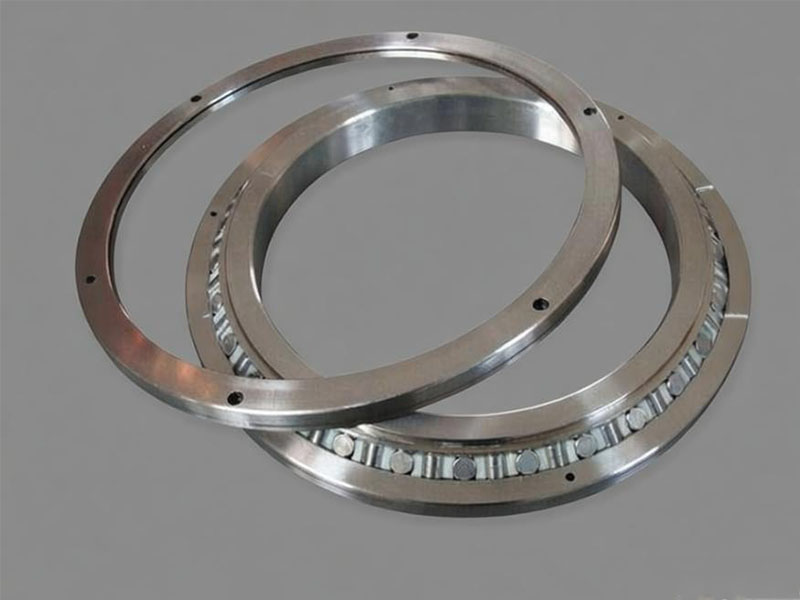
A cross roller bearing is a precision bearing that uses cylindrical rollers arranged perpendicularly to each other (at 90°) in alternating orientations. These rollers run in V‑shaped raceways, creating line contact instead of the point contact found in ball bearings.
This design allows a single cross roller bearing to simultaneously support:
- Radial loads (perpendicular to the shaft)
- Axial loads (from both directions)
- Tilting moment loads (overturning forces)
Traditionally, handling all three load types would require two or more separate bearings — for example, a pair of angular contact ball bearings mounted back‑to‑back. The cross roller bearing consolidates this functionality into one unit, saving space and reducing assembly complexity.
This fundamental design is the source of the five advantages listed below.
5 Reasons to Choose Cross Roller Bearings
1. 3–4× Higher System Rigidity Than Ball Bearings
Rigidity directly affects positioning accuracy, vibration suppression, and machining quality. Cross roller bearings achieve three to four times greater stiffness than equivalently sized ball bearings due to line‑contact geometry.
Quantified example: A typical P4 angular contact ball bearing with a 35 mm bore may offer axial stiffness of 150–200 N/µm under moderate preload. A cross roller bearing with similar cross‑sectional dimensions can exceed 600 N/µm.
This stiffness advantage translates into:
- Reduced deflection under alternating or shock loads
- Improved resistance to tilting moments in robot wrist joints
- Better chatter suppression in CNC rotary tables and milling spindles
For engineers designing high‑precision axes, this quantifiable stiffness difference often becomes the deciding factor.
2. Sub‑Micron Rotational Accuracy
The crossed roller arrangement inherently prevents two common sources of rotational error: roller skewing and sliding. As a result, cross roller bearings deliver radial runout as low as ≤0.005 mm at P5/P4 precision grades.
This level of accuracy is essential for:
- Coordinate measuring machines (CMMs)
- Optical inspection and semiconductor wafer handling systems
- Precision rotary tables for CNC machining centers
- CT scanner gantries and surgical robots
When rotational fidelity directly impacts measurement uncertainty or image reconstruction quality, cross roller bearings provide a clear and measurable advantage.
3. One Bearing Handles Radial, Axial, and Moment Loads – Saving 30–40% of Axial Space
A single cross roller bearing can replace a combination of two angular contact ball bearings mounted back‑to‑back, reducing the axial installation width by 30–40%.
Where this matters:
- Industrial robot arms — each millimeter saved allows higher payload or smaller servomotors
- Compact rotary tables — freed space accommodates larger workpieces or more powerful direct‑drive torque motors
- Medical imaging gantries — reduced bearing stack height enables more compact scanner designs
Additionally, cross roller bearings offer significantly higher tilting‑moment stiffness than four‑point contact ball bearings — often by 60% or more at identical envelope dimensions. For applications where overturning moments dominate, this performance gap is decisive.
4. Simplified Installation with Split Ring Design
Many cross roller bearings feature a split ring design — either the inner ring (RB series) or the outer ring (RE series) is divided into two halves. This is not a compromise; it is an engineered feature that simplifies installation and enables precise preload adjustment.
Benefits for your assembly process:
- Easier mounting onto stepped shafts or into confined housings
- Preload can be adjusted in the field using precision‑ground spacers
- No need for complex shimming or grinding as required with paired angular contact bearings
Proper preload eliminates backlash and optimizes the stiffness‑to‑friction trade‑off for your specific application — from low‑torque instrument axes to high‑rigidity machining spindles.
Installation tip: Always follow a 3‑step torque sequence (20% → 50% → 100% of final torque) in a cross pattern. For interference fits, heat the bearing to ≤80°C — never use an open flame.
5. Proven Performance in Mission‑Critical Industries
Cross roller bearings are the preferred choice for applications where failure is not an option. Their unique combination of stiffness, accuracy, and compactness has made them standard in:
| Industry | Typical Applications |
|---|---|
| Industrial Robotics | Joints, wrists, swivel units requiring combined load handling |
| Machine Tools | Rotary tables, indexing heads, tilting spindles for CNC machining |
| Medical Technology | CT gantries, X‑ray positioning, surgical robots |
| Semiconductor | Wafer handling robots, inspection stages |
| Precision Measurement | CMMs, optical comparators |
DUHUI supplies crossed‑roller bearings in RA, RB, RE, RU, and CRBH series — covering bore diameters from 20 mm to 800 mm. Our export track record includes deliveries to robotics integrators and machine tool builders across Europe, North America, and Southeast Asia.
Cross Roller Bearings vs. Other Bearing Types
The table below highlights the specific dimensions where cross roller bearings outperform common alternatives:
| Performance Dimension | Cross Roller Bearing | Angular Contact Ball Bearing (pair) | Four‑Point Contact Ball Bearing |
|---|---|---|---|
| System Rigidity | 3–4× baseline | Baseline (1×) | 1.2–1.5× |
| Rotational Accuracy (runout) | ≤0.005 mm (P5) | 0.008–0.015 mm | 0.008–0.020 mm |
| Combined Load Capacity | Excellent (radial + axial + moment) | Good (limited moment) | Moderate |
| Space Efficiency | Single bearing handles all loads | Requires two bearings + spacer | One bearing, lower stiffness |
| Installation | Split ring – simple preload adjustment | Complex – requires shimming | Moderate – fixed preload |
The engineering takeaway: When your design priorities are stiffness, accuracy, and compactness — cross roller bearings deliver superior performance across all three.
How to Select the Right Cross Roller Bearing for Your Application
Follow this systematic approach to ensure optimal selection:
Step 1: Define stiffness and accuracy needs
- General positioning (±0.02 mm) → P0/P5 class
- Precision positioning (<0.005 mm) → P4/P2 class
- High dynamic stiffness → specify negative internal clearance (preloaded)
Step 2: Calculate combined loads
- Document radial load (Fr), axial load (Fa), and tilting moment (M)
- Compare with manufacturer catalog ratings (Cr, C0r)
- Apply safety factor of 1.5–2.0 for dynamic applications
Step 3: Select series based on installation constraints
- RB series – split inner ring (easier shaft mounting)
- RE series – split outer ring (easier housing mounting)
- RU series – integrated mounting holes (no housing flange needed)
- CRBH series – ultra‑thin section (minimal radial space)
- RA series – basic thin section without mounting holes
Step 4: Confirm lubrication strategy
- Most cross roller bearings ship pre‑lubricated with lithium‑based grease
- Operating range: –20°C to +120°C
- Relubrication interval: 3–6 months under normal conditions
Frequently Asked Questions About Cross Roller Bearings
Q1: Is there a difference between “cross roller bearing” and “crossed roller bearing”?
A1: No. The two terms are used interchangeably in the industry. Both refer to bearings with cylindrical rollers arranged orthogonally.
Q2: How does cross roller bearing life compare to ball bearings?
A2: Under equivalent combined loads, cross roller bearings typically achieve longer L10 life due to line contact distributing stress over a larger area. Manufacturers can provide application‑specific life calculations per ISO 281.
Q3: Can a cross roller bearing replace an existing angular contact bearing pair?
A3: Yes — in most cases, a single cross roller bearing can directly replace a pair of angular contact bearings while reducing axial space by 30–40%. However, housing and shaft shoulders must be redesigned to accommodate the split ring geometry.
Q4: What precision grades are available?
A4: Cross roller bearings are available in P0, P5, P4, and P2 (ISO 492) classes. P4 and P2 are recommended for CNC rotary tables and semiconductor equipment.
Q5: What is the difference between RA, RB, RE, RU, and CRBH series?
A5: The series differ in ring splitting and mounting features:
– RA – solid ring, basic thin section
– RB – split inner ring (preload adjustable via spacer)
– RE – split outer ring (preload adjustable)
– RU – integrated inner/outer ring with mounting holes (no separate flange required)
– CRBH – ultra‑thin cross‑section for minimal radial envelope
Q6: How do I adjust preload on a split‑ring cross roller bearing?
A6: After mounting, measure the bearing’s running torque. If higher or lower than specification, the split‑ring spacer can be surface‑ground incrementally (each 0.005–0.010 mm reduction increases preload approximately 5–10%). Some manufacturers offer pre‑set assemblies to eliminate field adjustment.
Q7: What are the main failure modes to watch for?
A7: With proper installation and lubrication, cross roller bearings are highly reliable. In field service, the most common issues are loss of preload from fastener relaxation, raceway contamination during assembly, and lubricant degradation over time. Adhering to torque specifications and relubrication intervals prevents the vast majority of premature failures.
Conclusion
Cross roller bearings offer engineers a compelling value proposition: high stiffness (3–4× ball bearings), sub‑micron rotational accuracy, combined load handling in a single compact assembly, simplified installation, and proven reliability across critical industries. These five advantages explain why leading machine designers continue to specify cross roller bearings for their most demanding applications.
DUHUI Bearing provides a full range of standard cross roller bearing series — RA, RB, RE, RU, and CRBH — with precision grades up to P4. Our engineering team also offers custom modifications including special coatings, non‑standard dimensions, and preload‑set assemblies.