How do you determine the correct bearing for a machine, a gearbox, or a vehicle hub? Incorrect bearing selection often leads to premature failure, unplanned downtime, and increased maintenance costs. This seven‑step guide explains how to choose a bearing — covering load analysis, bearing type selection, speed limits, rigidity and runout, operating environment, lubrication, and fit verification.
Quick preview of the seven selection steps:
- Load analysis
- Bearing type by load
- Rotational speed check
- Rigidity and runout
- Operating environment
- Lubrication method
- Shaft and housing fits
First: Analyze Bearing Load and Load Capacity
Load analysis is the most critical step. Understanding the load helps define the required dynamic and static load ratings.
Load Type
- Radial load acts perpendicular to the shaft axis. Typical examples: electric motors, conveyor rollers.
- Axial load (thrust load) acts parallel to the shaft axis. Examples: vehicle wheel hubs during cornering, vertical shafts.
- Combined load includes both radial and axial components – the most common real-world scenario.
- Moment load occurs when the force acts at a distance from the bearing centerline, relevant in slew bearings and robotic joints.
Load Magnitude
Classify as light, medium, or heavy. Heavy loads generally require larger bearings or roller-type bearings.
Load Nature
- Constant load – stable during operation.
- Shock load – sudden impact peaks that may exceed normal loads.
- Vibratory load – cyclic forces common in vibrating screens, engines, compressors.
Load Ratings: Dynamic (C) and Static (Co)
- Dynamic load rating (C) – load at which a bearing achieves its rated L10 life under rotating conditions.
- Static load rating (Co) – maximum load a bearing can support while stationary without permanent deformation. Critical for shock loads and intermittent operation.
Second: Select Bearing Type by Load Characteristics
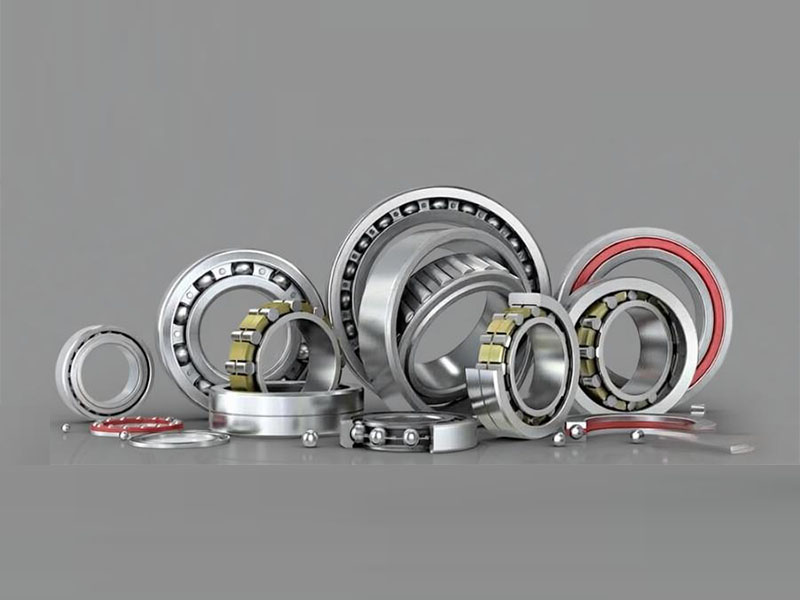
The fundamental distinction is between ball bearings and roller bearings.
Ball bearings (deep groove, angular contact) are suitable for:
- Light-to-medium loads
- Low-to-medium speeds
Roller bearings (cylindrical, tapered, spherical) are preferred for:
- Heavy loads
- Shock resistance
- Higher rigidity
For combined loads: Angular contact ball bearings and tapered roller bearings are optimal. For bi-directional axial loads, arrange two bearings back-to-back or face-to-face.
Third: Check Rotational Speed Requirements
Every bearing has a limiting speed – the maximum rotational speed at which the bearing can operate without excessive heat generation that degrades lubricant or bearing materials.
General guidelines:
- Ball bearings → higher speed capability
- Roller bearings → lower limiting speeds (line contact generates more friction)
- Caged bearings → higher speeds than full-complement bearings
- Ceramic hybrid bearings → higher speed limits than all-steel bearings
Factors that reduce permissible speed: heavy load, continuous operation, high ambient temperature, grease lubrication (compared to oil).
Fourth: Evaluate Rigidity and Runout
Rigidity refers to the bearing’s resistance to elastic deformation under load.
- Roller bearings have higher rigidity than ball bearings due to line contact.
- Preload increases rigidity but reduces permissible speed and increases heat.
Runout describes deviation from true rotation. High-precision applications (machine tool spindles, aerospace, measuring equipment) require low-runout bearings. ABEC/ISO precision classes define runout tolerances.
Fifth: Consider Operating Environment and Contamination
Environmental conditions significantly affect bearing selection and longevity.
| Condition | Consideration |
|---|---|
| Temperature extremes | May require special materials, lubricants, or internal clearance adjustments |
| Contaminants (dust, water, chemicals) | Effective sealing (sealed bearings or housing seals) |
| Corrosive environment | Stainless steel rings/balls, coatings, alternative cage materials |
| Vacuum or radiation | Solid lubrication (MoS₂, graphite) may be required |
Document the following: operating temperature range, contaminant type and level, required sealing level, corrosion resistance needs.
Sixth: Select Lubrication Method
Lubrication is critical to bearing life, temperature control, and speed capability. It separates rolling and sliding surfaces, protects against corrosion, and removes heat.
Grease lubrication – most common for general industrial applications. Advantages: cost-effective, simple, easy to retain.
Oil lubrication – required for high-speed applications where heat removal is critical. Types include circulating oil and oil-air mist.
Solid lubrication – used in vacuum, high-temperature furnaces, or radiation-exposed equipment (e.g., MoS₂ coatings).
Lubrication selection criteria:
- Speed: grease for most speeds; oil for highest speeds
- Load: heavy loads may require oil circulation for cooling
- Temperature: oil preferred at high temperatures; special greases for extremes
- Orientation: vertical shafts may have difficulty retaining grease
Establish a relubrication schedule based on bearing size, speed, temperature, and contamination level.
Seventh: Verify Shaft and Housing Fits
Proper fit directly affects bearing performance and life.
Internal clearance – the internal looseness within the bearing. Correct clearance selection accounts for:
- Interference fit reductions
- Thermal expansion differences
- Speed and preload requirements
Shaft and housing design should minimize distortion. Housing rigidity must be adequate; light alloy housings may require steel inserts. Follow manufacturer mounting specifications.
Selection Summary: Detailed Checklist
This detailed checklist provides a reliable method for how to choose a bearing for most industrial applications. Use it to verify your selection after following the seven steps above.
- Define load type (radial, axial, combined), magnitude, and nature
- Distinguish between dynamic (C) and static (Co) load requirements
- Select ball bearing for light-to-medium loads and moderate speeds, or roller bearing for heavy loads and shock resistance
- For combined loads, verify axial load capacity of the selected bearing type
- Confirm maximum application speed is below bearing limiting speed
- Verify rigidity and runout meet precision demands
- Document environmental conditions and select appropriate sealing or corrosion-resistant materials
- Choose lubrication method (grease, oil, or solid) and set relubrication interval
- Determine internal clearance and fit based on mounting and operating conditions
Frequently Asked Questions
Q1. What is the difference between radial load and axial load?
A1. Radial load acts perpendicular to the shaft axis; axial load acts parallel. Many applications involve combined loads.
Q2. How do I know if I need a ball bearing or a roller bearing?
A2. Ball bearings suit light-to-medium loads and lower-to-medium speeds. Roller bearings are for heavy loads, shock, and high rigidity.
Q3. What happens if I exceed a bearing’s limiting speed?
A3. Exceeding the limiting speed increases friction and heat, leading to lubricant breakdown, thermal expansion, and eventual seizure or failure.
Q4. Can I use grease lubrication for high-speed applications?
A4. Yes for moderate speeds. At very high speeds (generally above 10,000 RPM depending on bearing size), oil lubrication is better for heat removal.
Q5. How is bearing life calculated (L10 life)?
A5. L10 life is the number of revolutions that 90% of identical bearings achieve before fatigue failure. It depends on applied load relative to dynamic load rating.
Q6. What is bearing preload and why is it important?
A6. Preload is a constant axial load applied to remove internal clearance. It increases rigidity and accuracy but reduces speed and increases heat.
Q7. How often should bearings be relubricated?
A7. Relubrication intervals vary with size, speed, temperature, and environment. Manufacturer guidelines provide a starting point; field conditions may require adjustments.
Q8. What bearing precision class do I need (ABEC/ISO)?
A8. Standard industrial uses ABEC 1/P0 or ABEC 3/P6. High-precision applications (machine spindles, aerospace) need ABEC 5/P5, ABEC 7/P4, or higher.
Q9. Does cost affect bearing selection?
A9. Yes. In practice, cost and availability are also considered. Standard bearings are more economical and readily available; custom bearings may be justified when standard options cannot meet technical requirements. Always evaluate performance requirements against budget and delivery constraints.
For applications requiring non‑standard specifications (special materials, custom dimensions, or non‑standard lubricants), bearing manufacturers with in‑house engineering and production capabilities can provide tailored solutions. Consult your supplier’s technical department for application‑specific recommendations.