Selecting the right material for a bearing application directly impacts equipment performance, service life, and maintenance costs. What are the key differences between steel, stainless steel, plastic, and ceramic bearing materials? Which material is best suited for high-temperature or corrosive environments? This guide examines the major categories of bearing materials, their mechanical properties, and the considerations for material selection.
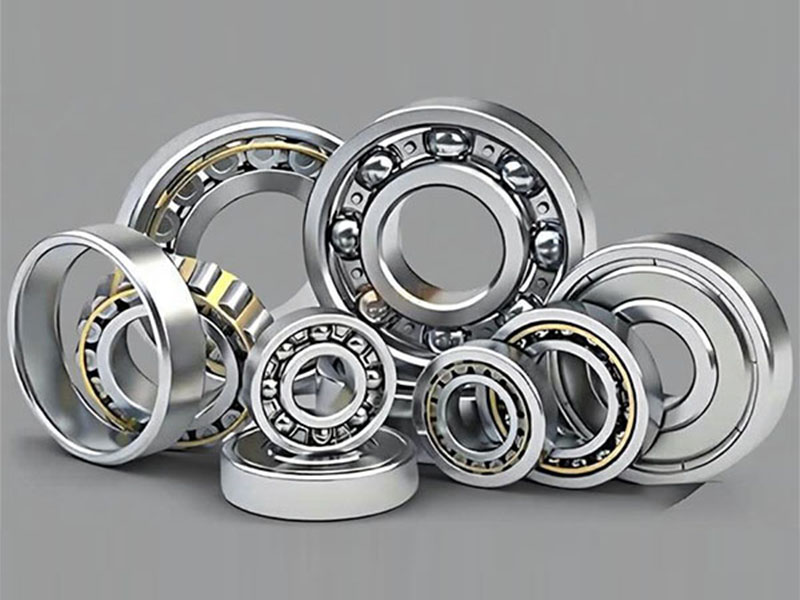
Metallic Bearing Materials
Metallic bearing materials remain the most widely used category across industrial applications due to their combination of strength, hardness, and fatigue resistance.
SAE 52100 Chrome Steel
SAE 52100 chrome steel is the standard material for precision ball bearings, roller bearings, and tapered roller bearings. This high-carbon chromium alloy contains approximately 1.5 percent chromium and is processed through controlled heat treatment to achieve a surface hardness of 60 to 64 HRc. The material offers excellent wear resistance and high dynamic load capacity, making it suitable for general manufacturing, automotive, and heavy machinery applications.
However, SAE 52100 has low corrosion resistance and requires proper lubrication and protection from moisture to prevent rust. Its maximum continuous operating temperature is approximately 120°C, beyond which hardness begins to degrade.
440C Martensitic Stainless Steel
For applications requiring corrosion resistance, 440C martensitic stainless steel is a common choice. With approximately 18 percent chromium content, 440C provides significantly better surface corrosion resistance than standard chrome steel.
The material undergoes rapid heating and quenching to form a hard crystalline martensitic structure, achieving hardness of approximately 58 HRc after heat treatment. Compared to SAE 52100, 440C has a slightly lower load carrying capacity but can sustain operating temperatures up to 250°C. This material is frequently specified for marine equipment, food processing machinery, and medical devices.
It should be noted, however, that 440C has limited resistance to seawater or salt spray. For more aggressive corrosive environments, alternative materials may be required.
316 Austenitic Stainless Steel
AISI 316 austenitic stainless steel offers superior corrosion resistance compared to 440C. Its low carbon content, typically below 0.08 percent, makes the material non-magnetic — a critical requirement for MRI equipment and other sensitive medical applications.
The primary limitation of 316 stainless steel is its low hardness, as the material cannot be effectively hardened through heat treatment. Consequently, 316 bearings are suitable only for low-load and low-speed applications. When both corrosion resistance and load capacity are required, hybrid designs or alternative materials may be preferable.
Engineering Plastics and Polymer Bearing Materials
Polymer and plastic bearing materials offer distinct advantages in weight reduction, corrosion resistance, and self-lubricating operation. Unlike metallic bearings, polymer bearings generally have lower dynamic load capacity — typically ranging from 5 to 30 MPa·m/s in PV (pressure-velocity) limits, whereas SAE 52100 steel bearings can sustain contact stresses exceeding 2,500 MPa. Therefore, plastic bearings are best suited for light to moderate load applications.
The table below compares key properties of common engineering plastics used in bearing applications.
| Material | Max Continuous Temperature | Dynamic Load Capacity (relative to steel) | Friction Coefficient | Chemical Resistance |
|---|---|---|---|---|
| POM-C (Acetal) | 80-100°C | Very low (~5% of steel) | 0.15-0.35 | Moderate |
| PEEK | 260°C | Low (~8% of steel) | 0.20-0.40 | Excellent |
| PTFE | 260°C | Very low (~3% of steel) | 0.05-0.10 | Excellent |
| Nylon (PA) | 90-110°C | Low (~6% of steel) | 0.20-0.40 | Moderate |
| PVDF | 150°C | Very low (~4% of steel) | 0.20-0.35 | Excellent |
| PE | 80°C | Very low (~3% of steel) | 0.15-0.25 | Good |
POM-C (Acetal Resin)
Polyoxymethylene (POM-C), also known as acetal resin, offers good rigidity, low friction coefficient, and dimensional stability. POM bearings are commonly used in precision applications including conveyor rollers, guide rails, and rotary components. The material is suitable for food contact applications where FDA compliance is required.
PEEK (Polyetheretherketone)
PEEK is a high-performance engineering plastic capable of continuous operation at temperatures up to 260°C. It offers high thermal stability, excellent chemical resistance, and good mechanical strength. PEEK bearings are frequently specified for semiconductor manufacturing, medical equipment, and chemical processing applications.
PTFE (Teflon)
PTFE exhibits one of the lowest friction coefficients among solid materials and performs well across a wide temperature range. Its self-lubricating properties eliminate the need for external lubrication in many applications, reducing maintenance requirements. PTFE bearings can be used in strong acid and strong alkali environments, including contact with fuming sulfuric acid and fuming nitric acid.
Nylon (PA)
Nylon bearings offer lightweight construction, low noise operation, and good wear resistance for light-duty applications such as household appliances and office equipment.
PVDF (Polyvinylidene Fluoride)
PVDF performs excellently in strong acid and alkali environments, including exposure to halogens and oxidizing agents. It is often specified for chemical processing equipment.
PE (Polyethylene)
PE provides an economical option for general-purpose applications where load requirements are minimal and operating temperatures remain below 80°C.
Ceramic Bearing Materials
Ceramic materials are increasingly specified for demanding applications where steel bearings reach performance limitations. Ceramic bearings can be approximately 60 percent lighter, 120 percent harder, and roughly 50 to 60 percent stiffer than their steel counterparts (based on elastic modulus comparison: silicon nitride at ~310 GPa vs. bearing steel at ~200 GPa). Maximum operating temperatures of full ceramic bearings exceed 700°C.
Silicon Nitride (Si₃N₄)
Silicon nitride is the most widely used ceramic material for bearing rolling elements. It combines high hardness exceeding 75 HRc equivalent, low density, high elastic modulus, and excellent thermal conductivity. Silicon nitride bearings are non-magnetic and electrically insulating, making them suitable for electric motors and aerospace applications.
Zirconia (ZrO₂)
Zirconia offers good fracture toughness and a coefficient of thermal expansion that closely matches alloy steel. This property is beneficial for maintaining bearing preload and contact angle across broad operating temperature ranges. Zirconia bearings are commonly specified for applications requiring corrosion resistance and moderate mechanical loads.
Silicon Carbide (SiC)
Silicon carbide provides the highest hardness among ceramic bearing materials and is specified for extremely demanding conditions, including high-temperature furnaces, chemical processing equipment, and applications involving abrasive media.
Hybrid Bearings
Hybrid bearings combine steel rings with ceramic rolling elements, typically silicon nitride balls and chrome or stainless steel races. This configuration offers several advantages over all-steel bearings:
- Higher limiting speeds due to lower density of ceramic balls
- Improved lubricant life and reduced friction
- Electrical insulation, preventing current passage through the bearing
- No cold-welding between rolling elements and raceways
- Lower operating temperatures
Hybrid bearings have been successfully used in aerospace systems, machine tool spindles, electric motors, and laboratory equipment. In terms of load capacity, hybrid bearings typically exhibit a dynamic load rating approximately 10 to 15 percent lower than equivalent all-steel bearings, depending on the specific geometry and material combination. Quality control of ceramic rolling elements is critical, as inherent defects such as porosity or cracks can act as crack nucleation sites.
How to Select the Right Bearing Material by Operating Conditions
The selection of bearing material requires systematic evaluation of multiple operating parameters:
Load Conditions. For high radial or axial loads, SAE 52100 chrome steel or through-hardened bearing steel remains the optimal choice due to its high dynamic load rating. For moderate loads with corrosion concerns, 440C stainless steel provides a balanced solution.
Speed Requirements. High-speed applications benefit from ceramic or hybrid bearings due to reduced centrifugal forces from lower density rolling elements. Silicon nitride balls reduce rotating mass by approximately 60 percent compared to steel balls.
Temperature Environment. Conventional bearing steels SAE 52100 and 440C are suitable up to approximately 120°C to 250°C, respectively. For temperatures exceeding 350°C, full ceramic bearings (Si₃N₄ or ZrO₂) or hybrid bearings with ceramic rolling elements should be specified. At extreme temperatures, polymer bearings may experience deformation or reduced mechanical properties.
Corrosion Exposure. In marine, chemical, or washdown environments, stainless steel grades (316 or 440C), polymer bearings (PEEK, PTFE, PVDF), or full ceramic bearings provide the necessary corrosion resistance. Note that 316 stainless steel offers superior corrosion resistance to 440C but cannot achieve comparable hardness.
Lubrication and Maintenance. For applications requiring maintenance-free operation or where lubricant contamination is a concern, self-lubricating polymer bearings (PTFE, PEEK) or ceramic bearings may be appropriate. Metal bearings require consistent lubrication to prevent wear and fatigue.
Electrical Conductivity. For electric motors, generators, or applications where electrical current passage through bearings would cause damage, non-conductive ceramic or polymer bearings provide electrical insulation.
Frequently Asked Questions about Bearing Materials
Q1: Which bearing material is best for high-temperature applications?
A1: Full ceramic bearings made of silicon nitride (Si₃N₄) offer the highest operating temperature capability, exceeding 700°C. For moderate high-temperature conditions up to 260°C, PEEK polymer bearings are suitable, while 440C stainless steel can operate continuously up to 250°C.
Q2: What is the most wear-resistant bearing material?
A2: Silicon nitride ceramic exhibits the highest hardness among common bearing materials (exceeding 75 HRc equivalent), followed by SAE 52100 chrome steel (60 to 64 HRc) and 440C stainless steel (approximately 58 HRc). For rolling contact fatigue resistance, SAE 52100 remains the industry benchmark due to its optimized microstructure.
Q3: Can plastic bearings replace steel bearings?
A3: Plastic bearings are suitable replacements for steel only in applications with low loads and moderate temperatures. They offer advantages in corrosion resistance, weight reduction, and self-lubrication. However, plastic bearings cannot match the load capacity, stiffness, or high-temperature performance of steel or ceramic bearings.
Q4: Are ceramic bearings worth the cost?
A4: Ceramic bearings typically cost significantly more than steel equivalents. Their value proposition depends on the application. For high-speed machinery, aerospace, or electric motors, the extended service life, reduced maintenance, and performance advantages often justify the premium. For general industrial applications, chrome steel bearings usually provide better cost-effectiveness.
Q5: What material is used for bearings in food processing equipment?
A5: Food processing applications commonly use 316 stainless steel for its corrosion resistance and cleanability. For FDA-compliant plastic bearing options, POM, PEEK, and PTFE are suitable materials that resist washdown chemicals and operate without external lubrication.
Q6: What is the difference between 440C and 316 stainless steel for bearings?
A6: 440C stainless steel can be heat-treated to achieve high hardness (approximately 58 HRc), making it suitable for load-bearing applications with moderate corrosion resistance. 316 stainless steel offers superior corrosion resistance and is non-magnetic, but remains soft and can only be used in low-load, low-speed applications. For applications requiring both high load capacity and corrosion resistance, hybrid bearings with ceramic rolling elements and 316 rings may be considered.
Q7: What is the difference between self-lubricating plastic bearings and conventionally lubricated steel bearings?
A7: Self-lubricating plastic bearings (e.g., PTFE or PEEK) operate without external grease or oil, reducing maintenance costs and eliminating lubricant contamination risks. They are ideal for cleanroom environments, food processing, and applications where relubrication is difficult. However, they have lower load and speed limits. Conventionally lubricated steel bearings deliver higher load capacity and speed capability but require regular lubrication and sealing to prevent lubricant leakage or contamination.
Q8: Which bearing materials are suitable for non-magnetic applications?
A8: 316 austenitic stainless steel is non-magnetic and is commonly used for MRI equipment and sensitive electronic devices. Full ceramic bearings (silicon nitride or zirconia) are also non-magnetic and provide higher hardness and wear resistance than 316 stainless steel. Hybrid bearings with ceramic rolling elements and 316 stainless steel rings combine non-magnetic properties with improved load capacity.
Conclusion
Selecting the appropriate bearing material requires balancing load capacity, speed, temperature, corrosion resistance, and cost. SAE 52100 chrome steel remains the most widely used material for general industrial applications due to its high load capacity and cost-effectiveness. Stainless steel grades extend corrosion resistance for demanding environments. Polymer and ceramic materials provide specialized solutions where metal bearings face performance limitations, including high-temperature, corrosive, or maintenance-free applications. Hybrid bearings offer a middle ground, combining ceramic rolling elements with steel races for high-speed operation.
For any bearing material selection decision, a thorough assessment of operating conditions, including load, speed, temperature, and exposure, is essential. Consulting detailed material property data and application-specific guidance will ensure optimal bearing performance and service life.