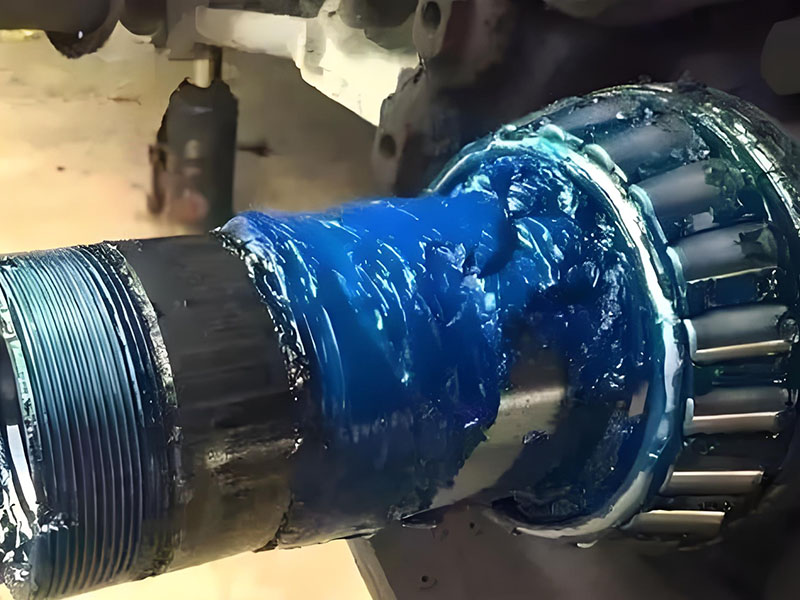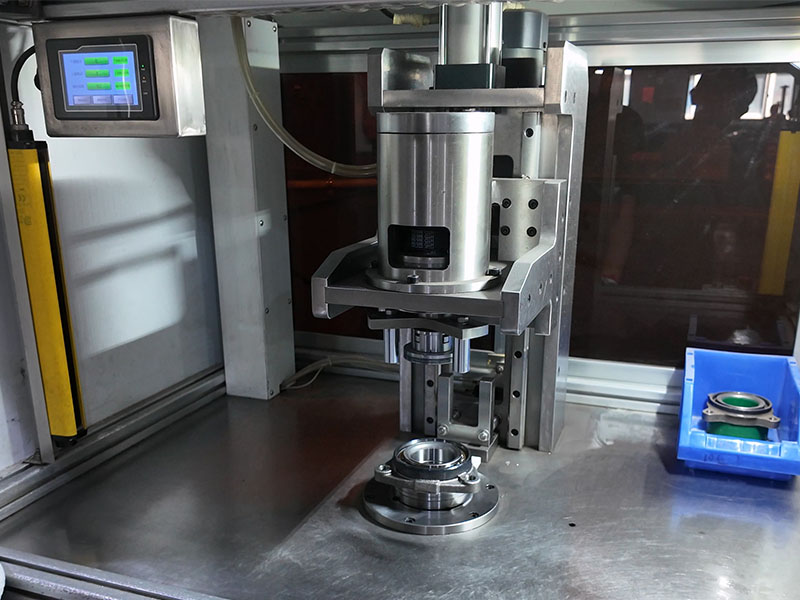
If you are comparing a roller bearing and a cylindrical roller bearing, you might think they are two completely separate products. In fact, the cylindrical roller bearing is one specific type within the larger roller bearing family. This article explains the relationship between them and highlights the key differences in a simple, practical way.
What Is a Roller Bearing?
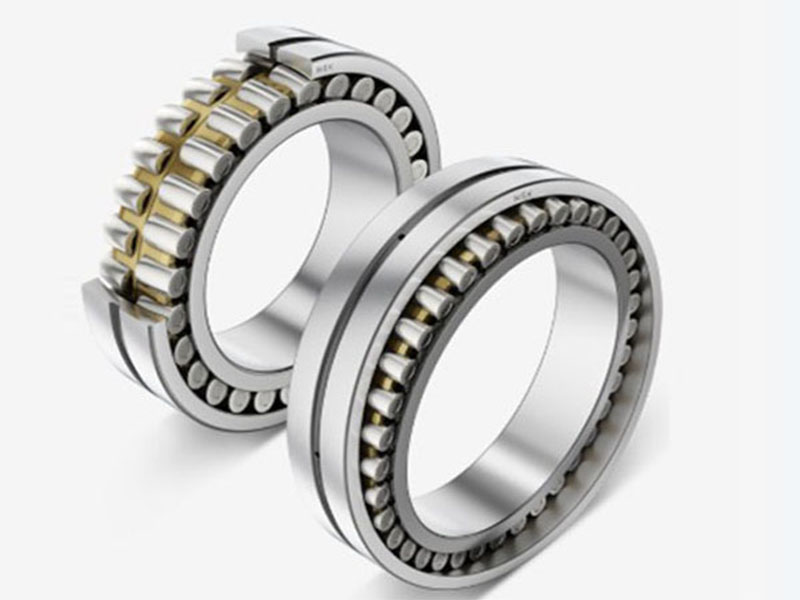
A roller bearing is a type of rolling-element bearing that uses cylindrical, tapered, spherical, or needle-shaped rollers between an inner ring and an outer ring. The rollers create line contact with the raceways, which helps distribute loads over a larger area compared to ball bearings.
Roller bearings are widely used in industrial machinery, automotive applications, and heavy equipment because they can support heavy radial loads and, depending on the design, some axial loads.
Common Roller Bearing Types
Roller bearings are not all the same. The main types include:
- Cylindrical roller bearings – straight cylindrical rollers
- Tapered roller bearings – tapered rollers for combined loads
- Spherical roller bearings – barrel-shaped rollers that self-align
- Needle roller bearings – long, thin rollers for compact spaces
Each type has different strengths and limitations. This article focuses on how cylindrical roller bearings compare to the broader roller bearing category.
What Is a Cylindrical Roller Bearing?
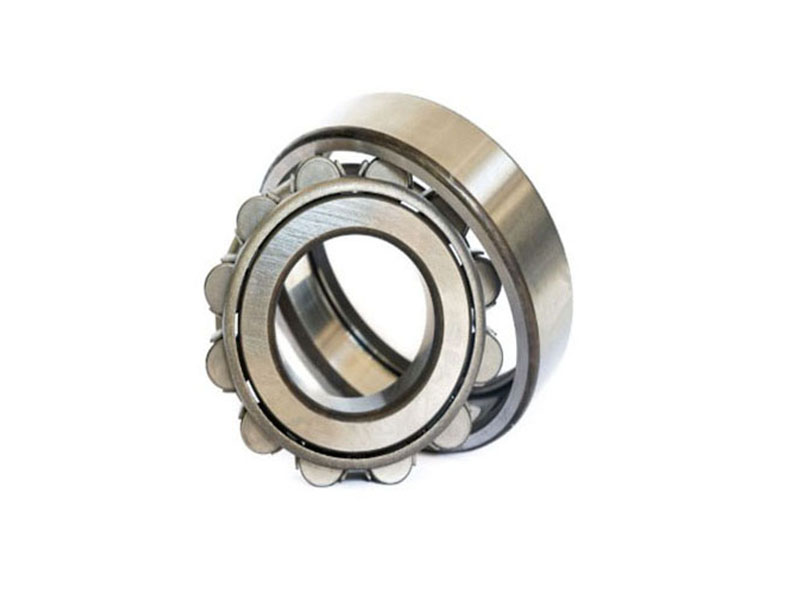
A cylindrical roller bearing is a specific type of roller bearing that uses cylindrical (straight) rollers arranged parallel to the shaft axis. The rollers are typically guided by ribs (flanges) on either the inner or outer ring, depending on the design.
Cylindrical roller bearings are designed primarily for high radial loads. Their line contact between the roller and raceway allows them to carry heavier radial loads than ball bearings of similar size. They also have relatively low friction and can operate at higher speeds than many other roller bearing types.
Because they have a zero contact angle, standard cylindrical roller bearings have limited ability to handle axial (thrust) loads. However, certain designs with flanges (such as NJ or NUP types) can accommodate moderate axial loads in one direction.
In short: every cylindrical roller bearing is a roller bearing, but not every roller bearing is a cylindrical roller bearing.
Key Differences Between Roller Bearings and Cylindrical Roller Bearings
Understanding the difference between roller bearing and cylindrical roller bearing requires looking at several factors. The table below summarizes the main points.
Comparison Table
| Characteristic | Roller Bearing (General Category) | Cylindrical Roller Bearing |
|---|---|---|
| Rolling element shape | Cylindrical, tapered, spherical, or needle | Cylindrical only |
| Relationship | A broad family | A specific member of the family |
| Primary load capacity | Varies by type | High radial load |
| Axial (thrust) load | Some types handle it (e.g., tapered) | Very limited (flanged designs moderate) |
| Speed capability | Moderate to high | High among roller bearings |
| Misalignment tolerance | Good in spherical types | Poor – requires precise alignment |
| Friction | Varies | Relatively low |
| Common applications | Wheel hubs, conveyors, gearboxes, crushers | Rolling mills, large motors, machine tool spindles |
Detailed Explanation of Differences
1. Rolling Element Shape
Roller bearings as a category can have different roller shapes. Cylindrical roller bearings always use straight, cylindrical rollers. If you see tapered, barrel-shaped, or needle rollers, it is not a cylindrical roller bearing.
2. Radial Load Capacity
Both general roller bearings and cylindrical roller bearings can handle radial loads, but cylindrical roller bearings are optimized for very high radial loads. For example, in rolling mills and heavy gearboxes, cylindrical roller bearings are often the first choice.
3. Axial (Thrust) Load Capacity
This is a major difference. Many general roller bearings – especially tapered roller bearings – are designed to handle combined radial and axial loads. Standard cylindrical roller bearings, however, are not meant for axial loads. If your application has significant thrust, a cylindrical roller bearing may not work unless you use a flanged design.
4. Alignment Capability
Some roller bearing types (spherical roller bearings) can tolerate up to 1.5–2 degrees of misalignment between the shaft and housing. Cylindrical roller bearings have very poor misalignment tolerance. Misalignment causes edge loading, which quickly damages the bearing.
5. Speed and Friction
Cylindrical roller bearings have low friction because the rollers are guided without significant sliding. They can operate at higher speeds than tapered roller bearings but generally lower than ball bearings. Other roller bearing types, such as needle bearings, have lower speed limits due to smaller roller diameters.
6. Maintenance Requirements
All roller bearings need regular lubrication. However, cylindrical roller bearings in heavy-load, high-speed applications require careful lubrication selection (oil or grease) to prevent overheating. Tapered roller bearings often need more frequent adjustment because of their axial play requirements.
Which Bearing Type Should You Choose?
Choosing between a general roller bearing type and a cylindrical roller bearing depends on your application conditions. Follow these simple guidelines:
- Choose a cylindrical roller bearing if:
- The load is mostly radial (perpendicular to shaft)
- Speed is moderate to high
- Shaft and housing alignment can be precise
- You do not have significant axial loads
- Choose a tapered roller bearing if:
- You need to handle combined radial and axial loads (e.g., vehicle wheel hubs)
- Choose a spherical roller bearing if:
- There is shaft misalignment or housing deflection
- You need heavy radial load capacity plus some axial load capacity
- Choose a needle roller bearing if:
- Space is very limited (small radial cross-section)
- Loads are moderate
In many industrial applications, cylindrical roller bearings are used as non-locating bearings (allowing thermal expansion) on the shaft, while a tapered roller bearing handles axial location.
Frequently Asked Questions (FAQs)
Q1: Is a cylindrical roller bearing the same as a roller bearing?
A1: No. A cylindrical roller bearing is one specific type of roller bearing. Roller bearings include cylindrical, tapered, spherical, and needle types. Think of “roller bearing” as the family name and “cylindrical roller bearing” as one member of that family.
Q2: Can I use a cylindrical roller bearing instead of a regular roller bearing?
A2: It depends on your load conditions. If your application requires axial load capacity or misalignment tolerance, a cylindrical roller bearing is likely not suitable. However, if the load is purely radial and alignment is good, a cylindrical roller bearing often performs better than other roller bearing types.
Q3: Which bearing is better for high-speed applications – roller bearing or cylindrical roller bearing?
A3: Among roller bearings, cylindrical roller bearings offer relatively high speed capability due to their low friction design. However, for extremely high speeds, ball bearings are typically better. Compared to tapered or spherical roller bearings, cylindrical roller bearings generally allow higher rotational speeds.
Q4: Can cylindrical roller bearings handle side loads (axial loads)?
A4: Standard cylindrical roller bearings have very limited axial load capacity. Some designs with flanges (e.g., NJ, NUP types) can handle moderate axial loads in one direction. If you need significant axial load capacity, consider tapered roller bearings or angular contact ball bearings instead.
Q5: How do I know if I need a cylindrical roller bearing or another type of roller bearing?
A5: Evaluate three main factors: (1) load direction – mainly radial or combined; (2) required speed; (3) alignment precision. If the load is mostly radial, speed is moderate to high, and alignment is good, a cylindrical roller bearing is a strong candidate. If you have axial loads or misalignment, choose another roller bearing type.
Q6: Are cylindrical roller bearings more expensive than other roller bearings?
A6: Cylindrical roller bearings are generally mid-range in cost compared to other roller bearing types. They are typically less expensive than precision tapered roller bearings but more expensive than some needle roller bearings. The price also depends on precision grade, cage material, and size.
Q7: What industries commonly use cylindrical roller bearings?
A7: Cylindrical roller bearings are widely used in steel mills (rolling mills), gearboxes, large electric motors, pumps, compressors, machine tool spindles, and wind turbines. They are chosen where heavy radial loads and moderate-to-high speeds are required.
Summary of Key Points
- Cylindrical roller bearings are a subtype of roller bearings, not a separate category.
- They excel at high radial loads and relatively high speeds.
- They have poor axial load capacity and low misalignment tolerance.
- Other roller bearing types (tapered, spherical, needle) are better for axial loads or misaligned conditions.
Conclusion
The main difference between a roller bearing and a cylindrical roller bearing is one of category versus specific type. Cylindrical roller bearings are a subset of the larger roller bearing family. They are designed for heavy radial loads, relatively high speeds, and require precise alignment. Other roller bearing types – such as tapered, spherical, and needle bearings – exist for applications involving axial loads, misalignment, or space constraints.
When selecting bearings for your equipment, first identify the load direction and operating conditions. If radial loads dominate and alignment can be maintained, a cylindrical roller bearing is often the best choice. For combined loads or misalignment, look at tapered or spherical roller bearings.