
Thrust Ball Bearing
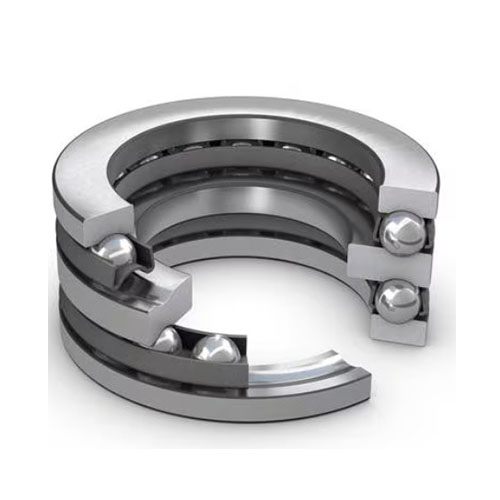
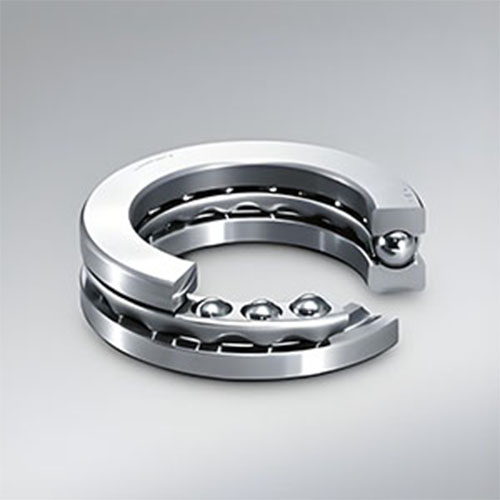
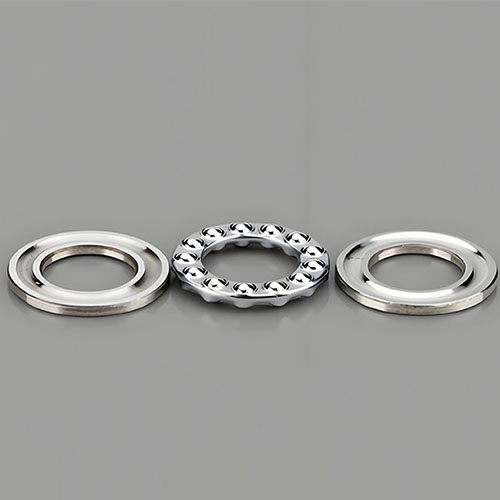
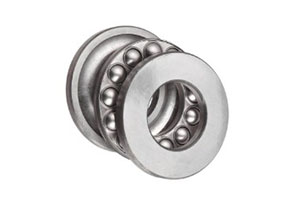
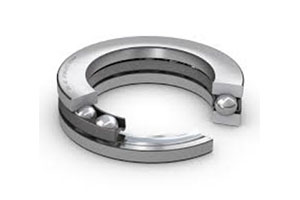
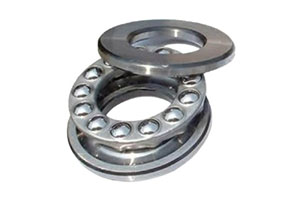
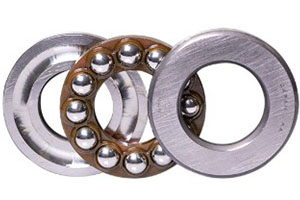
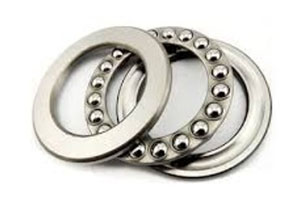
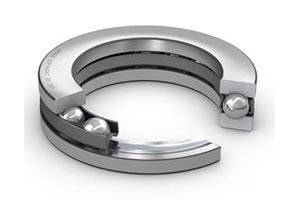
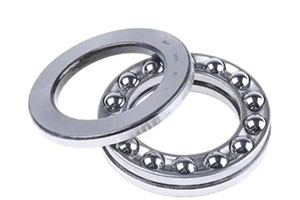
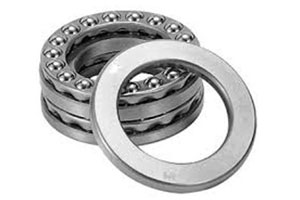
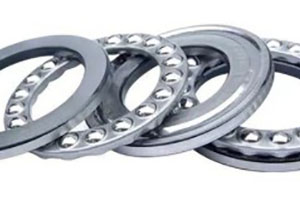
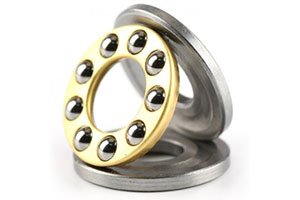
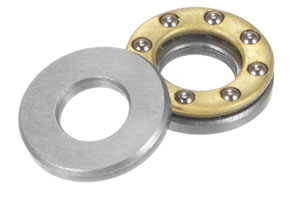
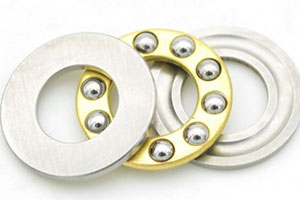
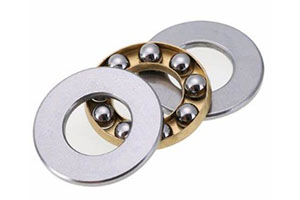
A thrust ball bearing is a rolling-element bearing designed to accommodate pure axial loads in one or two directions. Unlike radial bearings, thrust ball bearings are not intended to withstand radial forces. The bearing consists of three separable components: a shaft washer (inner ring with ground bore), a housing washer (outer ring with turned bore), and a ball-and-cage assembly positioned between them. Raceway surfaces are either flat (standard series) or spherical (aligning series).
Performance Characteristics
- Pure axial load support – Accommodates full axial loads in single or both directions. No radial load capacity. Must be paired with separate radial bearings when radial forces exist.
- Separable components – Shaft washer, housing washer, and ball cage assembly can be disassembled independently. This simplifies inspection, cleaning, and replacement of worn parts without dismantling entire machinery.
- Low rotational friction – Point contact between balls and raceways generates less friction than line-contact roller bearings. Enables operation at moderate to high speeds under lighter load conditions.
- Standardized dimensions – All metric single direction series follow DIN 711 and ISO 104 standards. Double direction series conform to DIN 712. Ensures dimensional interchangeability with major European and Asian bearing brands.
- Material options – SAE52100 chrome steel (standard, 60–64 HRC hardness). AISI 440C stainless steel for corrosive environments. Brass, pressed steel, or polyamide cages selected based on operating speed and temperature.
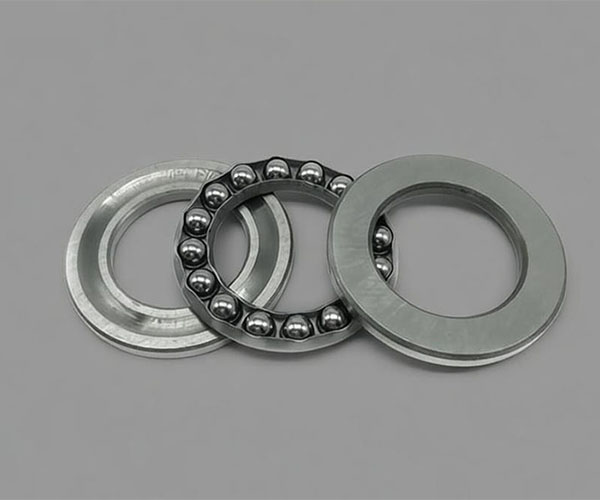
Component Structure, Design Features, and Materials
Thrust ball bearings employ three primary load-bearing components. The shaft washer features a ground bore for precise interference fit on rotating shafts. The housing washer has a turned bore with larger diameter, creating clearance fit with the shaft. The third component is the ball and cage assembly: steel balls retained by a cage that maintains proper ball spacing and prevents ball-to-ball contact. All three components can be separated for installation and maintenance.
Raceway washers are manufactured with either flat surfaces (511, 512, 513, 514, 522, 523, 524 series) or spherical surfaces (532, 533, 542, 543, 544 series). Spherical seat washers compensate for static angular misalignment between shaft and housing, reducing edge stress in applications where perfect alignment is not achievable. Angular contact thrust ball bearings use raceways inclined at 60° to the bearing axis, allowing combined axial and light radial load support at higher speeds than standard thrust ball bearings.
Manufacturing tolerances follow ISO Class 0 (normal precision) with options for Class 5 or Class 4 (precision grades). P5 and P6 precision grades are available for ball screw support and high-speed spindle applications. Heat treatment produces surface hardness of 60–64 HRC on raceways to resist rolling contact fatigue under repeated load cycling.
Cage material selection depends on operating conditions:
- Machined brass cages – Highest speed capacity, elevated temperature tolerance up to 250°C
- Pressed steel cages – Economical, moderate speed ratings, standard industrial conditions
- Polyamide (PA66) cages – Quiet operation, chemical resistance, speed limited, maximum 120°C
Load ratings are derived from ISO 281:2007. Basic static load rating C0 indicates the maximum static load before permanent deformation of rolling elements. Basic dynamic load rating C enables theoretical L10 lifespan calculation in millions of revolutions. Design engineers must reference series dimensional tables to match bore diameters (2mm up to 400mm for light series 511) to specific application load requirements.
Minimum axial load requirements must be observed. When applied axial load falls below the minimum value, rolling elements may skid rather than rotate, causing raceway smearing. Preload can be adjusted via spring loading or positioning shims to maintain internal contact forces. In double direction bearings, two rows of balls are separated by a centre washer for symmetrical bi-directional load absorption.
Product Types and Series
DUHUI Bearing manufactures metric thrust ball bearings in four main configurations: single direction, double direction, angular contact, and miniature. All series are dimensionally interchangeable with ISO standards, supporting aftermarket replacement across machinery types.
- Thrust Ball Bearing Types
- Single Direction Series
- Double Direction Series
- Angular Contact Series
- Miniature Series
Thrust Ball Bearing Types
Thrust ball bearings are manufactured in four distinct configurations based on load direction capacity, raceway geometry, and targeting application speed or space constraints. Selection depends on whether axial load is unidirectional or bidirectional, whether speed requires precision grades, and whether physical size limits standard dimensions.
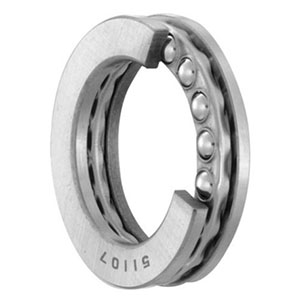
Support pure axial loads in one direction only. Shaft washer bore is ground for interference fit. Housing washer bore is turned larger for clearance fit. Used where axial force acts consistently from one side. Suitable for crane hooks, vertical pumps, and machine tool adjustment screws.
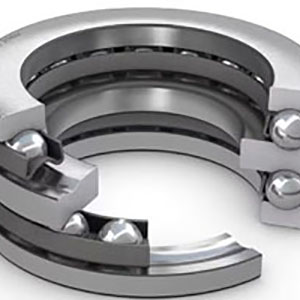
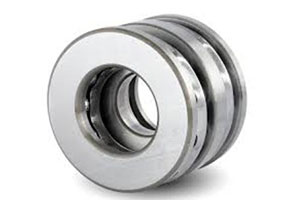
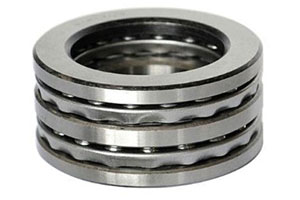
Contain two ball rows and a centre shaft washer. Support axial loads from both left and right directions without orientation requirements. Housing washers on both sides. Applied in vertical motor shafts, hydraulic lift cylinders, and gearbox bidirectional thrust positions.
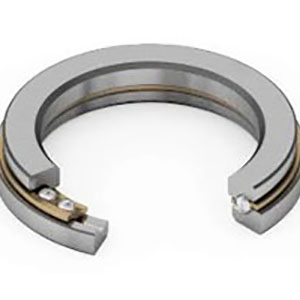
Raceways inclined at 60° relative to bearing axis. Designed for ball screw support in CNC machine tools. Provide high axial stiffness with moderate radial guidance. Manufactured to P4 or P5 precision grades for high-speed positioning accuracy.
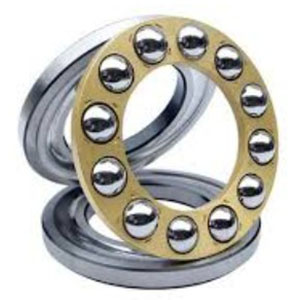
Bore diameters from 2mm to 18mm. Available in flat raceway (F series), grooved raceway (FM series), and stainless steel (SF/SFM series). Designed for compact assemblies where space limits standard thrust bearings. Chrome steel SAE52100 or AISI 440C stainless steel.
Single Direction Series
Single direction thrust ball bearings accept axial force from one side only. The shaft washer must be mounted on the rotating shaft with interference fit. Six series are available: flat seat standard series (511, 512, 513, 514) for aligned installations, and spherical seat aligning series (532, 533) for static misalignment compensation.
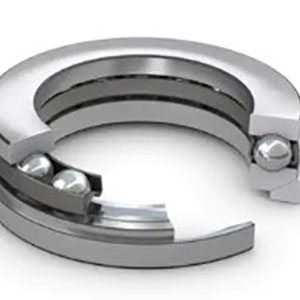
511 series–Light thrust ball bearing with flat shaft and housing washers. Maximum bore 400mm. Accommodates pure axial loads in one direction. Suitable for light machinery indexing tables, crane hook swivels, and conveyor adjustment screws. When spherical seat alignment is required, specify 532 series instead.
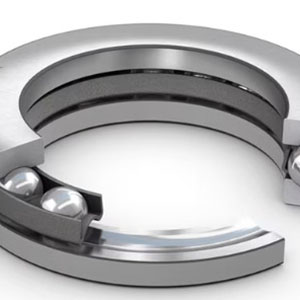
512 series–Medium-series thrust ball bearing with higher dynamic load capacity than 511 series at equivalent bore dimensions. Outer ring thickness identical to 513 series but bore capacity increased. Typical applications include medium loading tools, manual screw jacks, and crane slewing ring retaining plates.
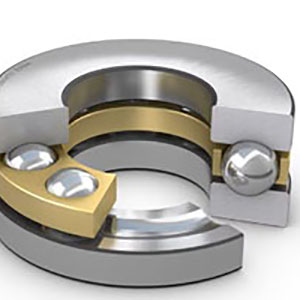
514 series–Maximum capacity metric single direction thrust ball bearing. Largest raceway cross-section within the standard single direction range. For extreme axial loads in mining material handling equipment, steel mill screwdown mechanisms, and heavy metallurgical processing roll necks.
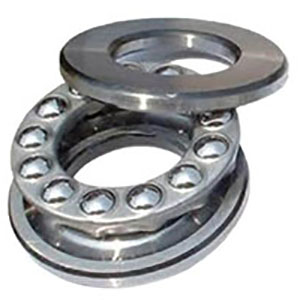
532 series–Single direction aligning thrust ball bearing supplied with spherical housing washer (type U2 for 532 design). Compensates for minor static shaft misalignment when matched with complementary shaft washer. Suitable for installation sites where perfect housing parallelism cannot be guaranteed.
Double Direction Series
Double direction thrust ball bearings contain two rows of balls arranged on both sides of a centre shaft washer. They accept axial loads from upward and downward directions without requiring bearing reversal during installation. Six series cover flat seat (522, 523, 524) for aligned applications and spherical seat aligning (542, 543, 544) for misalignment compensation.
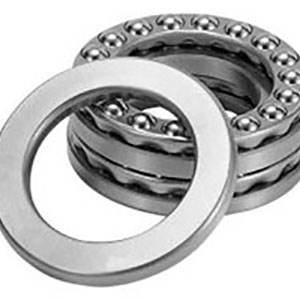
522 series–Double direction thrust ball bearing assembled with two rows of balls and flat seat washers. Accepts heavy axial loads from upward and downward directions without repositioning. Applied in mechanical screw jacks, vertical electric motor hollow shafts, and manual crane hoist thrust arrangements.
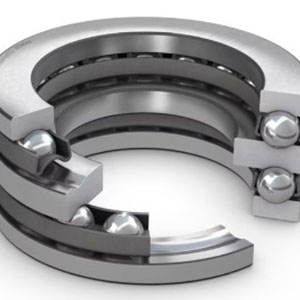
524 series – Extra Heavy Flat Seat Double-Direction for Extreme Bidirectional Loads
Extra-heavy double direction thrust ball bearing with maximum static axial rating within flat seat family. Outer diameter limits identical to 514 extra heavy single direction. Recommended for heaviest bidirectional loads in vertical mining equipment, hydraulic cylinder piston rod guides, and large valve actuators.
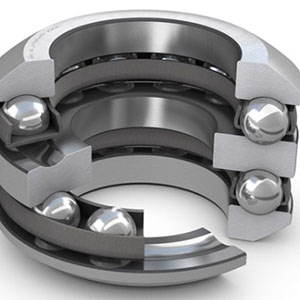
542 series–Double direction aligning thrust ball bearing incorporating spherical housing washer (type U2 for 542 series). Self-aligning design reduces installation error impacts and compensates for minor parallelism deviations between shaft and housing faces.
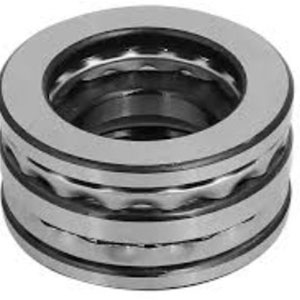
543 series–Heavy double direction aligning thrust ball bearing with spherical seat washers (type U2 or U3). Compensation capability up to manufacturer defined angular limits, typically 1.5 to 2 degrees. Applied in steel structural equipment, bridge bearing pivots, and heavy paper mill dryer roll thrust assemblies.
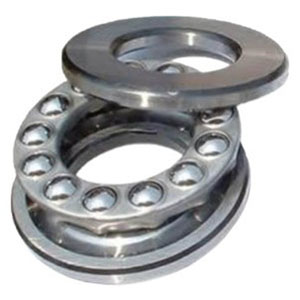
544 series–Extra-heavy double direction aligning bearing offering highest static axial rating combined with spherical seat self-alignment. Supplied with spherical housing and shaft washers for maximum misalignment tolerance. Installed in large wind turbine gearbox thrust discs, tunnel boring machine axial load bearings, and ship propeller shaft thrust block arrangements.
Angular Contact Series
Angular contact thrust ball bearings feature raceways inclined at 60° relative to the bearing axis, enabling combined axial and light radial load support at high speeds. Precision ground to P4 or P5 tolerance classes for positioning accuracy in CNC machine tools.
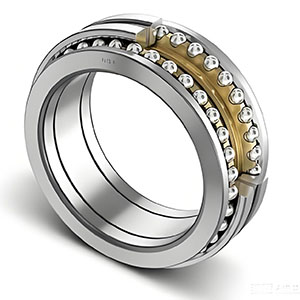
TAC series–Universal thrust angular contact bearing series offering compatibility with industry standard mounting dimensions. Optimised contact angles for ball screw support with high-speed, high-rigidity demands. Supplied as universal flush ground for duplex or triplex arrangements. Standard in CNC machining centres, precision grinding spindles, and industrial robot linear actuators.
Miniature Series
Miniature thrust ball bearings are manufactured for shaft diameters from 2mm to 18mm. Three construction types are available: F series (flat raceway, chrome steel), FM series (grooved raceway, chrome steel for higher load and speed), and SF/SFM series (stainless steel AISI 440C for corrosion resistance). All miniature thrust bearings are dimensionally interchangeable with major brand miniature bearing series.
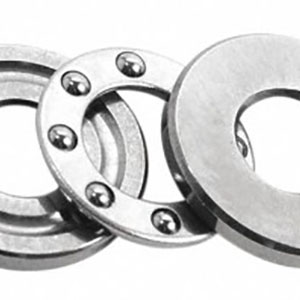
F series–Standard miniature thrust ball bearing with flat raceways. Designed for single-direction axial loads within compact assemblies. Chrome steel SAE52100, brass or pressed steel cage. Bore sizes 2mm to 18mm. Suitable for light loads in small electric motors, RC servos, 3D printer extruders, and office automation equipment requiring low friction axial positioning. Interchangeable with major brand dimensions.
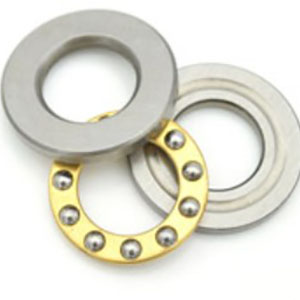
FM series – Grooved Raceway Miniature Thrust Ball Bearing, Chrome Steel
Grooved raceway miniature thrust ball bearing with increased load and speed capacity compared to standard F series. Raceway grooves guide balls more precisely, reducing friction and wear. Chrome steel with brass cage. Interchangeable with F series within identical dimensions. Ideal for RC helicopter swash plates, small gearboxes, precision instruments, and applications demanding enhanced axial rigidity.
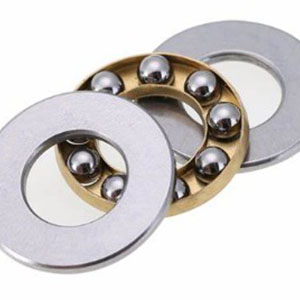
SF series – Stainless Steel Miniature Thrust Ball Bearing, Flat or Grooved Raceway
Stainless steel miniature thrust ball bearing manufactured from AISI 440C for corrosion resistance in moist or chemical environments. Available in flat raceway (SF series) and grooved raceway (SFM series) versions matching F and FM dimensions for drop-in replacement. Suitable for food processing equipment, marine deck hardware, medical device actuators, outdoor hobby products, and any application where chrome steel bearings would corrode.
Additional Thrust Bearing Types
Beyond ball-type thrust bearings, roller-type thrust bearings are available for applications requiring higher axial load capacity, misalignment tolerance, or compact axial space. Roller-type thrust bearings use line contact between rolling elements and raceways, delivering higher load capacity than similarly sized thrust ball bearings, but are typically limited to lower operating speeds due to increased friction. The following types are available.
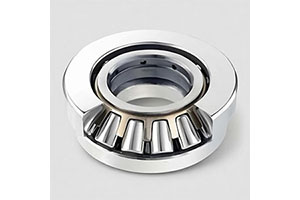
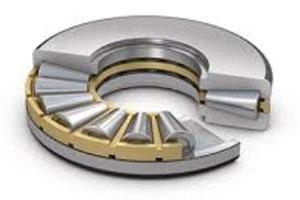
Thrust Tapered Roller Bearings for Combined Heavy Axial Load Utilize small tapered rollers arranged so that all roller axes converge at a point on the bearing axis. Tapered geometry creates optimized load distribution, achieving higher capacities than cylindrical types – some designs support static axial loads exceeding 2,000 kN. Capable of moderate radial guidance in addition to axial load. Suitable for rolling mill screwdown mechanisms, oil well swivels, and heavy extruder thrust positions.
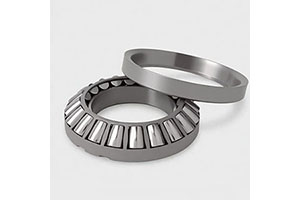
Feature barrel-shaped rollers within spherical raceways, enabling automatic self-alignment while handling extremely heavy axial loads. Can also accommodate radial loads simultaneously. Insensitive to shaft deflection and angular misalignment between shaft and housing. Essential for vertical shaft applications such as hydroelectric turbines, marine propeller shafts, and wind turbine main shaft thrust support.
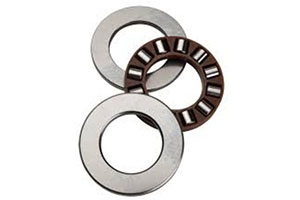
Use cylindrical rollers arranged radially in a cage. Line contact between rollers and raceways enables high axial load capacity and axial rigidity. Suitable for heavy loads at low to moderate speeds. Common applications include gearboxes, extruders, and heavy machinery. Bearings are separable for simplified mounting. Available for bore diameters from 35mm to 320mm.
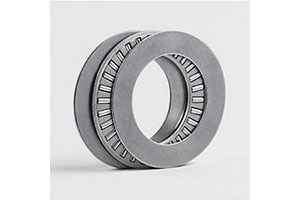
Minimize axial cross-section while maximizing load capacity. Use needle rollers arranged radially within a cage. Ideal for automotive automatic transmissions, air conditioning compressors, and applications with severe axial space constraints. Provide high rigidity despite small projection area due to line contact between needle rollers and raceways. Double-row designs available for increased service life.
Industrial Applications
Thrust ball bearings are specified where pure axial loads require support, rotating positioning accuracy is needed, and radial load forces are handled by separate bearings. The following sections detail the primary application scenarios by industry.

Single direction thrust ball bearings support axial steering column loads in passenger cars and light trucks. Also applied in engine flywheel thrust plates, clutch release bearing circuits, and manual gearbox counter shaft axial adjustment positions.
Heavy series 513 and 514 thrust ball bearings installed in excavator slew ring retaining plates, crane hook swivel blocks, and conveyor drive pulley thrust collars for consistent axial positioning under high load cycling.
Angular contact thrust ball bearings provide precision axial guidance for CNC machining centre ball screws, grinding spindle linear feeds, and gantry mill Z-axis drive screws requiring high stiffness and positional repeatability.
Double direction 522 and 523 series accommodate upward impeller thrust and downward shaft weight in vertical turbine pumps, cooling tower fan drives, and industrial agitator mixers without bearing orientation changes.
Miniature stainless steel SF series and low-noise F series thrust bearings support linear actuator screws, sample handling turntables, and diagnostic imaging gantries where clean operation and corrosion resistance are required.
Comparison Guides
Engineers selecting thrust ball bearings benefit from understanding functional differences between ball and roller technologies and between thrust bearings and radial bearings.
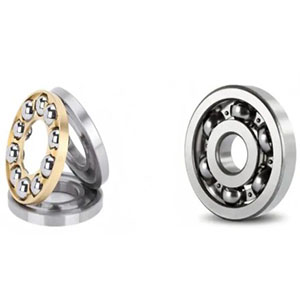
Radial ball bearings accommodate combined radial and axial loads through internal contact angle but offer limited pure axial capacity. Thrust ball bearings have horizontal raceways accepting full axial load, zero radial capacity, and higher speed capability than comparably sized thrust roller bearings. Standard radial ball bearings must be paired with separate thrust ball bearings when axial loads predominate.
For more details, please read“Radial vs Thrust Ball Bearings: Key Differences and How to Select”
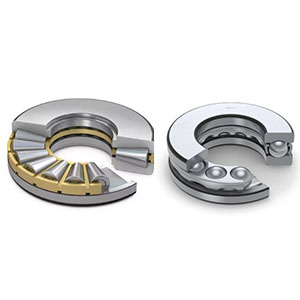
Thrust ball bearings produce lower friction and higher speed limits due to point contact between balls and raceways. Thrust roller bearings (cylindrical, tapered, spherical, needle) generate line contact for 3 to 5 times higher axial load capacity but increased friction and lower speed ceilings. Select thrust ball bearings for lighter loads with higher rotational speeds. Select thrust roller bearings for slow, heavy axial loading where cooling capacity is adequate.
For more details, please read“Thrust Ball Bearing vs. Thrust Roller Bearing”
Related Products
The following thrust ball bearing models represent commonly stocked dimensions in industrial aftermarket supply chains, arranged by series and application category. All models are manufactured to ISO standards and are dimensionally interchangeable with major brands.
Thrust Ball Bearing Installation Guide and Troubleshooting
Clean all mounting surfaces and inspect the thrust ball bearing for manufacturing defects or transit damage before installation. Check shaft and housing bore dimensional tolerances according to ISO 286 fit specifications. Prepare necessary tools including micrometers, calipers, torque wrench, soft-faced hammer, and cleaning materials. Verify that shaft shoulder squareness to axis is within 0.01mm per 100mm length.
Install Orientation – Critical Check for Single Direction Bearings
The most common installation error with single direction thrust ball bearings is interchanging the shaft washer and housing washer. The shaft washer has a ground bore that fits closely on the journal. The housing washer has a turned bore with larger diameter and visible clearance when placed over the same shaft. The two washers cannot be swapped. Check bearing markings — the shaft washer is identified by an “S” marking or smaller bore diameter.
Force Application Rules
Never transmit installation force through rolling elements or the cage. Use an installation sleeve or arbor press that contacts only the bearing ring face being press-fitted. For shaft fit, apply force to the shaft washer face only. For housing fit, apply force to the housing washer face only. Using a sleeve distributes load evenly around the ring circumference, preventing tilting or raceway brinelling.
Housing Fit and Radial Clearance
The housing washer outer diameter should maintain radial clearance of 0.02mm to 0.05mm relative to the housing bore. This clearance allows slight radial movement during operation while maintaining axial guidance. For spherical seat aligning series (532, 533, 542, 543), the spherical interface between washers automatically compensates for static misalignment up to the manufacturer’s specified limits.
Shaft Fit Selection
Shaft washer interference fit is recommended for rotating shaft applications. ISO fit class j6 or k6 typical for normal operating conditions. For stationary shaft applications with rotating housing, the shaft washer requires clearance fit (h6 or h7) and the housing washer requires interference fit (J6 or K6). After installation, rotate the assembly by hand to check for smooth operation without roughness or binding.
Preload Application – Minimum Axial Load
Thrust ball bearings require a minimum axial load to maintain rolling contact and prevent ball skidding. When applied axial load is too low to maintain ball rotation, skidding causes raceway smearing and temperature rise. For low load conditions, apply preload using wave springs, disc springs, or coil springs positioned between the shaft shoulder and bearing. Preload eliminates internal clearance and increases stiffness. Excessive preload increases friction and heat generation — follow manufacturer load tables. Recommended axial clearance approximately 0.003mm to 0.005mm for normal speed operation.
Failure Modes and Diagnostics
- Improper installation – Hammering bearing rings causes raceway brinelling or washer distortion. Typical indicators are increased running vibration and uneven rotation noise. Use correct press tools instead of hammers.
- Lubrication failure – Wrong grease type, insufficient fill volume, or degraded grease causes friction increase, overheating, and raceway scoring. Check grease re-lubrication intervals — typical 2,000 operating hours for normal conditions.
- Foreign particle ingress – Dirt or metallic debris introduced during installation enters the rolling path, resulting in abnormal wear patterns, vibration spikes, and eventual seizure. Clean work area and inspect housings before assembly.
- Overload fatigue – Bearing size mismatched to equipment duty cycle. Rolling elements and raceways develop flaking followed by noise increase and dimensional growth. Recalculate required dynamic load rating C to machine loads.
- Misalignment – Shaft and housing not parallel within specification. Load distribution concentrates on one edge of raceway, causing premature cage or ball damage. For non-aligning series, correct housing alignment. For misalignment-prone installations, specify 532 or 542 aligning series.
- Temperature rise – Inadequate lubrication combined with reduced internal clearance from thermal expansion. Raceway scoring and lubricant degradation follow quickly. Monitor bearing housing temperature with infrared thermometer during the first operating hour.
Service Life Extension
Use correct press tools and confirm proper shaft washer orientation before force application. Select appropriate grease type (lithium-based general purpose for standard conditions, synthetic for high speed, or food-grade for processing equipment) with sufficient base oil viscosity. Fill bearings to 30% to 50% of internal free space. Re-grease at scheduled intervals according to operating hours. Before storage, apply rust preventive coating and store in a humidity-controlled environment. Replace bearings at the first indication of raceway spalling or abnormal noise to prevent secondary equipment damage.
Selection requires evaluating three key parameters:
- Load direction and magnitude – Determine whether axial load is unidirectional or bidirectional. Single direction bearings (511–514, 532–533) suffice for loads from one side. Double direction bearings (522–524, 542–544) are mandatory when loads reverse. Calculate required dynamic load rating C from ISO 281:2007 based on actual axial force (kN) and desired L10 lifespan.
- Speed and precision requirements – For high-speed applications (above 10,000 RPM depending on bore size), select angular contact series with P4/P5 precision grades and brass cages. For standard industrial speeds, flat seat series with pressed steel cages are adequate. Grooved raceway miniature bearings (FM series) support higher speeds than flat F series.
- Installation conditions and environment – If shaft-to-housing misalignment cannot be maintained within 0.02mm parallelism, choose spherical seat aligning series (532, 533 for single direction; 542, 543, 544 for double direction). For corrosive environments (moisture, chemicals, wash-down), specify stainless steel AISI 440C miniature series (SF/SFM) or request custom stainless steel for larger bores.
No. Thrust ball bearings are designed for pure axial loads exclusively and cannot accommodate radial forces. When radial loads are present, separate radial bearings must be installed alongside the thrust bearing. Even small radial loads can cause uneven load distribution across the balls and raceways, leading to premature wear. Elevating misalignment or side loading will reduce operational lifespan significantly.
Single direction bearings support axial loads from one direction only and require correct orientation during installation (shaft washer to shaft journal, housing washer to housing). Double direction bearings contain two rows of balls arranged on either side of a centre washer, supporting axial loads from both left and right directions without orientation concerns. Double direction bearings are taller but eliminate load direction constraints.
Three cage types: machined brass cages (highest speed capacity, elevated temperature tolerance, 250°C maximum), pressed steel cages (economical, moderate speed ratings, suitable for standard industrial conditions), and polyamide (PA66) cages (quiet operation, chemical resistance, speed limitations, 120°C maximum). Choose brass for high-speed spindles, steel for standard applications, and polyamide for noise-sensitive or chemically exposed installations.
Yes, when the applied axial load falls below the manufacturer‘s minimum specified rating. Without sufficient load, rolling elements may skid rather than rotate, causing raceway damage known as smearing. Preload is applied using spring washers, disc springs, or adjusting shims between the housing shoulder and bearing face. Preload also eliminates internal clearance for improved positional stiffness.
Clean all mounting surfaces thoroughly. Identify the shaft washer (ground bore, smaller diameter, typically marked “S”) and housing washer (turned bore, larger diameter). Press the shaft washer onto the journal using a sleeve contacting only the washer face — never through balls or cage. The housing washer fits with radial clearance in the housing bore. Apply force only to the ring being pressed. After assembly, rotate by hand to verify smooth operation.
Service life is calculated using the L10 method defined in ISO 281:2007. Formula: L10 = (C/P)^3 × 10^6 revolutions, where C = basic dynamic load rating (provided in series dimension tables) and P = equivalent dynamic axial load. For steady axial load only, P equals the applied axial force in kilonewtons. For 90% reliability (standard L10), adjust with additional factors for lubrication, contamination, and operating conditions if required.
Grease lubrication suffices for 90% of standard applications. Lithium-based mineral oil grease with NLGI grade 2 consistency suits general industrial conditions. Fill free space inside the bearing to 30% to 50% for grease. For high-speed operation (above 10,000 RPM depending on bore size), oil bath or oil mist lubrication is required. Angular contact bearings for ball screw support recommend synthetic ester or mineral base oil with calcium complex thickener.
Standard thrust ball bearing components: SAE52100 chrome steel (AISI 52100 equivalent, 60–64 HRC hardness) for raceways and balls under normal conditions. Stainless steel grade AISI 440C is used for SF and SFM series for wash-down environments, marine hardware, and medical equipment requiring corrosion resistance. Ceramic hybrid bearings use Si3N4 silicon nitride balls with steel raceways for electrical insulation and high-speed capability.