How are ball bearings manufactured to achieve high precision, low friction, and long service life? The production of a ball bearing involves multiple stages, from raw material selection to final assembly, each requiring strict process control. This article outlines the standard manufacturing process of ball bearings, covering material properties, forming methods, heat treatment, machining, assembly, quality control, and packaging.
Raw Material Selection for Ball Bearings
The performance of a ball bearing is largely determined by its material. Manufacturers select steel grades based on application requirements such as load capacity, wear resistance, corrosion resistance, and operating temperature. Below are commonly used materials in ball bearing production:
- High-carbon chromium steel (e.g., AISI 52100): High carbon and chromium content provide excellent hardness and wear resistance. Used for rings and rolling elements in most industrial bearings. Suitable for high-load applications.
- Case-hardened bearing steel (e.g., AISI 4320, 8620): Low carbon content with surface hardening after carburizing. Offers high surface hardness and tough core, ideal for impact and heavy-duty conditions such as railroad and heavy machinery.
- Stainless bearing steel (e.g., AISI 440C, AISI 316): Chromium and nickel additions improve corrosion resistance. Used in food processing equipment, marine applications, and medical devices where moisture or chemicals are present.
- High-temperature bearing steel (e.g., M50, M50NiL): Molybdenum and tungsten enhance performance at elevated temperatures. Commonly found in aircraft engines and gas turbines where structural stability above 300°C is required.
- Medium-carbon alloy steel (e.g., AISI 1045, 4140): Balanced mechanical properties and lower cost. Suitable for slow-speed bearings or general mechanical parts where extreme precision is not critical.
Each material grade is verified through spectrometric analysis before entering production.
Blank Forming – From Bar Stock to Forgings
The manufacturing process begins with cylindrical bar stock cut into predetermined lengths. These blanks are heated to a forging temperature (typically 1050–1150°C for bearing steel) and shaped under pressure to form rough rings (inner and outer races) or near-net shapes. Forging aligns the metal grain flow along the contour of the bearing race, improving impact strength and fatigue life. After forging, the parts undergo annealing to relieve internal stresses and soften the material for subsequent machining.
Heat Treatment Process – Hardening and Stabilizing
Heat treatment is critical to achieve the required hardness (typically 58–65 HRC for chrome steel) and dimensional stability. The process includes:
- Austenitizing: Heating the forged rings above the critical temperature (around 830–860°C) to transform the microstructure into austenite.
- Quenching: Rapid cooling in oil or polymer to form martensite – a hard, brittle phase.
- Tempering: Reheating to 150–200°C to reduce brittleness while maintaining high hardness.
- Stabilization (optional): For precision bearings, a second tempering or cold treatment (-70°C to -80°C) minimizes retained austenite, ensuring dimensional stability over temperature fluctuations.
After heat treatment, components are washed to remove quench oil residues.
Precision Machining of Bearing Components
Machining transforms heat-treated blanks into finished geometries with micrometer-level tolerances. This stage is subdivided by component type.
Ball Manufacturing
Steel wire or rod is cut into short slugs, then cold-headed (upset forging) into a rough spherical shape. The balls are de-flashed and undergo soft grinding to remove the equatorial ring. Hard grinding and lapping follow, using abrasive stones and continuous recirculation to achieve sphericity within 0.05–0.1 μm. Finally, balls are polished and inspected by optical sorting machines for surface defects.
Ring Grinding and Superfinishing
The inner and outer rings are first ground on their bores, outer diameters, and raceways using vitrified grinding wheels. After rough grinding, superfinishing (also called micro-finishing) is applied to the raceway surface. This process uses a fine abrasive stone oscillating at low pressure, producing a cross-hatched pattern that retains lubricant and reduces friction. Raceway surface roughness is typically controlled below 0.05 μm Ra.
Cage Production
Cages (or retainers) separate balls and maintain uniform spacing. Common manufacturing methods include:
- Stamping: From steel strip for high-volume, low-cost bearings.
- Machining: From brass or steel tubing for larger or high-precision bearings.
- Injection molding: With glass-fiber reinforced polyamide for lightweight, low-noise applications.
All cages are deburred and dimensionally checked.
Assembly and Lubrication
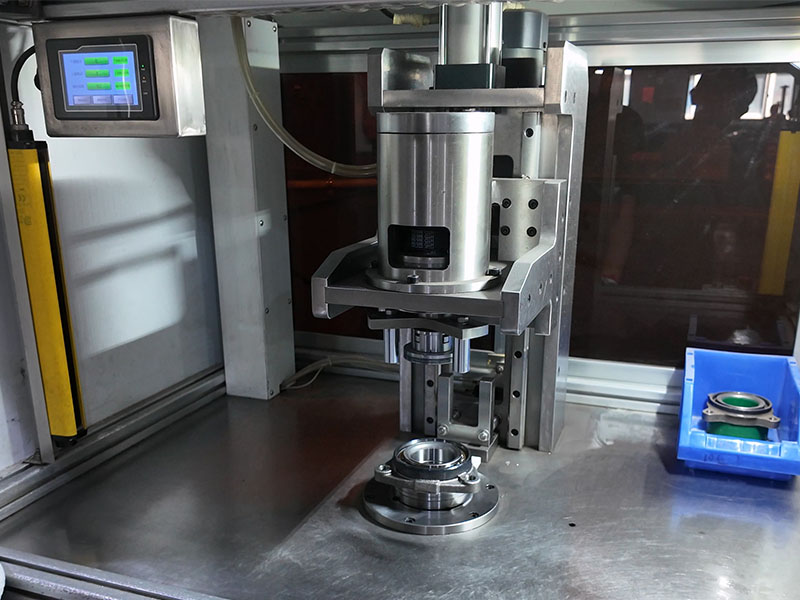
Cleanliness is essential at this stage. All components (rings, balls, cages) are washed in multi-stage cleaning lines to remove machining residues and dust. Assembly is performed in a cleanroom environment for high-precision bearings.
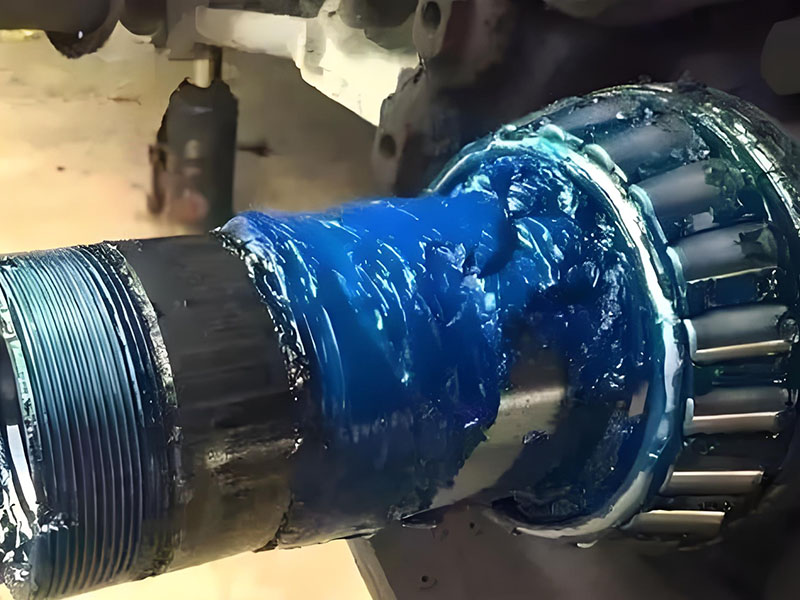
The assembly sequence: inner ring, cage, balls, then outer ring – or using an eccentric loading method for full-ball complement bearings. Once assembled, the bearing is greased or oil-lubricated. Grease type (lithium, polyurea, or synthetic) is selected based on operating temperature and speed. For oil lubrication, the bearing may be run-in to distribute the lubricant evenly.
Quality Control Throughout the Manufacturing Process
Quality control is not a single step but a system embedded in every stage. Key checks include:
- Incoming material inspection: Spectrochemical analysis, inclusion rating, and grain size measurement.
- In-process monitoring: Dimensional gauges (air gauges, laser micrometers) check raceway diameter, roundness, and wall thickness. Hardness tests (Rockwell or Vickers) verify heat treatment consistency. Eddy current or ultrasonic testing detects surface or subsurface cracks.
- Finished bearing tests: Noise (Anderson meter), vibration, radial and axial, torque, and rotational accuracy. For life-critical applications (e.g., aerospace), 100% nondestructive testing is performed.
All data is logged for traceability.
Packaging and Storage for Ball Bearings
After passing final inspection, bearings are preserved against corrosion. Standard practices include:
- Applying a thin rust-preventive oil (or anti-corrosion coating) to all exposed surfaces.
- Wrapping individually in vapor corrosion inhibitor (VCI) paper or film.
Placing bearings in plastic tubes or sealed bags, then into cardboard cartons. - Labeling with part number, batch code, and date of manufacture.
Storage recommendations: temperature 10–30°C, relative humidity below 60%, and avoidance of dust, vibration, or corrosive fumes. Bearings should remain in original packaging until installation.
Conclusion
The manufacturing process of ball bearings integrates metallurgy, thermal processing, precision machining, and strict quality assurance. Each step – from raw material selection to final packaging – directly influences bearing performance, noise, and service life. Understanding this process helps engineers specify the right bearing for their application, whether in automotive hubs, industrial gearboxes, or aerospace mechanisms.