Selecting the right bearing type is one of the most consequential decisions in rotating machinery design. Spherical roller bearings and cylindrical roller bearings serve fundamentally different purposes. Which bearing handles misalignment? Which one supports higher speeds? And most importantly — how do you choose the correct type for your application? This guide highlights the key differences and shows you how to choose correctly.
What Is a Spherical Roller Bearing?
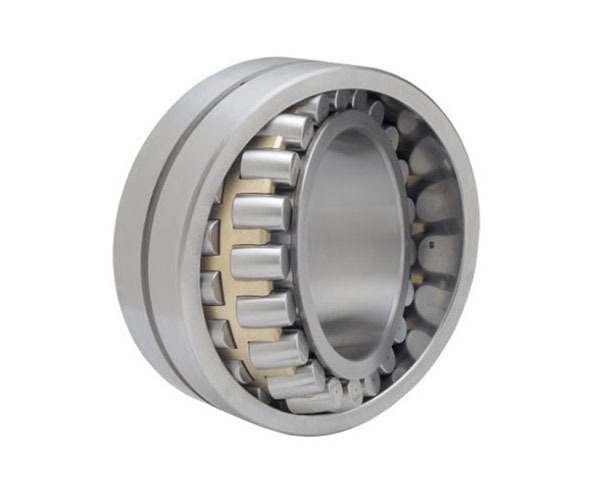
A spherical roller bearing (SRB) is a double-row rolling-element bearing designed to support high radial loads and moderate axial loads in both directions. Its defining characteristic is the spherical geometry of the outer ring raceway, which allows the bearing to self-align and accommodate angular misalignment between the shaft and housing without sacrificing performance.
Key Structural Features
- Two rows of barrel-shaped rollers: The rollers are symmetrical and slightly convex, designed to roll freely within the curved raceway of the outer ring.
- Spherical outer raceway: The outer ring contains a common spherical raceway surface that permits angular adjustment of the bearing axis relative to the housing.
- Cylindrical or tapered bore: Spherical roller bearings are available with either cylindrical or tapered bores. Tapered bore versions are typically mounted using adapter sleeves or withdrawal sleeves, which simplifies installation on stepped shafts.
- Sealed or open configurations: Open designs are standard; sealed versions incorporate integral contact seals to retain lubricant and exclude contaminants in dusty or wet environments.
Size and Load Range
Spherical roller bearings are manufactured in a wide range of dimensions, from small-bore sizes under 50 mm for light industrial applications up to large-bore bearings exceeding 1,000 mm for heavy industrial equipment such as mining crushers, kilns, and steel mill rolls. The double-row configuration provides a high load-carrying capacity relative to the bearing’s envelope dimensions.
What Is a Cylindrical Roller Bearing?
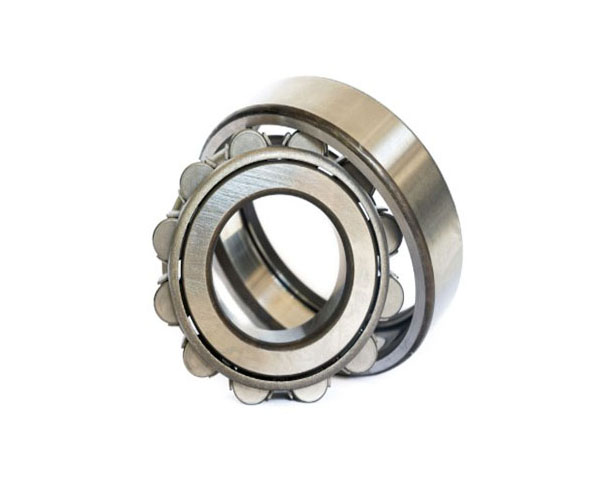
A cylindrical roller bearing (CRB) is a rolling-element bearing that uses straight cylindrical rollers as the rolling elements. The rollers maintain line contact with the inner and outer ring raceways, creating high radial stiffness and supporting very heavy radial loads. Cylindrical roller bearings are among the fastest roller bearing types due to their low friction characteristics.
Key Structural Features
- Straight cylindrical rollers with true line contact: The rollers are precisely ground to maintain straight geometry, creating a continuous line contact across the full roller length with the raceways.
- Separable design: Depending on the configuration, either the inner ring or outer ring can be removed separately from the roller and cage assembly. This simplifies mounting, dismounting, and maintenance, as the rings can be installed independently.
- Multiple flange configurations: The inner and outer rings may have integral flanges (ribs) that guide the rollers and, in some designs, provide limited axial load capacity.
- Crowned or end-relieved rollers: Many cylindrical roller bearings feature rollers with slight crowning or end relief to reduce edge stress concentrations under load.
- Caged vs. full-complement designs: Cylindrical roller bearings are available in two basic internal designs — caged types for higher speed operation and full-complement types (without cage) for maximum radial load capacity at lower speeds.
Designation Types and What They Mean
Single-row cylindrical roller bearings are classified by designation codes that indicate the flange arrangement and the bearing’s ability to accommodate axial loads and shaft expansion:
| Type | Inner Ring Flanges | Outer Ring Flanges | Axial Load Capability |
|---|---|---|---|
| NU | None | Both sides | None — free floating |
| N | Both sides | None | None — free floating |
| NJ | One side | Both sides | One direction |
| NF | Both sides | One side | One direction |
| NUP | One fixed + one loose flange | Both sides | Both directions |
The NU and N designs serve as non-locating bearings: they allow axial displacement of the shaft relative to the housing in both directions, accommodating thermal expansion without inducing axial loads. NJ, NF, and NUP designs offer varying degrees of axial location capability.
The Difference Between Spherical and Cylindrical Roller Bearings
Based on the six differences below, you can clearly distinguish the two bearing types and decide which fits your application.
Roller Geometry Difference
| Characteristic | Spherical Roller Bearing | Cylindrical Roller Bearing |
|---|---|---|
| Roller shape | Barrel-shaped (convex) | Straight cylinder |
| Contact with raceway | Modified line contact (oval patch) | True line contact |
| Behaviour under misalignment | Contact patch redistributes — stress is shared | Stress concentrates at roller ends |
| Radial stiffness | High | Very high |
The barrel-shaped rollers of a spherical bearing create an oval contact patch when loaded, providing flexibility and reducing stress concentration under misaligned conditions. Cylindrical bearings achieve true line contact across the full roller length, delivering maximum radial stiffness and precision. However, this makes cylindrical bearings highly sensitive to edge loading when misalignment occurs.
Misalignment Tolerance Difference
Spherical roller bearings are self-aligning and can typically tolerate 0.5° to 2° of angular misalignment, depending on the series and size. Some heavy-duty SRBs can accommodate up to 2° to 3° without significant performance degradation. This capability compensates for shaft deflection, housing distortion, and installation inaccuracies.
Cylindrical roller bearings have extremely limited misalignment tolerance. Even a small angular tilt — typically less than 0.04° — causes edge stress concentration at the roller ends, leading to premature raceway spalling and bearing failure. Precise alignment between shaft and housing is mandatory.
Load Capacity Difference (Radial and Axial)
Spherical roller bearings carry high radial loads and moderate-to-significant axial loads in both directions simultaneously. The double-row configuration spreads radial loads evenly across two rows of barrel-shaped rollers, while the spherical raceway geometry enables bidirectional axial thrust support.
Cylindrical roller bearings excel in purely radial load applications. Standard NU and N designs have no axial load capacity — they allow the shaft to float axially. NJ, NF, and NUP designs incorporate flanges that support light-to-moderate axial loads in one direction (NJ/NF) or light bidirectional loads (NUP). Cylindrical bearings should never be specified as the primary axial-load-carrying component for heavy thrust.
Speed Capability Difference
Cylindrical roller bearings achieve the highest operating speeds among all roller bearing types. The true rolling motion between cylindrical rollers and raceways generates minimal friction and low heat, making CRBs the preferred choice for high-speed applications such as electric motors, machine tool spindles, and turbines.
Spherical roller bearings generate more internal friction due to sliding contact between the barrel-shaped rollers and the guide ring flanges. They are suitable for moderate speeds only. Operating above the manufacturer’s reference speed accelerates cage wear and reduces service life.
Friction and Heat Generation Difference
Cylindrical roller bearings produce significantly lower friction because the rolling elements maintain pure rolling contact with minimal sliding. This results in lower operating temperatures, reduced energy consumption, and longer lubricant life.
Spherical roller bearings inherently generate higher friction. The barrel-shaped rollers must slide relative to the guide flanges as they roll within the spherical raceway, creating additional frictional torque. This makes spherical bearings more sensitive to lubrication quality and operating temperature, particularly at elevated speeds.
Mounting and Cost Difference
Cylindrical roller bearings are separable: inner and outer rings can be mounted independently. For NU-type bearings, the outer ring with roller assembly can be installed into the housing first, followed by the inner ring onto the shaft. This simplifies assembly, reduces maintenance downtime, and lowers replacement costs.
Spherical roller bearings are non-separable. The entire bearing — inner ring, two rows of rollers, cage, and outer ring — must be handled as a single unit. Larger SRBs can be heavy and require careful handling. However, spherical bearings generally require less precise housing machining because their self-alignment capability compensates for minor bore misalignment, which can offset some manufacturing costs.
Summary: Choose spherical roller bearings when your application involves shaft misalignment, combined radial-axial loads, or shock/vibration. Choose cylindrical roller bearings when radial stiffness, high rotational speed, and precise shaft positioning are the primary requirements — provided misalignment can be controlled below 0.04°.
How to Choose Between Spherical and Cylindrical Roller Bearings
Based on the six differences above, the following application guide helps you select the correct bearing type.
When to Choose a Spherical Roller Bearing
- Heavy equipment with long or flexible shafts — Conveyor systems, vibrating screens, bulk handling equipment where shaft deflection is unavoidable.
- Shock and vibration environments — Mining crushers, hammer mills, road construction equipment where impact loads occur.
- Combined radial and axial loads — Industrial gearboxes, paper mill rolls, wind turbine main shafts.
- Wind turbines — The main shaft bearing must accommodate shaft deflection under varying wind loads while handling high radial and thrust forces.
- Field installation with limited precision tooling — When perfect alignment of bearing housings cannot be guaranteed.
When to Choose a Cylindrical Roller Bearing
- High-speed electric motors — Low friction and high radial stiffness for rotor support.
- Machine tool spindles — High radial stiffness, low heat generation, and running accuracy.
- Rolling mill roll necks — Multi-row CRBs handle extreme radial loads while maintaining precise roll positioning.
- Gearboxes with spur gears — NU-type cylindrical bearings serve as floating bearings where radial loads dominate and thermal expansion must be accommodated.
- Applications requiring frequent dismounting — The separable design allows easy inspection and replacement.
The Most Common Selection Mistakes
Using cylindrical bearings where misalignment exists — Installing a CRB in an application with shaft deflection or housing distortion leads to edge loading and premature failure. If misalignment is present, specify a spherical roller bearing.
Running spherical bearings above their speed rating — Operating beyond the manufacturer’s reference speed accelerates cage wear and reduces life. When high speed is required, choose cylindrical roller bearings.
Ignoring axial load when choosing a cylindrical bearing designation — Specifying an NU or N-type bearing in an application with any axial load results in metal-to-metal contact. Use NJ, NF, or NUP types when limited axial load is present.
Specifying spherical bearings in precision machinery — The internal clearance and self-alignment feature of SRBs make them unsuitable for applications requiring extremely precise shaft positioning (e.g., CNC spindles). Cylindrical roller bearings offer superior radial stiffness and running accuracy.
Using ribbed cylindrical bearings (NJ/NUP) as thrust bearings — Ribbed cylindrical bearings accommodate incidental axial loads only, not sustained heavy thrust. For heavy axial loads, use dedicated thrust bearings or angular contact ball bearings.
Quick Decision Checklist
Choose a Spherical Roller Bearing if:
- Shaft misalignment may exceed 0.04° under any operating condition
- The load involves both radial and axial components simultaneously
- Shock loads, heavy vibration, or impact are part of the duty cycle
- Operating speed is within the bearing’s reference speed (consult manufacturer data)
- Field installation with limited precision tooling is required
- A single bearing unit handling multiple load directions simplifies the arrangement
- The application is in mining, cement, steel, or paper mills
Choose a Cylindrical Roller Bearing if:
- Shaft and housing alignment can be precisely controlled and sustained in service
- The primary load is radial with little or no axial component
- High rotational speed is a design requirement
- Maximum radial stiffness and geometric precision are needed
- Frequent dismounting and refitting is part of the maintenance routine
- Minimising bearing unit cost in a well-aligned system is a priority
- The application involves electric motors, machine tool spindles, rolling mills, or high-speed gearboxes
Quick Reference Table
| Parameter | Spherical Roller Bearing | Cylindrical Roller Bearing |
|---|---|---|
| Radial load capacity | Excellent (double row) | Excellent (very high) |
| Axial load capacity | Moderate to significant, bidirectional | None (NU/N), light unidirectional (NJ/NF), light bidirectional (NUP) |
| Speed capability | Moderate | Very high |
| Misalignment tolerance | 0.5°–2° (up to 3°) | <0.04° (practically none) |
| Separability | Non-separable | Separable |
| Typical relative cost | Higher | Lower (standard types) |
Frequently Asked Questions
Q1: How do I know if my application has a misalignment risk?
A1: Misalignment can arise from shaft deflection (common in long, slender shafts), housing distortion, foundation settlement, pipe strain, or machining inaccuracies. If your shaft length-to-diameter ratio exceeds 15:1, or equipment is mounted on a flexible structure, misalignment should be assumed. Use dial indicators or laser alignment tools to verify.
Q2: Can a cylindrical roller bearing replace a spherical roller bearing?
A2: Generally, no. Cylindrical roller bearings lack self-alignment capability. Replacing an SRB with a CRB in a misaligned application leads to rapid failure due to edge loading. A spherical roller bearing can sometimes replace a cylindrical bearing if misalignment exists and speed requirements permit.
Q3: Which bearing carries higher loads?
A3: Both have high radial load capacity. Spherical roller bearings generally offer higher combined (radial + axial) load capacity due to double-row design and bidirectional axial support. For purely radial loads, cylindrical roller bearings of comparable dimensions typically have a slightly higher rating because the full roller length engages in line contact.
Q4: Do spherical roller bearings need more maintenance?
A4: Yes, in most cases. Spherical roller bearings are more sensitive to lubrication quality and require more frequent relubrication than cylindrical bearings under similar conditions. The internal sliding friction generates more heat, which degrades lubricants faster.
Q5: Which bearing is better for conveyor systems?
A5: Spherical roller bearings are generally preferred for conveyor head, tail, and bend pulleys because their self-alignment capability accommodates shaft deflection and housing misalignment, and sealed versions retain lubricant effectively in dusty environments.
Q6: What is the difference between a spherical plain bearing and a spherical roller bearing?
A6: Spherical plain bearings use sliding contact between a spherical inner ring and outer ring — no rolling elements. They accommodate misalignment and oscillation at low speeds with higher friction. Spherical roller bearings use rolling elements (barrel-shaped rollers) and are designed for continuous rotation at higher speeds with lower friction.
Q7: How do lubrication requirements differ between the two bearing types?
A7: Cylindrical roller bearings operate reliably with ISO VG 68 to 150 oils in most high-speed applications, and grease is suitable for moderate speeds. Spherical roller bearings are more sensitive: for low-speed, high-load conditions, ISO VG 220 to 460 oils or greases containing extreme-pressure (EP) additives are commonly required. Spherical bearings also typically need shorter relubrication intervals.
Q8: What is the expected service life difference?
A8: Basic rating life follows the same ISO formula L₁₀ = (C/P)^(10/3) for both types. However, in practice, spherical roller bearings often have shorter actual life than cylindrical bearings under identical ideal conditions because of higher internal friction and heat generation. The difference becomes significant at higher speeds or poor lubrication. Always use manufacturer-adjusted life calculations that account for lubrication, contamination, and misalignment.