
Basic Design
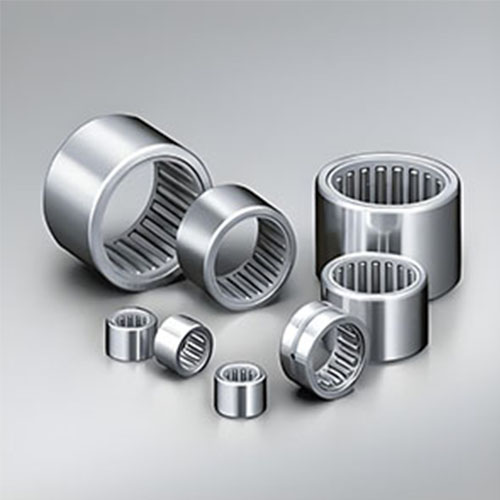
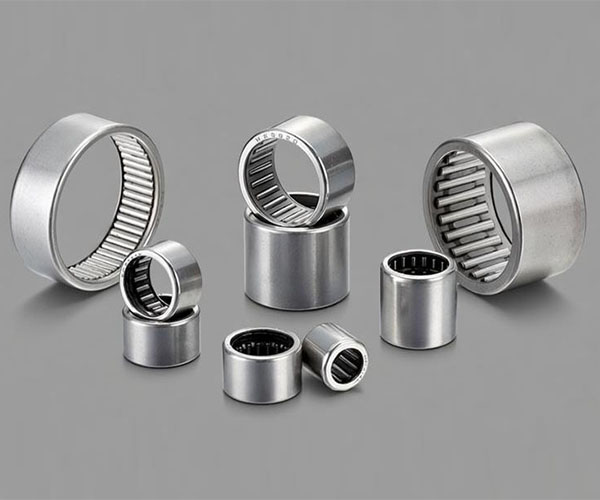
A needle roller bearing is a rolling element bearing that uses long, thin cylindrical rollers. The length of each roller is at least four times its diameter. This geometry allows the bearing to maintain a low profile while supporting relatively high radial loads.
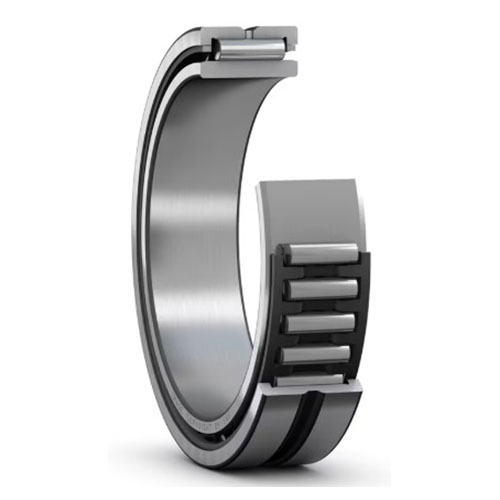
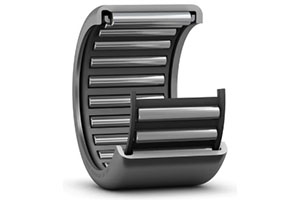
The main components are the outer ring (either stamped from steel sheet or machined from solid stock), the needle rollers, and usually a cage that separates and guides the rollers.
Key Advantages
- High radial load capacity within a small radial cross-section. The height is significantly lower than ball bearings or cylindrical roller bearings of comparable bore diameter.
- Caged bearings reduce friction and enable higher rotational speeds; Full complement (cageless) bearings maximize roller count for the highest radial load capacity, suitable for low-to-medium speed applications.
- Drawn cup design allows press-fit mounting directly into housing bores. No snap rings, shoulders, or separate housing rings are required, simplifying assembly and reducing component costs.
- Solid machined ring construction provides higher rigidity, better dimensional accuracy, and higher permissible speeds. Chosen for precision machine tools, high-speed gearboxes, and heavy industrial drives.
- Standardized dimensions ensure direct interchangeability with major international brands.
Needle Roller Bearing Selection
Proper selection requires evaluation of load type and direction, dimensional constraints, rotational speed, operating cycle, lubrication strategy, and environmental conditions. This section provides a technical overview for specifiers and maintenance engineers.
Load Type and Direction
Needle roller bearings are primarily designed for radial loads, meaning forces perpendicular to the shaft axis. A standard radial needle roller bearing cannot support axial loads. If the application requires axial load support, a thrust needle roller bearing (AXK series with washers) or a combined bearing (which integrates radial and axial rolling elements in one unit) must be specified.
Radial needle roller bearings (drawn cup HK/BK types and solid NA/NKI types) support pure radial loads only. They have no axial load capability. Thrust needle roller bearings (AXK series) support pure axial loads in one direction, with very low axial height. Combined bearings incorporate both radial needle rollers and axial ball or roller complements, allowing the same bearing to handle both load directions simultaneously.
Dimensional Sizing and Fit Selection
Three core dimensions must be determined: bore diameter (inside diameter), outside diameter, and width. For drawn cup needle roller bearings (HK, BK, HMK series), the housing bore is designed to accept the bearing with a press-fit interference. Recommended housing bore tolerances are H6 or H7, depending on operating conditions and housing material. For solid needle roller bearings with inner rings (NA, NKI), the shaft tolerance should follow ISO h5 or j5 for rotating shaft applications. When selecting bearings without inner rings (RNA, NKS), the shaft itself serves as the raceway and must be hardened to a minimum of 58 HRC and precision ground.
Speed Ratings and Cage Selection
Ball bearings are generally better suited for very high speed applications. Needle roller bearings handle higher radial loads but operate at lower speeds. Caged needle roller bearings incorporate a steel or polyamide cage that separates rollers. This reduces friction, improves lubricant distribution, and permits higher rotational speeds compared to full complement designs. Full complement (cageless) needle roller bearings contain the maximum possible number of rollers, delivering the highest radial load capacity among all needle bearing configurations. However, this increase in load capacity comes with higher internal friction, more heat generation, and lower permissible speeds. Full complement designs are ideal for heavy load, low-to-moderate speed applications such as planetary gear systems and oscillating mechanisms.
Operating Cycles and Motion Type
Evaluate the expected rotational speed (rpm), load constancy, and required service life. Needle roller bearings function effectively under full rotation or partial rotation with sufficiently large angular travel. They are generally not recommended for oscillatory motion with very small swing angles, such as only a few degrees of reciprocation. Under such conditions, the same groups of rollers repeatedly contact the same raceway zones. The lubricant film is squeezed out, and local wear accelerates. This condition is known as false brinelling or fretting corrosion.
Lubrication and Environmental Protection
Before installation, apply a thin, uniform layer of grease or oil to the shaft and housing bore. This reduces insertion friction, inhibits oxidation, and ensures the bearing runs freely from startup. Environmental factors including dust, moisture, washdowns, and chemical exposure dictate the required sealing arrangement and lubricant type. For food processing applications, NSF H1 food-grade greases are mandatory. Sealed versions (suffix RS, 2RS, or UU) incorporate contact seals that retain lubricant and block contamination ingress. In harsh environments, aligning needle roller bearings with integrated sealing may be specified.
Material Selection: Bearing Steel vs. Stainless Steel
Standard needle roller bearings are manufactured from high-carbon chromium bearing steel (AISI 52100 / GCr15), hardened to HRC 60-65 and precision ground. This material provides optimal hardness, wear resistance, and fatigue life for most industrial and automotive applications. Stainless steel needle roller bearings (typically 440C) offer corrosion resistance for food processing equipment, medical devices, pharmaceutical machinery, and marine applications requiring regular washdowns or exposure to water and mild chemicals. Non-standard surface coatings such as hard chrome or black oxide may be applied for additional protection in specific applications.
Basic Service Life Calculation per ISO 281
Needle roller bearing basic rating life follows the ISO 281 standard for roller bearings: L10 = (C / P)^(10/3) x 10^6 revolutions. The exponent 10/3 applies to all roller bearings. When only radial load Fr is applied, the equivalent dynamic bearing load P equals Fr. Adjusting factors for lubrication and contamination (a_ISO) may be used for more precise modified life estimations (Lnm). Consult manufacturer catalogs for the specific dynamic load rating C (expressed in kN) for each product series.
Standards and Interchangeability
Needle roller bearing boundary dimensions conform to ISO 1206-1982 and ISO 15:1998 for metric series. Inch-series dimensions follow ABMA standard 18.1. This standardization ensures that HK series, BK series, NK series, NA series, RNA series, and AXK thrust series are fully interchangeable across major global brands.
Product Types and Series
Needle roller bearings are classified into three primary categories based on outer ring construction: drawn cup (thin-walled stamped outer ring), solid (machined outer ring), and aligning (spherical outer diameter for misalignment compensation).
- Product Types
- Drawn Cup Series
- Solid Series
- Aligning Series
Product Types
Each needle roller bearing type serves specific application requirements. Drawn cup bearings prioritize space efficiency and cost-effectiveness. Solid bearings provide higher rigidity and precision. Aligning bearings compensate for angular misalignment between shaft and housing.
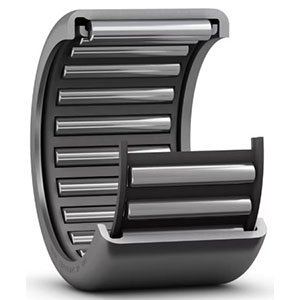
Drawn Cup Needle Roller Bearings-Thin-walled outer ring stamped from steel sheet. Press-fits directly into housing bore, eliminating separate housing rings. Offers the smallest radial cross-section among rolling bearings. Suitable for compact gearboxes, automotive transmissions, and applications where installation space is extremely limited.
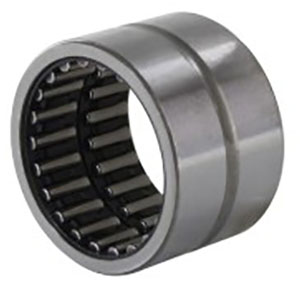
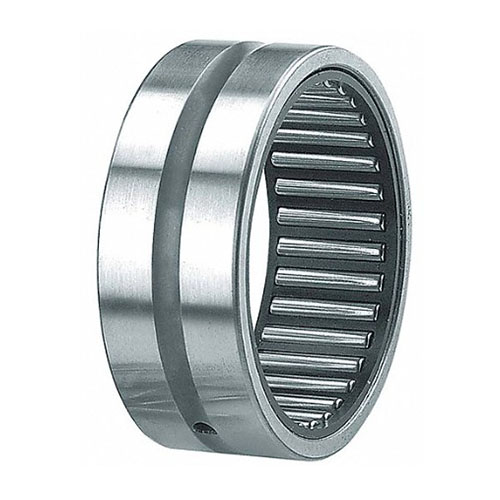
Solid Needle Roller Bearings-Machined outer ring from bearing steel, vacuum-degassed and precision ground. Higher radial rigidity, dimensional accuracy, and permissible speeds compared to drawn cup types. Designed for machine tools, high-speed gearboxes, heavy industrial drives, and applications requiring extended service life under high loads.
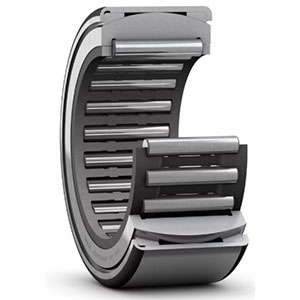
Aligning Needle Roller Bearings-Spherical outer ring surface seats into a matching concave housing bore or support ring. Compensates static misalignment up to 2-3 degrees. Prevents edge loading and premature wear caused by shaft deflection, mounting errors, or housing irregularities. Commonly used in universal joints, agricultural linkages, and cam followers.
Drawn Cup Needle Roller Bearing Series
Drawn cup needle roller bearings are manufactured from precision-drawn steel sheet with surface-hardened raceways. They are available in metric and inch dimensions, with or without cages, and with open ends, closed ends, or integral flanges for axial positioning. The following series are the most common aftermarket types.
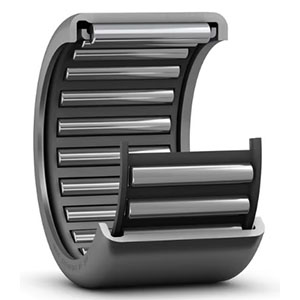
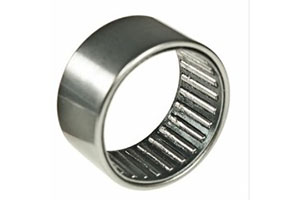
HK Series-Open-ended drawn cup needle roller bearing with cage. Features a deep-drawn, thin-walled outer ring for maximum radial load capacity in minimal space. Designed for applications requiring high dynamic loads or limited radial installation space. Can be mounted with tight interference fit, simplifying housing bore design. Widely used in automotive transmissions and two-cycle engines. Equipped with a cage for roller guidance.
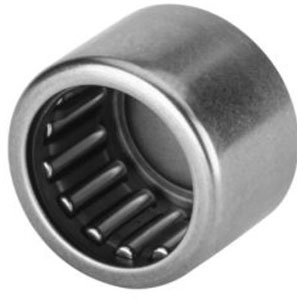
BK Series-Closed-end drawn cup needle roller bearing with similar design to HK series but with one end closed. The closed end provides axial location and acts as a shield against contamination entry. Suitable for shafts extending to the end of the housing where open-ended bearings cannot be used. Ideal for gearboxes where preventing debris ingress is critical while maintaining high radial load capacity and compact design.
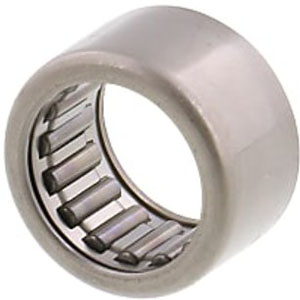
HMK Series-Metric drawn cup needle roller bearing series with press-fit outer ring and cage-guided rollers. Designed for very high radial loads and moderate speeds where housing bore cannot serve as raceway. The through-hardened outer ring provides a precise raceway for the needle rollers. Commonly used in truck transmissions, agricultural machinery, and industrial gearboxes requiring high radial stiffness and reliability under variable loads.
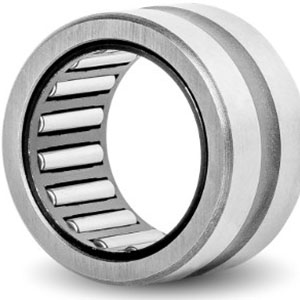
RNA49 Series-Metric drawn cup needle roller bearing without inner ring. Designed for use with shafts hardened and ground as raceways. Achieves very high radial load capacity in minimal radial section. The pressed outer ring with integrated raceway offers compactness and economy. Popular replacement for OEM applications in transmissions, compressors, and light industrial machinery requiring maximum load in limited space.
Solid Needle Roller Bearing Series
Solid needle roller bearings feature outer rings machined from bearing steel. They offer higher load capacity, better dimensional accuracy, and greater rigidity than drawn cup types. Available with or without inner rings, in single-row or double-row configurations, and with steel or polyamide cages. The following series are widely stocked in the aftermarket.
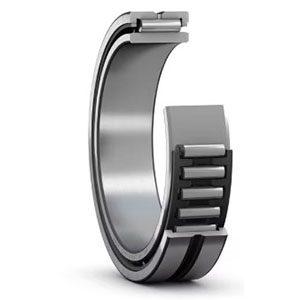
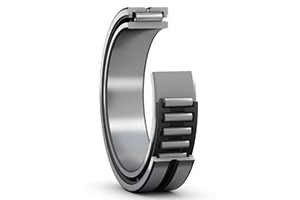
NA49 Series-Single-row machined solid outer ring needle roller bearing with inner ring. Ready-to-fit complete unit offering high radial capacity for applications where shaft cannot serve as raceway. Features integral lubrication holes, steel cage, and separable design for assembly ease. Widely used in industrial gearboxes, compressors, pumps, and material handling equipment requiring robust radial support. Accepts moderate axial loads.
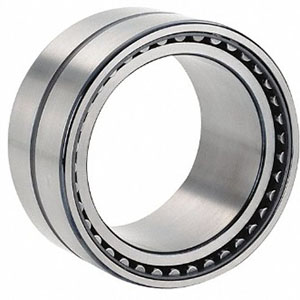
NKI Series-Machined-ring needle roller bearing with inner ring. Designed for maximum radial load capacity with thin cross-section. Comprises high-quality bearing steel, hardened raceways, and glass fiber reinforced polyamide cage (PA66) for high-speed capability. Available in standard and compact series. Suitable for automotive transmissions, industrial pumps, and agricultural machinery where space is limited but reliability essential.
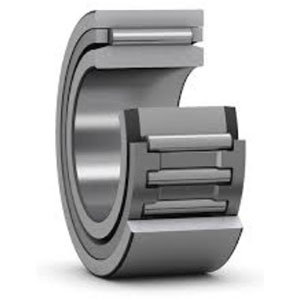
NAO Series-Double-row machined needle roller bearing with inner ring and outer ring, no cage. Full complement design for highest radial load capacity in compact dimensions. The cageless arrangement uses maximum possible rollers, providing extreme radial stiffness and ability to accommodate shock loads. Popular in construction equipment, crane sheaves, and heavy conveyor systems requiring brute force radial capacity.
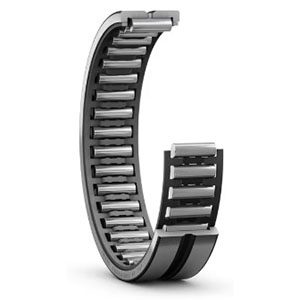
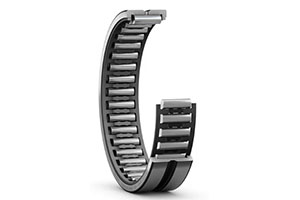
NKS Series-Single-row solid outer ring needle roller bearing without inner ring. For high-speed applications where shaft raceway can be hardened and ground. Features precision machined outer ring with integral flanges for roller guidance. Uses nylon cage for low friction and high limiting speed. Common in electric motors, compressors, and turbine engines where lightweight, compact radial support is essential.
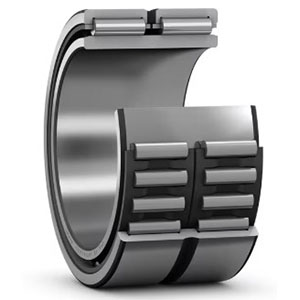
NA69 Series-Double-row solid needle roller bearing with inner ring, double the rollers in width dimension. Very high radial load capacity. Commonly used in planetary gearboxes where two separate bearings would occupy too much axial space. The cage-guided rollers ensure smooth operation under high speeds and moderate misalignment. Available sealed or open.
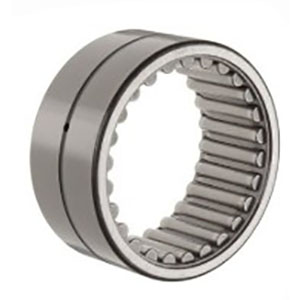
NA48 Series-Light series solid needle roller bearing with inner ring, thinner cross-section than NA49 for same bore. Allows higher speeds due to lower roller mass while still offering good radial capacity. Suitable for paper machinery, printing presses, and textile equipment where limited space and high speeds demand efficient bearing design. Open type with steel cage and lubrication features.
Aligning Needle Roller Bearing Series
Aligning needle roller bearings incorporate a spherical outer ring surface. When mounted in a corresponding concave housing bore, they compensate for static misalignment up to 2-3 degrees. This prevents edge loading and extends bearing life in applications with shaft deflection or mounting errors. The following series are common in aftermarket catalogs.
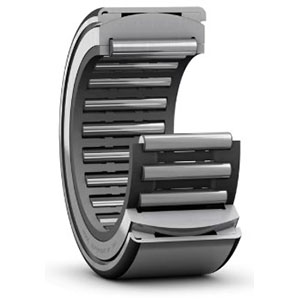
RPNA Series-Single-row aligning needle roller bearing without inner ring. Features spherical outer ring outer diameter, allowing misalignment compensation up to 2° when mounted in a matched spherical housing bore. Designed for applications where shaft deflection or mounting errors cause misalignment. The caged needle assembly remains correctly aligned despite angular errors, preventing edge loading and extending bearing life.
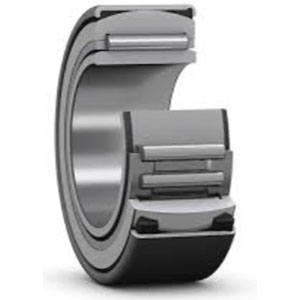
PNA Series-Single-row aligning needle roller bearing with outer ring, split inner ring, and sphered housing washer. Provides misalignment compensation while accepting moderate radial loads. The split inner ring design simplifies assembly onto shafts and allows for radial clearance adjustment after mounting. Applications include automotive universal joints, agricultural equipment, and linkage bearings experiencing angular displacement during operation.
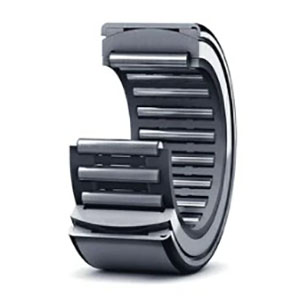
Compact Aligning Needle Roller Bearing Series-Compact aligning needle roller bearing with adhesive seal and spherical OD. Used in tape drives and compact robotics. Provides misalignment accommodation for precision motion control where limited space prohibits larger spherical solutions. Can handle high speeds despite low friction seals, maintaining cleanliness and alignment.
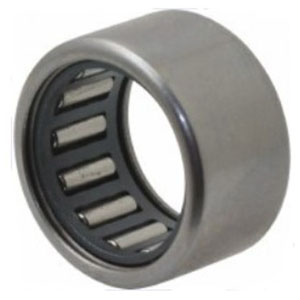
Inch-Series Drawn Cup Aligning Needle Bearing-Inch drawn cup needle roller bearing with spherical outer race. For applications originally designed for inch-series aligning bearings, widely used in tractor linkage pivot joints, backhoe buckets, and industrial loaders allowing oscillation without edge stress. Non-separable design, pre-lubricated, and easily removed for replacement.
Other Roller Bearing Types
In addition to needle roller bearings, DUHUI Bearing manufactures a comprehensive range of roller bearing types for applications requiring different load-handling characteristics, higher speeds, or combined load support.
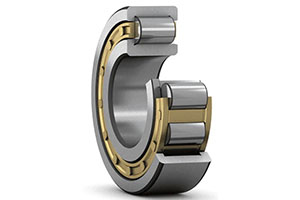
Cylindrical roller bearings utilize cylindrical rolling elements with line contact to outer and inner raceways. These bearings accommodate high radial loads at high speeds but provide negligible misalignment accommodation. Applications include electric motor shafts, gearboxes, and machine tool spindles requiring high radial stiffness.
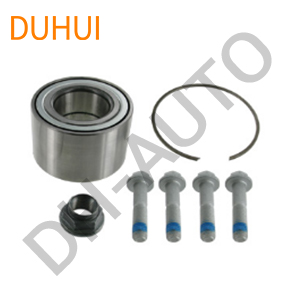
Tapered roller bearings feature conical rollers and raceways angled to handle combined radial and thrust loads. Single-row units support axial load in one direction only; paired sets accommodate bidirectional thrust. Standard for automotive wheel hubs, differential assemblies, and heavy-duty truck axles.
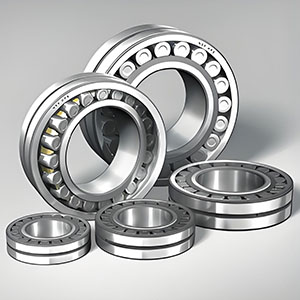
Spherical roller bearings accommodate heavy radial loads, moderate axial loads, and angular misalignment simultaneously. Two rows of barrel-shaped rollers operate between a spherical outer ring raceway and two inner ring raceways. Permissible misalignment typically 1.5-2.5 degrees. Suitable for harsh environments including mining, steel mills, vibratory screens, and paper machinery.
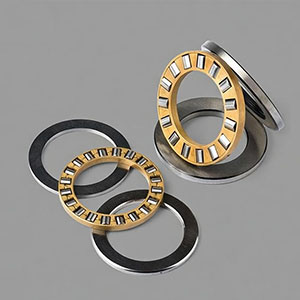
Thrust needle roller bearings (AXK series) consist of an axial needle roller and cage assembly fitted between two hardened washers (AS or LS). Compact axial height suits space-constrained assemblies, supporting high axial loads in one direction. Commonly used in automotive transmissions, power steering pumps, compressors, and industrial gearboxes requiring axial thrust in minimal axial space.
Applications
Needle roller bearings are specified across industries where high radial load capacity, compact radial cross-section, and reliable operation over extended cycles are required. The following sections detail specific applications by equipment category.

Manual and automatic transmissions use needle roller bearings on layshafts, countershafts, constant mesh gears, planetary gear sets, and selector shafts. Drawn cup bearings fit in narrow gear web spaces while solid types support higher dynamic loads on mainshafts.
Connecting rod big ends and small ends, rocker arm pivots, camshafts, and crankshafts rely on needle roller and cage assemblies. These compact bearings withstand shock loads, high temperatures, and marginal lubrication conditions while maintaining smooth rotation.
Motorcycle transmissions, clutches, swingarm pivots, and rear wheel supports utilize drawn cup and caged needle bearings for lightweight construction combined with high load capacity. Suspension linkages and universal joints incorporate aligning needle bearings for angular compensation under articulation.
Hydraulic piston pumps, vane pumps, air conditioning compressors, and reciprocating compressors specify needle roller bearings on rotating shafts and connecting rod pins. Solid types with inner rings are selected when the shaft cannot be hardened and ground as a raceway.
Planetary gearboxes, helical and spur gear reducers, and right-angle drives use needle roller bearings on planet gears and intermediate shafts. High-capacity solid NA69 double-row bearings and drawn cup HK bearings are standard selections for parallel-shaft and coaxial reducer designs.
Tractors, combine harvesters, forage harvesters, and balers require needle roller bearings in transmission drivelines, rake pivots, and PTO shafts. Sealed aligning bearings protect against dust and moisture ingress while compensating for frame flex and misalignment.
Technical Comparison Articles
Selecting the optimal bearing type requires balancing load capacity, speed, misalignment tolerance, and mounting configuration. The following comparison articles assist in making technically informed selections for specific application requirements.
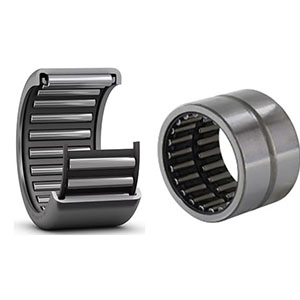
Drawn cup bearings minimize radial space and cost using thin-walled stamped outer rings press-fitted into housings. Solid bearings offer higher rigidity, precision, and permissible speeds via machined rings. Drawn cup types are preferred for high-volume transmission shafts; solid bearings for machine tool spindles and high-speed industrial gearboxes. This comparison examines dynamic load ratings, speed limits, and mounting requirements.
For more details, please read“Drawn Cup vs Solid Needle Roller Bearings”
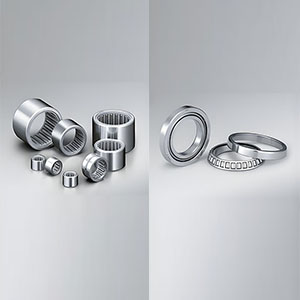
Needle roller bearings deliver higher radial load capacity per unit radial cross-section than tapered roller bearings, making them suitable for space-constrained shafts. Tapered roller bearings support combined radial and axial loads in one direction without requiring separate thrust bearings. Select needle bearings when axial space for radial loads is the primary constraint; select tapered bearings when combined loads demand monolithic support within moderate radial dimensions.
For more details, please read“Needle vs Tapered Roller Bearings”
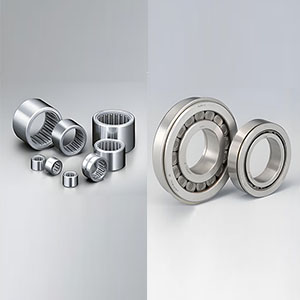
Cylindrical roller bearings permit higher speeds than comparably-sized needle roller bearings due to larger roller diameters and reduced roller-raceway contact stress density. However, needle bearings provide lower cross-sectional height and higher load capacity within the same radial envelope. This article compares limiting speeds, dynamic load ratings, and dimensional trade-offs for gearbox shaft supports, electric motor rotor location, and planetary transmission designs.
For more details, please read“Needle vs Cylindrical Roller Bearings”
Related Needle Roller Bearing Models
DUHUI Bearing maintains inventory of the following high-demand needle roller bearing models across drawn cup and solid series. All dimensions and load ratings conform to ISO standards and major brand interchangeability requirements.
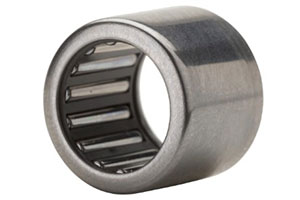
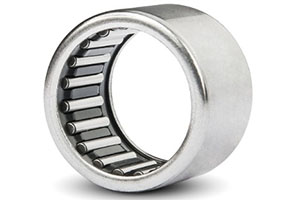
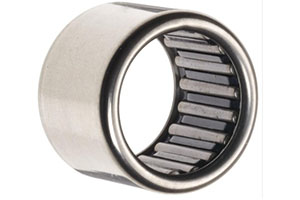
Needle Roller Bearing Installation, Maintenance, and Troubleshooting
Correct installation, regular inspection, and prompt diagnosis of operating anomalies are essential for achieving the specified service life of needle roller bearings. This section consolidates proven installation methods, verification procedures, fault diagnosis, and preventive maintenance recommendations based on industry standards and original equipment manufacturer practices.
Installation Methods Comparison
Select the appropriate installation technique based on bearing size, interference fit magnitude, and available tooling.
Press Fitting is the standard method for drawn cup bearings and solid bearings with moderate interference. Apply force uniformly to the bearing ring that has the interference fit. For drawn cup bearings, only the outer ring face is pressed. For solid bearings mounted onto shafts, only the inner ring face is pressed. Never transmit force through the needle rollers or cage. Use a mechanical or hydraulic press with a precisely machined sleeve that contacts only the intended ring face.
Shrink Fitting is used for heavy interference fits where cold press methods would risk distortion or scoring. Heat the housing uniformly to 80°C–120°C, expanding the bore dimensionally. Insert the bearing, and upon cooling, the housing contracts to secure the outer ring with the correct interference. Induction heating equipment provides controlled, localized expansion without an open flame.
Adhesive Fixing offers an alternative when conventional press or shrink fits are impractical in thin-walled housings or composite structures. Bearing-specific retaining compounds (anaerobic adhesives) fill the annular gap between the bearing outer ring and housing bore, curing to secure the bearing while accommodating minor bore irregularities. Select the grade based on operating temperature, media exposure, and required shear strength.
Manual Installation uses bearing installation blocks, drive plates, and sleeve adaptors for small bearings or field repair scenarios. Use a brass or nylon hammer to drive the sleeve uniformly. Avoid striking rollers or cages directly.
Specialized Tooling such as induction heaters with temperature-controlled cycles, hydraulic pullers for dismounting, and centering mandrels for multi-bearing shaft assemblies improves installation accuracy and reduces the risk of damage during replacement operations.
Post-Installation Verification
After installation, manually rotate the shaft or housing to confirm smooth rotation without unusual resistance or audible noise. Any roughness, foreign sound, or torque variation indicates potential misalignment, contamination, or installation error requiring immediate investigation.
Verify that the bearing ring end face is fully seated against the shaft shoulder or housing bore shoulder. Even small axial gaps permit axial migration during operation, leading to misalignment, edge loading, and early fatigue failure.
Confirm the correct grease fill quantity. The bearing internal free space should be filled to one-third to one-half with grease. Overfilling raises operating temperature due to churning losses and may cause grease leakage past seals. Underfilling reduces lubricant film thickness and accelerates roller-raceway contact fatigue.
For sealed bearings (suffix RS, 2RS, UU), inspect the sealing lip visually for cuts, distortion, or extrusion. Any seal damage compromises contamination protection and grease retention, altering the lubrication regime and reducing useful life.
Common Failure Types – Symptoms and Root Causes
Shaft Raceway Wear or Galling. Symptoms include polished zones or material transfer on the shaft surface acting as a raceway, increased rotational noise, and rising operating torque. Primary causes: insufficient shaft surface hardness (below 58 HRC for a bearing raceway), excessive shaft surface roughness (Ra exceeding 0.2 micrometers for precision applications), or lubricant film breakdown due to low oil-film-strength grease.
False Brinelling / Fretting Corrosion. Dark spots spaced at roller pitch intervals, red or brown oxide powder (fretting corrosion residue), and startup noise after periods of machine inactivity. This condition arises from vibration during transport or prolonged idle periods. The oscillatory motion at standstill squeezes lubricant from the roller-raceway contact zone, permitting direct metal-to-metal contact followed by oxidation.
Drawn-Cup Creep / Housing Rotation. Relative rotation between the cup outer diameter and housing bore wears the outer cup surface and may elevate bearing temperature. Root causes: housing material too soft or housing bore tolerance exceeding H7, resulting in insufficient press-fit interference. Drawn cup bearings must be seated with interference sufficient to prevent rotation under applied radial loads.
High Operating Temperature. Sustained bearing temperature exceeding 80-90°C degrades grease, reduces lubricant viscosity, and shortens calculated life. Potential causes: radial internal clearance too small following press-in mounting with excessive interference; grease overfill or incorrect viscosity grade; use of full complement bearing design at rotational speeds exceeding its lower speed limit.
Micropitting. Fine surface-initiated spalls distributed across the raceway, originating from surface fatigue. Contributing factors: insufficient lubricant film thickness allowing asperity contact; particulate contamination circulating in the lubrication system; operating speeds exceeding the design speed rating for the caged or full complement configuration.
Preventive Maintenance and Monitoring Recommendations
Dynamic monitoring of operating temperature and vibration levels should be logged at regular intervals. An infrared thermometer or thermal imaging camera detects abnormal temperature gradients across adjacent bearing positions. A hand-held vibration meter collects baseline data for trend analysis. Sudden increases in overall vibration amplitude indicate progressive rolling contact fatigue or contamination ingress.
Scheduled inspection intervals vary with operating environment. Dusty or abrasive agricultural and mining environments require lubricant and seal checks every 500 operating hours. Clean indoor industrial environments such as machine tool spindles allow extended inspection intervals up to 2000 hours. Service history records should include measured temperature, vibration data, and observed grease condition.
Replacement indicators include persistent abnormal audible noise after warm-up, deteriorating rotational precision (detected as increased runout or shaft displacement), or sudden temperature spikes beyond the bearing material’s thermal limit. When dismounting failed bearings, use a bearing puller with legs engaging the inner or outer ring face. Never apply force through the rolling elements or cage. Classify removed bearings by wear pattern to diagnose root causes.
Installation Best Practices
Prohibit hammering or impact loading through the needle rollers or cage under any circumstances. For solid bearings without integral flanges or shoulders, employ a guide sleeve that contacts the bearing ring face squarely, ensuring straight alignment during mounting. Clean all mating surfaces thoroughly before installation. Apply a thin layer of lubricant to facilitate insertion and protect against initial corrosion.
A needle roller bearing uses long, thin cylindrical rollers (needles) with a length at least four times the diameter, giving the bearing a very low cross-sectional height. A cylindrical roller bearing uses shorter, larger-diameter rollers, resulting in higher cross-sectional height but higher permissible speeds. Needle roller bearings are selected primarily for radial space-constrained applications where maximum load capacity per radial envelope is required.
Standard radial needle roller bearings support pure radial loads only; they are not designed for axial force accommodation. To support axial loads, specify thrust needle roller bearings (AXK series with washers) or combined bearings that integrate radial needle bearings with axial ball or roller complements.
Drawn cup bearings have an outer ring precision-stamped from sheet steel, yielding the lowest possible radial cross-section and lower manufacturing cost, suitable for high-volume production. Solid (machined) bearings have outer rings machined from bearing steel bar stock, offering higher radial rigidity, better dimensional precision, and higher permissible speeds. Select drawn cup for compact, cost-sensitive designs; select solid for high-speed, high-precision, or high-reliability applications.
Caged bearings incorporate a cage that separates and guides each needle roller. Separating reduces friction, improves lubricant distribution, and permits higher rotational speeds at the expense of reduced roller count and therefore lower radial load capacity. Full complement bearings omit the cage, allowing the maximum possible number of rollers – increasing radial load capacity significantly but generating higher internal friction and limiting permissible speeds. Choose caged for medium-to-high speed applications; choose full complement for heavy static and low-to-medium dynamic radial loads.
For solid needle roller bearings (NA, NKI), radial clearance is measured with feeler gauges or clearance gauges after installation in accordance with ISO 5753-1 clearance groups (C2, CN, C3, C4). For drawn cup bearings installed via press-fit into a housing bore, working clearance is determined by the combined influence of interference fit and shaft tolerance. For bearings without inner rings (RNA), the shaft must be manufactured to specified tolerances (h5 or j5) to achieve recommended operating clearance.
Preventing the transmission of installation forces through the needle rollers or cage is mandatory. Apply press or mounting force strictly to the bearing ring that has the interference fit (outer ring for press-fit drawn cup bearings; inner ring for solid bearings mounted onto shafts). Use installation sleeves that contact only the intended ring face. Never strike rollers or cages directly with a hammer or impact tool.
Open needle roller bearings require periodic relubrication via lubrication grooves and holes in the outer ring. Sealed bearings (suffix RS, 2RS, UU) are pre-filled with grease at the factory and are generally maintenance-free under normal operating conditions. In high-temperature (above 100°C), high-speed, or contaminated environments, even sealed bearings require replacement at defined service intervals or periodic relubrication using the manufacturer’s specified grease grade and quantity.
False brinelling occurs when a non-operating machine is subjected to external vibration, often during transportation or extended idle periods. The oscillatory movement at standstill squeezes the lubricant film out of roller-raceway contacts. In the absence of lubricant, metal-to-metal contact occurs and the contact points oxidize, forming red-brown fretting corrosion marks. Prevention measures include improved packaging restraints, periodic shaft rotation during storage, and application of anti-fretting coatings or greases engineered for vibration resistance.
Standard needle roller bearings are manufactured from high-carbon chromium bearing steel (AISI 52100, GCr15), hardened to HRC 60-65 and precision-ground. This material provides optimal core toughness and surface hardness for rolling contact fatigue in industrial and automotive applications. Stainless steel needle roller bearings (440C stainless steel) offer corrosion resistance for food processing, medical device, pharmaceutical, and marine applications where moisture, chemicals, or washdowns would corrode standard steel bearings.
Needle roller bearings operate efficiently under full rotation or partial rotation with large angular travel. When the bearing is limited to very small oscillating angles (e.g., only a few degrees of reciprocation), the same group of needle rollers repeatedly contacts the same raceway zones without distributing the load. The reciprocating motion does not replenish the lubricant film, causing local heating, lubricant film failure, and accelerated roller-raceway wear (false brinelling). For such oscillatory motions, specially lubricated sliding bearings or spherical bearings are generally preferred.
The basic rating life (L10) for needle roller bearings is governed by ISO 281, using the roller bearing exponent of 10/3: L10 = (C / P)^(10/3) × 10^6 revolutions. For radial loads alone, the equivalent dynamic bearing load P equals the applied radial load Fr. Extended life can be calculated using the modified rating life Lnm = a1 × a_ISO × L10, where a1 adjusts for reliability, and a_ISO accounts for lubrication conditions and contamination level. Consult the manufacturer’s catalog for the specific dynamic load rating C (kN) per bearing model.
Automotive transmissions incorporate needle roller bearings in multiple positions: constant-mesh gears on layshafts, planet gears in planetary ring gears, selector shafts, clutch release systems, differential pinion shafts, and reverse idler gears. Typical manual transmissions contain 8 to 12 needle roller bearings per unit. Drawn cup HK series bearings are commonly specified for gear web positions, while solid NA series bearings support higher dynamic loads on mainshafts and PTO outputs.
Yes. Needle roller bearing boundary dimensions are standardized under ISO 1206-1982 and ISO 15:1998 for metric series, with inch-series dimensions standardized under ABMA 18.1. TA, HK, BK, NK, NA, RNA, AXK, and support roller series all conform to these international dimensional standards, ensuring direct interchangeability with major global bearing brands.