
Definition and Components
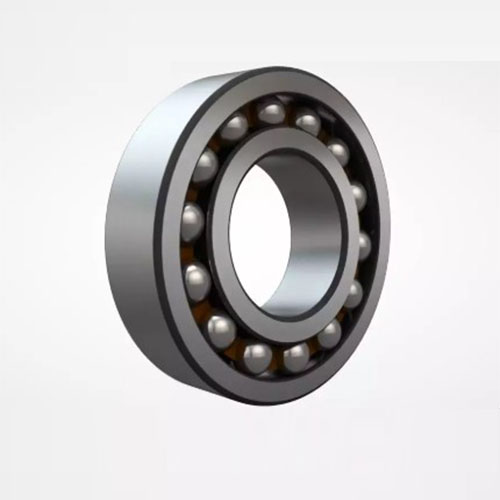
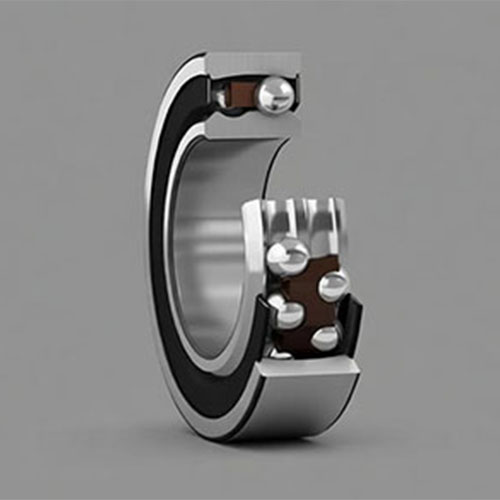
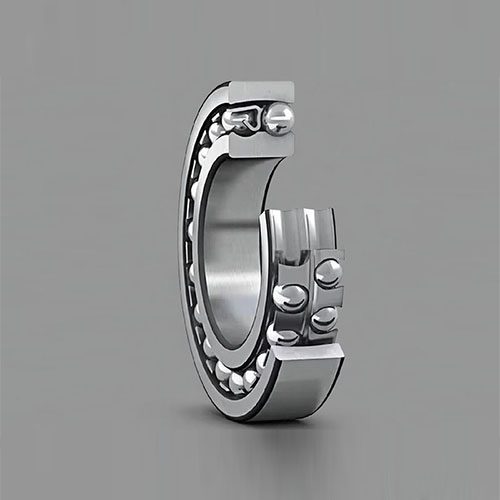
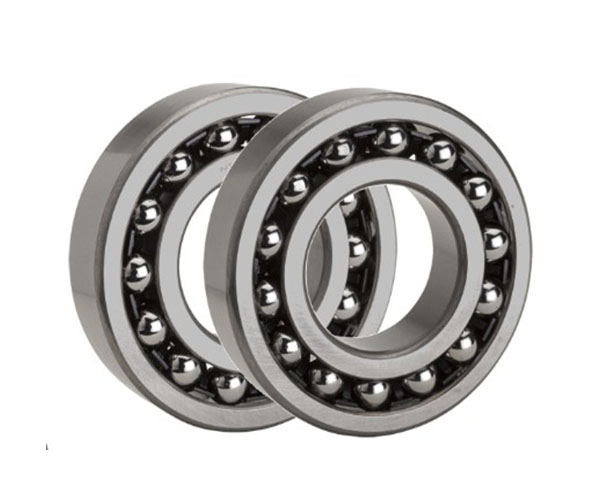
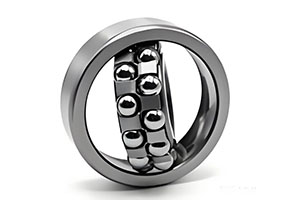
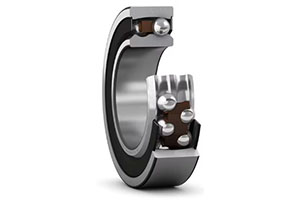
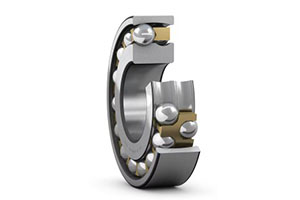
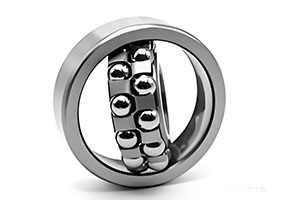
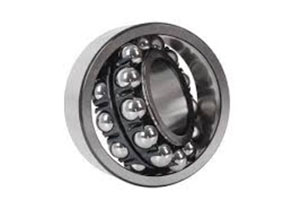
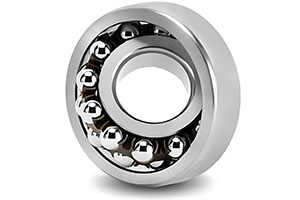
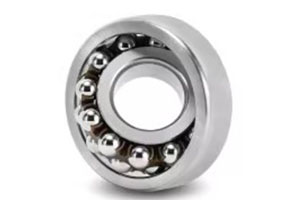
A self-aligning ball bearing is a double-row bearing whose outer ring has a spherical raceway. This geometry allows the inner ring, balls, and cage to pivot relative to the outer ring, accommodating angular misalignment between the shaft and housing without creating edge loading.
This bearing design consists of four main components:
- Outer ring with a single spherical raceway (centre of curvature coinciding with the bearing axis).
- Inner ring with two uninterrupted raceway grooves.
- Two rows of balls.
- A cage that separates and guides the balls, minimising friction and retaining lubricant.
Typical static misalignment accommodation for this type of bearing is 2°–3°, depending on series and operating conditions.
Details and Specifications
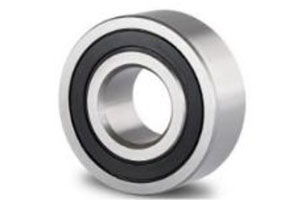
- Designs and variants – Open, sealed (2RS), extended inner ring, cylindrical or tapered bore (1:12).
- General bearing specifications – ISO dimension series 12, 13, 22, 23; steel, polyamide, or brass cages.
- Loads – Radial loads primary; limited axial load capacity (≤0.2–0.3 x C₀).
- Temperature limits – Standard -30°C to +120°C; higher with alternative greases/cages.
- Permissible speed – Series‑dependent; sealed bearings require speed derating due to seal drag.
- Design considerations – Misalignment angle, housing tolerances, lubrication method.
- Mounting – Cylindrical bore: press or thermal fit. Tapered bore: adapter sleeves or withdrawal sleeves.
- Designation system – Prefixes and suffixes indicate series, bore type, sealing, clearance, cage material.
Features and Benefits of Self‑Aligning Ball Bearings
Self-aligning ball bearings are engineered for applications where shaft deflection or mounting inaccuracies cannot be fully avoided. The following technical features define their operational behaviour.
Accommodate static and dynamic misalignment
The spherical outer ring raceway allows the inner ring to tilt relative to the outer ring. Standard self-aligning ball bearings tolerate static misalignment up to 2°–3° and dynamic misalignment (during rotation) up to approximately 1.5°–2°, depending on size and speed. This self‑alignment prevents edge loading, a common cause of premature fatigue in bearings. Even when housing bores are not perfectly aligned or shafts deflect under load, the bearing distributes contact stress evenly across the raceway.
Excellent high‑speed performance
Despite having two rows of balls, self-aligning ball bearings generate lower friction than spherical roller bearings under comparable conditions. The rolling contact produces less heat, allowing sustained operation at higher speeds. Typical reference speeds for open bearings range from 6 000 to 24 000 r/min, depending on series. This makes these bearings suitable for electric motors, fans, and textile spindles.
Minimum maintenance
Sealed variants (2RS) are pre‑lubricated with high‑quality grease and fitted with contact rubber seals that retain lubricant and exclude contaminants. Under normal conditions, sealed self-aligning ball bearings do not require relubrication over their design life. Open bearings can be relubricated via external fittings when needed.
Low friction
The ball‑to‑raceway contact area is small, resulting in low running and starting torque. Reduced friction translates into lower energy consumption, cooler operation, and less mechanical wear in associated machine components. This makes self-aligning ball bearings an efficient choice for continuous operation.
Excellent light‑load performance
Unlike roller bearings, which need a minimum load to maintain proper rolling action, ball elements roll freely even under very light radial loads. This characteristic is valuable for self-aligning ball bearings in applications with intermittent loading or extended low‑load phases, such as material handling systems operating below capacity.
Low noise
Due to the smooth rolling of balls and the optimised raceway geometry, self-aligning ball bearings generate low operating noise. Sealed types further attenuate sound while keeping contaminants out. Low noise is essential for HVAC equipment, hospital ventilation, food processing, and any noise‑sensitive environment.
Additional technical data (reference values)
- Operating temperature (standard): –30°C to +120°C
- Limiting speeds (grease‑lubricated, open bearings):
Series 12: up to 24 000 r/min (small bore)
Series 13: up to 20 000 r/min
Series 22: up to 14 000 r/min
Series 23: up to 11 000 r/min - Sealed bearings speed reduction: approx. 30‑40% compared to open types.
- Axial load capacity limit: 0.2 to 0.3 × C₀ (static radial load rating); pure axial loads are not recommended.
These performance characteristics have been verified through endurance testing and field data collected from applications in fans, conveyors, pumps, and agricultural machinery.
Bearing Types and Series
Self‑aligning ball bearings are grouped by design configuration and sealing option. Each bearing type serves specific operating and mounting requirements.
- Product Types
- Open Type Series
- Sealed Type Series
- Enhanced Design
Product Types
Self-aligning ball bearings are manufactured in three fundamental configurations. Open type bearings allow external lubrication and inspection. Sealed type bearings are pre-greased and maintenance‑free, protecting against contaminants. Enhanced design bearings with extended inner rings simplify axial retention on low‑precision shafts. The choice depends on operating environment, maintenance access, and mounting conditions.
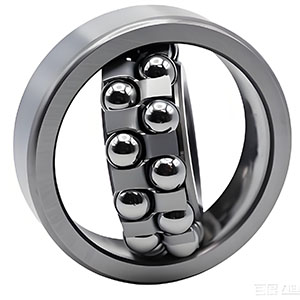
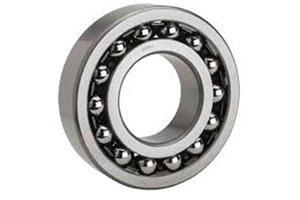
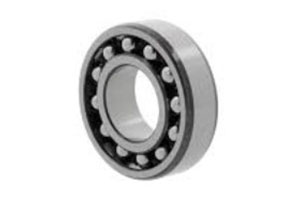
Open self-aligning ball bearings without integral seals. Suitable for moderate to clean environments where external lubrication is possible. These bearings allow visual inspection and relubrication through lines or grease fittings. They are preferred for high‑speed or high‑temperature applications where seal drag would be problematic.
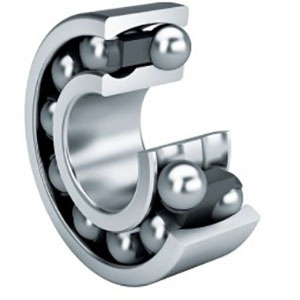
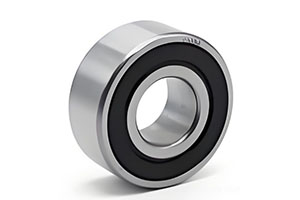
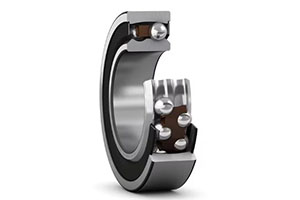
Sealed self-aligning ball bearings with two contact rubber seals (2RS). Pre‑greased for life, they exclude dust and moisture while retaining lubricant. Sealed bearings are maintenance‑free for the intended service life and operate effectively in moderately contaminated or humid conditions.
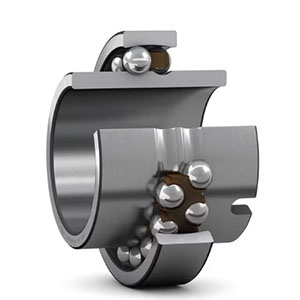
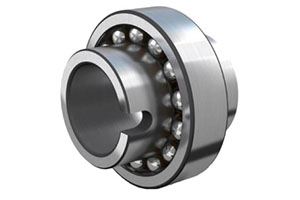
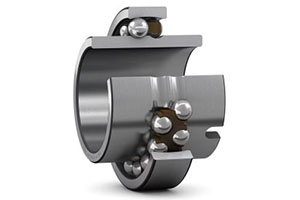
Self-aligning ball bearings with an extended inner ring (11200 and 11300 series). The inner ring projects beyond the outer ring, incorporating a slot for a pin or setscrew. This bearing design simplifies axial location on commercial‑grade shafts without requiring precision shoulder abutments.
Open Type Series
The following open series cover light to extra‑wide dimensions. All are double‑row self-aligning ball bearings with either cylindrical bores (standard) or 1:12 tapered bores (K suffix). Tapered bore bearings are mounted on adapter sleeves for easy installation on stepped shafts.
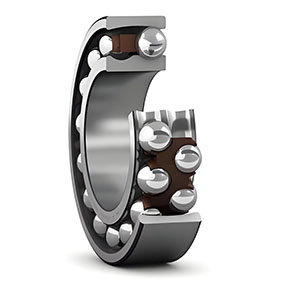
1200 series – Light double‑row open self-aligning ball bearing. Designed for low loads and moderate speeds, this series compensates for minor misalignment in fans and small electric motors. Its compact cross‑section suits space‑limited assemblies.
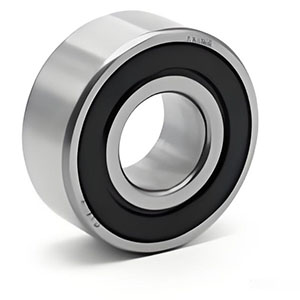
2200 series – Wide open bearing. The increased width of the 2200 series delivers higher radial load rating than narrower series of the same bore. Typical uses include gearboxes and conveyors.
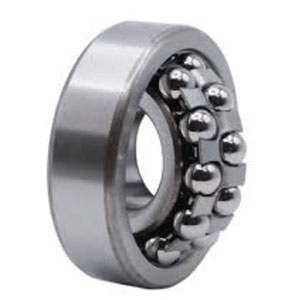
2300 series – Extra‑wide open bearing. Maximum load rating among open self-aligning ball bearings. Suitable for heavy industrial and agricultural equipment when outer diameter is not a limiting factor.
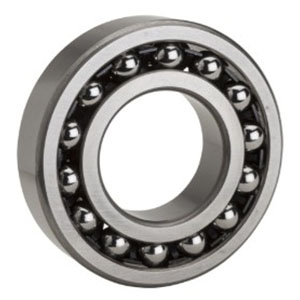
2200K series – Wide open self-aligning ball bearing with 1:12 tapered bore. Combines high radial capacity with easy mounting and dismounting using hydraulic nuts. Used in crushers and vibrating screens.
Sealed Type Series
These series add dual contact rubber seals to the open designs. Sealed self-aligning ball bearings are pre‑lubricated and require no regular regreasing. They protect against dust, moisture, and fibre contamination, making them suitable for textile, agricultural, and conveyor applications.
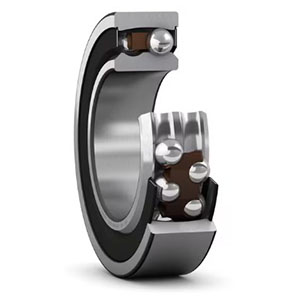
2200‑2RS series – Wide sealed bearing. This series integrates the high radial capacity of the 2200 design with double rubber seals. Ideal for harsh conveyor environments and industrial fan upgrades.
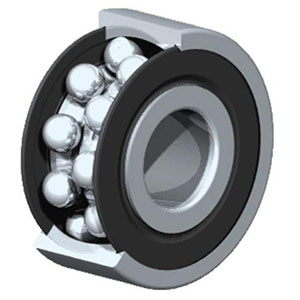
2300‑2RS series – Extra‑wide sealed bearing. Maximum load rating among sealed self-aligning ball bearings. Integral contact seals make it suitable for demanding agricultural equipment and vibrating machinery.
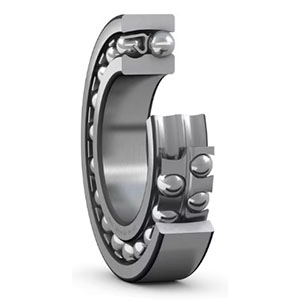
1200K‑2RS series – Light series sealed bearing with 1:12 tapered bore. Dual seals protect against contamination, while the taper allows easy assembly on adapter sleeves. Common in applications requiring both sealing and easy mounting.
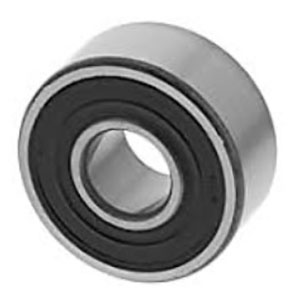
2200K‑2RS series – Wide, tapered bore sealed bearing. Delivers high radial load capacity together with the convenience of a 1:12 taper and full sealing. Used in fan and blower upgrades, especially in dusty settings.
Enhanced Design
These self-aligning ball bearings feature an inner ring that extends beyond the outer ring on one side. The extended portion contains a slot that accepts a pin or setscrew for axial retention. This bearing design simplifies mounting on commercial shafting without precision shoulders.
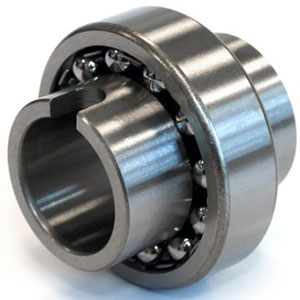
11200 series – Extended inner ring bearing, light series. The wider inner ring permits direct shaft mounting using pins or set screws. Designed for low‑precision drives such as light conveyors and agricultural feeders.
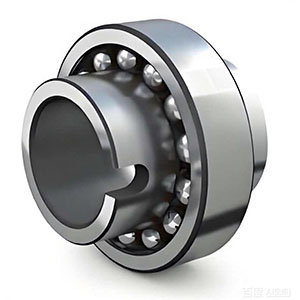
11300 series – Medium enhanced bearing with extended inner ring. Higher load capacity than the 11200 series. Typical applications include agricultural machinery and small industrial machines where axial location is simplified.
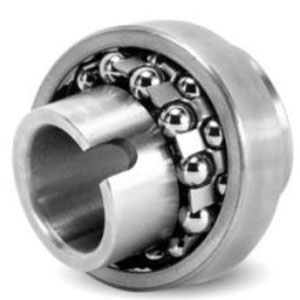
11200‑2RS series – Sealed variant of the 11200 series. Extended inner ring plus dual contact seals. Well‑suited for contaminated environments like farm equipment and outdoor conveyors.
Applications of Self‑Aligning Ball Bearing
Self‑aligning ball bearings are used wherever shaft misalignment or deflection occurs. The following industries and equipment commonly employ these bearings.

Used in transmission components, idler pulleys, and fan drives where minor misalignment arises from housing deformation.
Harvesters, spreaders, and tillage equipment. Extended inner‑ring and sealed bearing types resist dirt and moisture while tolerating shaft deflection.
Electric motors, pumps, compressors, and industrial fans. Open or sealed bearing designs based on speed and contamination level.
Conveyor rollers, sorting equipment, and elevators. Self‑aligning bearings compensate for long shaft spans and frame flexing.
Conveyor Bearings – Belt and roller conveyors in mining, warehousing, and packaging. Wide series bearings (22, 23) provide extra radial capacity.
Other Ball Bearings
In addition to self‑aligning ball bearings, the company manufactures other rolling bearing types for different load and alignment conditions.
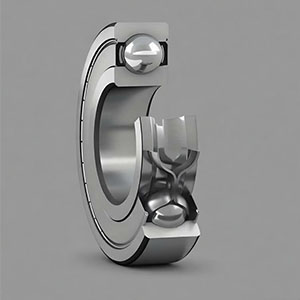
Single‑row bearings for radial and moderate axial loads. Not self‑aligning, but these bearings offer very low friction and high speed capability for applications with precise shaft‑housing alignment.
Bearings designed for combined radial and axial loads. Available in single‑row and double‑row configurations. Used in machine tool spindles and pumps.
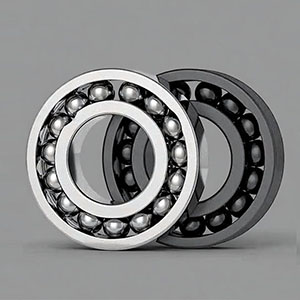
Small‑bore deep groove bearings (inner diameter down to 1 mm). Suitable for instruments, small motors, and precision mechanisms where space is limited.
Hot-selling Releated Bearing Models
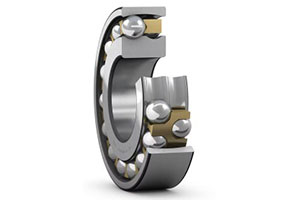
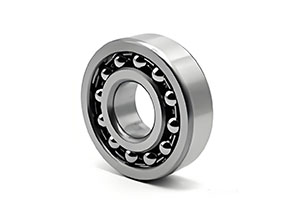
Commonly requested open, sealed, and extended inner‑ring bearing models with key dimensions and features.
Technical Resources and Engineering Information
Engineering information
Selection of the correct self-aligning ball bearing requires evaluation of radial load, required speed, permissible misalignment, operating temperature, and contamination level. Open bearings are preferred when external lubrication is possible or when speeds exceed the limit of sealed variants. Sealed self-aligning ball bearings suit applications where maintenance access is limited. Tapered bore bearings on adapter sleeves reduce mounting errors. Always compare the static safety factor (S₀ = C₀ / P₀) against shock load conditions.
Basic idea to select the bearing
- Determine the required bore diameter (shaft diameter) and select a dimension series (12,13,22,23) based on available space.
- Estimate radial load and equivalent dynamic bearing load (P). Calculate required basic dynamic load rating C with desired L₁₀ life.
- Check maximum speed against reference speed of the selected bearing. Derate for sealed types or poor lubrication.
- Confirm misalignment angle does not exceed 2°–3° (or less for dynamic misalignment).
- Choose open, sealed, or extended inner‑ring configuration according to the environment.
- Specify internal clearance (C2, CN, C3) based on fit and temperature gradient.
- For tapered shafts or adapter sleeve mounting, select a K‑suffix bearing.
Adapter sleeve – Tool and accessory selector
Adapter sleeves (designation H + shaft diameter) are used to mount self-aligning ball bearings with 1:12 tapered bore onto cylindrical shafts. The sleeve expands between the shaft and the bearing bore when the lock nut is tightened. Withdrawal sleeves facilitate dismounting. Selection steps:
- Determine bearing series and bore diameter (tapered dimension).
- Choose an adapter sleeve of the correct size (e.g., H306 for bore 30mm).
- Select lock nut (KM series) and locking washer (MB series).
- For hydraulic mounting, use oil injection equipment.
- For mechanical mounting, use a spanner and feeler gauge to control axial advance.
Self-aligning ball bearings use two rows of balls. These bearings have lower friction, higher speed capability, and lower load capacity than spherical roller bearings of similar size. Spherical roller bearings use barrel‑shaped rollers, handle heavier radial and axial loads, but generate more heat and require higher minimum load. Choose ball bearings for high speed and light to medium loads; choose roller bearings for heavy loads and shock.
For more details, please read “self‑aligning ball bearings vs spherical roller bearings?”.
For sealed self-aligning ball bearings, the factory‑filled grease is sufficient over the design life. For open bearings, lithium‑complex greases with NLGI grade 2, base oil viscosity 100‑150 mm²/s at 40°C are recommended for general use. Polyurea‑thickened greases suit high temperatures (up to 150°C). Avoid mixing different grease thickener types. Relubrication interval depends on speed, load, and temperature – refer to the engineering information page for calculation guidance.
For more details, please read “self‑aligning ball bearings vs spherical roller bearings?”.
Only limited axial loads are acceptable, typically ≤0.2·C₀ to ≤0.3·C₀ depending on bearing series. Pure axial loads alone are not permissible because the ball‑raceway contact geometry is optimised for radial load. If thrust loads are high, use angular contact ball bearings, deep groove ball bearings (for moderate thrust), or pair two self-aligning ball bearings in a back‑to‑back arrangement. For combined radial and axial loads within the limit, the equivalent dynamic load P = Fᵣ + Y·Fₐ (Y values are listed in the product specification table). When axial load exceeds the recommended limit, contact the manufacturer for application review.
For more details, please read “Can I use self‑aligning ball bearings with thrust loads?”.