Which bearing should you choose: sleeve or ball? The answer depends on your speed, temperature, and mounting orientation.
Sleeve bearings cost 20-40% less, run quieter (1-3 dBA), and handle shock loads well. But they are orientation-sensitive and perform best in vertical mounting. At 70°C, they become inoperable.
Ball bearings handle any mounting orientation, support both radial and axial loads, and last 50% longer than sleeve bearings at 25-60°C. Choose ball bearings for high-speed or high-temperature applications above 70°C.
Choosing the wrong bearing for your mechanical design can lead to premature failure, excessive noise, overheating, and unnecessary costs. If you are an engineer, procurement specialist, or mechanical designer working on automotive or industrial applications, you have likely faced this question: sleeve bearing or ball bearing?
Sleeve bearings and ball bearings operate on fundamentally different principles. One uses a sliding motion with a thin layer of lubricant separating two surfaces; the other uses spherical rolling elements that reduce friction through rolling contact. This fundamental difference affects everything from load capacity and speed capability to noise levels, mounting orientation, maintenance requirements, and total cost of ownership.
This guide breaks down the working principles, performance characteristics, advantages, and limitations of each bearing type. We will also provide a detailed side-by-side comparison and a practical decision framework to help you select the right bearing for your specific application.
What Is a Sleeve Bearing?
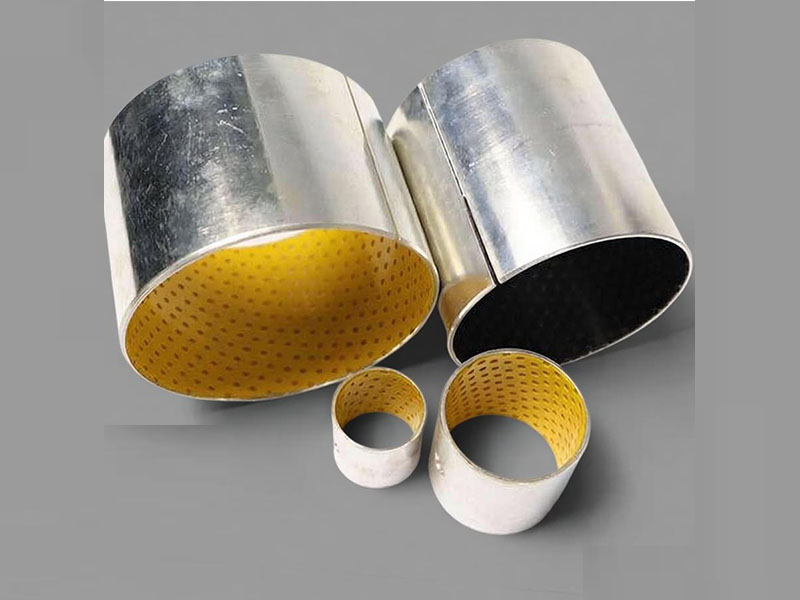
A sleeve bearing — also known as a plain bearing, bushing, or journal bearing — is the simplest type of bearing. It consists of a cylindrical sleeve (the bearing surface) that surrounds a rotating shaft. There are no rolling elements. The shaft rotates directly against the inner surface of the sleeve, with a thin film of lubricant separating the two surfaces to reduce friction and wear.
Working Principle
In a sleeve bearing, the shaft and the bearing surface are separated by a thin layer of lubricant (oil or grease). The shaft rides on this lubricant film, creating a conformal contact with the bearing surface. When the shaft is stationary, there is direct metal-to-metal contact. As the shaft begins to rotate, hydrodynamic pressure builds up in the lubricant, lifting the shaft off the bearing surface and creating a fluid film that supports the load.
This is called hydrodynamic lubrication. Under ideal conditions, the shaft never actually touches the bearing surface during operation — it rides entirely on the lubricant film.
Key Characteristics
- Sliding contact with hydrodynamic lubrication — The shaft slides against a lubricant film that separates it from the bearing surface.
- No rolling elements — Sleeve bearings contain no balls, rollers, or cages.
- Conformal contact geometry — The shaft and bearing surface form a conformal contact that distributes load across a relatively large area.
- Simple cylindrical construction — One-piece sleeve design with fewer moving parts.
- Multiple material options — Available in bronze, sintered metal, PTFE, rubber, ceramic, and engineered plastics.
- Self-lubricating options — Some sleeve bearings are made from porous materials (like sintered bronze) impregnated with oil, requiring no additional lubrication.
Advantages of Sleeve Bearings
- Lower initial cost — Sleeve bearings typically cost 20-40% less than comparable ball bearings due to simpler manufacturing and fewer components.
- Quieter operation — At low to moderate speeds, sleeve bearings are quieter than ball bearings by approximately 1-3 dBA.
- Higher load capacity in compact designs — The large contact area allows sleeve bearings to support high loads in a smaller radial cross-section compared to ball bearings.
- Excellent shock and vibration absorption — The lubricant film dampens impacts and vibrations, making sleeve bearings ideal for applications with intermittent or shock loading.
- Tolerant of contaminants — Sleeve bearings can embed small particles into the bearing surface, preventing shaft damage.
- Simpler construction — Fewer components mean lower manufacturing costs and fewer potential failure modes.
Disadvantages of Sleeve Bearings
- Limited speed capability — At high speeds, the lubricant film can break down, leading to metal-to-metal contact, increased friction, heat generation, and eventual seizure.
- Lubrication dependence — Without proper lubrication, sleeve bearings fail quickly. Lubricant evaporation is a common failure mode, especially at elevated temperatures.
- Limited high-temperature performance — Above 70°C, sleeve bearings become inoperable in many applications. Ball bearings maintain performance at these temperatures.
- Mounting orientation is critical — Sleeve bearings are orientation-sensitive and perform best in vertical mounting. Horizontal or other orientations significantly reduce product life due to lubricant distribution issues.
- Higher friction at startup — Before the hydrodynamic lubricant film is established, metal-to-metal contact creates higher friction and wear during startup.
- Shorter lifespan — Typical sleeve bearing L10 life is 30,000-40,000 hours, compared to 50,000-100,000+ hours for ball bearings.
- Noise increases over time — As lubricant degrades, sleeve bearing noise levels gradually increase.
Typical Applications
Sleeve bearings are widely used in applications where quiet operation, low cost, and moderate speeds are priorities:
- Electric cooling fans — Computer and automotive radiator fans
- Small electric motors — Fractional horsepower motors
- Household appliances — Washing machines, dryers, refrigerators
- Automotive accessories — Blower motors, window motors
- Printers and office equipment
- Power tools — Drills, grinders, sanders
- Agricultural equipment
- Textile machinery
What Is a Ball Bearing?
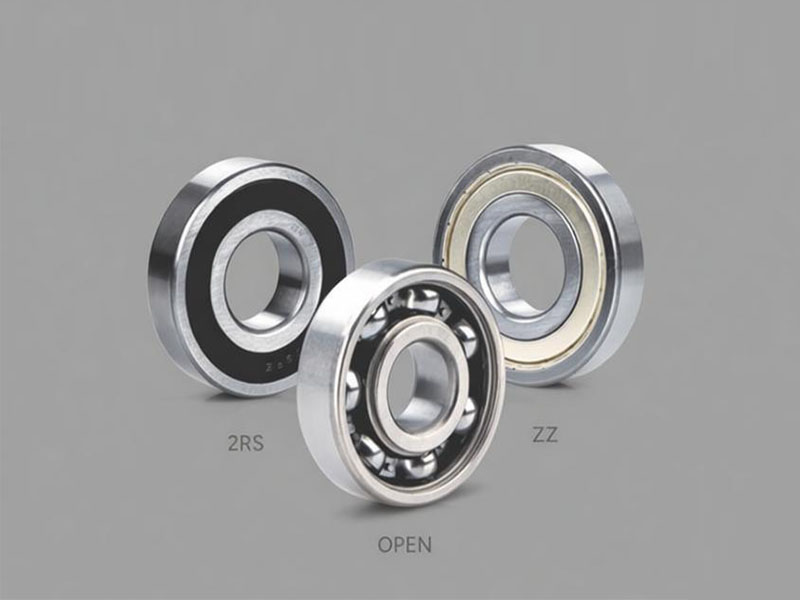
A ball bearing is a rolling-element bearing that uses spherical balls as the rolling elements between the inner and outer raceways. The balls are typically held in place by a cage (retainer) that maintains even spacing and prevents contact between individual balls.
Working Principle
The spherical balls roll between the inner and outer rings, forming a point contact with the raceway surfaces. This point contact creates a very small contact area, which minimizes friction and allows for extremely smooth rotation.
Key Characteristics
- Point contact geometry — Spherical balls contact the raceways at single points, minimizing friction.
- Rolling elements — Balls roll between inner and outer raceways, eliminating sliding friction.
- Cage-retained — Balls are held in evenly spaced positions by a retainer.
- High manufacturing precision — The small contact area demands very tight tolerances.
- Multiple configurations — Available in single-row, double-row, angular contact, self-aligning, and four-point contact designs.
- Sealed and shielded versions — Pre-lubricated and protected from contamination.
Advantages of Ball Bearings
- Simultaneous radial and axial load capacity — Ball bearings can handle both radial and axial loads, making them highly versatile.
- Superior high-speed performance — The point contact creates minimal friction, enabling ball bearings to reach speeds significantly higher than sleeve bearings.
- Low friction and heat generation — The small contact area minimizes metal-to-metal rubbing, resulting in very low friction and heat generation.
- Long service life — Ball bearings are durable, with typical L10 life of 50,000-100,000+ hours.
- Any mounting orientation — Ball bearings can be mounted in any orientation — horizontal, vertical, or at any angle — without affecting performance.
- Better high-temperature performance — Ball bearings maintain performance at higher temperatures. At 70°C, ball bearing fans ran for 45,000 hours, while sleeve bearings became inoperable.
- Maintenance-free options — Sealed ball bearings come pre-lubricated and are sealed to prevent contamination.
- Predictable service life — The L10 life calculation for ball bearings is well-established and reliable for maintenance planning.
Disadvantages of Ball Bearings
- Higher initial cost — Ball bearings generally cost 20-40% more than comparable sleeve bearings.
- Larger radial cross-section — Ball bearings require more radial space than sleeve bearings of comparable load capacity.
- Higher noise — Ball bearings are typically 1-3 dBA noisier than sleeve bearings at the same RPM.
- Lower shock load capacity — Ball bearings are less tolerant of shock and impact loads compared to sleeve bearings.
- Higher precision requirements — The small contact area demands very high precision during manufacturing and assembly.
- Risk of contamination damage — Contaminants entering the bearing can cause damage to the raceways and balls.
Typical Applications
Ball bearings are the most commonly used bearing type across industries, found in:
- Electric motors — High-speed electric motors and general-purpose motors
- Automotive wheel hubs — Supporting vehicle weight while enabling smooth rotation
- Household appliances — Fans, washing machines, air conditioners
- Industrial gearboxes — Power transmission applications
- Robotics and automation — Precision motion control
- Pumps and compressors — Various fluid handling applications
- Precision instruments — Equipment requiring high running accuracy
- Machine tools — High-speed spindles and precision machining equipment
- Computer cooling fans — Higher-end fans with longer life requirements
Key Differences Between Sleeve Bearings and Ball Bearings
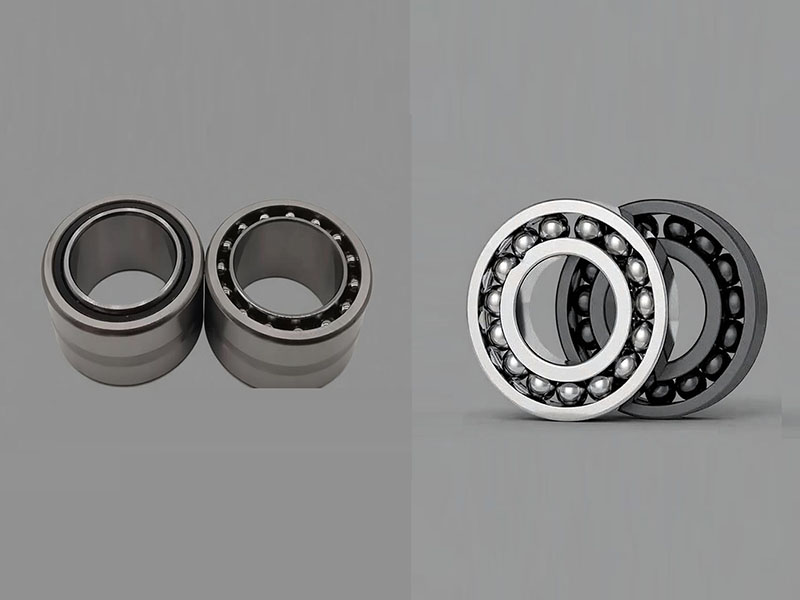
The following table provides a comprehensive sleeve bearing vs ball bearing comparison across all key performance dimensions. Each difference is rooted in the fundamental operating principle — sliding contact for sleeve bearings and rolling contact for ball bearings.
| Comparison Dimension | Sleeve Bearing | Ball Bearing |
|---|---|---|
| Operating Principle | Sliding contact (hydrodynamic film) | Rolling contact (rolling elements) |
| Contact Pattern | Conformal contact | Point contact |
| Radial Load Capacity | Excellent | Moderate |
| Axial Load Capacity | Limited | Good |
| Speed Capability | Low to moderate | High |
| Friction / Heat Generation | Higher at startup; lower at steady state | Consistently low |
| Radial Cross-Section | Thin, compact | Thicker |
| Service Life at 70°C | Inoperable | 45,000 hours (L10) |
| Service Life at 40°C | 52,000 hours (L10) | 75,000 hours (L10) |
| Service Life at 25°C | 80,000 hours (L10) | 95,000 hours (L10) |
| Noise (vs sleeve) | Baseline | 1-3 dBA higher |
| Cost | 20-40% lower | 20-40% higher |
| Mounting Orientation | Orientation-sensitive; best vertical | Any orientation acceptable |
| Maintenance | Regular lubrication required | Sealed types maintenance-free |
| Shock Load Capacity | Excellent | Moderate |
1. Operating Principle
This is the most fundamental difference. Sleeve bearings operate on sliding contact — the shaft rotates against a thin lubricant film. Under ideal hydrodynamic conditions, the shaft never touches the bearing surface. Ball bearings operate on rolling contact — spherical balls roll between raceways, minimizing friction.
2. Contact Pattern
Sleeve bearings feature a conformal contact area between shaft and bearing surface, distributing load across a wide area and providing damping. Ball bearings feature point contact between balls and raceways — extremely small contact area minimizes friction but concentrates load, making them more sensitive to shock.
3. Load Capacity
Radial Load: Sleeve bearings excel with high radial loads due to the large contact area. Ball bearings have moderate radial capacity for light to medium loads.
Axial Load: Ball bearings have a clear advantage — they handle radial, axial, and combined loads. Sleeve bearings are primarily radial-load bearings with limited axial capacity.
4. Speed Capability
Ball bearings win in high-speed applications. Rolling friction is significantly lower than sliding friction. Sleeve bearings are limited to low-to-moderate speeds — at high RPM, the lubricant film breaks down, causing metal-to-metal contact and seizure.
5. Friction and Heat Generation
Ball bearings generate consistently low friction and minimal heat. Sleeve bearings have higher friction at startup (before the hydrodynamic film forms), but once established, friction is relatively low. Any lubrication interruption causes friction to spike.
6. Space Efficiency
Sleeve bearings are more space-efficient — their simple cylindrical construction requires less radial space. Ball bearings require more space for balls, raceways, and cage.
7. Service Life and Reliability
L10 life comparison at various temperatures (source: NMBTC):
| Temperature | Sleeve Bearing (L10 hours) | Ball Bearing (L10 hours) | Ball Bearing Advantage |
|---|---|---|---|
| 25°C | 80,000 | 95,000 | +18% |
| 40°C | 52,000 | 75,000 | +44% |
| 50°C | 40,000 | 63,000 | +58% |
| 60°C | 30,000 | 54,000 | +80% |
| 70°C | Inoperable | 45,000 | N/A |
At 25-60°C, ball bearings outlast sleeve bearings by an average of 50%. At 70°C, ball bearings ran for 45,000 hours while sleeve bearings became inoperable.
8. Noise Level
Sleeve bearings are quieter — ball bearing fans are typically 1-3 dBA noisier. The sliding motion of sleeve bearings produces very little vibration.
9. Cost
Sleeve bearings cost 20-40% less upfront due to simpler manufacturing. Ball bearings cost more but often provide better long-term value through longer life and lower maintenance.
10. Mounting Orientation
Ball bearings mount in any orientation. Sleeve bearings are orientation-sensitive — they perform best in vertical mounting. Horizontal or other orientations compromise lubricant distribution and reduce life.
11. Maintenance
Sleeve bearings require regular lubrication — lubricant evaporation is a common failure mode. Sealed ball bearings are pre-lubricated and can be maintenance-free for their entire service life.
With these performance differences in mind, the following step-by-step guide will help you apply this data directly to your specific application.
How to Choose: A Step-by-Step Decision Guide
Step 1: Evaluate Speed Requirements
Is the operating speed high or does the application require sustained high-speed operation?
- Yes — Sleeve bearings are limited to moderate speeds. Choose a ball bearing.
- No — Proceed to Step 2.
Step 2: Evaluate Temperature
Does the application operate in high-temperature conditions (above 70°C / 158°F)?
- Yes — As detailed in the Service Life section above, sleeve bearings become inoperable at 70°C. Choose a ball bearing.
- No — Proceed to Step 3.
Step 3: Evaluate Mounting Orientation
What is the mounting orientation?
- Vertical — Sleeve bearings perform best in vertical orientation. Proceed to Step 4.
- Horizontal or other — Sleeve bearings are not recommended for non-vertical mounting. Choose a ball bearing.
Step 4: Evaluate the Load Type
Is there a significant axial (thrust) load?
- Yes — Sleeve bearings have limited axial capacity. Choose a ball bearing.
- No — Proceed to Step 5.
Step 5: Evaluate Noise Requirements
Is low noise a critical design requirement?
- Yes — Sleeve bearings are 1-3 dBA quieter. Consider a sleeve bearing (provided other conditions are met).
- No — Proceed to Step 6.
Step 6: Evaluate Shock Loads
Does the application involve shock loads or intermittent operation?
- Yes — Sleeve bearings absorb shock loads better. Consider a sleeve bearing.
- No — Proceed to Step 7.
Step 7: Evaluate Cost Strategy
Lowest initial cost or lowest total cost of ownership (TCO)?
- Lowest initial cost — Sleeve bearings cost 20-40% less. Choose a sleeve bearing.
- Lowest TCO / long-term reliability — Ball bearings offer longer life and lower maintenance. Choose a ball bearing.
Conclusion
There is no universal “best” bearing — the right choice depends entirely on your specific application conditions: speed, temperature, mounting orientation, load type, noise requirements, and cost constraints.
Choose sleeve bearings for vertical mounting, low-to-moderate speeds, primarily radial loads, noise-sensitive applications (1-3 dBA quieter), and budget-constrained projects.
Choose ball bearings for any mounting orientation, high-speed operation, combined radial and axial loads, high-temperature environments above 70°C, and applications requiring long service life with minimal maintenance.
Total cost of ownership (TCO) matters — while sleeve bearings cost 20-40% less upfront, sealed ball bearings often deliver better long-term value through extended service life and reduced maintenance.
FAQs
Q: Can sleeve bearings handle axial loads?
A: Sleeve bearings are primarily designed for radial loads with limited axial capacity. For significant axial loads, ball bearings are the better choice.
Q: Which bearing is better for high-speed applications?
A: Ball bearings. Their rolling contact creates minimal friction. Sleeve bearings are limited to low-to-moderate speeds due to lubricant film breakdown at high RPM.
Q: Which bearing is better for low-speed, heavy-load applications?
A: Sleeve bearings are generally the better choice for low-speed, heavy-load applications. The conformal contact distributes load across a larger area, and the hydrodynamic lubricant film provides excellent shock absorption. Ball bearings are more sensitive to heavy loads due to point contact stress concentration.
Q: Are sleeve bearings quieter than ball bearings?
A: Yes, by approximately 1-3 dBA at the same RPM. This makes sleeve bearings preferred for noise-sensitive applications like computer fans.
Q: Are sleeve bearings cheaper than ball bearings?
A: Yes, typically 20-40% less upfront. However, ball bearings often provide better long-term value through longer life and reduced maintenance.
Q: Can I mount a sleeve bearing in any orientation?
A: No. Sleeve bearings are orientation-sensitive and perform best in vertical mounting. Horizontal or other orientations reduce service life. Ball bearings mount in any orientation.
Q: Which bearing lasts longer at high temperatures?
A: Ball bearings. At 70°C, ball bearings ran for 45,000 hours while sleeve bearings became inoperable. At 25-60°C, ball bearings outlast sleeve bearings by 50% on average.
Q: Which bearing has higher starting torque?
A: Sleeve bearings have higher starting torque because the shaft must shear the lubricant film and overcome metal-to-metal contact before full hydrodynamic lubrication is established. Ball bearings have lower starting torque due to rolling contact, which is why they are preferred in applications requiring frequent starts and stops.
Q: Can I replace a sleeve bearing with a ball bearing (or vice versa)?
A: Not directly. While both types serve similar functions, they have different dimensions, mounting requirements, and lubrication needs. Sleeve bearings typically have thinner cross-sections and rely on shaft contact, while ball bearings require more radial space and precision mounting. Always consult the manufacturer’s specifications before attempting replacement.
Q: How do I know when a sleeve bearing or ball bearing needs replacement?
A: For sleeve bearings, signs include increased noise, shaft wobble, overheating, or visible lubricant leakage. For ball bearings, listen for grinding or rumbling sounds, feel for rough rotation, or check for excessive shaft play. Both types may show increased vibration or temperature rise before failure. Regular inspection intervals should be established based on operating hours and duty cycle.
Q: What is L10 life?
A: The operating time at which 90% of a group of bearings are statistically expected to survive under normal conditions. Sleeve bearings: 30,000-40,000 hours. Ball bearings: 50,000-100,000+ hours.